Intercom
 Shopify
 Stripe
 Slack
Slack Notion
 Google Workspace
 Confluence

Boost.ai: The Complete Guide (2026)


Boost.ai is one of the most recognized names in enterprise conversational AI, and if you support customers in banking, insurance, or the public sector — especially in Europe — it belongs on your shortlist. This Norwegian vendor has built its reputation on a hybrid AI platform that pairs traditional natural-language understanding with large language models, wrapped in the kind of governance controls that regulated industries demand. This guide covers what Boost.ai is, how its AI actually works, what it really costs, how it deploys, its strengths and weaknesses, and the honest alternatives worth comparing.

We build AI agents for customer service ourselves, so this is a practitioner's take, not marketing copy. We will keep it balanced — Boost.ai is a genuinely strong platform for the buyers it was built for, and a poor fit for others, and this guide tries to tell you which one you are.
What is Boost.ai?
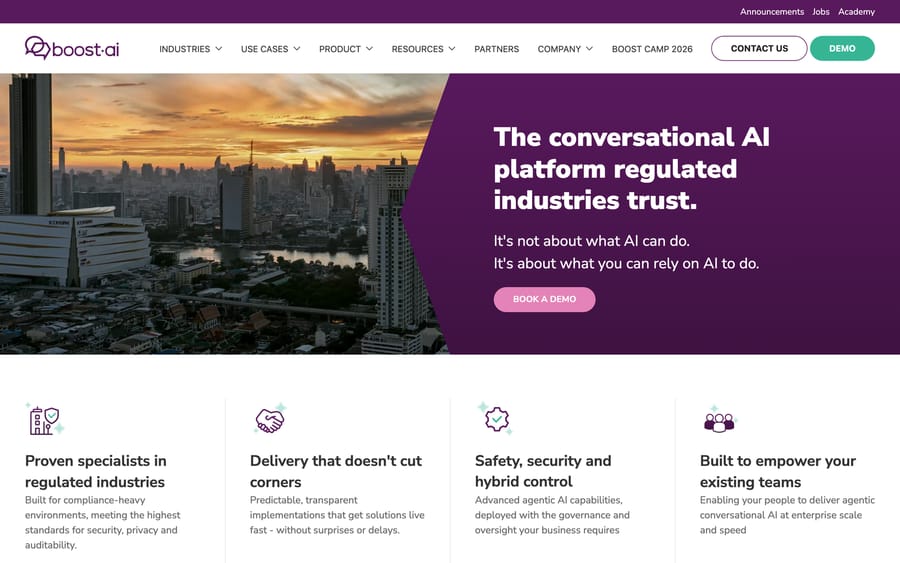
Boost.ai's homepage, positioning it as a conversational-AI platform for enterprise support.
Boost.ai is an enterprise conversational AI platform for building virtual agents (chatbots and voicebots) that automate customer support across chat and voice channels. Founded in Norway in 2016, the company has deep roots in European banking — its customer roster includes DNB, Nordea, Storebrand, and Santander, plus insurers, telcos, and public-sector agencies. That heritage shows up everywhere: EU data residency, GDPR-first audit logging, a pre-built financial-services intent library, and integrations with the contact-center (CCaaS) and backend systems large European enterprises actually run.
By its own numbers, Boost.ai says it has powered hundreds of enterprise deployments and handled well over 100 million automated conversations. It has reportedly appeared as a Leader or strong performer in analyst evaluations of conversational AI platforms — a meaningful signal for enterprise buyers who need analyst validation to get a deal through procurement.
The concrete proof points are in its flagship banking accounts (all figures below are as reported by Boost.ai and its customers in published case studies, not independently verified):
- DNB (Norway's largest bank) runs a virtual agent called Aino that, per Boost.ai's case study, automates roughly 50–60% of all incoming chat traffic and about 22% of total customer-service volume across all channels. Boost.ai reports that within six months of launch it was already handling more than half of inbound chat, and that it has since interacted with over a million customers. DNB is also said to run an internal, employee-facing agent that improved human-agent accuracy to around 80%.
- Nordea reportedly operates about 12 language-agnostic AI agents across four Nordic markets, with Boost.ai/Nordea reporting 90%+ in-scope resolution rates — around 91% for private-banking customers and 95% for corporate. Its private-banking agent, Nova, is reported to average more than 220,000 conversations a month.
The short version: Boost.ai is a serious enterprise platform, tuned hardest for regulated industries where "the AI cannot go off-script" is a hard requirement rather than a nice-to-have.
How Boost.ai's AI works
The defining characteristic of Boost.ai is its hybrid model. Rather than betting entirely on a large language model, it orchestrates two layers and lets you decide, per use case, how much autonomy the AI gets:
- Traditional NLU (natural-language understanding) — fine-tuned, multilingual intent models that give predictable, controllable, testable behavior for known, high-volume use cases (balance checks, card blocks, password resets).
- Large language models — layered on top for generative fluency, summarization, and handling the long tail of questions the intent models were never explicitly trained on, via prompt engineering plus Retrieval-Augmented Generation (RAG) over your own knowledge base.
Boost.ai frames this as giving enterprises "autonomy where it's safe, and control where it's critical." The LLM brings coverage and natural phrasing; the NLU layer and a stack of guardrails keep responses on-brand, accurate, and compliant. For a bank, that combination is the whole pitch — you get the conversational quality of generative AI without surrendering control over what the assistant is allowed to say or do.
Two newer capabilities are worth calling out because they define how Boost.ai has moved into the GenAI era:
- Generative Action — Boost.ai's approach to letting GenAI-powered agents actually do things (execute transactions, update records, complete multi-step workflows) rather than just answer questions, with guardrails suited to regulated, customer-facing environments.
- Test Studio — a persona-based automated testing suite that simulates real-world dialogues at scale to validate agent behavior before it ships. This matters more than it sounds: the hardest part of deploying AI in a bank is proving to risk and compliance that it behaves, and automated regression testing is how you keep proving it as the model and knowledge base change.
Around that core sit the enterprise controls: PII masking, role-based access, staging environments, audit trails, and approval/testing pipelines. Non-technical builders design and deploy through a visual, no-code UI.
Key features
- Hybrid AI orchestration — NLU + LLMs working together for both control and coverage, tunable per intent.
- Chat and voice, natively — Boost.ai positions voice as built-in rather than bolted on, so call-center automation and digital channels run on one platform and one set of conversation flows.
- Generative Action — GenAI agents that take real actions (lookups, transactions, record updates) with enterprise guardrails.
- Test Studio — persona-based automated testing to validate agents at scale before and after deployment.
- Multilingual, language-agnostic agents — fine-tuned language support that has notably extended to under-served European languages (including the Baltic languages) that most vendors skipped.
- Enterprise governance — PII masking, role-based access, audit trails, approval/testing pipelines, and guardrails.
- Industry solution libraries — pre-built intents and integrations for banking, insurance, and the public sector.
- No-code builder — a visual UI aimed at non-technical teams managing both chatbot and voicebot in one environment.
- CCaaS and backend integrations — pre-built connectors so agents can reach core systems and take end-to-end actions.
If your priority is having agents do things — look up an account, check a claim status, complete a transaction — the integration depth matters as much as the chat quality. (For a lighter, plain-English way to build those actions, compare with how custom tools work in a per-ticket model.)
Deployment and implementation reality
Boost.ai's no-code builder means non-engineers can author and maintain conversation flows, which is one of its most-praised strengths in user reviews. But "no-code" does not mean "no project." A regulated deployment is still an enterprise implementation:
- Intent design and content. For a bank, the up-front work is mapping the real intents, wiring the pre-built financial-services library to your terminology, and connecting the RAG knowledge base to accurate, current source content.
- System integrations. The high-value use cases (checking a balance, blocking a card, filing a claim) require connecting the agent to core banking, CRM, and CCaaS systems — the part that turns a chatbot into something that resolves rather than deflects.
- Testing and sign-off. This is where Test Studio earns its keep. Risk, legal, and compliance typically need evidence the agent stays in-scope, which means simulated-dialogue testing, audit trails, and staged rollout rather than a flip-the-switch launch.
- Ongoing tuning. Reported resolution rates like Nordea's 90%+ are the result of continuous iteration on intents and content, not a day-one number.
Realistically, expect a sales-led evaluation, a scoped implementation (often with Boost.ai or a partner's solution team), and a timeline measured in weeks to a few months for a meaningful production agent — faster for narrow use cases, longer for broad, multi-system, multi-language ones.
Integrations, channels, and languages
- Channels: web chat, in-app messaging, and voice (IVR/call-center automation), with the same agent logic reused across channels.
- Backend and CCaaS: pre-built integrations let agents execute transactions, update records, and complete workflows in enterprise systems, and connect into contact-center platforms so automated and human-handled conversations coexist.
- Languages: multilingual, language-agnostic agents — Nordea alone runs across four markets — with a track record of supporting less-common European languages other vendors ignored.
Security and compliance
This is Boost.ai's home turf and the reason Nordic banks chose it. The platform is designed EU-first:
- EU data residency and GDPR-first audit logging so customer data can stay inside the EU — often a hard legal requirement for European financial institutions.
- PII masking to keep sensitive data out of logs and, where configured, out of the LLM path.
- Role-based access control, staging environments, approval pipelines, and audit trails — the governance surface that lets a risk team actually approve an AI deployment.
- Guardrails and Test Studio to constrain and continuously verify agent behavior in customer-facing, regulated contexts.
If your legal team's first question about any AI vendor is "where does the data live and can we prove what the bot said," Boost.ai has a genuinely strong answer. Always confirm the specifics — hosting region, sub-processors, and any on-prem or private-cloud options — for your exact regulatory context, since these are negotiated per deal.
Boost.ai pricing (researched)
Boost.ai's pricing page.
Boost.ai does not publish list pricing or a self-serve calculator — this is a sales-led, quote-based enterprise product, and effective rates are negotiated per deal. That is the single most important thing to know before you evaluate it. Third-party software directories peg entry points in the range of roughly $5,000+ per month, but treat that as a rough floor rather than a real quote; your number depends heavily on the variables below.
What actually drives the cost:
- Volume — number of conversations/resolutions across your agents, which is the primary lever.
- Channels — voice automation is generally costlier to run than chat, so a voice-heavy deployment costs more than a chat-only one.
- Breadth and integrations — how many use cases, systems, and languages you deploy, and how much implementation help you need.
- Contract term and tier — higher-volume, longer commitments bring the effective per-conversation rate down.
Some third-party roundups describe outcome-based, per-resolution rates (on the order of ~$0.95 per resolved chat and ~$1.50 per resolved voice call at entry tiers). We could not confirm these as official Boost.ai list prices — they appear in analyst/aggregator content, and similar per-resolution figures are also quoted for other vendors — so treat them as directional, not authoritative. If a per-resolution model is on the table, get the exact definition of a "resolution" in writing before signing.
A few honest caveats:
- "Per resolution" pricing sounds clean, but resolutions can be defined generously; always confirm exactly what counts.
- At scale, voice automation can get expensive — model your actual volumes and channel mix before committing.
- Like most enterprise conversational-AI vendors, there is no true self-serve free trial; expect a sales-led proof of concept.
Compared with opaque six-figure competitors, Boost.ai's model is relatively rational — but it is still an enterprise purchase with a procurement cycle, not a swipe-your-card tool.
Pros and cons
Pros
- Deep, credible expertise in banking, insurance, and public-sector compliance — with named, referenceable customers (DNB, Nordea, Santander).
- Hybrid NLU + LLM model gives real, tunable control over what the AI says and does.
- Strong enterprise governance: PII masking, audit trails, staging, approvals, and automated testing via Test Studio.
- EU data residency and GDPR-first design — a major plus for European regulated buyers.
- Genuinely no-code builder; reviewers consistently praise ease of use and the ability to manage chatbot and voicebot in one place.
- Native voice, not a bolt-on — one platform for digital and call-center automation.
- Broad, sometimes rare, language coverage.
Cons
- Enterprise-oriented; likely overkill and over-budget for small or mid-market teams.
- Opaque, quote-only pricing and no self-serve trial — you cannot evaluate it quickly or cheaply.
- Meaningful implementation effort and timeline for broad, multi-system deployments.
- Reviewers cite reporting and analytics as a relative weak spot — filtering, exporting, and customization could be better.
- Heaviest value is in regulated industries — general support teams may pay for compliance depth they will never use.
- If you live inside a single help desk (Zendesk, Freshdesk, Gorgias), a full CCaaS-style platform is more machinery than the job needs.
Who Boost.ai is best for
Boost.ai is an excellent fit for regulated enterprises — especially banks, insurers, and public-sector organizations, and especially in Europe — that need conversational AI across chat and voice with strict governance, EU data residency, and compliance controls. If your risk and legal teams need to sign off on every AI response, your data must stay inside the EU, and you are automating high-stakes financial workflows at scale, Boost.ai was practically built for you.
It is a weaker fit for smaller teams, non-regulated businesses, or teams that simply want to automate the repetitive tickets inside a single help desk — without standing up an enterprise CCaaS deployment, a procurement cycle, and a multi-week implementation.
On independent review sites the sample is small but consistent: Capterra lists Boost.ai at 4.8 out of 5 from 23 reviews, which we read on September 21, 2026, with the no-code builder and the support team drawing most of the praise. G2 turned away every request we made that day, scripted and browser alike, so there is no G2 score here.
Boost.ai vs alternatives
Boost.ai competes at the enterprise/CCaaS end of the market with platforms like Cognigy and Kore.ai. That is a different segment from help-desk-native AI tools, which is why the honest comparison depends less on "who is better" and more on "what shape of problem you have." The table below frames the choice by use-case fit.
| Boost.ai | Cognigy | Kore.ai | Macha | |
|---|---|---|---|---|
| Model | Hybrid NLU + LLM enterprise platform | Enterprise conversational + voice AI | Enterprise conversational AI / agent platform | AI agent layer on top of your existing help desk |
| Best for | Regulated / banking, EU, chat + voice | Enterprise contact centers, voice | Large enterprises, broad automation | Teams on Zendesk/Freshdesk/Front/Intercom/Gorgias |
| Channels | Chat + native voice | Chat + native voice | Chat + voice | Help-desk tickets, email, chat |
| Pricing | Quote-only, sales-led | Enterprise, negotiated | Enterprise, negotiated | From $299/mo for 750 tickets (~$0.40/ticket), self-serve |
| Self-serve trial | No | No | No | Yes |
| Setup | No-code UI, sales-led implementation | Enterprise, technical | Enterprise, technical | Build agents in plain English |
| Compliance depth | Very high (EU/GDPR/banking) | High | High | Standard SaaS security |
If Boost.ai looks like more platform than your team needs, the honest alternative is a lighter model. Instead of deploying a standalone conversational-AI platform, Macha runs as an AI agent layer on top of the help desk you already use — Zendesk, Freshdesk, Front, Intercom, or Gorgias. You build agents in plain English, and you pay per ticket (from $299/month for 750 tickets) with transparent, self-serve pricing rather than a negotiated enterprise contract. It is a genuinely different shape of product: where Boost.ai is a broad, governance-first, chat-and-voice platform tuned for regulated banking, Macha is a fast, transparent way to automate the tickets in the tool your team already lives in. See Macha pricing for the per-ticket model.
To be clear about the trade-off: for a Nordic bank that needs EU data residency, native voice automation, and a compliance-first hybrid model, Boost.ai's depth is hard to match, and Macha is not trying to. For a support team that just wants to resolve repetitive tickets inside its existing help desk without an enterprise procurement cycle, that same depth is cost and complexity you do not need. Pick by fit, not by hype.
How we researched this
The product, deployment and compliance detail here comes from Boost.ai’s own site and documentation and from its published customer stories; Boost.ai does not publish prices, so the figures in the pricing section are the third-party and sales-reported ranges we could find at the time of writing, not a quote. On September 21, 2026 we re-checked the internal links in this post, read the Capterra rating quoted above, and added the comparisons — we did not obtain a new price on that pass. We have not deployed Boost.ai ourselves; there is no self-serve trial.
FAQ
What is Boost.ai? Boost.ai is a Norwegian enterprise conversational AI platform for building virtual agents that automate chat and voice support, with particular strength in banking, insurance, and the public sector. Founded in 2016, it is known for a hybrid NLU + LLM architecture and strong governance.
How much does Boost.ai cost? Boost.ai does not publish list pricing; it is a sales-led, quote-based enterprise product. Third-party directories suggest entry points around $5,000+ per month, but the real number is negotiated and driven by conversation volume, channel mix (voice costs more than chat), number of use cases and integrations, languages, and contract term. There is no self-serve free trial.
Is Boost.ai good for banks? Yes — banking is its core strength. Boost.ai offers EU data residency, GDPR-first audit logging, a pre-built financial-services intent library, and marquee customers including DNB, Nordea, Storebrand, and Santander. Per Boost.ai's own case studies, DNB's agent automates around 50–60% of chat traffic and Nordea reports 90%+ in-scope resolution.
What is Boost.ai's hybrid AI? It combines fine-tuned NLU intent models with large language models (via prompt engineering and RAG), so agents get the fluency of generative AI while keeping the control, predictability, and testability of intent-based automation. You tune how much autonomy the LLM gets per use case.
Does Boost.ai support voice? Yes. Boost.ai treats voice as native rather than an add-on, so the same agent logic drives both digital channels and call-center/IVR automation from one platform.
What are Boost.ai's main weaknesses? Reviewers most often cite reporting and analytics as an area for improvement (filtering, exporting, customization). More broadly, it is enterprise-priced and enterprise-scoped, has opaque quote-only pricing, no self-serve trial, and a real implementation effort — so it can be overkill for small or mid-market teams.
How long does a Boost.ai deployment take? It varies with scope. Narrow, single-use-case agents can go live quickly; broad, multi-system, multi-language deployments with full compliance sign-off run weeks to a few months, including intent design, integrations, testing (via Test Studio), and staged rollout.
What are good alternatives to Boost.ai? For enterprise voice and contact-center AI, Cognigy and Kore.ai are the common comparisons. For teams that want to automate inside an existing help desk with transparent per-ticket pricing and $50 of free usage, Macha is a lighter-weight alternative that layers onto Zendesk, Freshdesk, Front, Intercom, or Gorgias.
Want to automate support without an enterprise contract? Macha runs on top of Zendesk, Freshdesk, Front, Intercom, and Gorgias — build agents in plain English and pay per ticket. Start a free trial at getmacha.com or see Macha pricing.
Sources: boost.ai, Boost.ai conversational AI platform, Nordea case study, DNB case study, Boost.ai empowers DNB to automate half its chat traffic (FF News), Test Studio (PR Newswire), Generative Action (PR Newswire), G2 Boost.ai reviews, GetApp Boost.ai.
Resolve tickets automatically with AI agents
Macha's AI agents work on top of the help desk you already use — no code.