Intercom
 Shopify
 Stripe
 Slack
Slack Notion
 Google Workspace
 Confluence

Haptik AI: The Complete Guide (2026)


Jio Haptik is an enterprise conversational AI platform owned by Reliance's Jio, reporting more than 500 enterprise clients including Sephora, Swiggy, Paytm, and P&G. This guide covers what Haptik actually does, real customer results at OYO and Zurich Insurance verified against their individual case studies, what it costs since Haptik doesn't publish pricing, and how it compares to Kore.ai and Macha for teams evaluating enterprise conversational AI against a lighter, help-desk-native option.

Haptik's Indian-market roots show up in its reference customers and its channel priorities: WhatsApp sits alongside web and voice as a first-class channel, which matters in markets where WhatsApp is the default way a customer expects to reach a business.
What is Haptik?
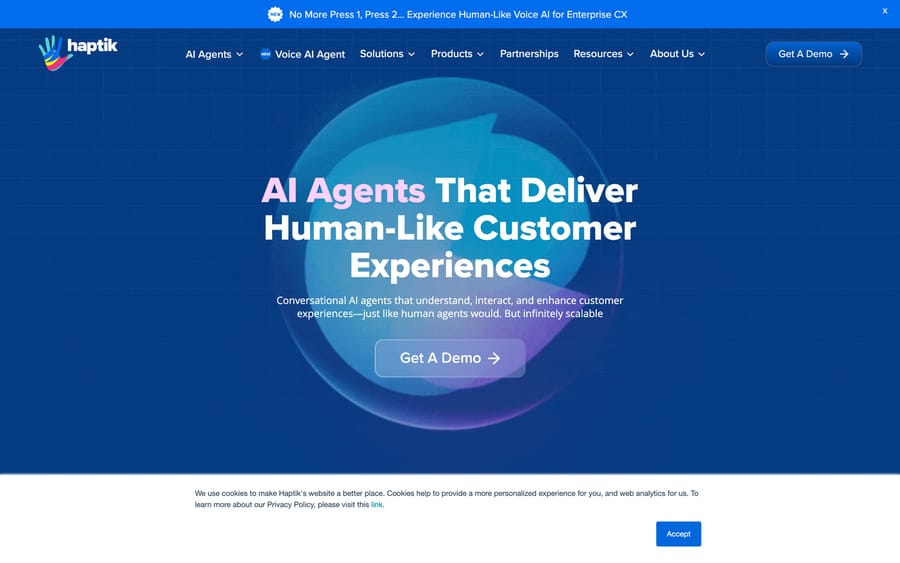
Jio Haptik builds enterprise-grade conversational AI agents deployed across web, chat, and voice, reaching customers on WhatsApp, RCS, Instagram Direct, Facebook Messenger, and the open web. The company reports a decade of AI expertise, strategic partnerships with OpenAI and Microsoft, and ownership by Jio (part of Reliance Industries), which gives it a distinctly strong footprint in the Indian enterprise market. Named customers span retail, fintech, travel, healthcare, ed tech, and media, including OYO, CARS24, Upstox, Zurich Insurance, Mondelez International, and BlueDart.
Voice AI agents support "advanced intent detection, context-aware responses, and multilingual fluency in 100+ languages," a meaningful claim in a market as linguistically diverse as India specifically. Knowledge bases can be built from PDFs, DOCX, PPTX, CSVs, and a company's own website, with human handoff for conversations the AI shouldn't finish alone.
Real, named results: OYO and Zurich Insurance
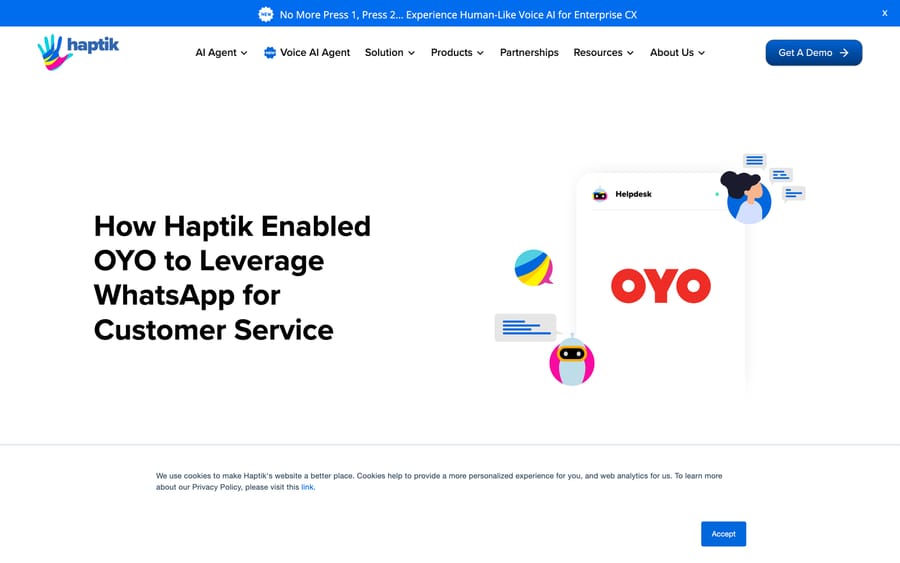
OYO's case study reports 85,000-plus monthly conversations, 55,000-plus monthly unique users engaged, and a 15% reduction in call-center traffic since deploying Haptik on WhatsApp. OYO's own product manager is quoted directly: "We have observed a significant reduction in the volume of calls to our customer care helplines since we implemented this solution." That's a specific, checkable claim tied to a named role at a named company, not an anonymous testimonial.
Zurich Insurance's case study, describing a chatbot the company branded "Zuri," reports an 84% automation rate, 70% of queries resolved end-to-end, and a 10% increase in website visitor engagement, deployed for lead generation and customer care on Zurich's own site. Both case studies carry the specific unit, percentage, and named company that make a statistic checkable rather than aspirational.
Key features
- Omnichannel deployment: WhatsApp, RCS, Instagram Direct, Facebook Messenger, and web from one platform, with WhatsApp treated as a primary channel rather than an afterthought.
- Voice AI agents with intent detection, context-aware responses, and 100-plus language support.
- Flexible knowledge ingestion: PDFs, DOCX, PPTX, CSVs, and a company's website feed the same knowledge base.
- Human handoff for conversations the AI shouldn't complete alone.
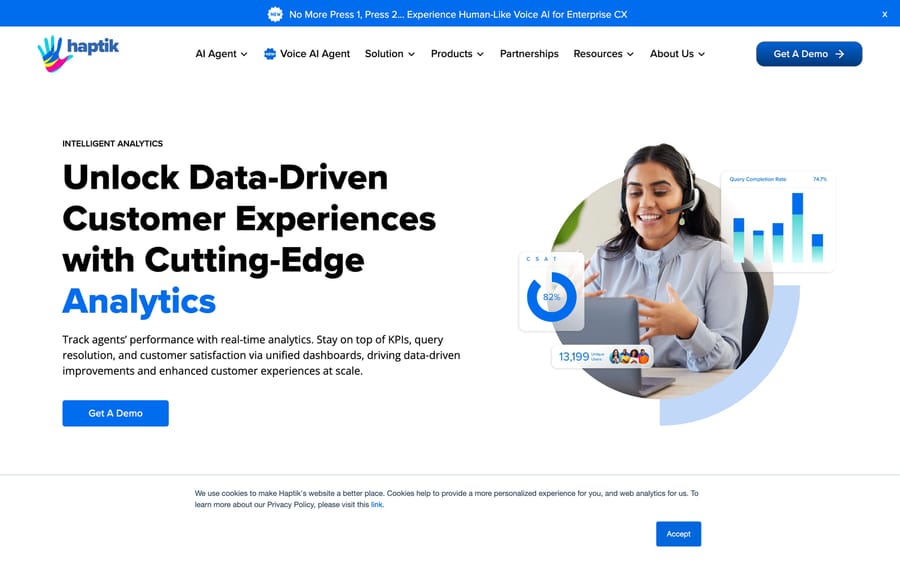
- Intelligent analytics: real-time KPI, query-resolution, and CSAT tracking through unified dashboards.
- Enterprise security and compliance: ISO, GDPR, CCPA, CPRA, CyberGRX, and FIPS 140-2 certifications claimed on the platform's security page.
Haptik pricing
Haptik does not publish pricing. The pricing page returns no rate card, only repeated calls to "Get a Demo" or "Request Demo." We have no reliable published number or third-party estimate to cite.
Given the breadth of Haptik's customer base, 500-plus enterprise clients spanning small e-commerce deployments to large insurers and telecoms, it's reasonable to assume pricing varies substantially by scale and channel mix (adding voice or WhatsApp Business API costs typically scale with message volume industry-wide). Budget for a sales conversation that scopes your specific channels and volume rather than expecting a single number to apply broadly.
The incentive worth naming: an enterprise sales-led model without a published rate lets Haptik price a Fortune 500 insurer differently from a fast-growing D2C retailer, which is standard practice in this category, but it also means the number you're quoted depends heavily on how the deal gets scoped and negotiated, not on a fixed unit cost you can calculate in advance.
What actual users say
Haptik's G2 reviews page returned a 403 to direct access. FeaturedCustomers.com gave an accessible alternative: 4.8 out of 5.0, based on 2,441 reference ratings, with 48 testimonials, 57 case studies, and 6 customer videos listed on the profile, checked 2026-09-17, an unusually large sample for this category. The page also confirms Samsung, KFC, Coca-Cola, Tata Group, and Club Mahindra as additional named clients alongside OYO and Zurich Insurance.
The individual testimonial and case-study text on that page sits behind a "locked content" wall requiring a FeaturedCustomers account to read, so we could not independently verify specific reviewer quotes beyond the aggregate score and client list. Treat the 4.8/5.0 figure as a real, checkable data point, and ask Haptik directly for a customer reference rather than relying on a quote you can't read in full.
Pros and cons
Pros
- Real, named case studies with specific, attributed metrics (OYO's 15% call-reduction, Zurich's 84% automation rate) rather than only vendor-reported aggregates.
- 4.8/5.0 on FeaturedCustomers, based on 2,441 reference ratings, a genuinely large sample for this category.
- Strong WhatsApp-first omnichannel support, a real advantage in markets (India and beyond) where WhatsApp is the default customer-service channel.
- Backed by Jio/Reliance, a real scale advantage for enterprise sales and infrastructure investment.
Cons
- No published pricing, and no reliable third-party estimate exists.
- No accessible G2 review page at the time of writing.
- Enterprise sales-led model means every deployment starts with a scoping conversation rather than a self-serve trial.
- Primarily proven in the Indian and broader APAC enterprise market; a North American or European buyer should ask directly for reference customers in their own region.
Who Haptik is best for
Haptik fits teams at an enterprise, retailer, fintech, travel company, or insurer, that needs a conversational AI agent deployed across WhatsApp and other messaging channels alongside voice and web, particularly in markets where WhatsApp is a primary customer-service surface. OYO and Zurich Insurance's case studies both describe exactly that shape of deployment: high message volume, real automation targets, measurable call-center offload.
It's the wrong choice for a team that wants to see a price before a demo call, or a small team whose support volume doesn't justify an enterprise sales cycle. A 15-person support team on a single help desk in a market where WhatsApp isn't the primary channel gets less specific benefit from Haptik's core strength than the case studies suggest.
Haptik vs alternatives
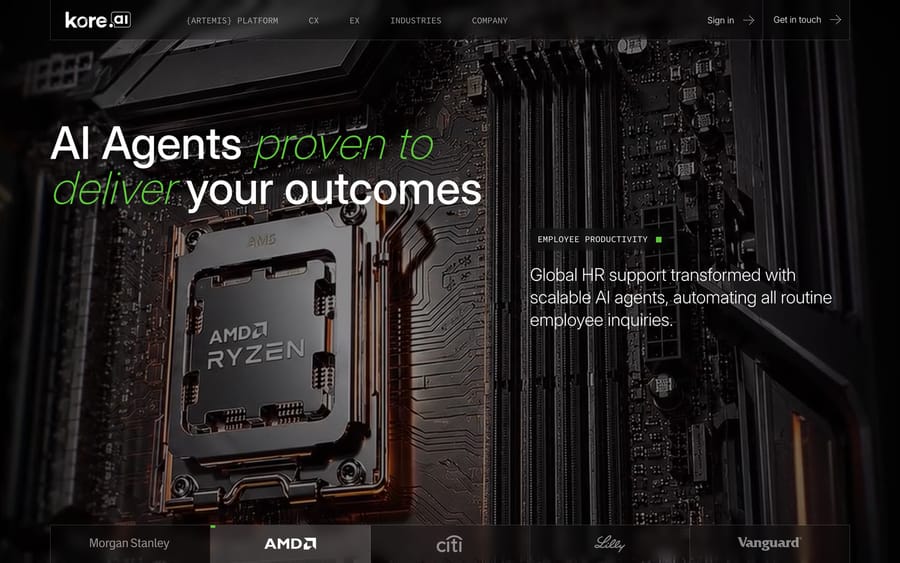
The closest comparison is Kore.ai, another enterprise conversational AI platform serving similarly large organizations across industries. Kore.ai also publishes no pricing page, consistent with enterprise, sales-led software in this category.
| Haptik | Kore.ai | Macha | |
|---|---|---|---|
| Model | Enterprise conversational AI, WhatsApp-first omnichannel | Broad enterprise conversational AI across industries | AI agent layer on your existing help desk |
| Best for | Enterprises needing strong WhatsApp/messaging coverage, especially in APAC | Enterprise contact centers across many verticals | Teams on Zendesk, Freshdesk, Gorgias, or Front |
| Pricing | Unpublished, sales-led | Unpublished, sales-led | From $299/mo for 750 tickets (~$0.40/ticket), published |
| Real-user rating | 4.8/5.0, 2,441 references (FeaturedCustomers) | Not independently verified for this guide | N/A (newer platform) |
| Self-serve trial | No | No | $50 free usage |
| Replaces your help desk? | No, layers onto existing messaging and voice channels | No, layers onto an existing CCaaS/CRM stack | No, sits on top of Zendesk, Freshdesk, Gorgias, or Front |
Haptik and Kore.ai both compete for the same enterprise buyer, though Haptik's WhatsApp-first channel strength and Indian/APAC reference base set it apart from Kore.ai's broader global positioning. For our detailed take on Kore.ai specifically, see our guide to Kore.ai. Neither vendor reaches a support team's ticket queue inside a help desk; that's where Macha fits instead, published per-ticket pricing and a self-serve trial as an AI agent layer inside Zendesk, Freshdesk, Gorgias, or Front. For more on how enterprise conversational AI compares to help-desk-native agents, see our guide to AI agents for customer service.
How we researched this
We checked Jio Haptik's homepage, Voice AI Agent page, Analytics page, and the OYO and Zurich Insurance case studies directly on 2026-09-17, using its sitemap to locate real case-study URLs. Both case studies carried specific, attributed figures consistent with the vendor's broader positioning. No pricing page exists. G2 returned a 403; FeaturedCustomers.com gave an accessible aggregate rating (4.8/5.0 based on 2,441 reference ratings), though the individual testimonial and case-study text on that page is locked behind an account wall, so we're not citing specific reviewer quotes from it. Kore.ai's homepage (captured previously for its own guide) is reused here for the comparison. We could not independently verify Haptik's exact enterprise pricing at any scale.
FAQ
What is Haptik? Jio Haptik is an enterprise conversational AI platform, owned by Reliance's Jio, that builds AI agents for web, chat, voice, and messaging channels like WhatsApp, RCS, Instagram Direct, and Facebook Messenger.
How much does Haptik cost? Haptik doesn't publish pricing. Every path leads to a demo request, and there's no reliable third-party estimate; pricing likely varies by channel mix and message volume.
Is there a free trial? No self-serve trial is published. Every path on the site leads to requesting a demo.
What results do Haptik customers report? OYO reports 85,000+ monthly conversations, 55,000+ monthly unique users engaged, and a 15% reduction in call-center traffic. Zurich Insurance reports an 84% automation rate and 70% of queries resolved end-to-end through its "Zuri" chatbot.
What do real users say about Haptik? FeaturedCustomers.com shows a 4.8/5.0 rating based on 2,441 reference ratings, checked 2026-09-17, across 48 testimonials and 57 case studies. The individual quote text on that page is locked behind an account wall, so treat the aggregate score as the verifiable data point.
Is Haptik only used in India? No, but its reference customers and case studies skew heavily toward the Indian and broader APAC market, reflecting its Jio/Reliance ownership. A buyer outside that region should ask for reference customers in their own market.
What are good alternatives to Haptik? Kore.ai is the closest comparison: another enterprise conversational AI platform with unpublished, sales-led pricing serving similar large organizations globally. For a team running a single help desk instead of a broad omnichannel messaging deployment, a lighter, help-desk-native AI agent is a better fit than either vendor.
Does Haptik replace a help desk? No. It layers onto an enterprise's existing messaging, voice, and web channels. It isn't a general-purpose ticket queue for a single support inbox.
Ready to automate the ticket queue with published, per-ticket pricing instead of a sales-led enterprise contract? See how Macha's pricing works or start a trial on top of the help desk you already run.
Sources: Jio Haptik, Haptik Voice AI Agents, Haptik Analytics, OYO case study, Zurich Insurance case study, FeaturedCustomers: Haptik reviews, Kore.ai.
Resolve tickets automatically with AI agents
Macha's AI agents work on top of the help desk you already use — no code.