Intercom
 Shopify
 Stripe
 Slack
Slack Notion
 Google Workspace
 Confluence

Genesys Cloud AI: The Complete Guide (2026)


Genesys Cloud is an enterprise contact-center platform whose AI features, virtual agents, predictive routing, an agent copilot, and a no-code builder called AI Studio, are unusually transparently priced for a vendor this size, right down to naming exactly how many "AI Experience tokens" each tier includes. This guide covers what those features actually do, the real published pricing by tier, why the token allocation is worth reading closely before you buy, the surprisingly thin review evidence available, and how it compares to the alternatives, including where a help-desk-native AI agent layer like Macha fits a support team that doesn't need a full enterprise contact-center platform.

We build AI agents for customer service ourselves, so this is written by people who have to evaluate platforms like this. We are not repeating a data sheet.
What is Genesys Cloud AI?
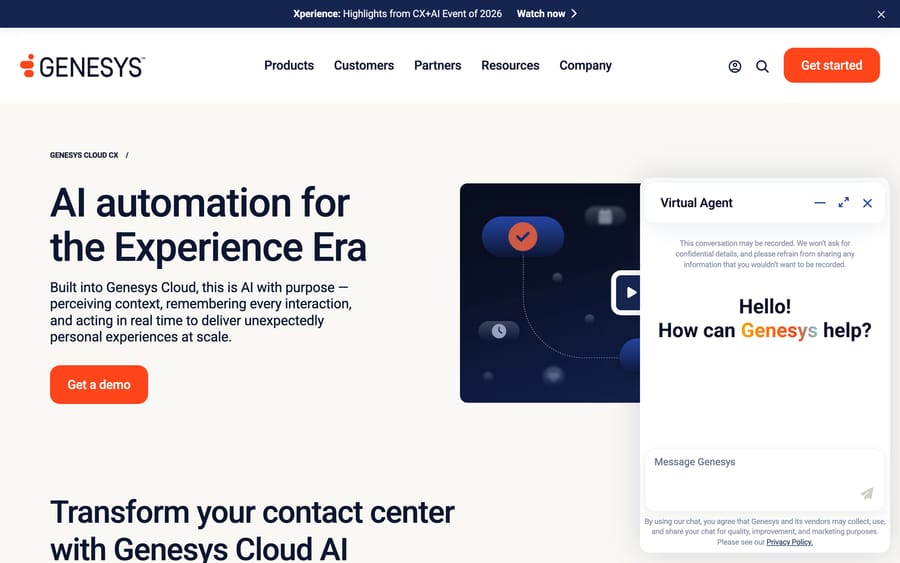
Genesys Cloud is a cloud contact-center platform (CCaaS), and its AI capabilities are built into the platform across five named areas instead of sold as one separate module: Virtual Agent handles self-service conversations across channels with the aim of understanding context well enough to avoid dead ends; Agent Copilot surfaces contextual knowledge-base information to a human agent in real time and auto-summarizes interactions afterward; Predictive Routing replaces static routing rules by matching a customer to whichever available agent is statistically best suited, optimized against a chosen KPI; Predictive Engagement analyzes visitor behavior to predict intent and trigger proactive, personalized outreach; and AI Studio is the no-code hub where a non-technical team builds and manages these AI experiences.
Genesys backs its claims with a named customer case study: Coca-Cola Bottlers' voicebots correctly matched customer intent in more than 80% of cases, which let agents resolve more queries on first contact and generated close to $5,000 in realized savings with a projected $20,000 annually. Visa is also named as an AI Studio customer, though without a specific result attached. Genesys's own 2025 "State of Customer Experience" report states that 42% of CX leaders surveyed call AI a strategic priority, a data point about the market instead of about Genesys's product specifically.
How Genesys Cloud's AI works
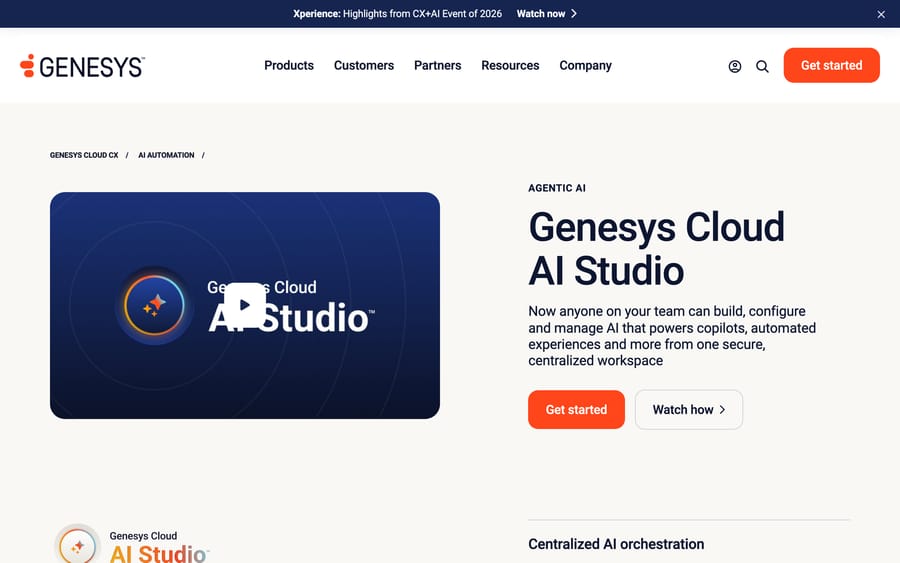
The mechanism worth understanding is AI Guides, the building block inside AI Studio: structured, executable instructions that combine step-by-step logic with generative AI, letting a non-technical team member describe a process in natural language, or point the system at existing process documentation, and get a working virtual agent out the other end. That's a meaningful lowering of the bar compared to a platform that requires a developer to hand-code every conversation flow.
Predictive Routing works differently from a typical "AI feature": instead of a chatbot a customer talks to, it's a matching algorithm running invisibly behind every call, deciding which of your available human agents gets a given customer based on a target outcome you define, average handle time, first-contact resolution, revenue per call, whatever KPI matters most to your operation. Agent Copilot then works alongside a human agent on the call itself, pulling knowledge-base answers in real time and writing the post-call summary automatically, work that would otherwise land on the agent after they hang up.
Key features
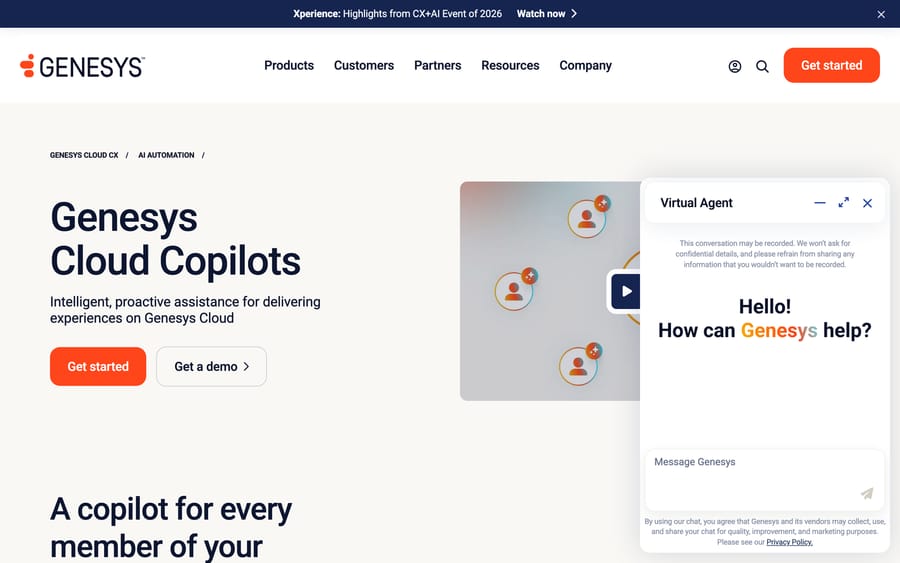
- Virtual Agent: self-service conversational AI across channels, aimed at resolving requests without a human.
- Agent Copilot: real-time knowledge surfacing plus automatic interaction summarization.
- Predictive Routing: matches customers to the best-suited available agent against a chosen KPI, replacing static routing rules.
- Predictive Engagement: analyzes visitor behavior to predict intent and trigger proactive, personalized outreach.
- AI Studio: a no-code hub for building, configuring, and managing AI experiences, including AI Guides built from natural-language descriptions.
- Knowledge Management: automatically surfaces relevant information to customers and agents, with effectiveness measured across channels.
- Named customer results (Coca-Cola Bottlers, Visa) instead of only anonymous percentages.
The review evidence here is unusually thin
This is worth stating directly instead of papering over: independent review evidence for Genesys is thinner than for any other vendor in this series. G2's review page and TrustRadius both blocked automated access during this research. Trustpilot loaded directly but shows only 3 reviews at a stated average of 2.8 out of 5, and the three individual reviews we could actually read were all 1-star, which doesn't cleanly average to 2.8. That gap suggests either more reviews exist than the three we could see, or the displayed average and the visible sample simply don't line up; we're flagging the discrepancy instead of picking whichever number looks better. The three reviews we could read, for what a tiny sample is worth:
"The support teams hide behind the impossible log captures and submitted ideas for development." Attributed to Dave (GB), Trustpilot, January 2026.
"A very bad platform and now every case takes double the time... It loses connection all the time and a lot of downtime." Attributed to Danne (SE), Trustpilot, November 2025.
"Genesys looks good on the surface, but the product behind the marketing is weak." Attributed to N D (CH), Trustpilot, April 2025.
Three reviews, all negative, is not a statistically meaningful verdict on a platform used by large enterprises worldwide, and Trustpilot's audience for enterprise software skews toward complaint-driven visits generally. Treat this as a prompt to ask Genesys for reference customers directly, not as a settled score.
Genesys Cloud AI pricing (published)
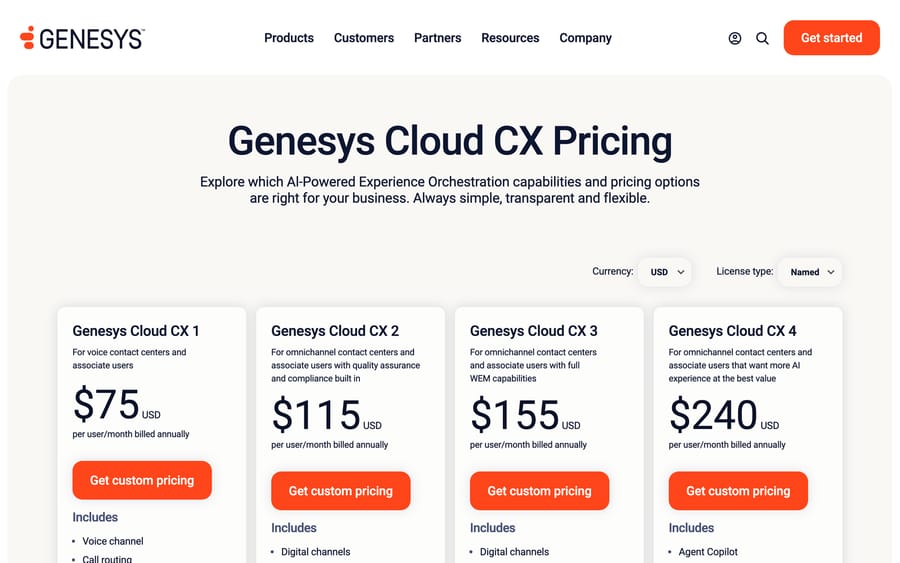
Genesys publishes real per-user pricing, unusually transparent for an enterprise CCaaS platform at this scale:
| Plan | Price (annual commitment) | AI included |
|---|---|---|
| Genesys Cloud CX 1 | $75/user/month | Voice-focused; 250 named / 350 concurrent AI Experience tokens per org/month included |
| Genesys Cloud CX 2 | $115/user/month | Omnichannel, quality assurance; same org-wide 250/350 token pool |
| Genesys Cloud CX 3 | $155/user/month | Omnichannel, full workforce engagement; same org-wide 250/350 token pool |
| Genesys Cloud CX 4 | $240/user/month | Omnichannel, journey management, plus +30 named / +39 concurrent tokens per named agent, on top of the org-wide pool |
The detail worth reading closely is the token structure itself, not a hard AI/no-AI split. Every tier, including CX1, ships with the same organization-wide pool: 250 named or 350 concurrent AI Experience tokens a month, shared across the whole account. What CX4 actually buys is a further allocation on top of that shared pool: +30 named or +39 concurrent tokens per named agent, every month. That's a real difference in scale rather than a switch that turns AI on, but the practical effect is similar for a large team: a 50-agent org on CX4 gets 1,500 additional named tokens a month stacked on the 250 every tier already includes, while a 50-agent org on CX1 is sharing that same 250-token pool across all 50 people. Genesys doesn't publish what happens, or what it costs, once an org or an agent exhausts its allocation on any tier. An undisclosed overage rate gives Genesys an incentive to let a customer discover the real AI cost only after they're already committed, in a follow-up sales conversation rather than on the public pricing page. Budget for that conversation with sales instead of assuming any tier's price is the ceiling on your AI spend. Custom pricing is also available directly from Genesys for organizations with different needs than the four published tiers cover.
What drives the price
- Which CX tier: the jump from CX1 to CX4 is $75 to $240 a user, more than 3x, and CX4 is where the per-agent AI token allowance scales up.
- AI Experience token consumption: every tier shares the same 250-named/350-concurrent org-wide pool; CX4 adds a further per-agent monthly allocation on top of it. Usage beyond either allocation is a genuine open question this guide couldn't answer from public pricing alone.
- Seat count and contract term: annual commitment pricing is what's published; multi-year or high-volume deals likely carry further negotiated discounts, consistent with how enterprise CCaaS contracts are typically structured.
Pros and cons
Pros
- Real, published per-user pricing across four tiers, unusually transparent for an enterprise contact-center platform.
- AI Studio's no-code AI Guides genuinely lower the bar for building a virtual agent without a developer.
- Predictive Routing addresses a real operational problem (agent-customer matching) that most AI vendors in this category don't touch at all.
- A named, specific customer result (Coca-Cola Bottlers) with real numbers instead of only a vague percentage.
Cons
- AI Experience tokens are metered on every tier through a shared org-wide pool; CX4 adds a further per-agent allocation, but what an overage costs on any tier isn't publicly disclosed.
- Independent review evidence is unusually thin: G2 and TrustRadius both blocked access, and Trustpilot shows only 3 reviews with numbers that don't cleanly reconcile.
- The 3x price jump from CX1 to CX4 is steep if your team primarily needs the AI features instead of the base contact-center platform.
- Built for enterprise-scale contact-center operations; a small support team evaluating this is likely buying more platform than it needs.
Who Genesys Cloud AI is best for
Genesys Cloud fits a large enterprise contact center that needs a full CCaaS platform, agent routing, workforce engagement, omnichannel support, and wants AI (virtual agents, copilot, predictive routing) built into that same platform instead of bolted on from a third party. If your operation already runs enough call and chat volume to justify CX4's token allocation, and you have an IT team that can build with AI Studio's no-code tools, Genesys covers a lot of ground in one contract.
It's the wrong choice if you're a small or mid-size team that doesn't need a full contact-center platform: even CX1 already includes a shared 250-token AI pool, so CX4's real value is a bigger per-agent AI allowance for a large team, not a switch that unlocks AI in the first place, and CX4 prices are steep to pay for token headroom you may not need. It's also a poor pick if you want a settled, independently verified review score before committing, since the review evidence for Genesys is thinner than for almost any other vendor in this category.
Genesys Cloud AI vs alternatives
| Genesys Cloud AI | Cresta | Macha | |
|---|---|---|---|
| Model | Full enterprise CCaaS platform with built-in AI (virtual agents, copilot, routing) | AI coaching and agent-assist layer for contact centers | AI agent layer on your existing help desk |
| Best for | Large enterprise contact centers replacing their entire CCaaS stack | Enterprise contact centers wanting real-time agent coaching | Support teams on Zendesk, Freshdesk, Gorgias or Front |
| Pricing | Published: $75-$240/user/month across 4 tiers; meaningful AI gated to the top tier | Not published; enterprise sales-led | From $299/mo for 750 tickets (~$0.40/ticket), published |
| Self-serve trial | No | No | Yes, $50 free usage, no credit card |
| Setup | Sales-led enterprise implementation | Sales-led implementation | Built, tested and monitored by the Macha team |
| Replaces your help desk? | It replaces your contact-center platform entirely | No | No, it deliberately augments your help desk |
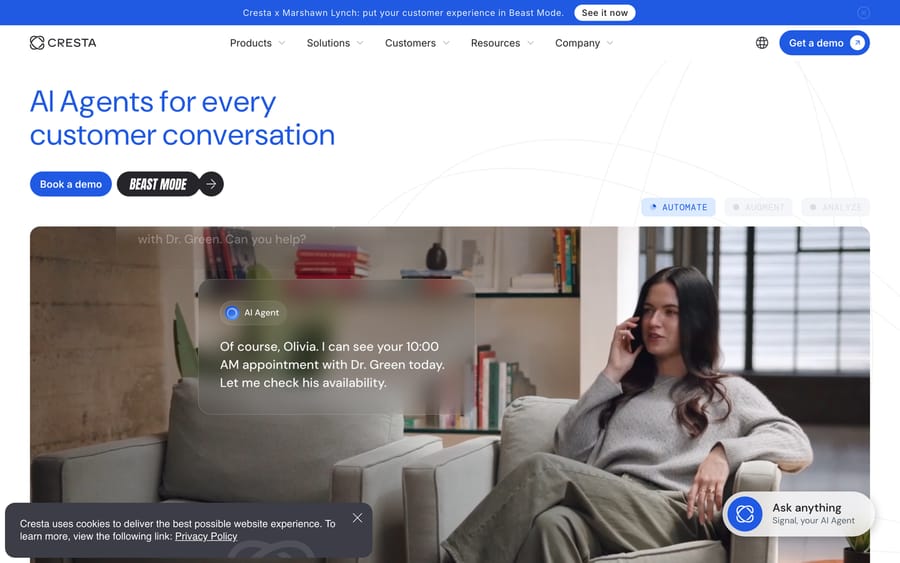
Genesys Cloud and Cresta both put AI to work in the contact center, but at very different scopes: Genesys is a full CCaaS platform you'd migrate your entire phone and chat operation onto, while Cresta layers coaching and agent-assist on top of infrastructure you likely already run. Our Cresta guide covers that narrower, coaching-focused platform in more depth.
Macha addresses a different problem for a much smaller team. It doesn't replace a contact-center platform; it drafts and resolves the written tickets a support team already gets inside a help desk like Zendesk, Freshdesk, Gorgias, or Front. If you're a 10 to 200-person support operation instead of an enterprise standing up a full CCaaS migration, Macha is priced transparently from $299/month for 750 tickets, about $0.40 a ticket at every tier, with $50 of free usage and no credit card to start. See Macha's pricing for the full table.
How we researched this
We checked Genesys's AI-and-automation and AI Studio pages directly, plus its published pricing page, all fetched cleanly on 2026-09-17, and re-fetched the pricing page on the same date to confirm the token structure applies org-wide on every tier rather than being exclusive to CX4. Customer results (Coca-Cola Bottlers, Visa) are Genesys's own published case studies. G2's review page and TrustRadius both returned 403 on every fetch attempt during this research. Trustpilot loaded directly, but its displayed 2.8/5 average and the three individual 1-star reviews we could read don't reconcile cleanly, a discrepancy we're reporting instead of smoothing over. This is the thinnest independent review evidence found for any vendor in this batch.
FAQ
What is Genesys Cloud AI? It's the set of AI capabilities built into the Genesys Cloud CCaaS platform: Virtual Agent for self-service conversations, Agent Copilot for real-time human-agent assist, Predictive Routing for smarter call matching, Predictive Engagement for proactive outreach, and AI Studio, a no-code hub for building all of it.
How much does Genesys Cloud AI cost? Genesys publishes four tiers: CX1 at $75/user/month, CX2 at $115, CX3 at $155, and CX4 at $240, all on an annual commitment. Every tier, including CX1, includes the same shared pool of 250 named or 350 concurrent AI Experience tokens per org per month; CX4 adds a further +30 named or +39 concurrent tokens per named agent on top of that pool. The cost of exceeding either allocation isn't publicly disclosed.
What are AI Experience tokens? A metered allocation of AI usage. Every Genesys Cloud tier, including CX1, includes the same shared pool of 250 named or 350 concurrent tokens per organization per month; CX4 adds a further +30 named or +39 concurrent tokens per named agent on top of that shared pool. It's a consumption limit rather than a simple on/off feature flag, and Genesys doesn't publish what happens once an org or an agent uses up its allocation.
What do Genesys reviews say? The independent evidence is unusually thin. G2 and TrustRadius both blocked automated access during this research, and Trustpilot shows only 3 reviews (all 1-star) against a displayed 2.8/5 average that doesn't cleanly reconcile with that sample.
What is AI Studio? Genesys Cloud's no-code hub for building AI experiences, including "AI Guides," structured instructions built from natural-language descriptions or existing process documents, letting a non-technical team member build a virtual agent without a developer.
What are good alternatives to Genesys Cloud AI? Cresta is a comparable AI platform focused specifically on real-time coaching, without requiring a full CCaaS platform migration. For a team whose real workload is a ticket queue instead of a contact-center operation, Macha is a different category of tool.
Does Genesys Cloud replace a help desk like Zendesk? It can replace a contact-center platform entirely, but it's a different category from a ticket-based help desk. A team running a written-ticket support queue alongside a phone/chat contact center often runs both types of tool.
Ready to automate your support inbox instead of migrating your entire contact center? Start a Macha trial with $50 of free usage and no credit card, or see Macha's pricing.
Sources: genesys.com/capabilities/ai-and-automation, genesys.com/capabilities/ai-studio, genesys.com/pricing, Trustpilot (trustpilot.com/review/genesys.com, fetched directly).
Resolve tickets automatically with AI agents
Macha's AI agents work on top of the help desk you already use — no code.