Intercom
 Shopify
 Stripe
 Slack
Slack Notion
 Google Workspace
 Confluence

eGain: The Complete Guide (2026)


eGain is a publicly traded (NASDAQ: EGAN) knowledge management and AI platform that customer service teams use to centralize their help content and feed it into AI agents, search, and human-agent desktops. This guide covers what eGain actually does, how its AI Knowledge Hub works, what it costs on the vendor's own published pricing page, where buyers push back, and how it stacks up against Coveo and against running AI agents directly on the help desk you already use.

eGain has been public since 1999, longer than most of the AI vendors we cover here have existed, and that history matters for how you should read its marketing. It isn't a new "AI knowledge" startup wrapping an LLM around a wiki. It's a 20-plus-year-old knowledge management vendor that has re-platformed around generative AI, and the product shows both halves of that: genuinely deep knowledge governance built up over two decades, sitting inside a UI and information architecture that predates the current wave of AI tools.
What is eGain?
eGain Corporation was founded in 1997 by Ashutosh Roy and Gunjan Sinha, out of their earlier experience running the search engine WhoWhere?, and went public on NASDAQ in 1999. It's headquartered in Sunnyvale, California, reported revenue of roughly $93 million in its 2024 fiscal year, and has grown partly by acquisition. SiteBridge (chat, 1999), Big Science and Inference (AI and case-based reasoning, 2000), and Exony (contact-center analytics, 2014) are all now folded into the current product line.
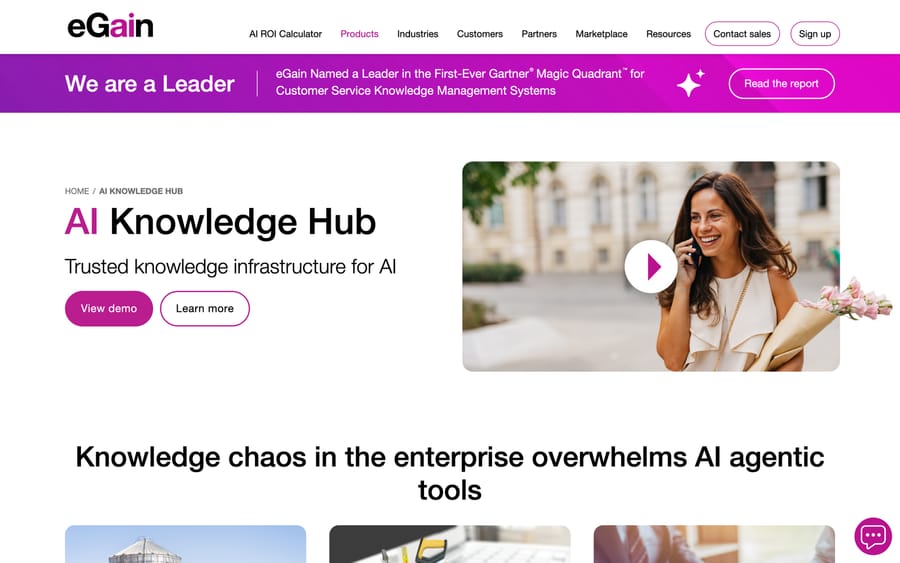
The current pitch is the AI Knowledge Hub: a single, governed knowledge platform that content authors, AI systems, and human agents all draw from. The goal is that a chatbot, a self-service portal, and a live agent's desktop are all answering from the same approved source, so they stop drifting into three different, slowly contradicting wikis. eGain frames itself as solving "knowledge chaos," its own term for a specific failure mode: a company buys an AI agent, points it at SharePoint, Confluence, a CRM's knowledge base, and a decade of PDFs, and the agent starts confidently answering from outdated or contradictory content because nobody unified the underlying sources first.
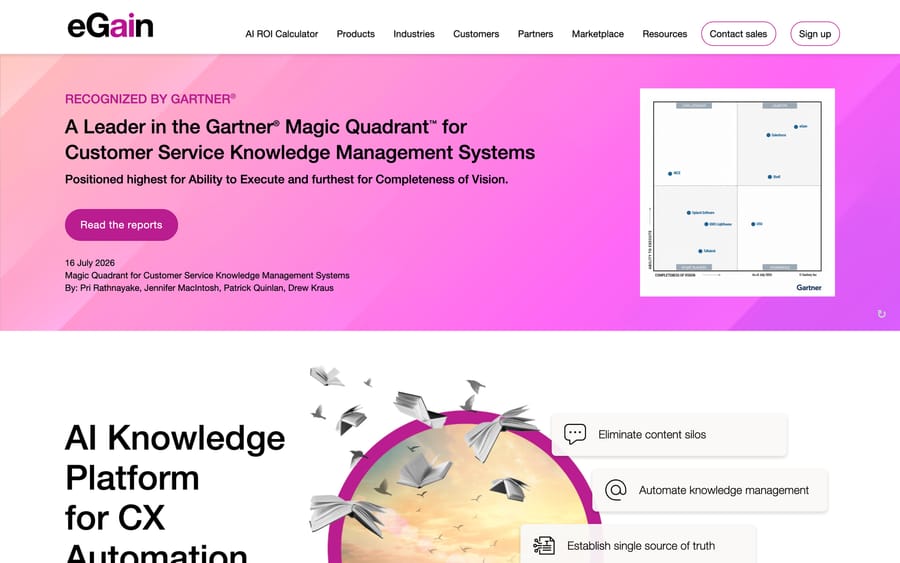
eGain is a Leader in Gartner's Magic Quadrant for Customer Service Knowledge Management Systems, positioned highest for ability to execute. That's a checkable claim, since Gartner tracks that category specifically, and it's the credential eGain leads with on its homepage.
How eGain's AI works
eGain's architecture separates into a few named products that are easy to confuse if you only skim the homepage:
- AI Knowledge Hub: the core knowledge platform, covering content creation, curation, compliance workflows, and a single repository other systems draw from.
- AI Knowledge Connectors: the integration layer that pulls content in from CRMs, SharePoint, and other silos.
- AI Agent for Customer Self-Service: a conversational agent for end customers, built on top of the Hub's content.
- AI Agent for Contact Center: the same underlying AI, pointed at human agents.
- AI Agent IVA: an interactive voice assistant for phone channels.
- Conversation Hub: the multichannel engagement layer (chat, email, social, cobrowse, calls).
- Agentic Studio: orchestration for running multiple AI agents together, so one agent can hand off to another instead of a single bot trying to cover everything.
- Composer: a developer platform for building custom AI applications on top of the Hub.
- Evaluator: quality assurance that scores AI-generated answers against the approved knowledge base.
The mechanism worth understanding is the separation of authoring from delivery. A subject-matter expert writes and approves an answer once in the Hub. eGain's AI reuses that same approved content across a self-service bot, a contact-center agent's screen, and a voice assistant. Nobody has to re-write "how do I cancel my subscription" three separate times for three channels. The Evaluator product exists because "the AI answered from approved content" and "the AI answered correctly" are different guarantees, and a bank or airline generally needs both checked separately.
On its own help site, eGain describes clients seeing self-service resolution rates of 30% to 70% depending on the complexity of the queries. For the harder questions that still escalate, it claims improvements of up to 35% in first-contact resolution, up to 60% in agent confidence, and up to 20 points of NPS from giving agents AI-assisted knowledge. Separately, on its main AI Knowledge Hub page, eGain cites a 37% increase in first-contact resolution, a 30-point NPS rise, and a 50% improvement in agent speed-to-competence, alongside BT (the telecom company) as an example customer handling 25 million conversations a year. Those are two different vendor-reported ranges from two different eGain pages. Treat both as eGain's own claim, not as one reconciled, independently audited figure.
Bring-your-own-bot architecture
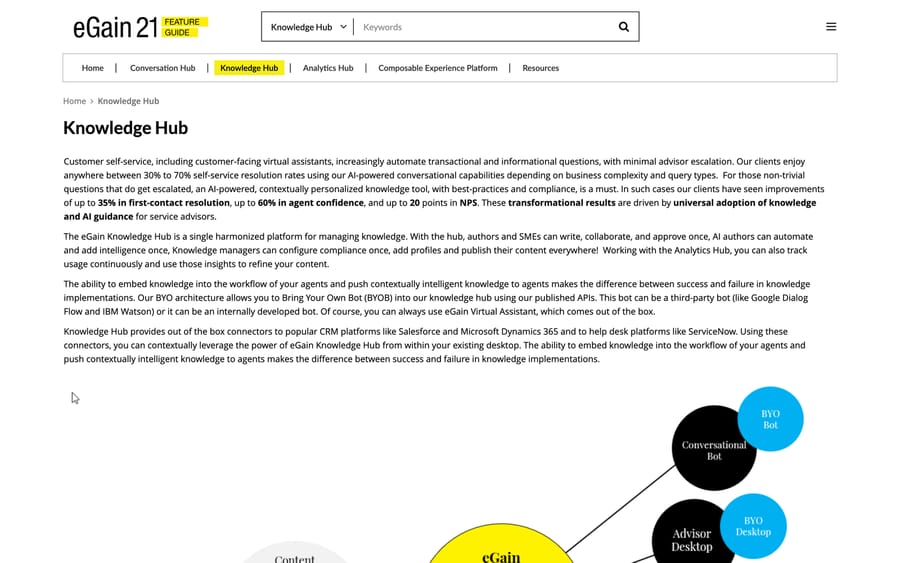
One detail from eGain's own feature documentation is worth calling out, because it cuts against the assumption that eGain locks you into its own chatbot. eGain's Knowledge Hub supports a "BYOB" (bring your own bot) model: you can point a third-party bot at eGain's knowledge via published APIs. The docs specifically mention Google Dialogflow and IBM Watson, or you can use eGain's own Virtual Assistant out of the box. In practice, eGain's real product is the governed knowledge layer. The conversational front end sitting on top of it is optional.
Key features
- Single governed knowledge repository feeding self-service, agent desktop, and voice, so a support team stops maintaining separate content per channel.
- AI-assisted authoring and curation, with compliance-focused workflows for regulated content.
- Duplicate, conflict, and broken-link detection across a knowledge base that's often accumulated for years.
- Bring-your-own-bot support via published APIs, plus eGain's own AI Agent products if you want the whole stack from one vendor.
- Evaluator, a distinct product for scoring AI answer quality against the approved knowledge base rather than a dashboard tab bolted onto the Hub.
- Native connectors into CRMs (Salesforce, Microsoft Dynamics 365) and help desks (ServiceNow, and a listed Zendesk Support integration).
- Multichannel delivery across chat, email, self-service portals, and voice.
eGain pricing
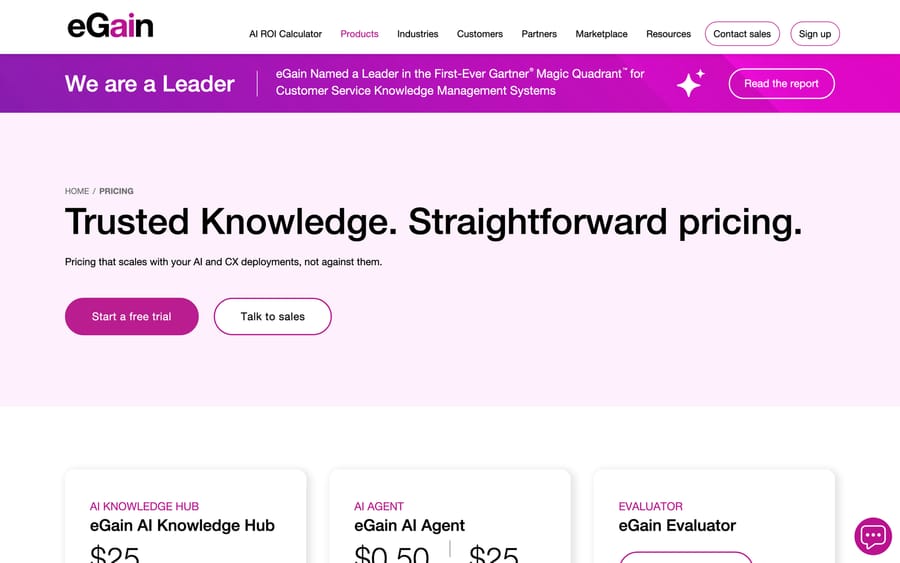
This is unusual among the vendors in this series: eGain actually publishes list prices on its site instead of routing every visitor to "contact sales."
| Product | Published price |
|---|---|
| AI Knowledge Hub | $25 per user per month |
| AI Agent | $0.50 per resolution, or $25 per user per month |
| AI Knowledge Connectors | $249 per month |
| Evaluator | Custom (quote-based) |
| Composer | Free to build and test; production cost depends on which underlying products you use |
eGain calls these "suggested list prices," the same hedge every vendor with a sales team applies to a published number. Expect some room to negotiate at volume, and don't assume the number on the page is exactly what a mid-size enterprise deal lands at. An AWS Marketplace listing for the AI Knowledge Hub prices a 5-named-user unit at $1,470 for a 12-month term, which works out to about $24.50 per user per month. That's close enough to the $25 headline figure that the published price looks real, not a teaser rate meant to get you into a sales call.
Per-user pricing on the Hub also sets an incentive worth naming: eGain earns more as your headcount grows, whether or not your actual support workload grows with it. A team that adds ten seats but handles the same ticket volume pays 40% more for the same knowledge base. The $0.50-per-resolution option on AI Agent is the opposite shape: it scales with usage, so it fits a team whose headcount is stable but whose ticket volume swings seasonally.
eGain also offers a 30-day, no-cost "Innovation in 30 Days" pilot with implementation support, aimed at letting a team see results before committing to a contract. That's a meaningfully different sales motion from the six-figure, sales-only cycle common among the enterprise AI platforms in this series.
Pros and cons
Pros
- Actually publishes pricing, which is rare in this category, and it's per-user or per-resolution rather than a mystery quote.
- Genuine knowledge-governance depth, built over two decades, not bolted on for the AI era.
- Bring-your-own-bot architecture avoids locking you into eGain's own conversational layer.
- A real 30-day pilot instead of a multi-quarter sales-only cycle.
- Gartner Magic Quadrant Leader in its core category, a credential most competitors in this list can't claim.
Cons
- The product surface is large. Nine named products (Hub, Connectors, two AI Agent variants, IVA, Conversation Hub, Agentic Studio, Composer, Evaluator) mean figuring out which combination you actually need takes real evaluation time.
- Independent review coverage is thin: G2, Gartner Peer Insights, Capterra and TrustRadius all failed to return usable review data for this product as of this writing (see below), which makes it harder to sanity-check the vendor's own resolution-rate claims against real users.
- Per-user pricing on the Knowledge Hub means cost scales with headcount, not with ticket or query volume, which can penalize a large team with a modest support workload.
- A platform built up over 20-plus years of acquisitions carries real legacy-integration surface. The UI shows its age in places next to newer, AI-native tools; its own help-center site is a visible example.
Real-user evidence
We checked G2, Gartner Peer Insights, Capterra, GetApp, TrustRadius, and PeerSpot for eGain's current AI products (AI Knowledge Hub, Knowledge+AI) on 2026-09-18. G2 and Gartner Peer Insights both returned access-blocked pages. Capterra's direct product listing 404'd. GetApp's listing showed the product page with zero reviews collected. PeerSpot explicitly states it has not yet collected reviews for eGain AI Knowledge Hub. eGain also has a Trustpilot profile with 6 reviews averaging 2.3 out of 5, but it's unclaimed, covers the company generally rather than this product, and is too small a sample to treat as evidence, so we're noting it rather than citing it as a rating.
The honest conclusion: for a company that's been public for over 25 years, eGain's current AI products have surprisingly little independent review coverage on the review sites we could reach. That's worth knowing before you buy on the strength of the vendor's own resolution-rate numbers alone. Ask eGain directly for reference customers you can call, since the review-site data isn't there to fill the gap.
Who eGain is best for
eGain fits a large enterprise or regulated organization that already has a real knowledge-chaos problem: content spread across SharePoint, a CRM, a help desk, and years of unmanaged documents, and a genuine need for a dedicated platform to unify and govern it before layering AI on top. The buyer profile is a knowledge management or CX operations lead, not a support team lead looking to automate this month's ticket queue. If your organization values the Gartner Leader credential and wants a vendor that will publish an actual per-user price instead of forcing a sales call, eGain is a legitimate, differentiated option in this category.
It's a poor fit if your actual problem is "we get 2,000 support tickets a month in Zendesk and want an agent to draft and send replies inside those tickets." eGain's Knowledge Hub is content infrastructure. Turning that into ticket-level automation still means adopting eGain's own AI Agent products, or wiring your own bot into its APIs, on top of the knowledge platform you're already paying per user for.
eGain vs alternatives
| eGain | Coveo | Macha | |
|---|---|---|---|
| Model | Governed knowledge platform + AI agents on top | AI-relevance / enterprise search platform | AI agent layer on your existing help desk |
| Best for | Enterprises unifying fragmented knowledge before automating | Enterprises needing AI-powered search across content silos | Teams on Zendesk, Freshdesk, Gorgias or Front automating ticket replies |
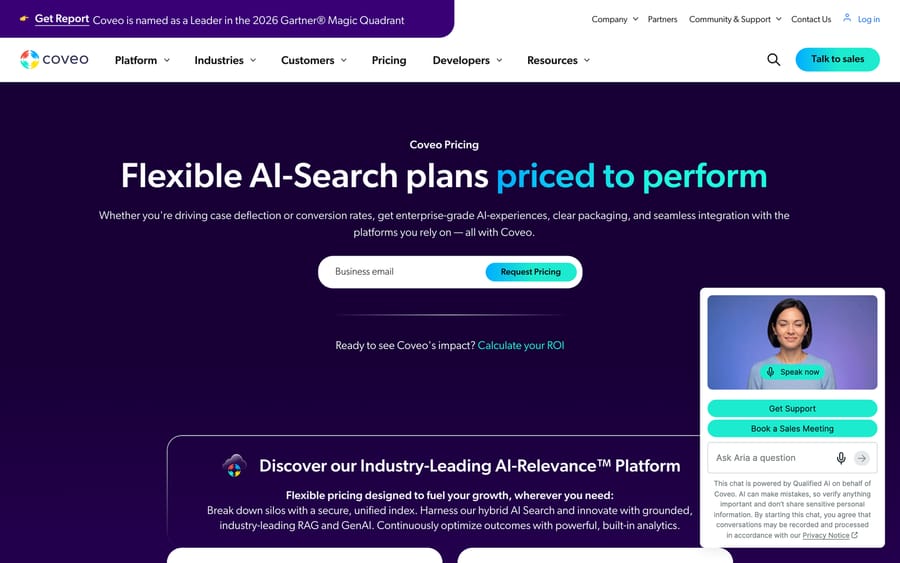
| Pricing | Published: $25/user/mo (Knowledge Hub), $0.50/resolution or $25/user/mo (AI Agent) | Not published; usage-based on 100k-query units, quote required | From $299/month for 750 tickets (~$0.40/ticket), published |
| Self-serve trial | 30-day no-cost pilot with implementation support | No, request pricing only | $50 of free usage, no credit card |
| Setup | Enterprise implementation; knowledge migration is the heavy lift | Enterprise implementation; content indexing and relevance tuning | Built, tested and monitored by the Macha team |
| Replaces your help desk? | No, sits alongside it and CRM/knowledge systems | No, sits alongside your content systems | No, runs on top of the help desk you already use |
Coveo's quote-only pricing carries its own incentive: without a public number, every deal gets sized to what the specific buyer looks able to pay, and a buyer with no benchmark has nothing to compare it to. eGain and Coveo both solve a genuinely different problem than Macha does. Both are knowledge and search infrastructure that something else (a bot, a search bar, an agent desktop) consumes. Macha starts from the opposite end: it assumes your knowledge already lives somewhere reasonable (your help desk's own articles, a Notion space, a Confluence wiki) and focuses on the agent that reads a ticket, drafts or takes the action, and stays inside the help desk your team already works in. If your actual blocker is fragmented, ungoverned content across a dozen systems, eGain's category is the right one to shop in. If your blocker is that you have decent knowledge already and still spend too much agent time on routine tickets, that's a narrower, cheaper problem, and it's the one Macha is built for.
How we researched this
We pulled eGain's own homepage, pricing page, AI Knowledge Hub product page, customer case-study page, and its public help-center feature guide directly, and cross-checked the per-user pricing against an AWS Marketplace listing for the same product. Company history (founding, IPO, acquisitions, revenue) came from eGain's Wikipedia entry, which cites public filings. We could not access usable review data from G2, Gartner Peer Insights, Capterra, or TrustRadius for eGain's current AI products as of 2026-09-18; each returned a blocked, missing, or empty page, so this guide leans more heavily on vendor-published material than the real-user evidence in our other guides, and we've said so above instead of inventing quotes to fill the gap.
If you're already running Zendesk, Freshdesk, Gorgias or Front and want AI agents that work inside your existing tickets instead of a separate knowledge platform, Macha is worth a look. See pricing for the full breakdown, or start a trial with $50 of free usage and no credit card required.
FAQ
What is eGain? eGain is a publicly traded (NASDAQ: EGAN) knowledge management and AI platform. Its core product, the AI Knowledge Hub, unifies fragmented content across CRMs, help desks, and document systems into one governed source that self-service bots, contact-center agents, and voice assistants all draw from.
How much does eGain cost? eGain publishes list prices: $25 per user per month for the AI Knowledge Hub, $0.50 per resolution or $25 per user per month for AI Agent, and $249 per month for AI Knowledge Connectors. Evaluator is custom-quoted, and Composer is free to build and test.
Does eGain offer a free trial? eGain offers a 30-day, no-cost pilot ("Innovation in 30 Days") with implementation support, rather than a self-serve signup.
Is eGain the same as eGain Knowledge+AI? Knowledge+AI and AI Knowledge Hub refer to the same current knowledge-platform product line. eGain has renamed and repackaged its knowledge product over time, so older reviews and listings sometimes use earlier names.
Who founded eGain and when? Ashutosh Roy and Gunjan Sinha founded eGain in 1997, drawing on their prior experience at the search engine WhoWhere?. The company went public on NASDAQ in 1999.
What does eGain integrate with? Published connectors include Salesforce and Microsoft Dynamics 365 for CRM, ServiceNow and a listed Zendesk Support app for help desks, and a bring-your-own-bot API that supports third-party bots such as Google Dialogflow and IBM Watson.
What are the best eGain alternatives? For AI-powered enterprise search and knowledge, Coveo is a direct comparison. For teams that want AI agents acting inside the help desk they already use instead of a separate knowledge platform, Macha is a lighter-weight, help-desk-native alternative.
Does eGain have good reviews? We couldn't find usable independent review data for eGain's current AI products on G2, Gartner Peer Insights, Capterra, or TrustRadius as of 2026-09-18; all returned blocked, missing, or empty pages. Ask eGain directly for reference customers if review-site validation matters to your evaluation.
Is eGain good for a small support team? Not particularly. Per-user pricing on the Knowledge Hub and a platform built around unifying enterprise-wide knowledge chaos both point toward larger organizations. A small team with a contained knowledge base and a single help desk will likely find a narrower, help-desk-native AI agent tool faster to deploy and cheaper to run.
What is eGain's Gartner ranking? eGain is named a Leader in the Gartner Magic Quadrant for Customer Service Knowledge Management Systems, positioned highest for ability to execute as of the July 2026 report cited on eGain's own site.
Sources: eGain homepage, eGain pricing, eGain AI Knowledge Hub, eGain customer stories, eGain 21 Feature Guide, Knowledge Hub, eGain on Wikipedia, AWS Marketplace, eGain AI Knowledge Hub, Coveo pricing.
Resolve tickets automatically with AI agents
Macha's AI agents work on top of the help desk you already use — no code.