
 Shopify
 Stripe
 Slack
Slack Notion
 Google Workspace
 Confluence

Gorgias vs Re:amaze (2026): Which Ecommerce Help Desk Fits Your Store?


Gorgias suits high-volume Shopify brands that want order edits and refunds inside the ticket, and it prices by ticket volume plus AI Agent interactions. Re:amaze suits smaller or multi-platform stores, with per-user plans from $29 a month and SMS and voice from its Pro plan.
Key takeaways
- Gorgias fits high-volume Shopify brands that edit orders and refund inside the ticket, while Re:amaze fits smaller or multi-platform stores paying from $29 a user a month.
- Gorgias helpdesk plans cost $10, $60, $360 and $900 a month billed monthly for 50 to 5,000 tickets, with AI Agent interactions billed on top.
- Re:amaze charges $29, $49 or $69 per user a month, includes 5 to 20 AI resolutions per user, and charges $0.85 for each extra resolution.
- Each Gorgias AI Agent interaction also counts as a helpdesk ticket, and interactions past the plan's AI bundle cost $1.50 each.
- For a store with 4 agents and 1,500 tickets a month, Re:amaze Pro costs $196 a month against $360 for Gorgias Pro before AI.

Pick Gorgias if you're a Shopify brand with high ticket volume and want agents editing orders, refunding and creating discount codes inside the ticket; pick Re:amaze if you're a smaller or multi-platform store that wants per-user pricing from $29 a user a month. Gorgias charges by ticket volume instead, from $10 a month for 50 tickets up to $900 a month for 5,000, with its AI Agent billed per automated interaction on top (gorgias.com/pricing and reamaze.com/pricing, checked 24 September 2026).
How do Gorgias and Re:amaze compare at a glance?
| Gorgias | Re:amaze | |
|---|---|---|
| Best for | Scaling Shopify / Shopify Plus DTC brands with high ticket volume | Smaller and multi-platform stores wanting predictable per-user pricing |
| Pricing model | Per ticket volume, never per agent: $10, $60, $360, $900 a month billed monthly | Per user: $29, $49, $69 a month; or $59 flat for Starter |
| Ecommerce / Shopify depth | Deepest: edit orders, refund, discount codes inside the ticket | Solid, broader across platforms |
| AI | AI Agent on every plan, bundles of automated interactions, $1.50 each past the bundle | Re:amaze AI Agent with 5 to 20 resolutions per user a month included, $0.85 each after |
| Channels | Email, chat, Facebook, Instagram, TikTok, WhatsApp; voice and SMS as usage-based add-ons | Email, chat, social on every plan; SMS and voice from Pro |
| Free trial | Yes, no credit card required | 14 days with Plus features, no credit card |
How much do Gorgias and Re:amaze cost?
Pricing is where these two diverge most. All figures below come from each vendor's official pricing page on 24 September 2026; check the live pages before you buy, because ecommerce help desks change their tiers and AI metering often.
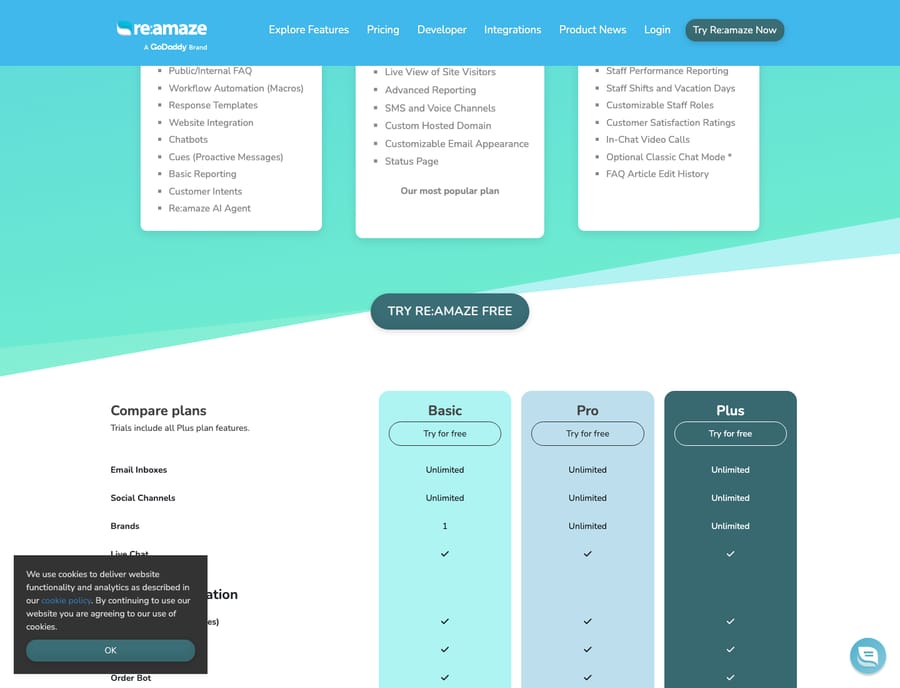
Re:amaze prices per user on published tiers. Its pricing page lists Basic at $29/user/mo, Pro at $49/user/mo, and Plus at $69/user/mo billed monthly, or $26.10, $44.10 and $62.10 billed annually (a 10% discount). A separate flat-rate Starter at $59/mo gives Basic features to unlimited team members but caps you at 500 responded conversations a month. AI resolutions are included per user (5 a month on Basic, 10 on Pro, 20 on Plus) and cost $0.85 each above that.
Gorgias prices on ticket volume and never per seat. Its pricing page has two views. The helpdesk alone costs $10 (Starter, 50 tickets), $60 (Basic, 300), $360 (Pro, 2,000) and $900 (Advanced, 5,000) a month billed monthly, or $50, $300 and $750 billed annually (Starter is monthly only). Past your limit you pay $0.40 a ticket on Starter and Basic and $0.36 on Pro and Advanced. Toggle "Add AI Agent" and the page shows helpdesk plus an AI Agent bundle: Starter $40/mo, Basic $77/mo, Pro $471/mo and Advanced $1,227/mo, the last three at annual rates, with 30, 30, 190 and 530 automated interactions included and $1.50 per automated interaction past the bundle.
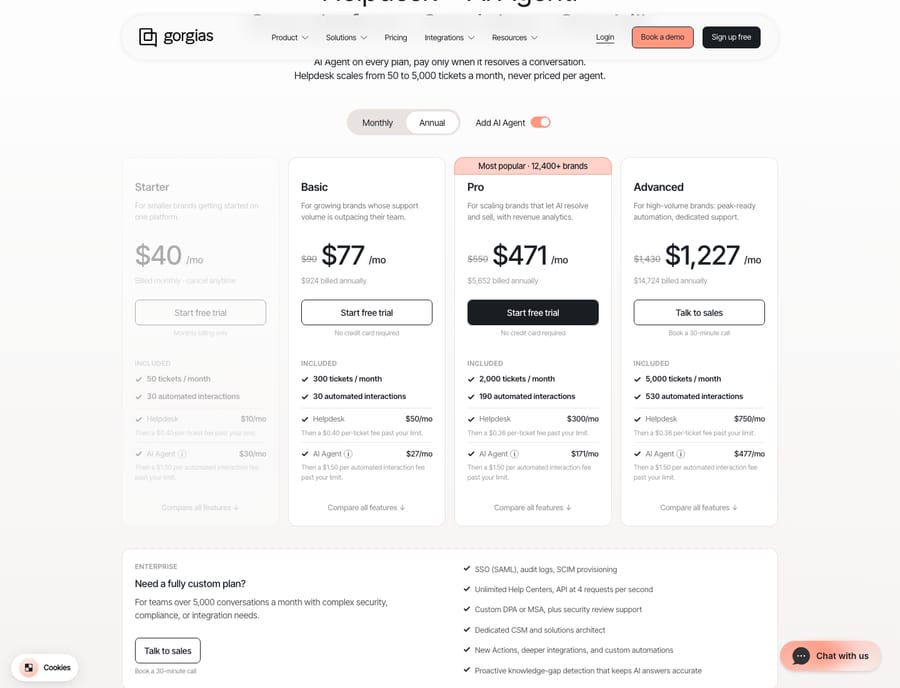
The number many first-time buyers miss is the overlap: per Gorgias's billing docs, an AI Agent interaction also counts as a helpdesk ticket, so a conversation the AI resolves uses both allowances. That's the incentive of a volume-plus-outcome model: the vendor earns on every ticket and again on every automated one. For a fuller breakdown of the tiers and overages, see our Gorgias pricing explained guide.
Here's the arithmetic for a mid-size store with 4 agents and 1,500 tickets a month, billed monthly and before AI. Re:amaze Pro is 4 × $49 = $196 a month. On Gorgias, Basic would be $60 plus 1,200 extra tickets × $0.40 = $540, so the sensible plan is Pro at $360. At the bottom, Gorgias Starter and Re:amaze Basic sit in the same range. As you scale, Re:amaze's cost tracks your headcount while Gorgias's tracks your ticket volume and AI usage. For a lean store, Re:amaze is usually cheaper. For a high-volume brand where Shopify depth pays for itself, Gorgias's cost can be justified, but go in with eyes open.
Which is better for Shopify and other ecommerce platforms?
This is Gorgias's home turf. Gorgias says it powers customer conversations for 40% of Shopify brands, and its Shopify integration lets you view a customer's full order history, edit orders, issue refunds, and create discount codes directly inside the ticket without tab-switching. Its app directory advertises 100+ apps, with featured connectors for Klaviyo, Recharge, Loop Returns, Yotpo, and Attentive. Gorgias also supports BigCommerce, Magento and WooCommerce, though its AI Agent requires a connected Shopify store. If your team lives inside Shopify all day, Gorgias removes the most friction. If you want the primer, our what is Gorgias explainer covers the model.
Re:amaze is deliberately platform-agnostic. It integrates with Shopify, BigCommerce, WooCommerce, and Magento, so a store running on something other than Shopify, or running several storefronts, gets full treatment. Re:amaze's ecommerce tooling is solid; it's just broader and shallower than Gorgias's Shopify-specific depth. The tradeoff is clear: Gorgias goes deep on one platform, Re:amaze goes wide across several.
How do their AI agents and automation compare?
Both platforms have shipped AI agents that answer and resolve tickets, and both layer rules-based automation underneath.
Gorgias's automation engine (Rules and Flows) is mature, and its AI Agent, now available on every plan, can resolve conversations end to end. The catch is that it's paid per automated interaction on top of the ticket fee, as noted above. It pays back best for stores with repetitive, high-volume queries. Our Gorgias AI Agent explained piece digs into how the resolver actually behaves.
Re:amaze bundles its Re:amaze AI Agent, workflow automation, chatbots (including an order bot), response templates, and customer intent detection, with 5 to 20 AI resolutions per user a month included depending on plan. It's a capable, well-integrated automation stack and arguably better value for a smaller store, though most reviewers still give Gorgias the edge on the sophistication of its autonomous resolution and the breadth of its rules engine.
Both are competent, neither will fully replace a human team, and the automation you actually get depends far more on your macros, help-center content, and how you connect your backend systems than on the vendor's marketing.
Which supports more channels?
Re:amaze covers email, live chat and social media channels on every plan, and adds SMS and voice channels from the Pro plan ($49/user/mo). That's a wide spread for the price, and a real reason multichannel stores pick it.
Gorgias covers the essentials: email, live chat, Facebook, Instagram, TikTok, and WhatsApp, with voice and SMS as usage-based add-ons that scale with call and text volume rather than bundled. For a Shopify store focused on the big channels, that's fine; if you want voice and SMS in the plan price, Re:amaze Pro is the simpler option.
Which is easier to set up and use?
Both tools review well on usability. Re:amaze reviewers repeatedly praise an intuitive interface and responsive vendor support, though some note the search function could be sharper. Gorgias reviewers (G2, Capterra) give strong marks to its Shopify integration and setup, with recurring complaints about pricing surprises and inconsistent post-launch support.
Onboarding-wise, Gorgias is fast if you're on Shopify; migration tools are good and the ecommerce integration works out of the box. Re:amaze is straightforward for smaller teams and shines when you're wiring up multiple channels or storefronts. Both offer free trials without a credit card, so run your own tickets through each before deciding.
What are the pros and cons of each?
Gorgias pros: Deepest Shopify order management inside the ticket; large ecommerce app ecosystem; mature automation and a capable AI Agent on every plan; strong adoption among scaling DTC brands.
Gorgias cons: Expensive as you scale; AI interactions billed on top of ticket fees, and they count as tickets too; heavily Shopify-centric, with the AI Agent requiring Shopify; reviewers flag inconsistent support.
Re:amaze pros: Affordable, predictable per-user pricing; SMS and voice in the plan from Pro; platform-agnostic across Shopify, BigCommerce, WooCommerce, Magento; consistently praised ease of use and support.
Re:amaze cons: Shopify integration, while good, isn't as deep as Gorgias's; smaller integration library; AI resolver is capable but generally rated a step behind Gorgias's.
Which should you choose?
- Scaling Shopify / Shopify Plus DTC brand, high ticket volume, order edits and refunds central to support? Choose Gorgias. The Shopify depth and app ecosystem justify the cost at scale. Just budget for AI interactions.
- Smaller store, or running BigCommerce / WooCommerce / Magento (or multiple storefronts)? Choose Re:amaze. Predictable per-user pricing and platform-agnostic support fit better.
- Multichannel-first (SMS and voice matter) on a budget? Re:amaze Pro wins on channels included for the money.
- Want the deepest autonomous AI resolver and don't mind paying per interaction? Gorgias has the edge here today.
Still weighing the field beyond these two? Our best Gorgias alternatives roundup puts both in wider context.
Can you add an AI agent layer on top of Gorgias?
Here's the part both comparisons tend to bury: the help desk you choose is where tickets land, not necessarily where they get answered. Gorgias and Re:amaze each ship their own AI, but if you want an AI agent that reasons over your policies, looks up real order and account data, and drafts or sends grounded replies, that layer can sit on top of the platform rather than inside it. The broader category of AI agents for customer service exists for exactly this, and it's worth understanding the build-versus-buy tradeoff before committing.
Macha runs on Zendesk, Freshdesk, Gorgias, Front, HubSpot or Intercom, and on this pairing it connects to Gorgias as a native connector (see the Macha + Gorgias integration). It reaches into your systems through a custom tool that turns a REST API into something the agent can call, so "where's order #4471?" gets answered instead of queued. Macha bills per ticket, one conversation charged once however many messages it takes, never per resolution: one plan from $299 a month for up to 750 tickets, with setup and monitoring by the Macha team included.
FAQ
Is Re:amaze cheaper than Gorgias? Usually, especially for small teams. Re:amaze charges per user ($29, $49 or $69 a month), while Gorgias charges by ticket volume ($10 to $900 a month billed monthly) plus AI Agent interactions. In our 4-agent, 1,500-ticket example, Re:amaze Pro costs $196 a month against $360 for Gorgias Pro. Verify current pricing on each vendor's page.
Which is better for Shopify? Gorgias. Its Shopify integration lets you edit orders, issue refunds, and create discount codes inside the ticket, and its AI Agent is built around a connected Shopify store. Re:amaze supports Shopify well too, but Gorgias goes deeper for Shopify-first stores.
Which supports more channels? Re:amaze includes email, chat and social on every plan and SMS and voice from Pro. Gorgias covers email, chat, Facebook, Instagram, TikTok and WhatsApp, and sells voice and SMS as usage-based add-ons.
Does Gorgias charge extra for AI? Yes. The AI Agent is available on every plan but paid through bundles of automated interactions ($1.50 each past the bundle), and each AI Agent interaction also counts as a helpdesk ticket, a common source of pricing surprises.
Can I add AI to whichever help desk I choose? It depends on the tool. Macha runs on Zendesk, Freshdesk, Gorgias, Front, HubSpot or Intercom, so with this pair it works on top of Gorgias, reading and writing the same tickets while looking up live data and drafting grounded replies. It complements the platform's own AI rather than replacing your help desk.
Ready to add an agent layer on top of your ecommerce help desk? Start a free trial of Macha and connect it in minutes.