Intercom
 Shopify
 Stripe
 Slack
Slack Notion
 Google Workspace
 Confluence

Is Gorgias AI Cheaper Than Zendesk AI? Pricing Compared (2026)


Gorgias charges less per AI resolution than Zendesk, but each Gorgias AI interaction also uses up a billable helpdesk ticket, and Zendesk changed what it bills for on 18 May 2026. At 3,000 tickets a month with half resolved by AI, the two end up within a few hundred dollars of each other.
Key takeaways
- Gorgias AI Agent is cheaper per resolution than Zendesk AI, at $0.90 to $1.00 per interaction against the $1.50 to $2.00 on Zendesk's pricing page.
- Gorgias' pricing FAQ states that each AI Agent interaction also counts as a helpdesk ticket, so one AI resolution can trigger a ticket overage of $0.36 to $0.40.
- Since 18 May 2026, Zendesk bills only verified resolutions, while assisted escalation and contained resolution do not count against the per-seat allowance.
- In a worked month of 3,000 tickets with 1,500 AI resolutions, Gorgias costs about $2,010 to $2,796 and Zendesk Suite Professional about $2,800.
- Gorgias charges $1.50 for each automated interaction past the plan's bundle, which is 190 interactions on Pro, so bundle size drives the real Gorgias AI cost.

Gorgias AI Agent is cheaper per resolution than Zendesk's AI agents ($0.90 to $1.00 per interaction against Zendesk's published $1.50 to $2.00), but every Gorgias AI interaction also counts as a billable helpdesk ticket, so at 3,000 tickets a month with half resolved by AI the two land between about $2,010 and $2,800 each. The gap depends on which Gorgias AI bundle you buy, not on the sticker rate.
| Gorgias AI Agent | Zendesk AI agents | |
|---|---|---|
| Per-resolution rate | $0.90 annual, $1.00 monthly (Gorgias pricing FAQ) | $1.50 committed, $2.00 pay-as-you-go (Zendesk pricing page) |
| Past the included amount | $1.50 per automated interaction | Pay-as-you-go by default; admins can pause the AI instead |
| What's billable | Interactions fully resolved with no human within 72 hours | Verified resolutions only (since 18 May 2026) |
| The catch | Each AI interaction also counts as a helpdesk ticket | Needs a seat plan underneath (Suite Professional $115/agent/month annual) |
| Included allowance | AI bundle per plan: 30, 30, 190 or 530 interactions | $5 per seat per month on Suite Professional, capped at $5,000 a year |
| Best fit | Shopify brands | B2B, B2C, IT, multi-product |
A quick disclosure: Macha (which publishes this) builds an AI agent layer that runs on top of helpdesks like Zendesk and Freshdesk, and we bill on a different model. We mention that once, near the end.
Where do these numbers come from?
We read Gorgias' pricing page and FAQ, Zendesk's pricing page and Zendesk's help articles on 24 September 2026, and cross-checked against independent 2026 breakdowns (eesel, Ringly, myAskAI, Chatarmin, CorePiper). We captured the live pricing pages ourselves (below). Pricing in this category changes often, and Zendesk reworked how AI agents are billed on 18 May 2026, so treat every number here as "verify before you sign."
Update (September 2026): Salesforce completed its acquisition of Fin (the company renamed itself from Intercom on 12 May 2026) on 10 September 2026. Fin keeps selling at $0.99 per outcome. Worth weighing in any long-term Intercom or Fin decision.
How much does each AI agent cost per resolution?
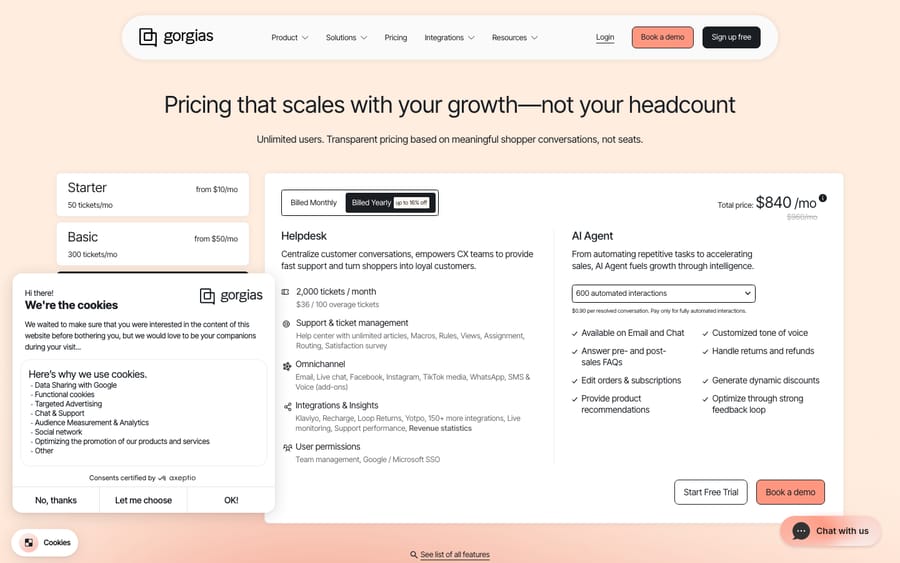
- Gorgias AI Agent: Gorgias' pricing FAQ says AI Agent interactions are $0.90 each on annual plans or $1.00 on monthly plans. Each plan includes a bundle (30 interactions on Starter and Basic, 190 on Pro, 530 on Advanced), and past it each automated interaction costs $1.50.
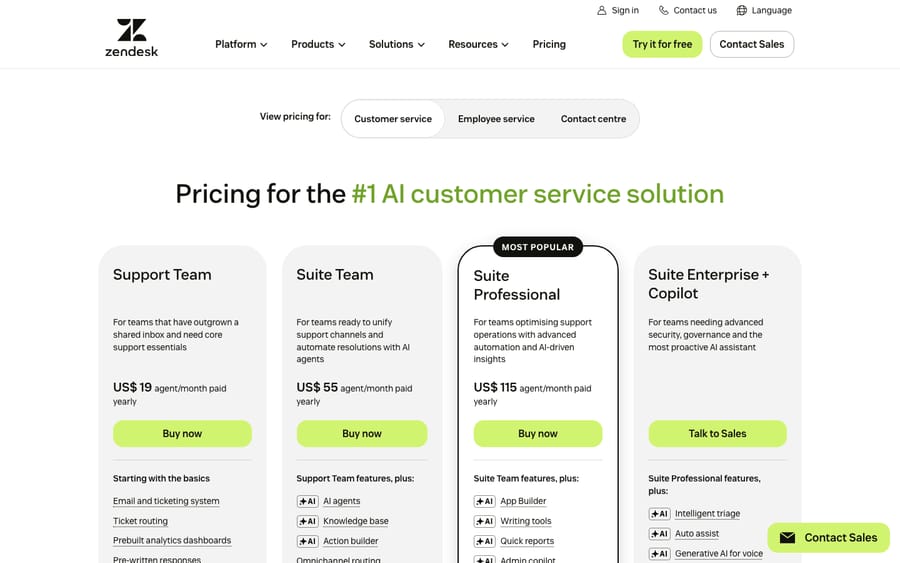
- Zendesk AI agents: Zendesk's pricing page says AI agents are billed per automated resolution and lists the rate: $1.50 per resolution committed and $2.00 pay-as-you-go.
So per resolution, Gorgias looks cheaper: $0.90 to $1.00 against $1.50 to $2.00. That isn't the whole story, for two reasons: the two vendors count resolutions differently, and a Gorgias resolution also costs you a ticket.
A note on the Gorgias $1.00 vs $0.90 rate: Gorgias' pricing FAQ frames it as a billing-cadence split ($1.00 monthly, $0.90 annual), while the plan comparison table on the same page lists a per-interaction rate by plan ($1.00 Starter, $0.90 Basic, $0.90 Pro, $0.85 Advanced). Confirm the exact rate for your plan and billing cadence with Gorgias before you budget.
What counts as a billable resolution on each?
This is where the two diverge, and it matters more than the per-unit price.
Gorgias defines an automated interaction as a request fully resolved without agent involvement, by AI Agent or another automation such as Flows or Order Management. If the shopper still ends up talking to a support agent within 72 hours, Gorgias charges the conversation only as a helpdesk ticket. That definition is fairly conservative (a human escalation cancels the AI charge), but it means the count you see today isn't final for three days.
Zendesk introduced automated resolution tiers on 18 May 2026. Assisted escalation (the AI gathers context, then hands to a human) and contained resolution (the AI keeps the conversation contained but doesn't verify a fix) don't count against your resolution allowance. Only a verified resolution does. That's a buyer-friendly change, because you no longer pay for the AI merely touching a ticket. But "verified" is doing real work in that sentence, so audit how Zendesk attributes it against your own re-contact data. Since the same date, each seat also earns a monthly dollar allowance toward resolutions: $2 on Team, $5 on Growth and Professional, $10 on Enterprise (Suite plans), capped at $5,000 a year, per Zendesk's allowance article.
If you want the full breakdown of how Zendesk's resolutions and add-ons stack up, see our Zendesk AI pricing explained guide.
Why can one Gorgias AI resolution be billed twice?
Gorgias' own pricing FAQ says it directly: "Each AI Agent interaction also counts as a helpdesk ticket and is billed accordingly." Gorgias plans bundle a fixed number of tickets: Starter $10 a month (50 tickets, monthly only), Basic $60 (300), Pro $360 (2,000), Advanced $900 (5,000), with annual pricing at Basic $50, Pro $300 and Advanced $750. Past the ticket quota, each extra ticket costs $0.40 (Starter and Basic) or $0.36 (Pro and Advanced).
So a single AI resolution can hit you twice: once for the $0.90 to $1.00 AI fee, and again because it consumes a ticket from your quota, which triggers a ticket overage if you're over. The more your AI resolves, the faster you burn through the ticket allowance. Gorgias doesn't hide it, but it's two line items for one automated event, and it's easy to miss when you compare $0.90 to Zendesk's $1.50.
Zendesk's model has its own gotcha. By default, once the per-seat allowance is used up, your account is charged pay-as-you-go for further resolutions. Admins can switch the setting to "Don't allow overage," which pauses the AI agent at the limit instead. What Zendesk doesn't do is count one resolution as two billable units.
How do Gorgias and Zendesk AI pricing compare side by side?
| Gorgias AI Agent | Zendesk AI agents | |
|---|---|---|
| Per-resolution rate | $0.90 (annual), $1.00 (monthly) | $1.50 committed, $2.00 PAYG |
| Overage rate | $1.50 per interaction past the bundle | Pay-as-you-go past the allowance, unless overage is switched off |
| What's billable | Only AI-only resolutions (no human within 72 hours) | Only verified resolutions; assisted escalation and contained resolution don't count (since 18 May 2026) |
| The catch | AI interaction also consumes a helpdesk ticket, so double-count plus ticket overage | Requires a Suite seat plan underneath |
| Base platform | $10 to $900 a month plan tiers (ticket-quota based) | Suite Team $55, Suite Professional $115 per agent/month (annual) |
| Best-fit segment | Ecommerce and Shopify brands | Broad B2B/B2C, IT, multi-product orgs |
| Recent change | AI Agent sold as per-plan bundles of interactions | Resolution tiers and per-seat dollar allowance, 18 May 2026 |
Rates read on 24 September 2026; confirm on each vendor's pricing page before budgeting.
What does the same month cost on each?
Let's run an identical month through both. Assume a mid-size Shopify brand:
- 3,000 support tickets a month.
- The AI resolves 50% on its own, so 1,500 automated resolutions; the other 1,500 go to humans.
- 5 support agents.
Gorgias path (annual Pro plan):
- Pro plan: $300 a month, includes 2,000 tickets.
- Ticket count: all 3,000 tickets (the 1,500 AI resolutions plus the 1,500 human ones) count toward quota. 3,000 − 2,000 included = 1,000 ticket overage × $0.36 = $360.
- AI fees, if Gorgias sells you a bundle sized to 1,500 at the FAQ's $0.90 rate: 1,500 × $0.90 = $1,350. Total ≈ $300 + $360 + $1,350 = about $2,010 a month.
- AI fees, if you stay on Pro's published annual bundle ($171 for 190 interactions) and pay $1.50 for the rest: $171 + 1,310 × $1.50 = $2,136. Total ≈ $300 + $360 + $2,136 = about $2,796 a month.
Note what the double-count did: the 1,500 AI resolutions are why you blew past the 2,000-ticket quota, adding $360 that a naive "$0.90 × 1,500" estimate misses. The bigger swing is the bundle. Pricing larger AI bundles is a conversation with Gorgias, so pin that number down for your tier before you commit.
Zendesk path (Suite Professional, $1.50 per resolution committed):
- Seats: 5 agents × $115 = $575 a month (annual billing).
- Allowance: 5 seats × $5 = $25 a month toward resolutions.
- Resolution fees, assuming all 1,500 are verified resolutions: 1,500 × $1.50 = $2,250, minus the $25 allowance = $2,225.
- Total ≈ $575 + $2,225 = about $2,800 a month. At the $2.00 pay-as-you-go rate it would be about $3,550.
At this volume the two land closer than the headline rates suggest: about $2,010 to $2,796 on Gorgias against about $2,800 on Zendesk. Gorgias' ticket overage eats into its advantage, and Zendesk's free assisted and contained outcomes trim its total if some of your 1,500 don't verify. Flip the assumptions and the winner can flip: at a higher AI resolution rate, Gorgias' ticket double-count bites harder; with many seats and modest resolution volume, Zendesk's seat cost dominates. Run your own numbers. For the broader landscape of how these models behave, see our guide to AI agent pricing models.
What do users say about the cost?
The worked example is our model; here's what customers report after the invoices land. Both products are well rated overall, and the cost complaints line up with the two mechanics above.
Gorgias held roughly 4.6/5 on G2 and 4.7/5 on Capterra in mid-2026 readings. The cost gripes cluster on the per-resolution-plus-ticket math. One G2 reviewer put it bluntly: "It's a bit too expensive." (G2, 2026). More pointed: a Shopify App Store reviewer on the Advanced plan (roughly $13,500 a year, three years in) reported being charged about "$14,000 on TOP" in AI Agent fees after switching the AI on, saying nothing flagged the cost until the invoice arrived (Shopify App Store, 2026). That's the double-count and bundle overage compounding at high volume.
Zendesk sat at about 4.3/5 on G2 (6,800-plus reviews) in mid-2026. The recurring cost complaint is renewal and overage bill shock, and paying per AI response regardless of value. One reviewer, quoted across review aggregations, called the automated-resolution billing "a rip off… You can't even export the data on what people ask the bot," adding "we stopped using it because ARs are a rip off" (G2/Capterra, 2026).
A caveat on sourcing: G2 and Capterra reviewer identities are usually anonymized (and the pages block automated fetching), so we attribute these by platform, rough role or plan, and year, not by name. We quote them as published. Treat the dollar figures as individual reports, not averages.
Which one fits an ecommerce brand better?
Price isn't the only axis. Gorgias is built for ecommerce: it's Shopify-native (its AI Agent requires a connected Shopify store), with order, refund and subscription context built in, and its AI Agent can run commerce actions (track an order, process a return) without custom plumbing. For a DTC or Shopify brand, that fit can be worth more than a per-resolution rate, because the AI resolves more of your tickets out of the box.
Zendesk is the generalist: broader, more configurable, stronger for B2B, IT, multi-product orgs and complex routing, with a far larger app ecosystem. Its AI agent is less ecommerce-specialized but more flexible across industries. We compare the two platforms beyond AI pricing in Zendesk vs Gorgias.
The honest read: if your tickets are "where's my order / I want a refund" and you're on Shopify, Gorgias' domain fit likely lifts your resolution rate enough to matter more than the sticker price. If your support is varied, technical or B2B, Zendesk's breadth usually wins regardless of the per-unit number.
Who should choose which?
- Choose Gorgias if: you're a Shopify brand, your ticket mix is commerce-heavy, and you want the lowest per-resolution rate, as long as you model the ticket double-count and the bundle size into your real cost per resolution.
- Choose Zendesk if: you need breadth (B2B, IT, multi-channel, complex workflows), you value the May 2026 change that stops assisted and contained outcomes from counting, and you can carry seat costs underneath.
- Either way: get each vendor's exact resolution definition in writing, and audit it against your CSAT and re-contact data. The unit you're billed on is only as honest as its definition.
Is there a pricing model that avoids the resolution debate?
Both Gorgias and Zendesk tie your bill to a resolution, an outcome whose definition the vendor controls. The alternative is billing per ticket: one conversation between the agent and one person, charged once however many messages, lookups or drafts it takes. That's the model Macha uses. Macha is an AI agent layer that runs on top of the helpdesk you already have (Gorgias and Zendesk among six supported) rather than replacing it, so it's not a like-for-like swap for either tool here.
The trade-off: a per-ticket model prices the unit your helpdesk already counts and sidesteps "what counts as a resolution?" entirely. One thread is one charge whether the agent settles it in one reply or fifteen. Per-resolution gives you a tidier "pay only when it works" story, but only if you accept the vendor's definition of works. They suit different buyers. If you already run Gorgias or Zendesk and want to add AI without changing helpdesks, you can start with $50 of free usage, no credit card, and watch your own ticket counts before deciding. Macha's pricing starts at $299 a month for 750 tickets, about $0.40 each, with setup and monitoring by the Macha team included.
Frequently asked questions
Is Gorgias AI cheaper than Zendesk AI? Per resolution, yes: $0.90 to $1.00 on Gorgias against the $1.50 to $2.00 on Zendesk's pricing page. But each Gorgias AI interaction also consumes a helpdesk ticket from your plan quota, and interactions past the plan's bundle cost $1.50. At 3,000 tickets with 1,500 AI resolutions, our example lands at about $2,010 to $2,796 on Gorgias and about $2,800 on Zendesk.
What is the Gorgias double-billing issue? When Gorgias' AI Agent resolves a ticket, you pay the per-interaction fee and the interaction counts against your plan's ticket quota, as Gorgias' pricing FAQ states. If that pushes you over quota, you also pay a ticket overage of $0.36 to $0.40. One automated event can generate two charges.
How does Zendesk define an automated resolution in 2026? Since 18 May 2026, Zendesk sorts AI outcomes into three tiers. Assisted escalation and contained resolution don't count against your allowance; only a verified resolution does. Each seat earns a monthly allowance ($2, $5 or $10 by plan, capped at $5,000 a year), and past it you pay pay-as-you-go unless you switch overage off.
Does Gorgias charge for resolutions a human helped with? Not as an AI interaction. If the shopper talks to a support agent within 72 hours of the automated resolution, Gorgias charges the conversation only as a helpdesk ticket. That also means AI counts (and bills) settle three days after the fact.
Which is better for a Shopify store? Gorgias is Shopify-native, and its AI Agent requires a connected Shopify store, with commerce context that often lifts its AI resolution rate on order, refund and subscription tickets. For DTC brands that's frequently worth more than the per-resolution price. Zendesk is the broader generalist, stronger for B2B, IT and complex multi-product support.
So which should you pick?
Gorgias wins on the headline per-resolution rate ($0.90 to $1.00 against $1.50 to $2.00) and on ecommerce fit, but each AI interaction also counts as a billable ticket and interactions past the bundle cost $1.50, which can erase the gap at real volume. Zendesk costs more per resolution and carries seat costs underneath, but since May 2026 only verified resolutions count and admins can cap overage by pausing the AI. The right pick comes down to your segment (Shopify-native or generalist) and your traffic shape, not the sticker rate. Get each vendor's resolution definition in writing, run your own volume through both, and check current rates on their pricing pages.
Rates read on 24 September 2026 from each vendor's pricing page and help articles; Zendesk's per-resolution rates were rechecked on its pricing page on 25 September 2026. Next review by December 2026.
Add AI agents to your Zendesk
Macha reads the ticket, drafts the reply and takes the action, inside the Zendesk you already run.