Shopify
 Stripe
 Slack
Slack Notion
 Google Workspace
 Confluence

Gorgias vs Zoho Desk (2026): Which Help Desk Fits Your Store?


Gorgias is the ecommerce help desk that puts Shopify orders and refunds inside the ticket and bills by ticket volume, while Zoho Desk is a cheaper per-user help desk for any industry. Pick Gorgias for store support and Zoho Desk for price, telephony or a Zoho-based stack.
Key takeaways
- Gorgias suits Shopify, WooCommerce and BigCommerce stores that want order actions inside the ticket, while Zoho Desk suits budget-conscious teams and companies already running Zoho apps.
- Gorgias charges by ticket volume, never per agent: the helpdesk costs $10 a month for 50 tickets up to $750 for 5,000 on annual billing, with overage at $0.40 or $0.36 a ticket.
- Gorgias' AI Agent bundles price automated interactions at $0.85 to $1.00 each, then $1.50 past the bundle, and each interaction also counts as a helpdesk ticket.
- Zoho Desk is free for 3 users, then Express $7, Standard $14, Professional $23 and Enterprise $40 per user a month billed annually, or $9 to $50 billed monthly.
- Zoho Desk includes built-in telephony from the Professional plan, while Gorgias sells Voice and SMS as paid add-ons priced by call and text volume.

Choose Gorgias if you run a Shopify, WooCommerce or BigCommerce store and want order actions inside the ticket; choose Zoho Desk if you want the cheapest per-agent help desk (free for 3 users, then $7 to $40 per user a month billed annually) or already run Zoho apps. Gorgias never prices per agent: it charges by ticket volume, from $10 a month for 50 tickets, plus an AI Agent fee per automated interaction.
How do Gorgias and Zoho Desk compare at a glance?
| Gorgias | Zoho Desk | |
|---|---|---|
| Best for | Ecommerce brands on Shopify, WooCommerce or BigCommerce that live inside orders | Budget-conscious teams and Zoho-suite users across any industry |
| Pricing model | Per ticket volume, never per agent; helpdesk from $10/mo (50 tickets) | Per user; Free for 3 users, Express $7, Standard $14, Professional $23, Enterprise $40 (annual) |
| AI pricing | AI Agent on every plan, $0.85 to $1.00 per automated interaction in a bundle, then $1.50 | Zia features by tier; generative AI uses your own OpenAI key |
| Ecommerce depth | Native: orders, refunds, edits inside the ticket | General-purpose; ecommerce via integrations |
| Channels | Email, chat, social, help center; Voice and SMS as paid add-ons | Email, social, web forms; live chat from Standard, telephony from Professional |
| Standout strength | Shopify context and ecommerce automation | Price, flexibility, and the Zoho ecosystem |
Is Gorgias or Zoho Desk cheaper?
The pricing models are structurally different, and that difference matters more than any single number.
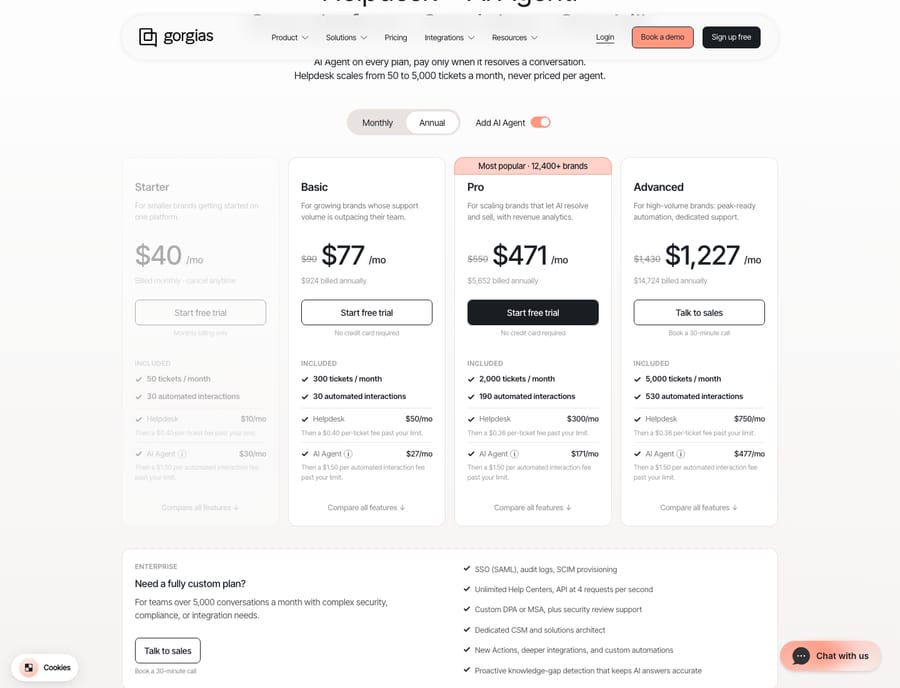
Gorgias prices by ticket volume, not per agent. Gorgias' pricing page (checked 24 September 2026) lists the helpdesk alone at $10/mo for 50 tickets (Starter), $50 for 300 (Basic), $300 for 2,000 (Pro) and $750 for 5,000 (Advanced) billed annually, with overage at $0.40 a ticket on Starter and Basic and $0.36 on Pro and Advanced. Starter is monthly-only, and Basic through Advanced run $60, $360 and $900 billed monthly. Starter includes 3 user seats; the other plans include 500.
The headline prices you'll often see, $40, $77, $471 and $1,227 a month, are the same plans with the AI Agent bundle added (Basic and up billed annually). The bundles hold 30, 30, 190 and 530 automated interactions, priced at $1.00, $0.90, $0.90 and $0.85 each by plan; past the bundle, each automated interaction costs $1.50. Gorgias' pricing FAQ also says each AI Agent interaction counts as a helpdesk ticket, so an AI-resolved conversation pays both fees. The incentive is plain: a ticket-volume model scales with seasonality (you don't pay for idle seats in a quiet month) but spikes during a surge of low-value tickets.
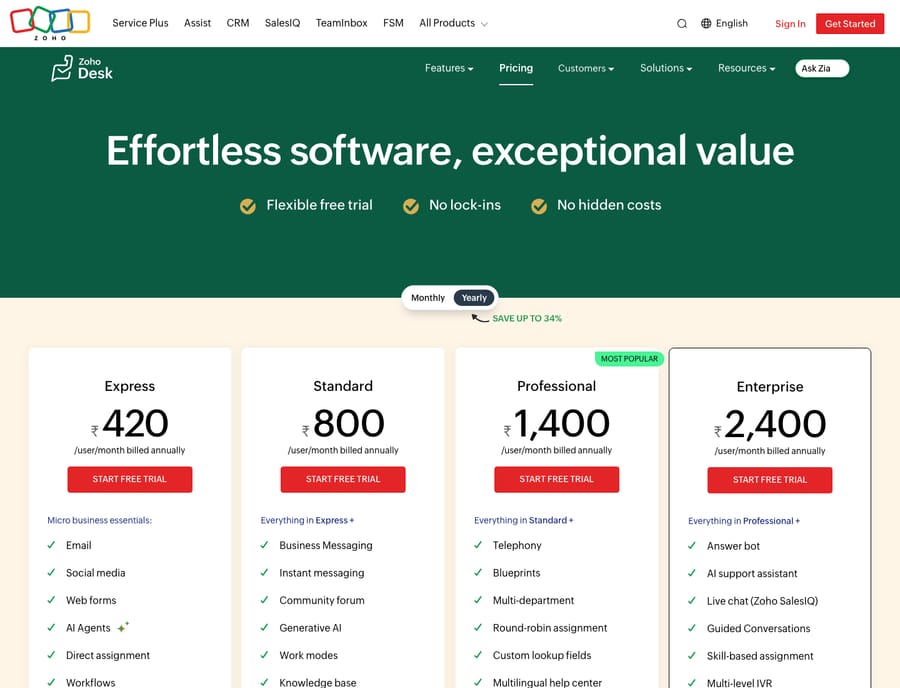
Zoho Desk takes the traditional per-user, per-month route, and it's dramatically cheaper at the entry. The Free plan covers up to 3 users. Per Zoho's own USD price data behind Zoho Desk's pricing page, the paid tiers are Express $7, Standard $14, Professional $23 and Enterprise $40 per user a month billed annually, or $9, $20, $35 and $50 billed monthly. Express is capped at 5 users. There's a 15-day free trial with no card. The screenshot below renders on Zoho's India storefront, so it shows INR (Rs 420 to 2,400 per user a month billed yearly); check the price for your region.
Some arithmetic: a 5-agent store handling 300 tickets a month pays $50 on Gorgias Basic (helpdesk only, annual) or $70 on Zoho Desk Standard ($14 × 5). At 2,000 tickets and 8 agents, Gorgias Pro is $300 before AI, while Zoho Standard is $112. Zoho gets cheaper relative to Gorgias as volume per agent rises; Gorgias wins when a small team handles low volume or when headcount swings. We break the Gorgias side down further in Gorgias pricing explained.
Which is better for a Shopify store?
This is where the two tools separate most clearly, and for a store it may be the deciding factor.
Gorgias was built for ecommerce. Its Shopify integration lets an agent see the full order history, issue a refund, edit an order, and cancel without leaving the ticket. Order status, items, spend and lifetime value sit beside the conversation, so "where's my order?" becomes a one-click answer rather than a tab-hop into the store admin. Gorgias' pricing page lists Shopify, WooCommerce, BigCommerce and Magento integrations, and its automations are shaped around ecommerce intents (WISMO, returns, exchanges, address changes). For the fuller picture of the product, see what is Gorgias.
Zoho Desk is a general-purpose help desk. It's flexible software, but ecommerce depth isn't native: you reach it through integrations (Shopify connectors exist, as do custom setups on Zoho's platform) rather than a purpose-built commerce view. For a store that wants order actions inside the ticket out of the box, that's a real gap. For a business where support spans products, services and internal teams, Zoho Desk's breadth is an asset.
How do their AI features differ?
Both platforms have real AI in 2026; they differ in shape and in how you pay for it.
Gorgias' AI Agent is included on every plan and trained on ecommerce workflows. It resolves routine requests (order tracking, shipping updates, cancellations, returns) around the clock, and its pricing page lists actions like cancel, discount and apply. Rules and Macros handle repetitive tickets. The trade-off is the billing described above: bundles of automated interactions, $1.50 each past the bundle, and each one also counted as a ticket. There's more on how the autonomous piece behaves in the Gorgias AI Agent explained.
Zoho Desk brings Zia, spread across tiers: Answer Bot and sentiment analysis from Standard, field predictions and anomaly alerts from Professional, and prebuilt Desk AI agents with Zia Actions on Enterprise, per Zoho's plan comparison. Generative AI features run on your own OpenAI key. Because Zia sits in a larger suite, its automations and blueprints can reach into Zoho CRM, Books and the rest of the stack. It's broad, but it won't natively reason about a Shopify order the way a commerce-native agent does.
Whichever you lean toward, it helps to understand the wider category first; our primer on AI agents for customer service covers what these systems can and can't do.
Which channels does each support?
Gorgias' comparison table lists email, chat, social and a help center on every plan, with Voice and SMS as paid add-ons priced by call and text volume. Its channel strength is depth on the channels DTC shoppers actually use.
Zoho Desk covers email, social and web forms from Express, live chat and IM apps from Standard, telephony from Professional, and SalesIQ and IVR on Enterprise. Built-in phone support is a real differentiator if voice matters to you, though you need Professional ($23 annual) to get it. For a business that runs a call center alongside tickets, Zoho Desk's telephony is hard to beat at the price.
Which is easier to set up?
Gorgias is quick to stand up for a Shopify store: connect the store, import macros, and the ecommerce context appears with little configuration. Reviewers most often praise ease of use and the Shopify integration; the common complaint is that the Rules builder gets complicated once you're running many automations.
Zoho Desk is highly configurable, which cuts both ways: more setup up front, a lot of control, and familiar territory if you already live in Zoho. Its review base is large and broad, reflecting its general-purpose reach. If you're weighing the wider field, our best Gorgias alternatives roundup and Gorgias review add context.
What are the pros and cons of each?
Gorgias pros: Shopify, WooCommerce and BigCommerce depth; order actions inside the ticket; ecommerce-trained AI Agent on every plan; ticket-volume billing that never charges per agent; strong automation for DTC intents. Gorgias cons: expensive at higher tiers and during volume spikes; AI interactions billed per interaction and as a ticket; Voice and SMS cost extra; only 3 seats on Starter; Rules builder complexity at scale.
Zoho Desk pros: low prices, including a free 3-user plan; flexible across any industry; built-in telephony from Professional; deep integration with the wider Zoho suite; Zia AI and blueprints; predictable per-user pricing. Zoho Desk cons: no native ecommerce view, so commerce depth comes via integrations; less order-centric out of the box; more configuration; phone and the stronger AI features sit on upper tiers.
Which should you choose?
- You're a Shopify (or BigCommerce, WooCommerce) DTC brand and want orders, refunds and LTV inside the ticket: choose Gorgias. The ecommerce depth pays for itself in handle time.
- You're a budget-conscious or early-stage team, or you run support across products and services beyond a single store: choose Zoho Desk, and start on Free or Express.
- You already live in the Zoho ecosystem (CRM, Books, Projects): Zoho Desk is the low-friction pick.
- Voice is central to your support: Zoho Desk Professional for built-in telephony; Gorgias sells Voice as an add-on.
- Your ticket volume swings hard with campaigns and seasons: Gorgias' ticket-volume model can be fairer than paying for idle seats.
For a wider field of options beyond these two, see the best Gorgias alternatives.
Can you add an AI agent layer on top of either?
On Gorgias, yes. Macha runs an AI agent layer on top of your existing help desk rather than replacing it, and it has a native Gorgias integration. It reads and writes the same tickets, resolves or drafts grounded replies, and looks up live order or account data through a custom tool. Macha runs on Zendesk, Freshdesk, Gorgias, Front, HubSpot or Intercom; it doesn't connect to Zoho Desk, so a Zoho team would lean on Zia instead. Macha bills per ticket, one conversation charged once however many messages it takes, from $299 a month for up to 750 tickets, with setup and monitoring by the Macha team included.
FAQ
Is Gorgias or Zoho Desk cheaper? Zoho Desk is cheaper for most teams: a Free plan for 3 users and paid plans from $7 to $40 per user a month billed annually. Gorgias charges by ticket volume, from $10 a month for 50 tickets (helpdesk only) to $750 for 5,000 on annual billing, plus AI Agent fees, so total cost depends on traffic rather than headcount.
Which is better for a Shopify store? Gorgias, in most cases. Its native Shopify integration surfaces order history and lets agents refund, edit and cancel inside the ticket, depth Zoho Desk doesn't offer natively. Zoho Desk can connect to Shopify via integrations but isn't purpose-built for commerce.
Does Zoho Desk have AI like Gorgias? Yes. Zoho Desk includes Zia: Answer Bot and sentiment from Standard, predictions and anomaly alerts from Professional, and AI agents on Enterprise. Gorgias' AI Agent is more ecommerce-specialized and included on every plan, billed per automated interaction at $0.85 to $1.00 in a bundle and $1.50 beyond it.
What about phone support? Zoho Desk has built-in telephony from the Professional plan and is the stronger pick if voice is central. Gorgias offers Voice and SMS as paid add-ons on any plan, priced by call and text volume.
Can I add AI to either without switching help desks? On Gorgias, yes: Macha connects natively and resolves or drafts grounded replies inside your existing tickets while Gorgias stays the system of record. Macha doesn't connect to Zoho Desk, so Zoho teams should look at Zia or a Zoho-compatible tool.
Running Gorgias and want an AI agent layer on top? Start a free trial of Macha with $50 of usage and no credit card.