Intercom
 Shopify
 Stripe
 Slack
Slack Notion
 Google Workspace
 Confluence

Guru: The Complete Guide (2026)


Guru is a knowledge management platform, now positioned as "the governed knowledge layer for enterprise AI," that structures a company's scattered documents, verifies them against real usage, and feeds permission-aware, cited answers to both employees and AI tools like Claude and Slack bots. Guru has quietly moved its pricing model: independent reviews still describe published Starter, Builder and Expert tiers, but Guru's own pricing page today says it's "not a per-seat tool" and fully custom instead. This guide covers what Guru actually does, how its verification loop works, what's changed about its pricing and positioning, and how it compares to Glean and Shelf.

We build AI agents for customer service ourselves, and Guru's problem is the layer underneath ours: making sure the knowledge an agent reads from is accurate and current.
What is Guru?
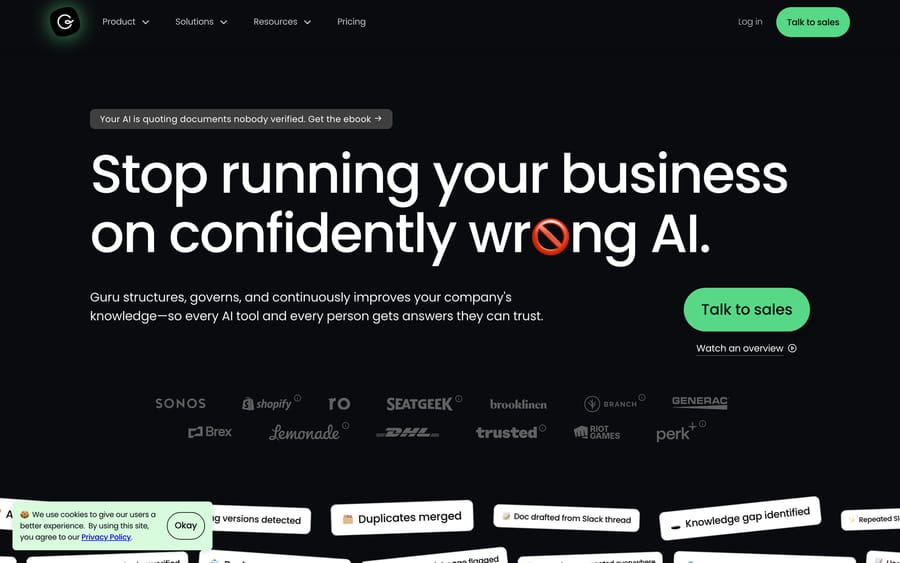
Guru was founded in 2013 and is based in Philadelphia, with 51-200 employees according to its own LinkedIn page. It raised a $2.7 million seed round in September 2015 and a $25 million Series B in December 2018, both reported directly by TechCrunch. We checked TechCrunch's Guru tag page for anything newer and found nothing, so 2018 is the last funding event we could verify.
The company's current pitch centers on a specific, checkable claim: half of all AI responses contain inaccuracies when the underlying knowledge isn't verified, a stat Guru links to its own research instead of stating without a source. Its argument is that verification, tracking which documents are current, flagging conflicts, routing stale content for expert review, has to happen before an AI system can be trusted with that knowledge.
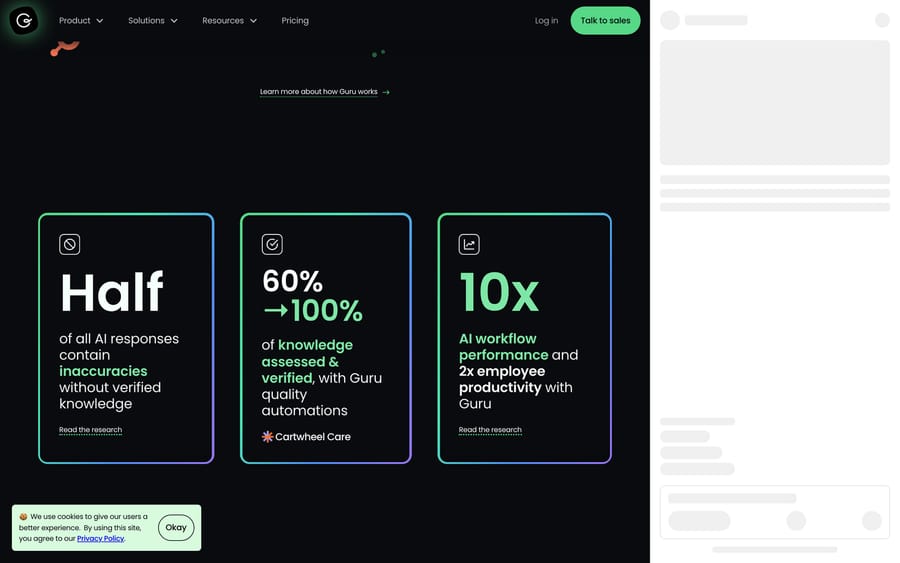
Customers named with individually attributed results include Steno (cut support volume in half with a Knowledge Agent built in days), HireVue (cut support onboarding time by 60%), Paraco Gas (reduced call handle time by 8%) and Cartwheel Care (took knowledge verification from 60% to 100%). Broader named accounts include Shopify, SeatGeek, Lemonade, TravelPerk and Spotify.
How Guru's AI actually works
Guru's platform runs on a loop of four connected steps.
Structure takes scattered documents and organizes them into discrete, addressable cards instead of leaving knowledge buried in long documents nobody fully reads. Govern applies permissions so an answer respects who's actually allowed to see it, then attaches citations so a person or an AI system can trace an answer back to its source. Verify is the mechanism that separates Guru from a static wiki: as content gets used, Guru flags duplicates, conflicts and gaps, and routes anything stale to an expert for re-approval instead of letting it sit indefinitely. Deliver surfaces the verified answer everywhere it's needed: Slack, Teams, a browser extension, or directly inside an AI tool like Claude through MCP.
That verification step is the actual product. A knowledge base that's merely searchable doesn't tell an AI system whether a given document is still true; Guru's verification loop is built specifically to answer that question before the content ever reaches a model.
Key features
- Knowledge cards structured for quick answers instead of long-form documents nobody finishes reading.
- Verification workflows that flag stale, duplicate or conflicting content and route it for expert review.
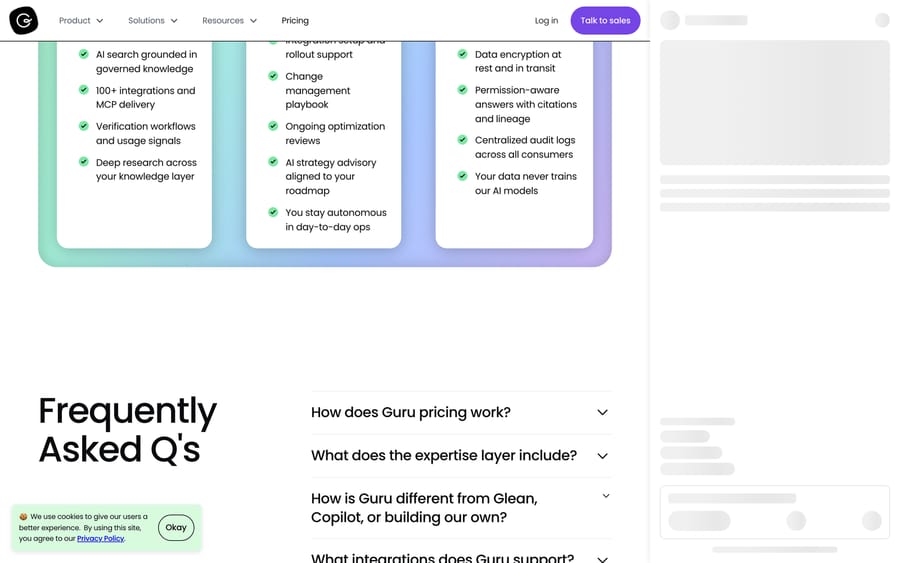
- 100+ integrations and MCP delivery, surfacing verified answers inside Slack, Teams, browsers and AI tools directly.
- Permission-aware answers with citations and lineage, so an AI response can be traced back to its source document.
- Centralized audit logs across every place Guru's knowledge gets consumed.
- Data handling guarantee: Guru states customer data never trains its AI models.
Pricing
Guru's own pricing page has changed its story. As of this research pass, /pricing describes Guru as "the enterprise AI knowledge solution custom fit to you," explicitly saying it is "not a per-seat tool" and that cost depends on "your organization's scale, knowledge complexity, and AI maturity." That's a meaningfully different pitch from Bloomfire's independent review of Guru, checked the same day, which still describes a Starter, Builder and Expert tier structure aimed at small and mid-size teams.
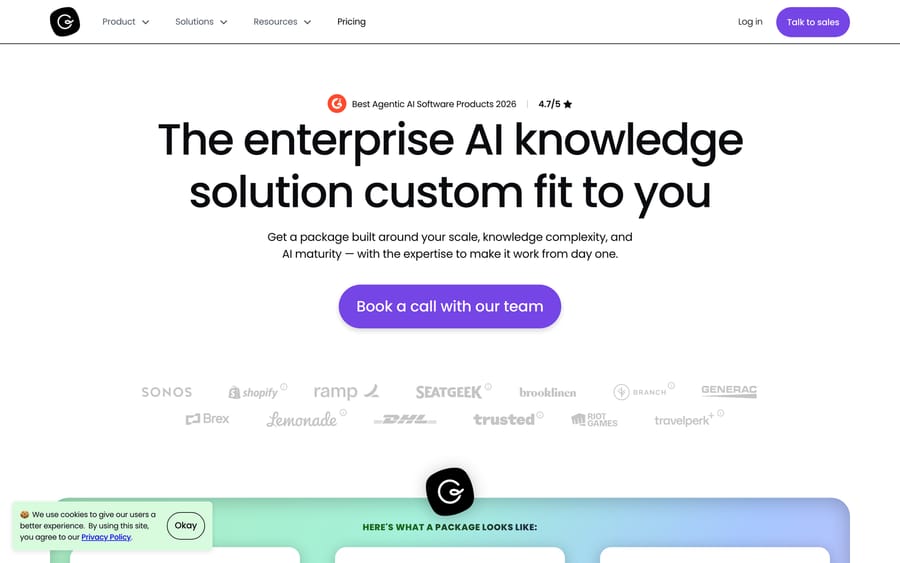
Read together, this looks like Guru repositioning upmarket: from a self-serve SMB knowledge tool with published tiers toward a custom-quoted enterprise platform sold with "a dedicated team of solution engineers" included. The incentive is straightforward for a company chasing bigger logos like Shopify and Spotify: a custom quote captures more from an enterprise deal than a fixed public tier ever could, and it stops competitors from anchoring a comparison against Guru's old public numbers.
What users say
Guru holds a 4.8 out of 5 average on GetApp from 640 reviews, a genuinely large sample, checked 2026-09-18. Alyssa V., a Business Travel Consultant, said it "helps us get more information regarding the processes in order to deliver high quality service to our clients." On the downside, Anh L., a Head of Martech, flagged timezone friction getting support from Guru's team, and Ricardo V., a Client Adviser, said "the search engine is a little crazy, sometimes you can't find the exact document your searching for."
Guru's own pricing page separately displays a 4.7/5 G2 badge tied to a "Best Agentic AI Software Products 2026" award. G2's own review page returned a 403 when we tried to check the underlying review count directly, so we can confirm the badge exists on Guru's site but not independently verify G2's number behind it. PeerSpot has not yet collected any reviews for Guru.
The pattern across both sources: strong overall satisfaction, with search precision and support responsiveness as the two recurring complaints.
Pros and cons
Pros
- A large, genuine review sample: 640 reviews on GetApp at a strong 4.8 average.
- Verification workflows solve a real problem: most knowledge bases have no mechanism for catching stale content before it gets cited.
- Individually attributed customer results (Steno, HireVue, Paraco Gas) with specific, checkable numbers.
- MCP delivery means Guru's verified knowledge can feed an AI tool like Claude directly, not just a search bar.
Cons
- Pricing has become opaque: independent reviews still describe published tiers that are absent from Guru's current site.
- Search precision is a recurring complaint in real reviews ("a little crazy," per one client adviser), despite the verification layer.
- G2's specific review count behind the 4.7 badge couldn't be independently confirmed; the page blocked our fetch.
- Support responsiveness across time zones came up unprompted in an independent review.
Who Guru is best for
Guru fits teams that already have real knowledge sprawl, support, sales or success content scattered across docs and Slack threads, and need a system that actively flags what's gone stale instead of trusting whoever wrote it originally. The repositioning toward custom enterprise pricing suggests Guru increasingly wants larger accounts with real AI-maturity requirements.
It's a weaker fit for a small team that wants to see a price before booking a call, since Guru's current site pushes every visitor toward a sales conversation. A team in that position might get further, faster with a self-serve alternative.
Guru vs alternatives
| Guru | Glean | Shelf | Macha | |
|---|---|---|---|---|
| Model | Governed knowledge layer: structure, verify and deliver company knowledge | Enterprise search, AI assistant and agent builder over a company-wide graph | Cortex knowledge layer for customer-service and contact-center content specifically | AI agent layer on your existing help desk |
| Scope | Company-wide knowledge, any department | Company-wide search across every internal tool | Customer service and contact-center knowledge | Customer support, inside Zendesk, Freshdesk, Gorgias or Front |
| Pricing | Custom, per Guru's current site; independent reviews still cite older published tiers | Not published; estimated $25-48/seat/month depending on size (third-party) | Not published; no third-party contract data found | From $299/month for 750 tickets (about $0.40 per ticket), published |
| Reviews | 4.8/5 from 640 reviews (GetApp); 4.7 G2 badge shown on-site | No PeerSpot listing; G2 blocked | 4.7/141 vendor-cited; no PeerSpot reviews | N/A |
| Best for | Teams with real knowledge sprawl needing active verification | Company-wide search across every department | Large contact centers with legacy documentation | Teams wanting agents to act inside tickets, not just find answers |
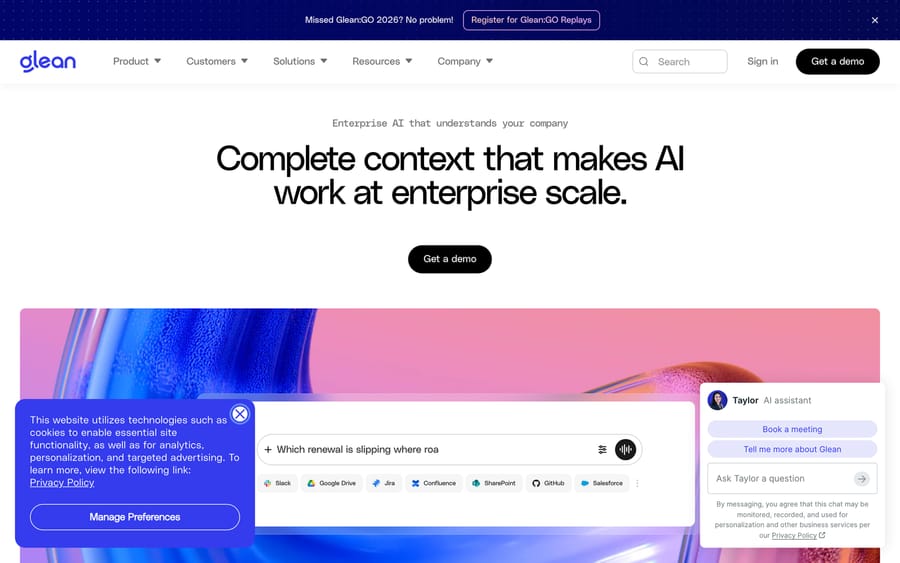
Guru's own pricing FAQ names Glean directly as a comparison point, which says something about how Guru sees its own competitive set. The practical difference: Glean indexes everything a company owns for every department, while Guru's governance and verification loop is narrower and more deliberately curated.
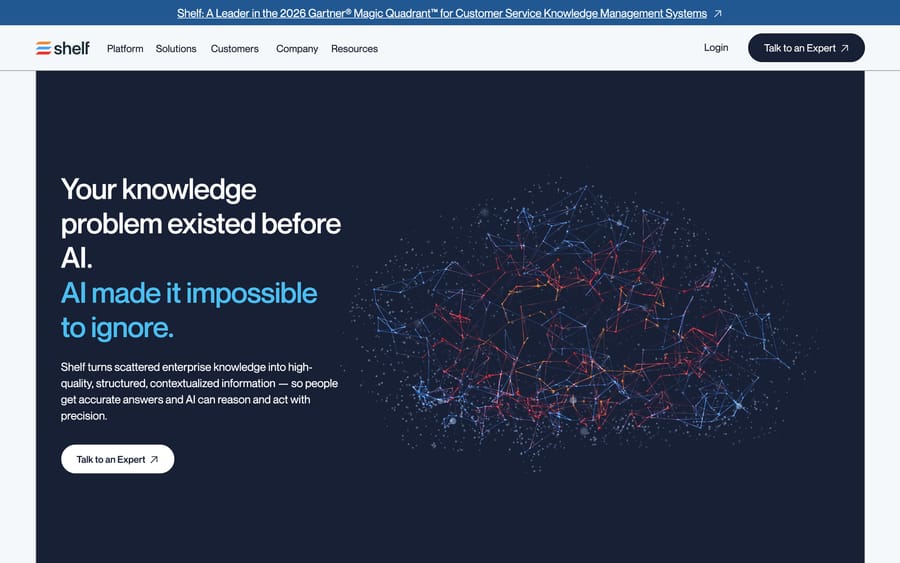
Shelf is the closer comparison on subject matter: both frame themselves around governed, verified knowledge for AI, and both have moved toward enterprise, sales-led pricing rather than a self-serve checkout. Shelf leans harder into customer-service and contact-center use cases specifically; Guru's customer base (Shopify, SeatGeek, Spotify) looks more cross-functional.
None of the three resolves a support ticket; all three make the knowledge underneath one more trustworthy. Macha sits on the resolution side: an AI agent layer that drafts and resolves tickets inside Zendesk, Freshdesk, Gorgias, Front, HubSpot or Intercom, priced $299/month for 750 tickets (about $0.40 per ticket). A support team running Macha still benefits from a verification layer like Guru's underneath it.
FAQ
How much does Guru cost? Guru's current pricing page describes a fully custom model based on organization scale and knowledge complexity, explicitly not per-seat. Independent third-party reviews checked the same day still describe a Starter/Builder/Expert tier structure, so the two sources currently disagree, worth asking Guru's sales team to clarify directly.
Is Guru good, based on real reviews? Yes, with real evidence behind it: a 4.8/5 average from 640 reviews on GetApp, plus a 4.7 G2 badge shown on Guru's own site. Recurring complaints center on search precision and support response times across time zones.
What's the difference between Guru and Glean? Guru's own pricing FAQ raises this comparison directly. Glean indexes a company's entire tool stack for every department; Guru is a narrower, verification-focused knowledge layer, historically more self-serve before its recent shift toward custom enterprise pricing.
Has Guru's funding changed recently? The most recent round we could verify is a $25 million Series B from December 2018, reported by TechCrunch. We found no newer funding announcement.
Does Guru work with AI tools like Claude? Yes. Guru delivers verified, permission-aware answers through MCP, meaning an AI tool like Claude can pull from Guru's governed knowledge layer directly rather than an ungoverned document dump.
Who is Guru best for? A team with real, scattered knowledge across support, sales or success content that needs active verification, flagging what's stale or conflicting, rather than a static wiki nobody maintains.
Check current Macha pricing if the actual need is agents drafting and resolving tickets rather than governing the knowledge behind them, or start a trial to see AI agents working inside a real help desk.
Sources:
- Guru homepage
- Guru pricing
- Guru customers
- What Is Guru? A Comprehensive Guide, Bloomfire
- "Guru, With $2.7 Million In Funding, Simplifies Internal Knowledge Sharing," TechCrunch, Sept 1, 2015 (techcrunch.com)
- "AI-powered knowledge-sharing platform Guru raises $25 million Series B," TechCrunch, Dec 12, 2018 (techcrunch.com)
- Guru on GetApp (getapp.com, collaboration-software/a/guru/reviews) — blocks automated fetches, checked by hand 2026-09-18
- Glean
- Shelf
Resolve tickets automatically with AI agents
Macha's AI agents work on top of the help desk you already use — no code.