Intercom
 Shopify
 Stripe
 Slack
Slack Notion
 Google Workspace
 Confluence

Intercom Fin vs HubSpot Breeze: Which AI Agent Costs Less in 2026?


Intercom Fin charges $0.99 per outcome and HubSpot Breeze Customer Agent charges $0.50 per resolved conversation, but the two meter different units and Breeze needs a paid HubSpot Professional or Enterprise plan underneath it. Which one costs less depends mostly on whether you already pay for HubSpot.
Key takeaways
- Intercom Fin charges $0.99 per outcome with no platform fee on non-Intercom help desks, while HubSpot Breeze Customer Agent charges $0.50 per resolved conversation on a paid HubSpot plan.
- At 5,000 conversations a month and a 65% resolution rate, Intercom Fin costs about $3,218 and HubSpot Breeze about $2,045 including five Service Hub Professional seats.
- HubSpot Breeze counts a conversation resolved only if no human handoff happens within 72 hours, while Intercom Fin also bills procedure handoffs and self-serve routing as outcomes.
- HubSpot Service Hub Professional costs $90 a seat a month billed annually and includes 3,000 credits, enough for 60 Breeze resolutions at 50 credits each.
- Intercom Fin keeps its $0.99 rate after Salesforce completed its acquisition on September 10, 2026, and still applies a 50-outcome monthly minimum on non-Intercom help desks.
Intercom Fin costs $0.99 per outcome and HubSpot Breeze Customer Agent costs $0.50 per resolved conversation, but Breeze only runs on a paid HubSpot Professional or Enterprise subscription (Service Hub Professional is $90 a seat a month billed annually), while Fin charges no platform fee on a non-Intercom help desk (fin.ai/pricing, hubspot.com/pricing/service, both checked 24 September 2026). At 5,000 conversations a month, that works out to about $3,218 for Fin and about $2,045 for Breeze with five Service Hub seats, so the cheaper option depends mostly on whether you already pay for HubSpot.
| Intercom Fin | HubSpot Breeze Customer Agent | |
|---|---|---|
| Headline rate | $0.99 per outcome | $0.50 per resolved conversation (50 credits) |
| Billable unit | Resolution, procedure handoff, disqualification or self-serve routing | Resolved conversation (no human handoff within 72h) |
| Handoff to human | Counts as a billable outcome | Does not count (within 72h window) |
| "Success" assumption | No further help requested after Fin's last answer | Content shared / action taken + no handoff in 72h (can reopen & re-bill) |
| Lead qualification | $9.99 per qualification | Prospecting Agent $1.00 per recommended lead (separate agent) |
| Platform required | None on non-Intercom help desks; Intercom seats if run in Intercom | Any HubSpot hub at Professional or Enterprise (Service Hub Pro $90/seat/mo annual) |
| Platform/setup fee | None for non-Intercom integrations | Bundled into the HubSpot subscription |
| Minimum | 50 outcomes/month (non-Intercom) | Governed by your HubSpot plan + credits |
| Included credits | n/a (pure usage) | 3,000 a month on Service Hub Pro (60 resolutions), 5,000 on Enterprise |
| Free trial | 14 days, unlimited outcomes | 14 days of free access |
| Best fit | Teams on any help desk wanting a standalone agent | Teams already standardized on HubSpot |
Rates change often. Confirm on fin.ai/pricing and HubSpot's Service Hub pricing page before budgeting.
One disclosure: Macha, which publishes this, also sells an AI agent layer, but it competes with neither of these in the way you might expect. Macha runs on top of Zendesk, Freshdesk, Gorgias, Front, HubSpot or Intercom rather than replacing any of them. It gets a short aside near the end, not the verdict.
Update, September 2026: Salesforce signed a definitive agreement to acquire Fin (formerly Intercom) on June 15, 2026, for roughly $3.6 billion (TechCrunch), and completed the acquisition on September 10, 2026 (Salesforce). Fin keeps serving existing customers and the $0.99 rate is unchanged since the close. If you're weighing Fin, factor the change of ownership and the roadmap into your decision alongside the per-outcome rate.
What are Intercom Fin and HubSpot Breeze Customer Agent?
- Intercom Fin is a standalone AI agent that resolves customer conversations. It was built by Intercom (a messaging-first support platform) but is sold to run on your help desk: Intercom, Zendesk, Salesforce, HubSpot, Freshworks, Front, Gorgias and others. Our complete Intercom Fin guide covers the full feature picture.
- HubSpot Breeze Customer Agent is HubSpot's AI support agent, bundled into the HubSpot platform. It isn't sold as a standalone product; it lives inside HubSpot and draws on your HubSpot knowledge base and CRM data.
That difference, standalone agent vs CRM-bundled agent, is the backdrop for every pricing decision below.
How is each one billed?
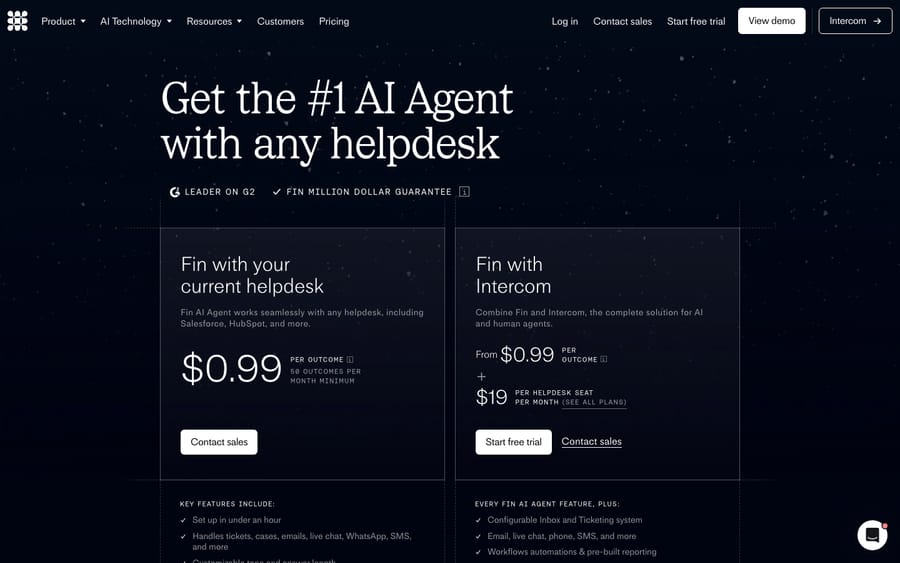
Intercom Fin: $0.99 per outcome
Fin charges $0.99 per outcome, where an "outcome" is one of these (fin.ai/pricing, checked September 2026):
- Resolution: no further help is requested after Fin's last answer.
- Procedure handoff: Fin completes a workflow you've configured that ends in a human handoff.
- Disqualification: Fin determines a prospect doesn't match your qualification criteria.
- Self-serve routing: Fin sends the customer to a self-serve path.
A separate event, Qualification (Fin matches a prospect to your lead criteria), is billed at $9.99 each. That's a sales action, not a support one. You're charged once per conversation, not per message or per action Fin takes inside it.
Two structural details matter:
- Minimum: on non-Intercom help desks there's a 50-outcome/month minimum, roughly a $49.50 floor.
- Platform fee: Fin's pricing page states that there are no integration fees, setup fees, or platform charges. If you run Fin inside Intercom, that changes: you pay for Intercom seats ($29 a seat for Essential, $85 for Advanced and $132 for Expert, billed annually; Intercom has also shown $19 for Essential in a pricing test) on top of the $0.99 outcomes (intercom.com/pricing).
HubSpot Breeze Customer Agent: $0.50 per resolved conversation
On April 14, 2026 HubSpot moved Breeze Customer Agent from $1.00 per conversation to $0.50 per resolved conversation, so you only pay when the agent completes the task (HubSpot company news). It's billed in HubSpot Credits: 50 credits per resolved conversation. Extra credits cost $9 per 1,000 on annual billing.
HubSpot's definition of "resolved" is unusually specific (resolve247): a conversation counts as resolved when the agent shares a content source (like a knowledge-base article) or performs an action (like a password reset) and no human handoff happens within 72 hours of the agent's final message. The catch: if a customer replies after 72 hours, the conversation can reopen and potentially re-bill, so long email threads can trigger more than one charge.
Two structural details, mirroring Fin's:
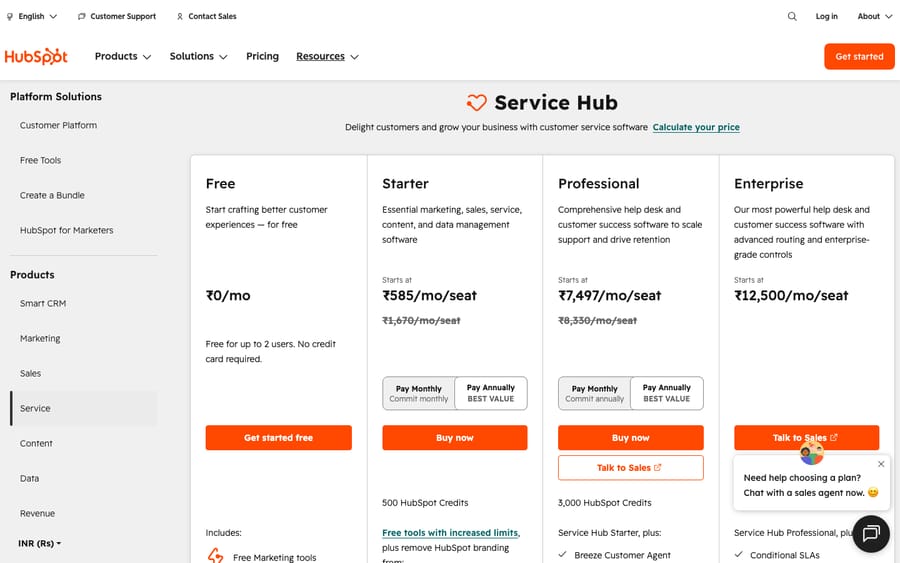
- Platform requirement: Breeze Customer Agent needs a paid Professional or Enterprise subscription to a HubSpot hub (Service, Sales, Marketing, Content, Data, Smart CRM or Revenue); Free and Starter don't qualify (HubSpot KB). For a support team that usually means Service Hub Professional at $90 a seat a month billed annually, $100 monthly. The $0.50 sits on top of that cost.
- Included credits: Service Hub Professional includes 3,000 HubSpot Credits a month and Enterprise 5,000. At 50 credits per resolution, 3,000 credits covers 60 resolutions a month, not thousands.
Why does the billable unit matter more than the rate?
Both call themselves "outcome-based," but they meter different things:
- Fin bills an outcome: a resolution, a handoff, a disqualification or a self-serve route. A handoff to a human still counts as a billable outcome, because Fin did the work of triaging and routing it.
- Breeze bills a resolved conversation, and a handoff to a human within 72 hours specifically does not count. You only pay when Breeze closes it out without a human.
That's a real split in incentives. Fin's model says "we charge for reaching a conclusion, including correctly deciding a human should take it." Breeze's says "we only charge when we kept the human out of it." Neither is obviously fairer. Fin can bill for conversations a human still finished, while Breeze's 72-hour window can count a customer who simply gave up (or who comes back on day 4 and re-triggers a charge). Both rely on a time-based assumption of success, the soft spot every per-resolution model shares. We unpack that across vendors in AI agent pricing models, explained.
What does each cost at the same volume?
Run identical traffic through each. Assume a mid-size team:
- 5,000 customer conversations/month reach the AI agent.
- HubSpot says its Customer Agent resolves 65% of conversations. Using 65% for both keeps the comparison level: 3,250 resolved and 1,750 escalated to humans.
- For the platform line, assume a 5-seat support team on Service Hub Professional.
| Cost component | Intercom Fin (on, say, Zendesk) | HubSpot Breeze (on Service Hub Pro) |
|---|---|---|
| Per-outcome / per-resolution usage | 3,250 × $0.99 = ~$3,218 | 3,250 × $0.50 = $1,625 |
| Platform / subscription | $0 (no platform fee, non-Intercom) | 5 seats × $90 = $450 |
| Included-credit offset | n/a | 3,000 credits = 60 resolutions = minus $30 |
| Approx. monthly total | ~$3,218 | ~$2,045 |
What this tells you, and what it hides:
- Breeze's per-unit rate is half of Fin's, and it stays cheaper here even after adding the Service Hub seats, if you'd be paying for HubSpot anyway. The $450 platform line is only a true extra cost if you're not already a HubSpot shop.
- Fin's number is the whole bill. There's no platform fee underneath it on a non-Intercom help desk, so the $3,218 is what you pay. That predictability has value.
- Resolution rate moves Fin's bill more. Salesforce cites a 76% average resolution rate for Fin. At 76%, Fin resolves 3,800 conversations and bills about $3,762; the better the agent does, the more each vendor earns.
- The 1,750 escalated conversations are free in both: Fin only bills the outcome, Breeze only bills the resolved ones. But Fin would bill a procedure handoff as an outcome, so if many of those 1,750 are configured handoffs rather than raw escalations, Fin's count (and bill) climbs.
- The 72-hour reopen risk is a Breeze-only variable. If your conversations are long email threads, Breeze can re-bill a reopened thread, a cost the table can't predict.
The cheaper option is almost entirely decided by which platform you already live on, not by the $0.50-vs-$0.99 gap.
Who should choose Fin, and who should choose Breeze?
Choose Intercom Fin if:
- You're on a non-HubSpot help desk (Zendesk, Salesforce, Freshworks, or Intercom itself) and want an agent that doesn't force a new CRM into your stack.
- You value a single, predictable usage bill with no platform fee underneath it.
- You're happy to pay for triaging and routing (handoffs as outcomes), because correctly escalating is work too.
- You do a lot of lead qualification and can accept the $9.99 qualification rate (or won't use that event).
Choose HubSpot Breeze if:
- You're already on HubSpot at Professional or Enterprise, and Breeze is essentially "switch it on" with a CRM you already pay for.
- You want the lowest per-resolution rate and only want to pay when a human never touched the conversation.
- Your support already lives next to your CRM and marketing data, and the unified record is worth more than help desk flexibility.
- Your conversations are short and self-contained (lower risk of the 72-hour reopen re-billing you).
Where does Macha fit?
Neither Fin nor Breeze is what Macha competes with directly. Macha is an AI agent layer: it runs on top of the help desk you already operate rather than asking you to adopt Intercom's platform or HubSpot's CRM, and it connects to Zendesk, Freshdesk, Gorgias, Front, HubSpot or Intercom. Breeze and Fin are the native options on their own platforms; Macha is the option when you'd rather choose the AI layer separately from the desk.
On the pricing-model question: Macha bills per ticket, one thread with one person charged once however many messages it takes, rather than per assumed "resolution." Pricing starts at $299 a month for up to 750 tickets, with setup and monitoring by the Macha team included. We chose per-ticket billing for the reason both models above expose: "resolved" is a time-window guess, and a ticket is something you can count in your own help desk. The trade-off is real (a ticket is billed whether or not the agent resolves it), and it isn't automatically cheaper. You can test it on your own tickets with $50 of free usage, no credit card required. For a broader field, see our roundup of the best AI customer service agents.
Frequently asked questions
Is Intercom Fin or HubSpot Breeze cheaper? On the headline rate, Breeze ($0.50 per resolved conversation) is half of Fin ($0.99 per outcome). But Breeze requires a paid HubSpot Professional or Enterprise subscription (Service Hub Pro is $90 a seat a month annual) that Fin doesn't, while Fin charges no platform fee on non-Intercom help desks. If you already pay for HubSpot, Breeze is usually cheaper overall; if you're on another help desk, Fin avoids adding a CRM cost.
What's the difference between an "outcome" and a "resolved conversation"? Fin bills an outcome (a resolution, a procedure handoff, a disqualification or a self-serve route), so a conversation Fin routes to a human still counts. Breeze bills a resolved conversation, and a human handoff within 72 hours does not count, so you only pay when no human was involved.
Does HubSpot Breeze really charge per resolution now? Yes. Since April 14, 2026, Breeze Customer Agent costs $0.50 per resolved conversation (50 credits), down from $1.00 per conversation. Extra credits cost $9 per 1,000 on annual billing. A conversation counts as resolved when the agent shares content or performs an action and no human handoff occurs within 72 hours, but it can reopen and re-bill if the customer replies later.
Can I use Intercom Fin without paying for Intercom? Yes. Fin runs on non-Intercom help desks (Zendesk, Salesforce, HubSpot, Freshworks and others) with no setup, integration, or platform fee: $0.99 per outcome and a 50-outcome/month minimum. If you run Fin inside Intercom, you also pay for Intercom seats, from $29 a seat billed annually.
Which has the longer free trial? They're now the same length. Intercom Fin offers a 14-day trial with unlimited outcomes and no credit card. HubSpot's pricing page and knowledge base now describe 14 days of free Customer Agent access with no credits used; HubSpot's April announcement said 28 days, so check which applies to your account.
Did the Salesforce acquisition change Fin's price? No. Salesforce completed the acquisition on September 10, 2026, and fin.ai/pricing still lists $0.99 per outcome and $9.99 per qualification.
Which should you pick?
The $0.50-vs-$0.99 comparison misleads if you stop there. Fin and Breeze meter different units, define success differently, and assume different starting points: Fin is a standalone agent for any help desk with no platform fee, while Breeze is the cheaper per-unit option that only makes sense if you already pay for HubSpot. If you're on HubSpot, Breeze adds little on top and the lower rate wins. If you're on anything else, Fin avoids dragging a CRM into your stack and gives you one predictable usage bill. Either way, run your real resolution rate and conversation length through both models, and ask for the exact definition behind the "outcome" or "resolved conversation" you'll be billed for. That definition, not the sticker price, is where the money moves.
Rates checked 24 September 2026 against fin.ai/pricing, intercom.com/pricing, hubspot.com/pricing/service and HubSpot's knowledge base. Pricing in this category changes often; next review by December 2026.
Add AI agents to your HubSpot
Macha reads the ticket, drafts the reply and takes the action, inside the HubSpot you already run.