Intercom
 Shopify
 Stripe
 Slack
Slack Notion
 Google Workspace
 Confluence

Is Intercom Fin Cheaper Than Zendesk AI? Pricing Compared (2026)


Intercom Fin charges $0.99 per outcome with no platform fee, while Zendesk AI agents cost about $1.50 per verified resolution committed or $2 pay-as-you-go. The cheaper one for your team depends on what each vendor counts as billable, your lead-qualification mix and the seat plan underneath.
Key takeaways
- Intercom Fin charges $0.99 per outcome with no platform fee, while Zendesk AI agents cost about $1.50 per verified resolution committed or about $2 pay-as-you-go.
- Since May 18, 2026, Zendesk bills only Verified Resolutions, while Assisted Escalations and Contained Resolutions, where the customer simply didn't ask for more help, are free.
- Fin bills a resolution whenever no further help is requested after its last answer, and charges $9.99 for each lead qualification.
- At 2,000 monthly resolutions, Intercom Fin costs about $1,980, while Zendesk AI costs about $3,000 committed or about $4,000 pay-as-you-go, before seat plans.
- Fin's old $49 monthly base is gone; Fin on a non-Intercom help desk now carries a 50-outcome monthly minimum, and Fin inside Intercom needs seats from $29.

Intercom Fin is usually cheaper per unit than Zendesk AI: Fin charges $0.99 per outcome with no platform fee, while Zendesk AI agents cost about $1.50 per verified resolution on a committed plan and about $2 pay-as-you-go, so 2,000 billable resolutions a month come to about $1,980 on Fin against $3,000 to $4,000 on Zendesk. The gap narrows or flips once you account for what each vendor counts as billable, Fin's $9.99 lead qualifications, and the seat plan underneath each agent. A disclosure up front: Macha, the company publishing this, sells an AI agent layer that bills on a third model (per ticket). We mention it once, as another trade-off, not the winner.
Update, September 2026: Salesforce signed a definitive agreement on June 15, 2026 to acquire Fin (formerly Intercom) for about $3.6 billion and completed the acquisition on September 10, 2026, with Fin folding into Agentforce. The pricing below reflects Fin's public terms as of September 2026. Weigh the ownership change (integration into Salesforce's stack, possible repackaging, future pricing shifts) alongside today's per-outcome rate before committing.
How do the two pricing models compare at a glance?
| Intercom Fin | Zendesk AI agents | |
|---|---|---|
| Headline rate | $0.99 per outcome | $1.50 per automated resolution (committed); $2 pay-as-you-go (Zendesk pricing page) |
| Billable unit | An "outcome": resolution, procedure handoff, disqualification or self-serve routing | A "Verified Resolution" (AI resolved it and a verification step confirmed it) |
| Premium unit | Lead qualification at $9.99 | n/a (single resolution rate) |
| Billing granularity | Once per conversation, even if Fin answers several questions | Per verified resolution |
| Free / not charged | Conversations passed to a human with no outcome | Assisted Escalations and Contained Resolutions |
| Monthly minimum | 50 outcomes a month when Fin runs on a non-Intercom help desk; no platform or setup fee | Tied to your committed resolution bundle / contract |
| Platform requirement | An Intercom seat plan ($29–$132 a seat) if run inside Intercom; none on other help desks | A paid Zendesk Suite/Support seat plan underneath |
| Free trial | 14 days, unlimited outcomes, no credit card | Standard Zendesk trial; resolution allowance on plan |
Rates checked September 2026 on fin.ai/pricing, intercom.com/pricing and Zendesk's help center. Zendesk's per-resolution rates are listed in the plan comparison table on its pricing page (checked September 25, 2026); confirm them in your quote.
How did we compare Fin and Zendesk AI?
We pulled Fin's rates directly from fin.ai/pricing and Intercom's seat prices from intercom.com/pricing, and took Zendesk's billing rules from its own help-center documentation. Zendesk's pricing page describes paying per automated resolution, and its plan comparison table lists the $1.50 committed and $2 pay-as-you-go rates. Pricing in this category changes often; treat every number here as "current as of September 2026, verify before you sign."
How does each one define a billable resolution?
This is the most important line in the contract, and the two platforms draw it differently.
Intercom Fin charges $0.99 for an outcome, and a resolution is the most common kind. Per Fin's pricing page, a resolution counts when no further help is requested after Fin's last answer. The customer doesn't have to confirm anything; leaving without asking for more is enough. Three other outcomes also bill at $0.99: a procedure handoff (Fin runs a configured procedure that hands off), a disqualification, and a self-serve routing. A qualification (Fin qualifies a sales lead) is the premium event at $9.99. You're charged once per conversation no matter how many questions Fin fields, and you're not charged when a conversation is passed to your team with no outcome.
The thing to notice is how resolution is inferred. A customer who got a perfect answer and one who gave up in frustration both "request no further help," and both bill. That's the per-resolution model's universal soft spot, not a Fin quirk, but it's worth auditing against your CSAT and re-contact data. Our complete Intercom Fin guide goes deeper on how outcomes are counted.
Zendesk AI agents charge per automated resolution: the AI handles a customer's issue start to finish without a human. If it escalates, you don't pay for that interaction. Since May 18, 2026, Zendesk's help doc (About automated resolution tiers) splits every AI conversation into three tiers. Assisted Escalation: the AI contributed but a human completed the resolution. Free. Contained Resolution: the AI handled the interaction to completion and the customer didn't ask for more help. Also free. Verified Resolution: the AI resolved the issue and Zendesk's verification confirmed it. This is the only tier that draws from your allowance. The conversation has to end first, and Zendesk defines "end" by channel: 72 hours after the last message on email, 2 hours by default on messaging (extendable to 72), and at hang-up on voice. Our Zendesk AI pricing explainer tracks the details.
Look at the Contained tier closely. It's almost word for word Fin's definition of a billable resolution ("the customer didn't ask for more help"), and Zendesk gives it away free. So 2,000 "resolutions" on Fin and 2,000 on Zendesk are not the same 2,000 events. Fin's rule tends to count more conversations as billable; Zendesk's verified rule counts fewer, each at a higher price. Hold that thought for the worked example.
What's free and what's charged on each platform?
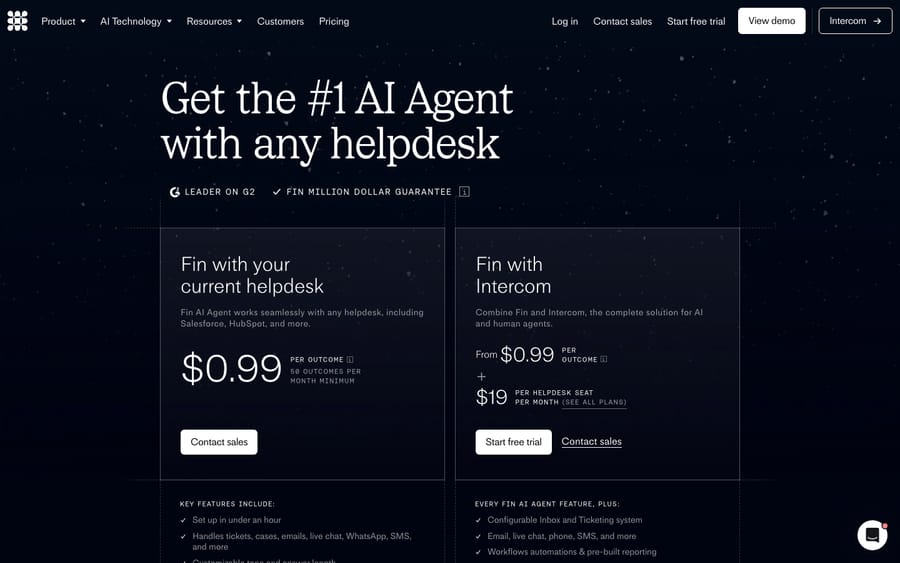
Intercom Fin: Fin's pricing page now reads "No setup, integration, or platform fees." The older $49 monthly base that bundled the first 50 resolutions is gone. What's left is $0.99 per outcome, with a 50-outcome monthly minimum when Fin runs on a non-Intercom help desk (so about $49.50 a month is the floor there). No charge for conversations Fin passes to a human without an outcome. The 14-day trial gives unlimited outcomes and needs no credit card, which is useful for sizing your real resolution rate before any bill lands. If you run Fin inside Intercom you also pay for Intercom seats: $29 a seat a month on Essential, $85 on Advanced and $132 on Expert, billed annually, with at least one full seat. On another help desk (Fin lists Salesforce, HubSpot, Freshworks, Dixa, Front, Zoho, Sprinklr and Gorgias among them) there's no Intercom seat cost.
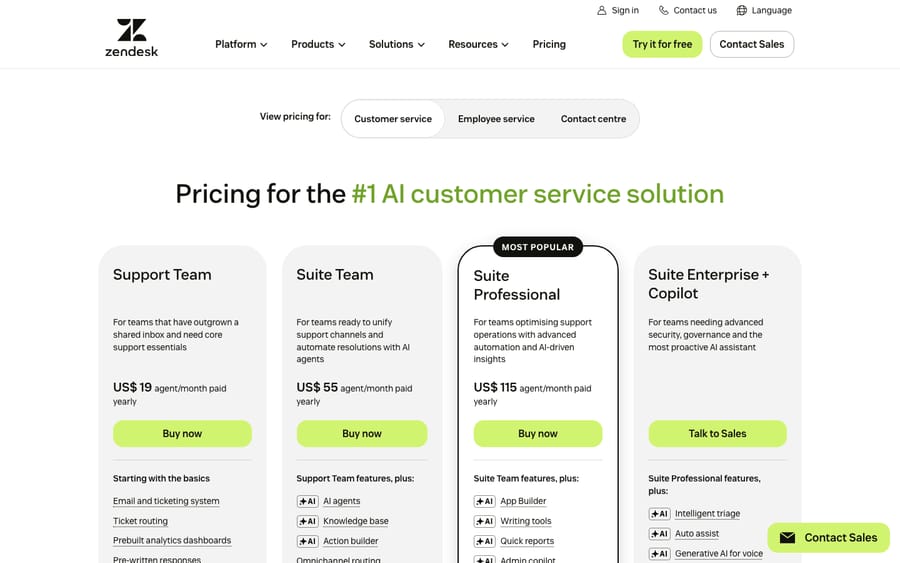
Zendesk AI agents: escalations to humans aren't billed, and under the May 2026 tiers Assisted Escalations and Contained Resolutions are free; only Verified Resolutions bill. Each plan draws resolutions from an allowance: Zendesk's pricing table lists 5 included automated resolutions per agent a month on Support Team and Suite Team and 10 on Suite Professional (up to 10,000 a year), and its help center describes the same allowance as a monthly dollar amount per seat ($2, $5 or $10 by plan). Past the allowance you pay $1.50 committed or $2 pay-as-you-go. The catch most buyers miss: AI agents sit on top of a paid Zendesk seat plan, from $55 an agent a month on Suite Team and $115 on Suite Professional, billed yearly. Zendesk's AI is priced as an extension of those seats. If you also want AI help for your human agents, the Copilot add-on is $50 an agent a month on Professional and higher plans (Zendesk pricing).
Which is more predictable at scale?
Both models are usage-based, so both push volume risk onto you: a viral moment or an outage spikes ticket volume and your AI bill with it. Neither gives you the plan-it-once predictability of per-seat pricing. They differ in two ways:
- Definitional risk. Fin's rule means your billable count tracks "conversations where the customer didn't ask again," which is fuzzier and tends to run higher. Zendesk ties billing to a verification step and gives away the contained tier, so there are fewer surprise counts, each at a higher unit price.
- Commitment levers. Zendesk's committed resolution bundles (and enterprise contracts that let you shift budget between human seats and resolutions) give procurement a dial to pre-buy volume at the lower rate. Fin's lever is simpler: one rate, no platform fee, a 50-outcome floor off Intercom. That suits smaller or spiky volumes but offers less of a bulk discount at very high scale.
Net: Fin is simpler and cheaper at low-to-mid volume; Zendesk's committed pricing rewards high, steady volume, provided you can forecast it well enough to commit.
What do 2,000 resolutions a month cost on each?
Assume a mid-size team whose AI handles 2,000 billable resolutions in a month. Here's the AI-agent line on each platform (seat costs for the underlying help desk are separate):
| Scenario | Calculation | Approx. monthly AI cost |
|---|---|---|
| Intercom Fin (all standard outcomes) | 2,000 × $0.99 | ~$1,980 |
| Intercom Fin (incl. 200 qualifications) | 1,800 × $0.99 + 200 × $9.99 | ~$3,780 |
| Zendesk AI (committed) | 2,000 × $1.50 (less small free allowance) | ~$3,000 |
| Zendesk AI (pay-as-you-go) | 2,000 × $2.00 | ~$4,000 |
How to read this table:
- On a pure per-unit basis, Fin is cheaper at $1,980 against Zendesk's $3,000–$4,000, if your outcomes are ordinary resolutions. Lead-qualification-heavy use changes that fast: each qualification is $9.99, so a sales-oriented deployment can overtake Zendesk (second row).
- The "2,000" isn't identical across vendors. Fin's no-further-help rule logs more billable events from the same traffic; Zendesk's verified bar logs fewer but pricier ones. Suppose 2,000 conversations end without the customer asking again, and Zendesk verifies 1,500 of them. Fin bills 2,000 × $0.99 = $1,980; Zendesk bills 1,500 × $1.50 = $2,250 committed. The gap shrinks from about $1,000 to $270. To compare properly, run the same conversations through both and compare total bills.
- Add the platform underneath. Ten agents on Suite Professional is $1,150 a month before any AI; ten on Intercom Advanced is $850. Fin on a help desk you already own adds no Intercom seats at all, which is why an existing-Zendesk shop and a Fin-on-another-desk shop reach different totals at identical resolution counts.
- There's no universal winner. Swap in your real qualification mix, your committed-vs-PAYG status, and your verified-vs-contained split, and the cheaper option can flip.
What do users say about the cost?
Vendor pricing pages tell you the rate; users tell you how it behaves once volume scales. Both products are well rated overall on G2 and Capterra. The praise is mostly about deflection and ease of deployment; the recurring cost complaint, for both, is the same: usage-based AI billing is hard to forecast and "the bill grows as the bot works." A methodology note: detailed G2 and Capterra review bodies are often behind a login or bot wall, so for verbatim quotes we lean on publicly readable community threads (Reddit, Intercom's community forum), attributed and dated as closely as the source allows.
On Intercom Fin, the loudest complaint targets assumed resolutions and how fast the bill climbs. In a widely shared Reddit thread (a user running roughly a 40-agent support team, ~2024–2025): "I was already spending over $4k/month… now it's shot up to $9k," with the poster adding that Intercom's pricing is "way more complicated than their marketing page suggests." On Intercom's own community forum, a thread titled "Fin's flawed assumed resolved & pricing design" (~2025) reports Fin marking conversations "assumed resolved" even when a human agent stepped in to fix an answer Fin got wrong, meaning a $0.99 charge for a conversation the agent didn't resolve.
On Zendesk, the cost complaint is the per-resolution rate stacked on top of seats. From a Reddit thread on Zendesk's automated resolutions (~2025): "We stopped using it because ARs are a rip off, and it's a rushed product to get into the AI hype", with a side complaint about not being able to export what customers asked the bot. The broader theme from reviewers is that a fixed license plus AI add-ons plus uncapped per-resolution charges make month-end totals hard to predict. Zendesk's May 2026 move to bill only verified resolutions answers the "you're charging me for non-resolutions" critique directly.
Neither vendor's users are revolting over the headline rate. They're frustrated by predictability and by what counts as billable, which is the axis this comparison turns on.
Who should choose Intercom Fin, and who should choose Zendesk AI?
Choose Intercom Fin if you're already on Intercom, or if you want an AI agent on a non-Intercom help desk. The economics favor Fin at low-to-mid volume: $0.99 per outcome, no platform fee, a 50-outcome floor off Intercom, and a 14-day unlimited-outcome trial to size usage first. It's also the cleaner pick if you don't run Zendesk and don't want to. Watch-outs: the no-further-help definition can inflate counts, and $9.99 qualifications make lead-gen use cases pricey.
Choose Zendesk AI agents if you already live in Zendesk. When you're paying for Suite seats anyway, native AI avoids a second vendor, and committed bundles give procurement real levers at high, steady volume. The verified-resolution bar (only Verified Resolutions bill; Assisted Escalations and Contained Resolutions are free) is a stricter billing trigger than Fin's. Watch-outs: the per-unit rate is higher, allowances are small, and the tier definitions changed in May 2026, so get the current ones in writing. Zendesk's acquisitions of Ultimate (2024) and Forethought (2026) signal heavy investment in agentic AI, and also that the pricing here is still moving.
For buyers not committed to either platform: because Fin runs on top of other help desks, the real question is often "which help desk am I standardizing on?" first, and "which AI agent prices better for my traffic?" second.
Is there a pricing model that doesn't bill per resolution?
Fin and Zendesk both bill per resolution; they disagree on what a resolution is and what it costs. A third model changes where the risk sits: per ticket.
Macha is an AI agent layer that runs on top of Zendesk, Freshdesk, Gorgias, Front, HubSpot and Intercom rather than replacing them, and it bills per ticket: one thread with one person, charged once however many messages, lookups, drafts or tool calls it takes, and the model the agent runs on doesn't change it. Pricing starts at $299 a month for 750 tickets and runs to $3,999 for 10,000, about $0.40 a ticket at every tier, with setup and monitoring by the Macha team included. The trade-off: per-ticket billing takes the "was this really resolved?" judgment off your invoice and ties the bill to a number you already know, your ticket volume. But you pay for every ticket the agent works, finished or not, whereas "$0.99 when it resolves" only charges on a win. At 2,000 tickets, Macha's $1,199 tier (3,000 tickets) sits between Fin's $1,980 and Zendesk's $3,000 for 2,000 resolutions, but only the Macha figure covers tickets the agent didn't close. It's a different place to put the risk. We break down all three approaches in AI agent pricing models explained. To watch it run on your own tickets, start with $50 of free usage, no credit card required.
Frequently asked questions
Is Intercom Fin cheaper than Zendesk AI? Per unit, usually yes: Fin's $0.99 per outcome undercuts Zendesk's $1.50 committed / $2 pay-as-you-go per automated resolution. Two caveats can flip it: Fin's $9.99 lead qualifications make sales-heavy use more expensive, and Fin bills any conversation where the customer asks for no further help, while Zendesk bills only verified resolutions and gives contained ones away. Run your own traffic through both before concluding.
What counts as a billable resolution on each platform? Fin bills $0.99 for an "outcome" (a resolution, where no further help is requested after Fin's last answer; a procedure handoff; a disqualification; or a self-serve routing), once per conversation. Zendesk bills per automated resolution; since May 18, 2026 only Verified Resolutions bill, checked after the conversation ends (72 hours on email, 2 hours by default on messaging), while Assisted Escalations and Contained Resolutions are free.
Do I have to pay for Intercom or Zendesk seats to use their AI agents? For Zendesk, yes: AI agents sit on top of a paid Suite or Support seat plan, from $55 an agent a month on Suite Team. For Fin, only if you run it inside Intercom ($29 to $132 a seat a month); on other help desks such as Salesforce, HubSpot, Freshworks, Zoho, Front or Gorgias, Fin costs $0.99 per outcome with a 50-outcome monthly minimum and no Intercom seats.
Is there a free trial or minimum? Fin has a 14-day trial with unlimited outcomes and no credit card, no platform fee, and a 50-outcome monthly minimum only when it runs on a non-Intercom help desk. The old $49 base that bundled 50 resolutions no longer appears on Fin's pricing page. Zendesk draws resolutions from a plan allowance (5 per agent a month on Support Team and Suite Team, 10 on Suite Professional) and offers a standard trial; past the allowance you pay per verified resolution.
Which should I pick if I'm not already on either platform? Decide your help desk first. If you're standardizing on Zendesk, its native AI avoids a second vendor and rewards high committed volume. If you're on another help desk (or want flexibility), Fin runs standalone and tends to be cheaper at low-to-mid volume.
What should you do before signing either contract?
Get the exact resolution definition in writing, along with the per-resolution rate your contract uses. Export a month of conversations and count how many would bill under each rule: Fin's no-further-help rule against Zendesk's verified tier. Price your real qualification mix on Fin, and add the seat plan underneath each agent before comparing totals. Then audit billed resolutions against CSAT for the first 30 days.
Rates checked in September 2026 on fin.ai/pricing, intercom.com/pricing, zendesk.com/pricing and Zendesk's automated resolution tiers article; Zendesk's per-resolution rates and included resolutions come from its pricing page, rechecked September 25, 2026. Next review by December 2026.
Add AI agents to your Zendesk
Macha reads the ticket, drafts the reply and takes the action, inside the Zendesk you already run.