Intercom
 Shopify
 Stripe
 Slack
Slack Notion
 Google Workspace
 Confluence

Is Intercom Worth It in 2026? Review of Pricing, Pros, Cons and Who It's For


Intercom has the best messenger in its category and one of the strongest AI agents in Fin, and a bill that's hard to predict once Fin outcomes and add-ons stack on top of seats. Whether it's worth it comes down to your size, your channels and how comfortable you are with usage-based pricing.
Key takeaways
- Intercom suits product-led SaaS teams best, scoring 4.5 out of 5 on G2 from roughly 3,855 reviews, with most complaints clustering around cost at the SMB end.
- Intercom seats cost $29, $85 or $132 per seat a month billed annually, and Fin is billed on top at $0.99 per outcome.
- An 8-agent Intercom team on Advanced with about 2,100 Fin outcomes a month pays about $2,760 a month before WhatsApp, proactive messaging or Copilot.
- Running Fin standalone on another help desk carries a 50-outcome monthly minimum of about $49.50, while Intercom's Copilot add-on costs $29 per agent a month billed annually.
- Salesforce completed its roughly $3.6 billion acquisition of Fin, formerly Intercom, on 10 September 2026, and cites a 76% average Fin resolution rate.

Intercom is a strong choice in 2026 for product-led SaaS teams: it scores 4.5/5 on G2 from roughly 3,855 reviews, has the most polished messenger in the category, and bundles Fin, an AI agent billed at $0.99 per outcome. The catch is the bill. Seats run $29, $85 or $132 a month billed annually, Fin outcomes and add-ons stack on top, and the total is hard to forecast before you've run real volume through it.
| Question | Short answer (checked September 24, 2026) |
|---|---|
| Seat price | Essential $29, Advanced $85, Expert $132 per seat a month, billed annually; 1 full seat minimum |
| AI agent | Fin at $0.99 per outcome, on top of seats |
| Trial | 14 days, no credit card |
| Ratings | G2 4.5/5 (~3,855 reviews), Capterra 4.5/5 (~1,133 reviews), observed June 2026 |
| Best for | Product-led SaaS and digital-first teams whose customers live in-app |
| Weak spot | Cost predictability, especially for SMBs |
| Owner | Salesforce, since 10 September 2026 |
One disclosure up front: Macha is our own product, an AI agent layer that runs on top of Zendesk, Freshdesk, Gorgias, Front, HubSpot or Intercom. It isn't a help desk, so it appears exactly once below, flagged as ours, and never as an "alternative" in a list.
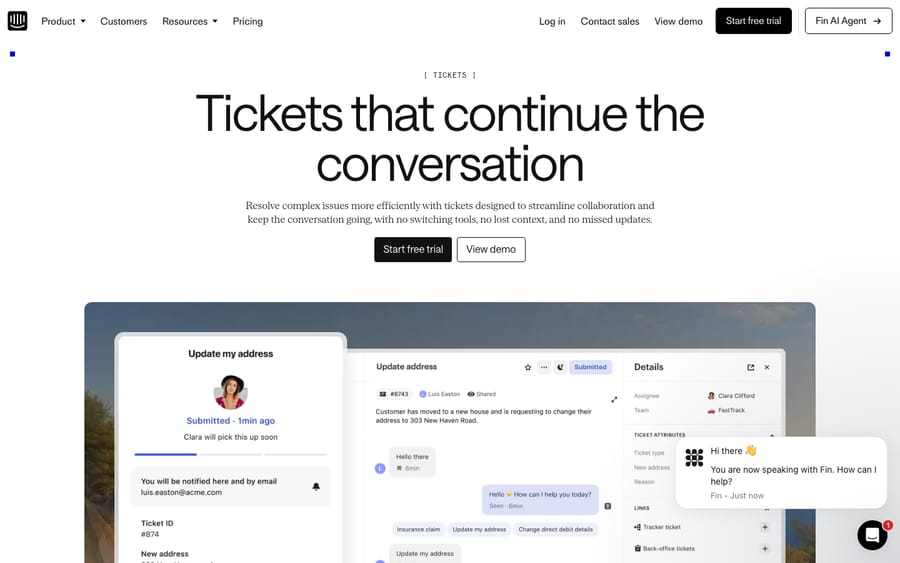
How we reviewed it: seat and add-on pricing re-checked on 24 September 2026 against Intercom's pricing page; ratings and sentiment drawn from current G2 and Capterra reviews (those pages block automated access, so the numbers are cited from research in June 2026, not screenshotted); and the product experience grounded in Intercom's own site and help-desk UI, shown below.
What is Intercom, and who is it built for?
Intercom started life as a business messenger (the chat bubble in the corner of thousands of SaaS apps) and grew into a full customer service and engagement platform: live chat, a shared inbox/ticketing help desk, a help center, outbound messaging, product tours, and, since 2023, an AI agent called Fin that has become the company's center of gravity. Its identity is modern, product-led support: support that lives inside the product experience rather than in a separate email queue.
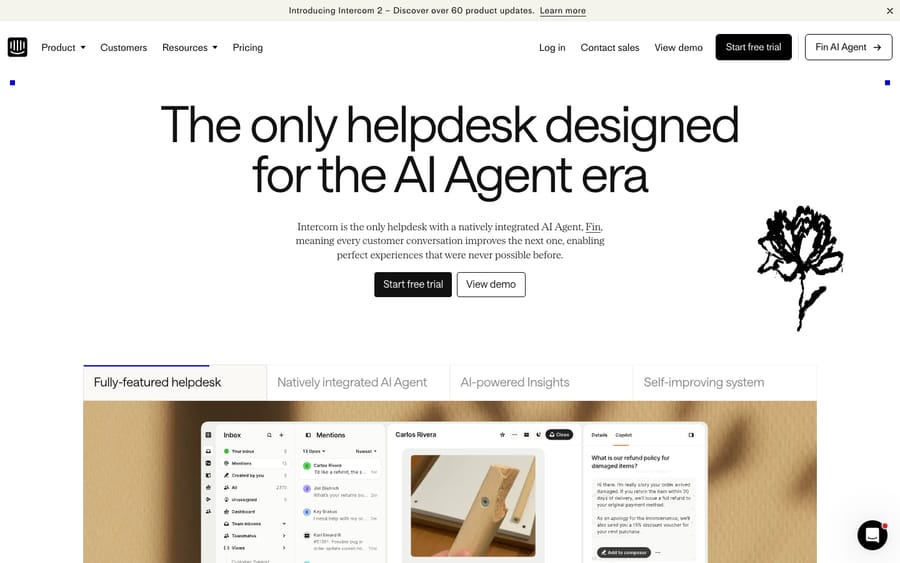
It's built primarily for product-led SaaS and digital-first businesses, companies whose customers are already inside a web or mobile app, where in-app messaging, proactive nudges, and an AI agent that deflects repetitive questions pay off most. It scales well into mid-market and larger support orgs, especially those leaning hard into AI. The one-line summary: Intercom is the tool you reach for when customer experience and AI-driven deflection matter more than rock-bottom cost or simplicity.
What changed at Intercom in 2026?
Two things happened this year that any 2026 buyer needs to weigh, so we'll get them out of the way before the pros and cons.
First, on 12 May 2026, Intercom rebranded the company to "Fin", the name of its AI agent, reflecting how central the AI product has become. The help-desk platform itself keeps the Intercom name, and the company has said the rebrand is purely corporate: no migration, contracts and logins continue. So "Intercom" the product still exists; "Intercom" the company is now Fin.
Second, and bigger: on 15 June 2026, Salesforce signed a definitive agreement to acquire Fin (formerly Intercom) for roughly $3.6 billion, and completed the acquisition on 10 September 2026. Salesforce's closing announcement says Fin serves more than 30,000 companies and joins Salesforce AI Labs while continuing to serve existing customers. The $0.99 Fin rate hasn't moved since the close. For prospective buyers this is still a soft con: post-acquisition roadmaps, pricing, and standalone product priorities stay uncertain until integration plans are clear. Intercom's small-and-mid-market positioning has historically been the fast, packaged counterpoint to Agentforce's heavier enterprise build, which is exactly the kind of difference that can shift under new ownership. None of this is a reason to rule Intercom out, but it's a reason to ask your account rep pointed questions about the next 18 months before signing a long contract. (Terms per Salesforce's agreement press release and TechCrunch, 15 June 2026, and Salesforce's completion release, 10 September 2026.)
What do you actually get in the product?
A fair review has to look at what you actually get. Polish is Intercom's signature, but the platform is broad.
The Messenger and in-app experience
This is Intercom's crown jewel. The Messenger, the in-app/website chat surface, is the most refined in the category: customizable, fast, and able to surface help articles, bots, product tours, and human chat in one widget. If your customers live inside a web or mobile app, nothing else feels quite as native. Reviewers consistently single out the clean, modern interface as a top reason they stay.
Fin AI agent
Fin is Intercom's AI agent, and in 2026 it's the headline. It resolves customer queries end-to-end across chat, email, and other channels by drawing on your help content and configured procedures, escalating to a human when it can't. Salesforce's completion announcement cites an average resolution rate of 76%, and Fin is frequently ranked the top AI agent on G2 by review volume. The important caveat: that's an average across Fin's customer base, and your number depends heavily on knowledge-base quality. Sparse help content caps what any AI can resolve, so a small team with thin docs should expect to land well below the average until the content catches up. Fin is very good; it isn't magic, and it rewards teams that have invested in documentation. We go deeper in our Fin AI explainer.
Help desk, inbox and ticketing
Beyond chat, Intercom is a full help desk: a shared inbox, tickets, assignment rules, macros, SLAs, and a workflow builder. The company rebuilt this layer (marketed as "Intercom 2") and continues to invest in it. It's capable and pleasant to use, though heavy ticketing teams migrating from a traditional desk sometimes find the conversation-first model an adjustment rather than a drop-in replacement.
Outbound and proactive messaging
Intercom's roots in marketing-style messaging show: proactive messages, product tours, banners, and series-based campaigns let you reach users in-app before they ask for help. This outbound muscle is something pure help desks lack, and it's a real differentiator for product and growth teams, though the fuller proactive features are a paid add-on (more below).
Help center and self-service
A built-in help center powers public articles and feeds Fin's deflection. As with every AI-first desk, the better your articles, the more Fin resolves, so the knowledge base isn't optional polish; it's the engine that makes the AI economics work.
How much does Intercom cost in 2026?
Here's the current published pricing for Intercom's seat plans, re-checked on 24 September 2026.
| Plan | Per seat/mo (billed annually) | Built for |
|---|---|---|
| Essential | $29* | Small teams wanting chat, inbox, and basic help desk |
| Advanced | $85 | Growing teams needing automation, multiple workflows |
| Expert | $132 | Larger orgs needing advanced roles, SLAs, security |
*Intercom has been running a live pricing test on Essential: the annual figure showed $19 on 20 September 2026 and $29 on 24 September. Monthly billing costs more on every plan, but the page doesn't print the monthly seat figure, so check intercom.com/pricing for what your own account is shown. Every plan needs at least one full seat, and there's a 14-day free trial with no credit card.
A few footnotes that matter more than the table:
- Fin is billed separately, per outcome. Fin AI costs $0.99 per outcome, counted when the customer confirms their question is resolved, doesn't ask for more help, or Fin completes a configured workflow. That's per outcome, not per conversation or per seat: usage-based billing on top of your seats. Running Fin on your existing help desk (standalone) carries a 50-outcome/month minimum (~$49.50/mo).
- Add-ons stack fast. Copilot (agent-assist) costs $29 per agent/mo billed annually or $35 monthly, with 10 free Copilot conversations per agent a month; Proactive Support Plus is $99/mo for 500 outbound messages. Neither is in the base seat price.
- The effective bill is the real number. This is the single most-cited frustration in reviews. A realistic mid-size example: 8 agents on Advanced is $680 a month in seats, and ~2,100 Fin outcomes at $0.99 adds $2,079, for about $2,760 a month before WhatsApp, proactive, or Copilot. Reviewers regularly report landing well above their first estimate once seats, outcomes, and add-ons combine.
The practical takeaway: Intercom's sticker price (an entry seat in the twenties) looks approachable, but its effective price is governed by AI volume you can't fully predict on day one. The incentive is plain: the more Fin resolves, the more Intercom earns, so the line that grows with success is the one you can't cap. If you adopt Fin aggressively, which is the whole point of buying Intercom in 2026, model the outcome line separately from seats and run your own conversation volumes. We break the full math down in our Intercom pricing explainer.
Seat, Fin, Copilot and Proactive Support Plus prices verified against Intercom's pricing page on 24 September 2026; the per-outcome math is an illustration and usage-dependent, so verify with Intercom for your volume.
What do real users say about Intercom?
Aggregate scores are the closest thing to a crowd-sourced verdict. Observed 21 June 2026:
- G2: 4.5 / 5 from roughly 3,855 reviews on Intercom, Inc.'s seller profile, a very large sample, and Fin is frequently ranked the #1 AI agent on G2 by review count.
- Capterra: 4.5 / 5 from about 1,133 reviews (Ease of Use 4.4, Customer Service 4.3), consistent with G2.
Those are strong, consistent numbers, high enough to take Intercom seriously. Just as telling is what reviewers repeatedly praise and gripe about. Here's the read on both sides, in reviewers' words and recurring themes where we could attribute them.
What reviewers praise. Ease of use and a clean, modern interface top nearly every positive review. As one Capterra reviewer put it, "for over a year, I've loved Intercom's ease of use… the interface is clean," and another noted it's "easy to set up and very customizable." The Messenger and Fin's automation are the other recurring wins: reviewers credit Fin with meaningfully reducing ticket volume and freeing agents for harder work. The through-line is that teams that lean into the AI and in-app messaging feel they get real productivity back.
What reviewers criticize. Two themes dominate the negative reviews. First, cost: "the pricing was a little steep, especially as a small business" is a refrain repeated almost verbatim across listings, with startups and SMBs feeling priced out. Second, and more specific, the pricing model itself: reviewers describe the per-resolution-plus-add-ons structure as confusing and hard to forecast. One G2 sentiment captured it as "the per-resolution model can become expensive quickly and makes forecasting support costs harder." A learning curve on the broader platform and inconsistent experiences with Intercom's own support round out the common gripes. None are dealbreakers for the right team, but they're the predictable friction points, and they cluster heavily at the SMB end.
What are Intercom's pros and cons?
Pros
- Best-in-class Messenger and in-app experience. The most polished chat/messaging surface in the category, ideal if your customers live inside a web or mobile app.
- Strong AI agent in Fin. Capable end-to-end resolution, frequently top-ranked, with real deflection upside when your knowledge base is solid.
- Modern, cohesive UX. Clean design and an integrated toolkit (chat, inbox, help center, outbound) in one place, the most-praised aspect across reviews.
- Outbound and proactive muscle. Product tours, proactive messages, and campaigns that pure help desks don't offer.
- Product-led fit. Purpose-built for SaaS and digital-first teams that treat support as part of the product experience.
Cons
- Expensive, and unpredictably so. The per-outcome Fin billing plus per-seat plans plus add-ons make the effective cost hard to forecast.
- Confusing pricing structure. Features split across seats, usage, and add-ons is the single most-cited complaint, and budgeting takes real modeling.
- Steep for SMBs and startups. Smaller teams consistently feel priced out of the advanced features that make Intercom worth it.
- Learning curve. The breadth that powers the platform can feel overwhelming early; routing and automation take effort to configure well.
- Acquisition uncertainty. The completed Salesforce deal puts the standalone roadmap and pricing in flux, a real risk to weigh on a multi-year contract.
- Inconsistent own-support. A recurring (and ironic, for a support vendor) complaint about response quality and speed.
Who should choose Intercom, and who shouldn't?
Choose Intercom if you're a product-led SaaS or digital-first business whose customers live in-app, you want the best messenger and a strong AI agent, you're planning to lean into AI deflection and have (or will build) the knowledge base to feed it, and you can absorb usage-based pricing. For scale-ups and mid-market teams that fit this profile, Intercom is excellent, and the 4.5 ratings across G2 and Capterra reflect a lot of happy teams in exactly that bucket.
Look elsewhere if you're a budget-conscious SMB, you run simple email-first support where a messenger and an AI agent are overkill, or you need predictable, flat pricing you can forecast to the dollar. At that end, the value equation tips against Intercom fast, and it's worth weighing the field. We line up the strongest options in the best Intercom alternatives.
Where does an AI agent layer like Macha fit?
One thread from the cons deserves a little more: Intercom's AI economics are usage-based and bundled into its own ecosystem. You pay per Fin outcome, on Intercom's seats, on Intercom's desk. That's a clean fit if Intercom is your help desk. But plenty of teams want a dedicated AI agent layer on top of the desk they already run rather than re-platforming.
That's the category our own product, Macha, sits in, disclosed plainly because it's ours, with the limitation up front: Macha is a layer, not a platform. It runs on Zendesk, Freshdesk, Gorgias, Front, HubSpot or Intercom, and it doesn't replace any of them. So if Intercom is your platform, Macha can run agents on your Intercom inbox, but Fin is the native path and Macha is not a swap for the platform itself. Macha reads the customer's actual question, pulls from your connected knowledge, and resolves in-thread, billing per ticket (one conversation, charged once however many steps it takes) rather than per seat or per resolution: from $299 a month for 750 tickets, about $0.40 a ticket, with setup and monitoring by the Macha team included. If you're on Zendesk, you can see how the agent layer works or try it ($50 of free usage, no credit card required). If you're happy on Intercom with Fin, stick with Fin.
What are the main Intercom alternatives?
No review is complete without naming the field. If Intercom's cost, complexity, or acquisition uncertainty give you pause, the usual contenders are Zendesk (deeper, enterprise-grade ticketing), Freshdesk (easier, better SMB value), Help Scout and Front (simpler, inbox-style, email-first), Gorgias (e-commerce focus), and Zoho Desk (value, especially inside Zoho). We break down strengths, weaknesses, and pricing for each in the best Intercom alternatives, worth a read before you commit either way.
Frequently asked questions
Is Intercom good in 2026? Yes, for the right team. It carries strong, consistent aggregate ratings (G2 4.5/5 from ~3,855 reviews, Capterra 4.5/5 from ~1,133) and excels at in-app messaging, modern UX, and AI-driven deflection via Fin. The main caveats are high and unpredictable cost, a confusing pricing structure, a learning curve, and roadmap uncertainty following the Salesforce acquisition, which completed on 10 September 2026.
How much does Intercom cost? Seat plans run $29 (Essential), $85 (Advanced) and $132 (Expert) per seat a month billed annually, with higher monthly-billing rates, a 1-seat minimum and a 14-day trial. Essential has been in a live pricing test between $19 and $29. Fin AI is billed separately at $0.99 per outcome, with a 50-outcome/month minimum for standalone use. Add-ons like Copilot ($29/agent annually, $35 monthly) and Proactive Support Plus ($99/mo) stack on top. See our pricing explainer for the full math.
What are Intercom's main pros and cons? Pros: best-in-class Messenger, a strong AI agent in Fin, modern cohesive UX, outbound/proactive messaging, and a great product-led fit. Cons: expensive and hard-to-forecast pricing, a confusing per-outcome-plus-add-ons model, steep for SMBs, a learning curve, acquisition uncertainty, and inconsistent own-support.
Is Intercom worth it? For product-led SaaS and scale-ups that lean into AI and in-app messaging, generally yes; it's one of the best experiences in the category. For budget-conscious SMBs or simple email-first support, model the effective cost (seats + Fin outcomes + add-ons) carefully and weigh it against the alternatives first.
Is Fin AI worth paying for? It's capable and frequently top-ranked, but its value hinges on two things: your conversation volume and your knowledge-base quality. Above a few hundred conversations a month with well-documented help content, the per-outcome economics can pay off; below that, or with sparse docs, results (and value) drop sharply. See our Fin AI explainer.
What does the Salesforce acquisition mean for Intercom? On 15 June 2026 Salesforce agreed to acquire Fin (Intercom's parent, renamed from Intercom in May 2026) for ~$3.6B, and completed the acquisition on 10 September 2026. Fin keeps serving existing customers and the $0.99 rate is unchanged so far, but the standalone roadmap, pricing, and product priorities are uncertain until integration plans firm up, which is a real factor to weigh before signing a long contract.
So is Intercom good or bad for your team?
Intercom earns its reputation. It's the most polished messenger in the category, it has one of the strongest AI agents in Fin, and its modern, product-led toolkit is a pleasure to use, and the steady 4.5 ratings across thousands of reviews back that up. The caveats are equally real: it's expensive and unpredictably so, the per-outcome-plus-add-ons pricing is the most-cited frustration in reviews, it's steep for smaller teams, and Salesforce's completed acquisition adds roadmap uncertainty on top.
So the verdict isn't "good" or "bad"; it's "good for whom." If you're a product-led SaaS or scale-up that lives in-app and is betting on AI deflection, Intercom is one of the best tools you can buy. Just model your effective cost (seats + Fin outcomes + add-ons) before you sign. If you're a budget-minded SMB or you run simple email support, the value gap is real, and the alternatives deserve a serious look first.
Pricing verified against Intercom's pricing page on 24 September 2026. Aggregate ratings and review sentiment were observed in June 2026 on G2 and Capterra and may change, so verify before relying on them. The Salesforce acquisition, announced 15 June 2026, completed on 10 September 2026. Macha is our own product (an AI agent layer that runs on top of your help desk rather than replacing it), disclosed as such.
Add AI agents to your Intercom
Macha reads the conversation, drafts the reply and takes the action, inside the Intercom you already run.