Intercom
 Shopify
 Stripe
 Slack
Slack Notion
 Google Workspace
 Confluence

Is Intercom Worth It in 2026? Costs, Fit and Verdict


Intercom is worth it for product-led SaaS teams with real volume and good docs, and hard to justify for small email-first teams. Seats start at $29 billed annually, but Fin's $0.99 per outcome is usually the bigger part of the bill.
Key takeaways
- Intercom is worth it for product-led SaaS teams with high chat volume and a solid knowledge base, and rarely worth it for budget-tight, email-first support teams.
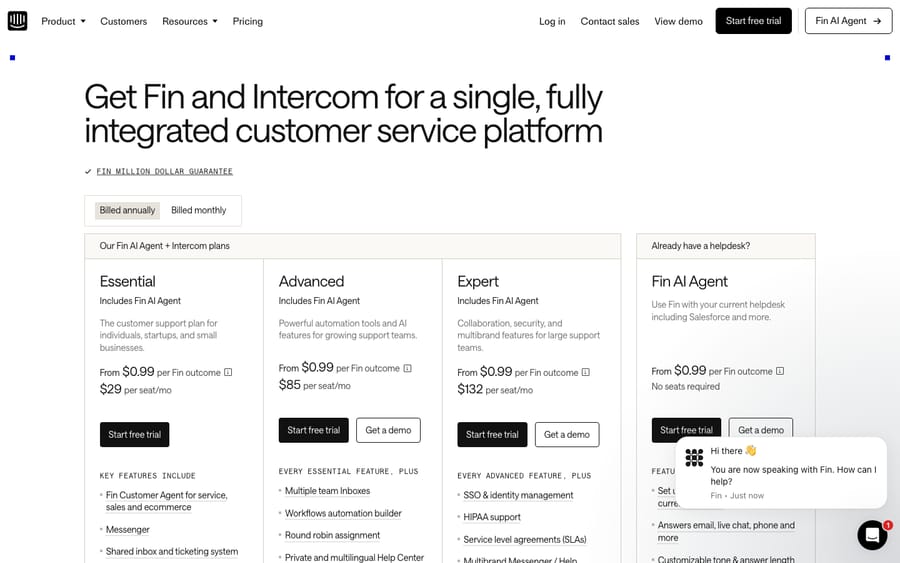
- Intercom seats cost $29 on Essential, $85 on Advanced and $132 on Expert per seat a month billed annually, with Fin billed on top at $0.99 per outcome.
- An 8-agent Intercom team on Advanced resolving 2,100 Fin outcomes a month pays $2,759 before add-ons, and Fin outcomes make up $2,079 of that.
- Intercom holds 4.5 out of 5 on G2 from roughly 3,500 reviews and 4.5 out of 5 on Capterra from about 1,100 reviews, as observed in June 2026.
- Salesforce agreed on 15 June 2026 to acquire Fin, formerly Intercom, for about $3.6 billion and completed the deal on 10 September 2026.

Intercom is worth it for product-led SaaS teams with real chat volume and a solid help center, and rarely worth it for small, email-first teams: seats start at $29 a seat billed annually, and Fin, the AI agent, adds $0.99 for every outcome it delivers (intercom.com/pricing, checked 24 September 2026). The seats are rarely the big number. In our 8-agent example below, Fin outcomes are three times the seat cost. Salesforce completed its acquisition of Fin, the company formerly called Intercom, on 10 September 2026, which adds roadmap risk to any multi-year contract.
| Question | Answer (checked 24 September 2026) |
|---|---|
| Seat prices (billed annually) | Essential $29, Advanced $85, Expert $132 per seat a month |
| AI agent | Fin at $0.99 per outcome, on top of seats |
| Common add-ons | Copilot $29 per agent a month (annual); Proactive Support Plus $99 a month |
| Trial and minimum | 14-day trial; 1 full seat minimum |
| Worth it for | Product-led SaaS, in-app support, high volume with good docs |
| Not worth it for | Budget-tight SMBs, email-first support, teams that need a fixed bill |
| Owner | Salesforce, since 10 September 2026 |
This is a decision piece, not a feature tour. For capabilities, pros and cons, read our complete Intercom review; for the line-by-line money math, our Intercom pricing explainer goes deeper. One disclosure: Macha is our own product, an AI agent layer that runs on top of Zendesk, Freshdesk, Gorgias, Front, HubSpot or Intercom. It is not a help desk and never replaces one, so it shows up once below, flagged as ours, and never as an "alternative" to Intercom itself.
How we assessed it: seat, Fin and add-on prices checked against Intercom's pricing page on 24 September 2026; ratings and recurring sentiment taken from G2 and Capterra in June 2026 (those pages block automated access, so the numbers are cited from research, not screenshotted); and we factored in the two pieces of 2026 news that change the calculus: Intercom's rebrand and its acquisition by Salesforce.
Is Intercom worth it? The short answer
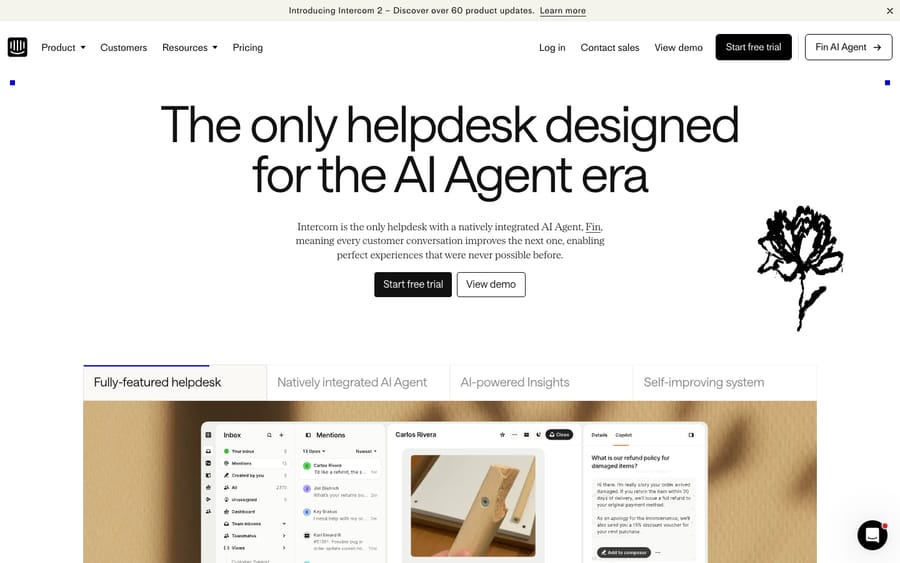
Intercom is worth it if you're a product-led SaaS or digital-first business whose customers live inside a web or mobile app, you value in-app messaging and a strong AI agent, and you have a knowledge base good enough to feed that agent. For that profile, it's one of the best tools you can buy.
Intercom is not worth it if you're a budget-conscious SMB, you run simple email-first support where a polished messenger is overkill, or you need flat pricing you can forecast to the dollar. At that end, you pay premium rates for capability you won't fully use, and the per-outcome AI billing turns your bill into a moving target.
Everything below is the reasoning behind that split.
What does Intercom actually cost per month?
Most "is it worth it" debates about Intercom go sideways because people compare the seat price ("$29 a seat, that's reasonable") against tools priced in a completely different way. Intercom's real cost has two independent moving parts, and you have to model both.
1. Seats: what you pay per human agent, per month.
| Plan | Per seat/mo (billed annually) |
|---|---|
| Essential | $29* |
| Advanced | $85 |
| Expert | $132 |
*Intercom has also shown $19 for Essential in a live pricing test. Monthly billing costs more, but the pricing page does not list the monthly rates, so confirm yours at checkout.
2. Fin, the AI agent, billed per outcome. This is the part that makes Intercom Intercom in 2026, and it's billed separately at $0.99 per outcome on every plan. An outcome is a resolution (the customer confirms the answer helped, or doesn't ask for more help) or a procedure handoff (Fin completes a configured workflow and hands off). Fin charges once per conversation at most, and never per seat. It's usage billing layered on top of your seats, and it scales with your volume, which is the number you can't predict on day one.
On top of those two, add-ons stack: Copilot (agent assist) at $29 per agent a month billed annually or $35 monthly, Proactive Support Plus at $99 a month including 500 outbound messages, plus usage fees for SMS, WhatsApp and phone. None of these are in the seat price.
So the value equation isn't "is the entry seat worth it." It's: (seats × plan price) + (monthly Fin outcomes × $0.99) + add-ons, measured against how many support hours Fin saves you and how much the in-app experience is worth to your business. Worth-it depends on the outcomes, not the seat price.
What does a real 8-agent team pay?
Seat math alone misleads, so here is a realistic mid-size scenario.
Say you're an 8-agent team on the Advanced plan, handling steady chat and email volume, and Fin resolves around 2,100 outcomes a month (plausible for a product with decent traffic and a solid help center):
- Seats: 8 × $85 = $680/mo
- Fin: 2,100 × $0.99 = $2,079/mo
- Subtotal: $2,759/mo, before Copilot, proactive messaging or WhatsApp.
Add Copilot for the team (8 × $29 = $232) and Proactive Support Plus ($99) and you reach about $3,090 a month, or about $37,000 a year. Look at the split: the seats are under a quarter of the bill. Fin is the bill. Teams that budget for seats alone get surprised by outcomes.
Now the worth-it test. At $2,079 a month, Fin is resolving 2,100 tickets without a human touching them. If each would have cost an agent 10 minutes, that's 350 agent-hours, more than two full-time people. For a team buried in repetitive volume, that math works. For a team handling 150 nuanced tickets a month, paying premium seats plus a per-outcome meter for an AI with little to deflect, the same math is upside down.
That's the crux: Intercom's value scales with volume and knowledge-base quality. Above a few hundred well-documented conversations a month, the economics tend to pay off. Below that, or with thin help content that caps what Fin can resolve, you're paying for a Ferrari to drive to the mailbox. Salesforce cites a 76% average resolution rate for Fin (Salesforce, 10 September 2026), but that is an average across customers who have invested in their content; sparse docs pull any AI agent well below it. Full math in our pricing explainer.
What do real users say about Intercom?
Aggregate ratings are the closest thing to a crowd-sourced verdict, and Intercom's are strong. Observed June 2026:
- G2: 4.5 / 5 from roughly 3,500 reviews, a large sample, with Fin often ranked among the top AI agents on G2 by review volume.
- Capterra: 4.5 / 5 from about 1,100 reviews, with Ease of Use and Customer Service scoring in the mid-4s.
Those numbers say the product is good. They don't say whether it's worth it for you, and that's where the content of the reviews matters more than the score. The pattern is consistent.
On the worth-it side, reviewers praise ease of use and the interface. One Capterra reviewer's sentiment, echoed across the listing: "for over a year, I've loved Intercom's ease of use… the interface is clean." Another recurring theme is Fin pulling real weight: reviewers credit it with meaningfully reducing ticket volume and freeing agents for harder work. The teams that call Intercom worth it are almost always the ones that leaned into the AI and in-app messaging.
On the not-worth-it side, two themes dominate, and both are about money, not quality. First, raw cost: "the pricing was a little steep, especially as a small business" is repeated almost verbatim across listings. Second, unpredictability: reviewers describe the per-resolution-plus-add-ons model as hard to forecast, captured by one G2 sentiment that "the per-resolution model can become expensive quickly and makes forecasting support costs harder." Almost nobody says Intercom is a bad product; the "not worth it" camp says it's a good product at a price they couldn't justify. That distinction is the whole decision.
(Ratings and quotes observed June 2026 on G2 and Capterra and presented as recurring reviewer sentiment; those pages block automated capture, so attribution is paraphrased from listing themes. Verify before relying on them.)
Who is Intercom worth it for?
- Product-led SaaS and digital-first businesses. If your customers already live inside your app, Intercom's Messenger and proactive messaging deliver value no email-first desk can match.
- Scale-ups betting on AI deflection. Teams with real volume and a solid knowledge base get the most from Fin's per-outcome model: high deflection spreads the seat cost and the AI pays for itself.
- Teams that treat CX as part of the product. If support, onboarding nudges and in-app engagement are part of how you retain customers, the integrated toolkit justifies the premium.
- Mid-market and up that can absorb usage billing. If a variable AI line item doesn't break your finance team, and you'll model it, the ceiling on value is high.
Who is Intercom probably not worth it for?
- Budget-conscious SMBs and startups. You pay premium seat rates for breadth you won't use, and the features that make Intercom shine sit on the $85 and $132 tiers. Reviewers in this group are the loudest "not worth it" voices.
- Simple, email-first support teams. If you don't need a top-tier messenger or an AI agent, you're buying a platform for one feature. A simpler, flat-priced desk is better value.
- Teams that fear a variable bill. If a per-outcome meter that can swing your monthly spend worries you, Intercom's model is a poor fit however good the product is.
- Low-volume or thin-knowledge-base teams. Fin can't deflect what your docs don't cover, so you'd pay the premium without the deflection that earns it back.
If you land in this group, see the field before deciding. We line up the strongest options in the best Intercom alternatives.
Does the Salesforce acquisition change whether Intercom is worth it?
A worth-it call in 2026 has to factor in ownership. On 15 June 2026, Salesforce signed a definitive agreement to acquire Fin (the company formerly named Intercom, rebranded on 12 May 2026) for roughly $3.6 billion, folding it into the Agentforce platform, and completed the acquisition on 10 September 2026. The help-desk product keeps the Intercom name for now, and the $0.99 outcome price is unchanged since the deal closed.
This isn't a reason to rule Intercom out. Day to day nothing has changed yet, and the underlying tech is exactly why Salesforce bought it. But it's a real, soft con: after the acquisition, the standalone roadmap, pricing and small-and-mid-market focus are uncertain until integration plans firm up. If you're signing a multi-year contract, ask your rep direct questions about the next 18 months before you commit. (Per Salesforce's press release, TechCrunch and CNBC, 15 June 2026, and Salesforce's completion release, 10 September 2026.)
Where does an AI agent layer like Macha fit?
The thread running through every "not worth it" review is the same: Intercom's AI value is bundled into its own ecosystem. You pay per Fin outcome, on Intercom's seats, on Intercom's desk. That's a clean deal if Intercom is your help desk. Plenty of teams run a different desk and just want an AI agent layer on top of it, without moving platforms.
That's the category our own product, Macha, sits in, disclosed plainly because it's ours. Macha runs on Zendesk, Freshdesk, Gorgias, Front, HubSpot or Intercom, and it is a layer, not a platform. If Intercom is your platform, Macha can put agents on your Intercom inbox, but it will not replace Intercom, and Fin is the native path. Macha is not a help desk and not an Intercom alternative. It reads the customer's actual question, pulls from your connected knowledge and resolves in the thread, billed per ticket (charged once however many messages it takes) rather than per seat or per resolution: one plan from $299 a month for up to 750 tickets, with setup and monitoring by the Macha team included. If you're on Zendesk, you can see how the agent layer works or try it with $50 of free usage and no credit card. If you're happy on Intercom, stick with Fin.
Frequently asked questions
Is Intercom worth it in 2026? For the right team, yes. It carries strong ratings (G2 4.5/5 from roughly 3,500 reviews, Capterra 4.5/5 from about 1,100 as of June 2026) and excels at in-app messaging, modern UX and AI deflection through Fin. It's worth it for product-led SaaS and scale-ups with the volume and knowledge base to feed the AI. It's harder to justify for budget-conscious SMBs, simple email-first support, or teams that need flat pricing.
Is Intercom worth the money? That depends on your volume and your docs. The real cost is seats plus Fin outcomes ($0.99 each) plus add-ons. Seats are $29 (Essential), $85 (Advanced) and $132 (Expert) per seat a month billed annually. In our 8-agent Advanced example, Fin outcomes came to $2,079 against $680 of seats. Above a few hundred well-documented conversations a month, the deflection tends to pay for the premium; below that, the value gap is real. See our pricing explainer.
Should I use Intercom for a small business? Usually only if you're a product-led SaaS where in-app messaging and Fin deflection matter. For general SMB email and chat support, smaller teams consistently report it's expensive relative to the value they get, and they are the loudest "not worth it" group in the reviews. Weigh the alternatives first.
Is Fin AI worth paying for? It's capable and highly rated, and Salesforce cites a 76% average resolution rate. Its value still hinges on conversation volume and knowledge-base quality. With a few hundred well-documented conversations a month, $0.99 per outcome can pay off; with sparse docs, resolution rates and value drop sharply.
Does the Salesforce acquisition change whether Intercom is worth it? Not the day-to-day value, but it adds roadmap uncertainty. Salesforce agreed to acquire Fin (Intercom's parent) for about $3.6B on 15 June 2026, folding it into Agentforce, and completed the deal on 10 September 2026. Standalone pricing and product priorities could shift under new ownership, so factor it in before signing a long contract.
So should you buy Intercom?
Intercom is worth it for the team it was built for. If you're a product-led SaaS or scale-up that lives in-app, has real support volume, has invested in your knowledge base, and can absorb usage pricing, you're buying one of the best customer experiences in the category and the value equation works in your favor. The 4.5 ratings are mostly this team talking. If you're a budget-conscious SMB, run simple email-first support, or need pricing you can forecast to the dollar, it's a good product that's not worth it for you: you'd pay a premium for capability you won't fully use, on a meter you can't fully predict.
Either way, don't decide on the seat price. Model your monthly cost (seats + Fin outcomes + add-ons) against the support hours it saves, read our full Intercom review and pricing explainer for detail, and if the value gap looks real, give the alternatives a serious look before you sign.
Seat, Fin and add-on prices checked against Intercom's pricing page on 24 September 2026; Fin costs depend on usage. Ratings and review sentiment observed June 2026 on G2 and Capterra and may change. The Salesforce acquisition, announced 15 June 2026, completed on 10 September 2026. Macha is our own product, disclosed as such.
Add AI agents to your Intercom
Macha reads the conversation, drafts the reply and takes the action, inside the Intercom you already run.