Intercom
 Shopify
 Stripe
 Slack
Slack Notion
 Google Workspace
 Confluence

Jira Intercom Integration: Connect Them for Your AI Agent (2026)


Support and engineering live in two systems, and your agents feel it every day: a bug report lands in Intercom, but the issue that tracks the fix, its status, and its owner all live in Jira — one tab over. A Jira Intercom integration is one of the most-requested connections in customer support, and there's more than one way to do it depending on what you actually need.

This guide covers both: the native Jira app for Intercom (and where it stops), and how to give your AI agent live Jira issue lookups and actions right inside a conversation using a Custom Tool.
Framing first. Macha runs on top of the Intercom you already use — it's an AI-agent layer, not an Intercom or Jira replacement. Fin and your Inbox keep working as they do; Macha reads the conversation, reasons, and reaches into Jira to answer or act.
Want the broader picture on connecting any app to Intercom? See our pillar on building custom Intercom integrations — this piece focuses on giving your AI agent live Jira access.
The native option — and where it stops
Intercom does offer a native Jira app in the App Store. The free Jira Cloud for Intercom app lets a human agent create and link Jira work items from the Inbox and get live status updates on a conversation when the linked issue changes; a paid companion app and the separate "Jira for Tickets" integration add commenting and unlinking. If all you need is a human manually linking issues to conversations, that may be enough.
Where it stops:
- It's agent-driven by a human, not the AI. A person clicks to create or link an issue; it doesn't let an AI agent decide to file a bug or check a status mid-conversation and reason over the result.
- It's Jira Cloud only. The native app supports Jira Cloud — if you run Jira Server or Data Center, it's off the table.
- It's fixed. You get the link-and-status flow the app provides — not the specific query or field write your workflow needs (e.g. "is there already an open issue for this?" or "add the customer's account to the ticket").
For a lot of teams, manual linking is fine. For anyone who wants their AI agent to actually use Jira, there's a lighter, more flexible path.
What you actually want: the agent using Jira live
The high-value version of this integration isn't a manual link — it's the agent doing the work. A customer reports a bug in Intercom; the agent recognizes it, checks Jira for an existing open issue, and either reports the live status back ("this is fixed in the next release") or files a new issue with the details — grounded in Jira, not a copy-paste. That's what a Custom Tool enables.
How to connect them with a Custom Tool
A Custom Tool is a single action you define once and point at Jira's REST API. No marketplace app, no code — and it works against Jira Cloud, Server, or Data Center.
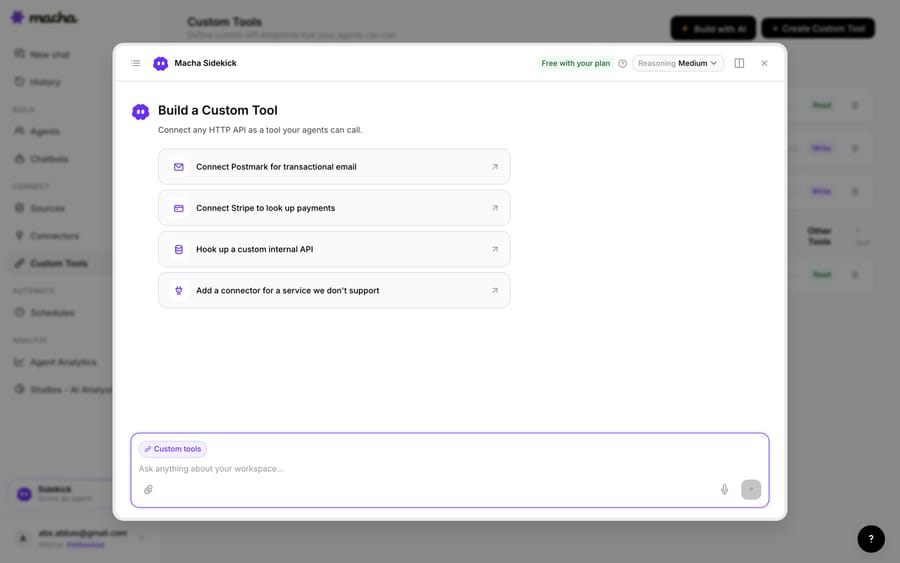
1. Point it at the Jira API. Jira exposes a REST API (with OAuth 2.0 or an API token); you give Macha the endpoint and credentials. The built-in Sidekick can scaffold the request from a plain-English description if you'd rather not fill in the form.
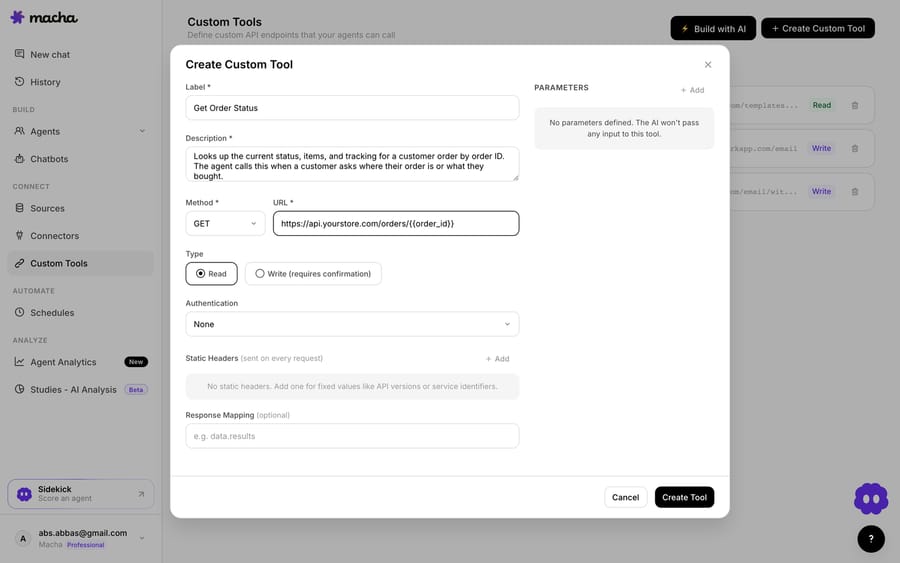
2. Define the action. Give it a label and a description the AI uses to decide when to call it — e.g. "Search Jira for an open issue matching this bug" or "Create a Jira bug report from this conversation" — set the method and URL (a JQL search or the issue endpoint on Jira's REST API, with placeholders like {{summary}}), and choose Read or Write. A status lookup is a Read; creating an issue is a Write, which requires confirmation before it runs.
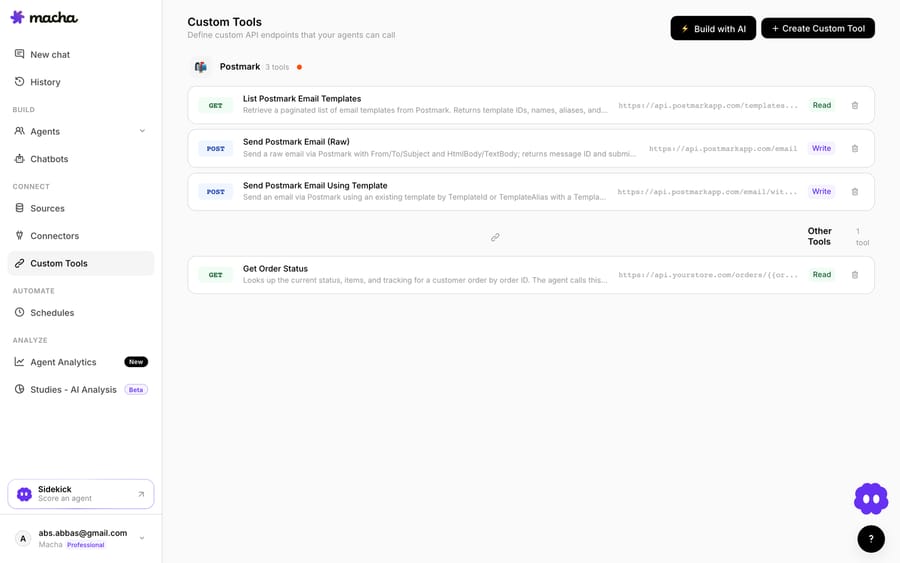
3. The agent uses it live. Once the tool exists, the agent calls it mid-conversation, passes the bug details or issue key, and reasons over what Jira returns — reporting the status or filing the issue.
Read vs Write, and staying safe
Because a Custom Tool can reach into Jira, the guardrails matter: Read tools (issue lookups, status checks) are free to call; Write tools (create an issue, add a comment, transition a status) require confirmation. Each tool is scoped to one action, permissioned per agent, and every call is audited. Jira's OAuth or API token handles credentials, so secrets never live in the conversation.
Teams usually build a few Jira tools and group them — a "search for existing issue," a "create bug report," a "read issue status" — alongside tools for their other systems.
Native app vs Custom Tool — which to use
- Use the native Jira app if you're on Jira Cloud and just want human agents to manually create and link issues to conversations with live status updates.
- Use a Custom Tool when you want your AI agent to search, file, or read Jira issues from the conversation, you run Jira Server or Data Center, or you need a specific query or write the native app doesn't expose. The two can coexist.
Beyond the lookup
Once the agent can reach Jira, the same pattern covers more: check for a duplicate before filing, read an issue's status to answer "is this fixed yet?", create a bug with the customer's account and repro steps attached, or transition an issue on resolution. And because Custom Tools aren't Jira-specific, the same approach connects your CRM, billing system, or internal API — see the Custom Tools integration directory for 200+ tools, or the full pillar on building custom Intercom integrations.
The bottom line
Intercom's native Jira app lets a human link issues to conversations. A Custom Tool puts Jira in your AI agent's hands — live searches, status reads, and issue creation, decided in context, on any plan and any Jira deployment, no code. You describe the action, point it at the Jira API, and your Intercom agents can use it inside a conversation with Read/Write guardrails and a full audit trail.
Ready to try it? See how Custom Tools work, browse the integration directory, or start a free trial and wire up your first Jira tool today.
Frequently asked questions
Does Intercom have a native Jira integration? Yes — the free Jira Cloud for Intercom app lets human agents create and link Jira work items from the Inbox with live status updates (a paid companion app adds commenting). It's Jira Cloud only and human-driven; a Custom Tool adds live, agent-driven searches and actions on any Jira deployment.
Do I need an engineer to connect Jira to Intercom this way? No. You describe the action in plain English and Macha's Sidekick scaffolds the Jira request, auth, and parameters. Technical teams can go deeper with full control over the JQL query, issue fields, headers, and response mapping.
Can the agent create Jira issues, or only read them? Both. Reads (searches, status checks) run freely; writes — creating an issue, adding a comment, transitioning a status — require a confirmation step, and you control which agents can use them.
Does it work with Jira Server or Data Center? Yes. Unlike the native app, which is Jira Cloud only, a Custom Tool can point at any Jira REST API endpoint — Cloud, Server, or Data Center.
Resolve tickets automatically with AI agents
Macha's AI agents work on top of the help desk you already use — no code.