Shopify
 Stripe
 Slack
Slack Notion
 Google Workspace
 Confluence

How Does Macha's Shopify Integration Work? Orders, Customers and Refunds for Your AI Agent


Order-status and refund-status questions fill ecommerce queues, and every one needs the real order pulled from Shopify. Macha's Shopify connector gives the AI agents in your help desk that order data, plus refunds behind a confirmation step.
Key takeaways
- Macha's Shopify connector, shipped March 22, 2026, connects over OAuth and gives agents eight tools: search_products, get_order, lookup_customer, get_customer_orders, search_orders, get_discounts, create_refund and Cancel Order.
- Macha's create_refund tool needs human confirmation before it runs, so the agent proposes a refund and a person or a defined policy approves it before money moves.
- A Macha WISMO resolution that reads the ticket, calls get_order and posts the reply counts as one ticket, about $0.40 on the $299-a-month plan for 750 tickets.
- Gorgias says each resolved conversation costs $0.90 on most plans and $1 on Starter, while eesel sells credit batches from $299 a month for 500 tickets or chats and Richpanel $0.20 per AI-handled conversation.
- Macha's Shopify connector shipped with seven tools on March 22, 2026, and the tool picker and public integrations page now list eight, including Cancel Order.

Macha's Shopify integration connects your store over OAuth and gives the AI agents inside your existing help desk eight Shopify tools: search_products, get_order, lookup_customer, get_customer_orders, search_orders, get_discounts, create_refund and Cancel Order, with refunds and cancellations held behind a confirmation step. Macha shipped the OAuth connector on March 22, 2026, and it runs on Zendesk, Freshdesk, Gorgias, Front, HubSpot or Intercom, so the agent answers inside the ticket your team already works.
| Question | Answer |
|---|---|
| How it connects | Shopify OAuth through the Macha AI app |
| Tools | 8: products, orders, customers, order history, order search, discounts, refunds, cancellations |
| Refunds | create_refund needs human confirmation before it runs |
| Where the agent works | Inside your help desk, plus Slack for internal lookups |
| Price | Per ticket: $299 a month for 750 tickets, about $0.40 each |
The framing matters, because it changes how this fits: Macha is not a Shopify support app that replaces your helpdesk. It is an AI agent layer on top of the help desk you already run, and the Shopify connector gives those agents real commerce context and the ability to act inside the ticket. Further down we compare it with the native Shopify apps (Gorgias, Richpanel) and another agent layer (eesel), including where they're the better pick.
What makes a Shopify AI support agent more than a chatbot?
There's a meaningful difference between a chatbot that talks about orders and an agent that reads them. As one competitor guide bluntly put it, "a tool that just chats without pulling order history is a generic chatbot in a Shopify costume." The whole value is in the data round-trip: a customer writes in, the agent identifies the order, fetches the live fulfillment and payment status from Shopify, and answers with the actual tracking link, not a templated "please allow 5–7 business days."
Macha does this as a connector, not a rebuild of your stack. The agents live wherever your tickets already live. When a ticket lands in Zendesk, the agent reads it, calls Shopify for the order, drafts (or sends) the reply, and updates the ticket, all in one pass. That's the difference between bolting on another inbox and adding intelligence to the one your team already uses.
How do you connect Shopify to Macha?
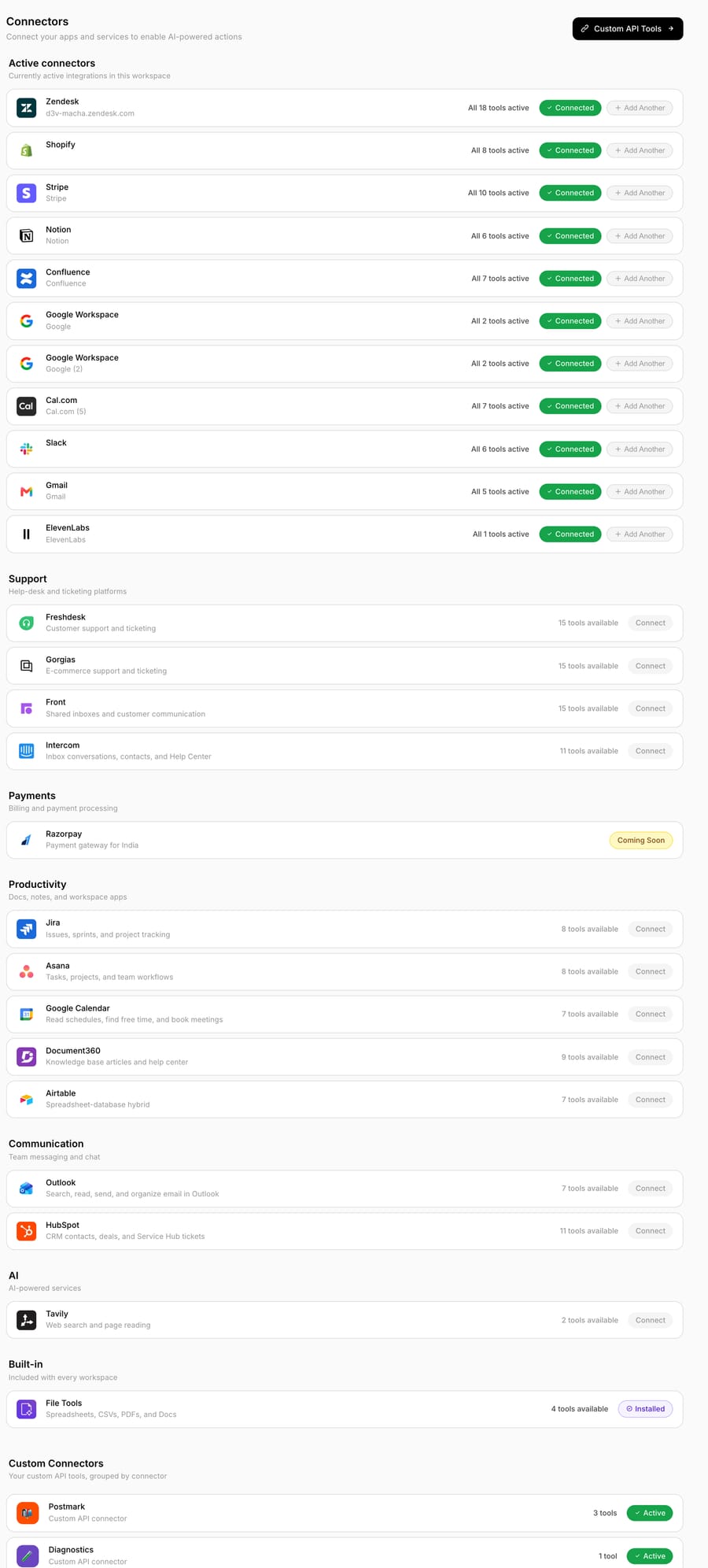
You add Shopify the same way you add any connector in Macha: open the connector library, pick Shopify, and authorize. The connection runs through Shopify OAuth, so you grant scoped access through Shopify's own consent screen rather than copying long-lived API keys into a form. Macha shipped the full OAuth Shopify connector on March 22, 2026, and it ships with a pre-configured demo Shopify support agent so you can see the tools working against sample data before you point them at your live store.
OAuth matters more than it sounds. None of the major Shopify-AI buyer guides I read for this piece even mention how their agents authenticate; they jump straight to features. But auth is exactly where a commerce integration earns or loses your trust: scoped OAuth grants are revocable from the Shopify side, survive password rotations, and don't leave a static admin key sitting in a settings panel. It's the unglamorous part that an operator actually has to live with.
Which Shopify tools can a Macha agent use?
Once connected, your agents can call any of these. Each one is a tool the agent decides to use based on the conversation; you don't script a rigid flow, you give the agent the tools and the policy and let it reason about which to call.
| Tool | What the agent can do |
|---|---|
| search_products | Find products in the catalog by title, SKU, vendor, or type, for availability and "do you sell X?" questions. |
| get_order | Pull one order by ID or order number with full line items, fulfillment status, tracking, and payment status. The WISMO workhorse. |
| lookup_customer | Retrieve a Shopify customer profile (contact details and account history) to verify who you're talking to. |
| get_customer_orders | List a customer's full order history, so the agent has context beyond the single order in front of it. |
| search_orders | Find orders by email, fulfillment status, financial status, or date range, for "my order from last week" with no number. |
| get_discounts | Read active discount and promotion details to answer "is my code still valid?" accurately. |
| create_refund | Issue a refund against an order, gated behind an explicit confirmation step (see below). |
| Cancel Order | Cancel an order. By default it refunds to the original payment method and restocks the items, and it asks for confirmation in chat. |
The "where is my order?" loop
This is the one that pays for the integration. A pattern Macha ships as a use case is auto-resolve order status inquiries: the agent reads the Zendesk ticket, calls get_order (or search_orders if the customer didn't give a number), and posts a reply with the live status and tracking, then updates the ticket fields. The customer gets a real answer in seconds; the queue gets shorter; no agent ever opened the Shopify admin in a second tab. We walk through the full pattern in How to auto-resolve "where is my order?" inquiries with AI.
It works beyond the helpdesk too. Another shipped pattern, handle "where is my order" from Slack, lets the agent answer an internal "hey, where's order #1043?" from a teammate by pulling the order and replying in-thread: same tool, different surface.
Customer and order lookup mid-conversation
Half of good support is context. With lookup_customer, get_customer_orders, and search_orders, an agent can quietly establish who it's talking to and what they've bought before it answers, so a VIP gets recognized, a first-time buyer gets the careful version, and a "this is my third broken unit" complaint is verifiable instead of taken on faith. Macha ships this as look up order details mid-conversation (Get Order + Get Customer) and feeds it into richer flows like alert the team when a VIP customer submits a ticket, where the agent pulls the customer and their order history before deciding whether to escalate.
Can the AI agent issue Shopify refunds?
Refunds are where most teams get nervous about AI, and rightly so. create_refund and Cancel Order are the Shopify tools that move money, so Macha treats them differently from the read-only tools: they're gated behind a confirmation step. The agent can do all the reasoning (identify the order, check the financial status, determine the eligible amount) and then propose the refund rather than silently firing it. A human (or an explicit policy you've defined) confirms before the money actually moves.
We unpack the propose-and-confirm pattern, and how to widen it as trust grows, in Process refund requests automatically (safely) with an AI agent.
This is the single biggest gap I found in the competitive set. The popular 2026 Shopify-AI guides talk about agents that "write refunds in-platform," and they talk about governance in the abstract (SOC 2, ISO 42001, "deterministic controls") but none of them describe an actual per-action confirmation gate on the refund itself. A confirmation gate is the thing that lets you turn refunds on at all: you get the speed of the agent doing the lookup and the math, without handing it an unsupervised checkbook. Start with the agent drafting refunds for a human to approve; widen the policy as you build trust in its judgment.
For refund flows that also need to verify the underlying payment (say, an order paid through Stripe rather than Shopify Payments), Macha pairs the Shopify connector with Stripe so the agent can read the payment before proposing the refund. The shipped handle order cancellation requests use case strings exactly this together: get_order from Shopify, Get Payment from Stripe, then a comment back on the ticket.
How does it fit the helpdesk you already run?
To be explicit, because it's the thing people get wrong: you do not replace your help desk (Zendesk, Freshdesk, Gorgias, Front, HubSpot or Intercom) with Macha. The Shopify connector adds commerce superpowers to the agents that work inside those tools. A typical end-to-end shape looks like this:
- A ticket arrives in your helpdesk.
- The Macha agent reads it and recognizes a WISMO question.
- It calls Shopify
get_orderfor live status and tracking. - It drafts or sends the reply and updates the ticket.
- If the customer wants a refund, the agent proposes
create_refundfor confirmation instead of guessing.
If you're on Zendesk specifically, the Macha on Zendesk page walks through how the agents, triggers, and connectors line up inside that helpdesk. The Shopify connector is one tile in a wider connector library; most ecommerce teams run it alongside Zendesk and Stripe, and route the hard cases to Slack.
Which AI agent for Shopify should you choose?
Most "best AI agents for Shopify" roundups mix two different kinds of product, and it's worth being clear about which you actually need before you compare prices. Some are native Shopify support apps with their own inbox and chat widget (Gorgias, Richpanel); some are agent layers that bolt onto a helpdesk you already run (eesel, Macha). They solve overlapping problems from opposite ends.
| Tool | What it is | Best when… |
|---|---|---|
| Gorgias | Native ecommerce helpdesk + AI agent | You want one all-in-one platform and don't already have a ticketing system. |
| Richpanel | Native ecommerce helpdesk + AI + self-service portal | You want a per-seat helpdesk ($99 a seat) with AI at $0.20 per AI-handled conversation and a free self-service portal. |
| eesel | AI agent layer over your existing helpdesk | You want self-serve automation billed in monthly credit batches and already have a helpdesk. |
| Macha | AI agent layer over your existing helpdesk | You already run Zendesk, Freshdesk, Gorgias, Front, HubSpot or Intercom and want agents that read Shopify and act, with refunds behind a confirmation gate and per-ticket pricing. |
For a wider, vendor-by-vendor look at the category, see our guide to AI customer service for Shopify stores. The honest takeaway: if you have no helpdesk, a native app is the more direct buy. If you already have one and want to make it smarter without migrating, that's the Macha shape, and the OAuth connection and refund confirmation gate described above are where it differs from the other agent layers.
What does the Shopify integration cost?
Macha bills per ticket: one conversation, charged once, however many steps the agent takes to finish it. Pricing starts at $299 a month for 750 tickets, about $0.40 each. The model an agent runs on doesn't change that number.
Make it concrete. A typical fully-automated WISMO resolution takes three steps, and the whole thing is one ticket:
| Step | Action | What it adds to the bill |
|---|---|---|
| 1. Read the incoming ticket | classify / read | nothing extra |
| 2. Look up the order | get_order | nothing extra |
| 3. Draft and post the reply | reply | nothing extra |
| Total | one resolved WISMO ticket | 1 ticket ≈ $0.40 |
If the customer didn't give an order number and the agent has to search_orders first, or it adds a lookup_customer to recognize a VIP, that's more work but it is still the same single ticket. The point: a clean WISMO resolution costs about $0.40 however many lookups it takes, and you can see every action in the run. Because the bill is per conversation rather than per outcome, you're not penalized for the agent doing thorough lookups, and you're never arguing about what counted as a resolution. Start with the free trial ($50 of usage, about 125 tickets, no credit card) and see the pricing page: the same plan runs from $599 for 1,500 tickets up to $3,999 for 10,000, with setup and monitoring by the Macha team included.
For comparison, from each vendor's own pages on September 24, 2026: Gorgias says each resolved conversation costs $0.90 on most plans and $1 on Starter, on top of a helpdesk plan. eesel sells monthly credit batches from $299 for 500 credits (one credit per ticket or chat, about $0.60 each on that batch; rechecked October 6, 2026). Richpanel charges $99 a seat per month plus $0.20 per AI-handled conversation, with its self-service portal included free. Macha bills per ticket as well: one conversation, charged once however many messages and lookups it takes, from $299 a month for 750 tickets, about $0.40 each, and never per resolution, so the bill never hangs on an outcome definition you don't control.
When is Macha the wrong fit for Shopify support?
It's only fair to mark the edges:
- You need a helpdesk (or a chat surface) already. Macha is the agent layer; it isn't a standalone Shopify support app with its own customer-facing widget you install from the App Store. If you have no helpdesk and want a one-click Shopify chat bubble, a native app like Gorgias or Richpanel is a more direct fit; Macha shines once you have a ticketing system you want to make smarter.
- The tool list has grown since the release. The OAuth connector shipped March 22, 2026 with seven tools; the tool picker and our integrations listing now show eight, with Cancel Order added (checked September 28, 2026). If your dashboard shows a newer flow, that's the one to trust.
- Refund automation should start supervised. Don't flip
create_refundto fully autonomous on day one. Run it in propose-and-confirm mode, watch the proposals against your refund policy, and only then widen the auto-approve conditions. The confirmation gate exists precisely so you can do this gradually. - It's commerce context, not a recommendation engine. The tools are built for support resolution: orders, customers, refunds, availability. If your goal is conversion-optimized product recommendation or cart recovery, that's a different class of tool.
FAQ
Does Macha replace my Shopify helpdesk app? No. Macha is an AI agent layer that runs on top of Zendesk, Freshdesk, Gorgias, Front, HubSpot or Intercom. The Shopify connector gives those agents live order, customer, and refund tools inside the helpdesk you already use.
How does the agent connect to Shopify? Through Shopify OAuth: you authorize scoped access on Shopify's own consent screen, and the grant is revocable from your Shopify admin. No static admin API key to paste or rotate.
Can the agent issue refunds automatically? It can propose them. create_refund is gated behind a confirmation step, so the agent does the lookup and the math but a human (or an explicit policy you set) confirms before money moves. You can widen the policy as you build trust.
What can it answer without any human involvement? Read-only questions, such as order status and tracking (WISMO), customer and order history, product availability, and discount validity, are the natural fully-automated set, because they only read from Shopify and never change anything.
How is it priced? Per ticket: one conversation, charged once, however many lookups and replies it takes. From $299 a month for 750 tickets, about $0.40 each. Start with the free trial ($50 of usage, no credit card required) and see pricing.
Which other connectors pair well with Shopify? Stripe for payment verification on refunds and cancellations, your helpdesk (Zendesk, Freshdesk, Gorgias, Front, HubSpot or Intercom) for the ticket itself, and Slack for internal lookups and escalations. Browse the full integrations library.
Get started
If WISMO and refund questions are eating your queue, the fastest path is to connect the store and let an agent take the first pass. Start a free trial ($50 of usage, no credit card required), add the Shopify connector over OAuth, and point a support agent at your order-status tickets; read the docs for the full connector walkthrough, or see how the layer fits on Zendesk.
Written by Abbas (Customer Support & AI, Macha) · Reviewed by Ankeet Guha (Co-founder & CTO) · Published 2026-06-24 · Last updated 2026-06-24.