Intercom
 Shopify
 Stripe
 Slack
Slack Notion
 Google Workspace
 Confluence

MaestroQA: The Complete Guide (2026)


MaestroQA is a conversation-quality platform that scores customer service interactions against a rubric a team builds itself, using a mix of automated AI grading and human review, then feeds the results into coaching, root-cause analysis and reporting. It doesn't publish list pricing. The most credible number we could find, from Vendr's aggregated contract data, puts the median contract at $23,520 a year, with real deals ranging from $6,720 for a small team to over $131,000 for an enterprise rollout. This guide covers what MaestroQA actually does, how its AI grading and coaching mechanics work, what it really costs, what verified users say, and how it stacks up against Zendesk QA and Level AI.

We build AI agents for customer service ourselves, so we read a QA platform like this for the same reason a buyer would: to see whether the scoring is mechanical or just a dashboard with opinions attached.
What is MaestroQA?
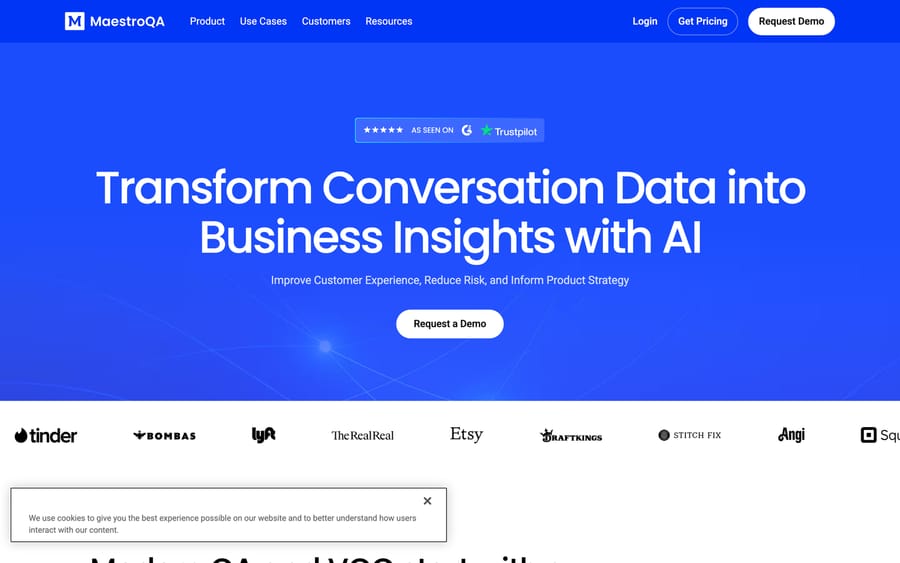
MaestroQA was founded in 2013 and is based in New York, with 51-200 employees according to its LinkedIn profile. We found no public funding announcement or Wikipedia entry for the company: it reads as an established, lightly-funded vendor that grew quietly over 13 years. It sells into support organizations that already run a help desk (Zendesk, Gladly, Freshworks and others) and want a dedicated layer for measuring quality, on top of whatever CSAT survey they already collect.
The company's own positioning is blunt about a real limitation of CSAT: a customer can leave a five-star rating on an interaction where the agent broke policy, missed an upsell, or gave an answer that will generate a follow-up ticket next week. MaestroQA's pitch is that scoring the conversation itself catches problems a satisfaction score misses entirely, since the survey only measures how the customer felt at the end.
Customers named on MaestroQA's site include Etsy, DraftKings, Stitch Fix, Angi, Square, Tinder, Bombas, Lyft and The RealReal, alongside dozens more listed on its customers page. Individually attributed results include Getaround (30% CSAT increase), Aceable (147% CSAT increase), Etsy (14%) and Greenhouse (10%), plus Freshly and MeUndies each reporting CSAT in the 96-99% range. Those numbers come from MaestroQA's own case studies, so read them as the vendor's selected best wins.
How MaestroQA's AI actually works
The product is built around three connected layers.
AutoQA scores every conversation, not a sample, using a mix of three scoring methods MaestroQA calls LLM-based, phrase-match and process-based metrics. A phrase-match rule can check whether an agent used a required disclosure; an LLM-based metric can judge something fuzzier, like whether the agent showed empathy; a process-based check can confirm a required step happened, such as verifying identity before discussing an account. Because it grades 100% of interactions instead of a manual sample, MaestroQA can surface which specific conversations are worth a human reviewer's time, rather than a QA team spot-checking at random and hoping to catch what matters.
Root cause analysis combines what MaestroQA describes as GPT-powered AI queries with human analysis, letting a QA lead ask a natural-language question across the full conversation set (its AskAI feature) and then validate what comes back against actual transcripts. This is the mechanism that turns a pile of graded tickets into an answer to a specific question, like which onboarding step generates the most confused follow-ups this month.
Coaching takes the graded output and turns it into targeted 1:1 session tracking, tied back to the specific scorecard categories an agent is weak on, rather than a generic "great job this month" review.
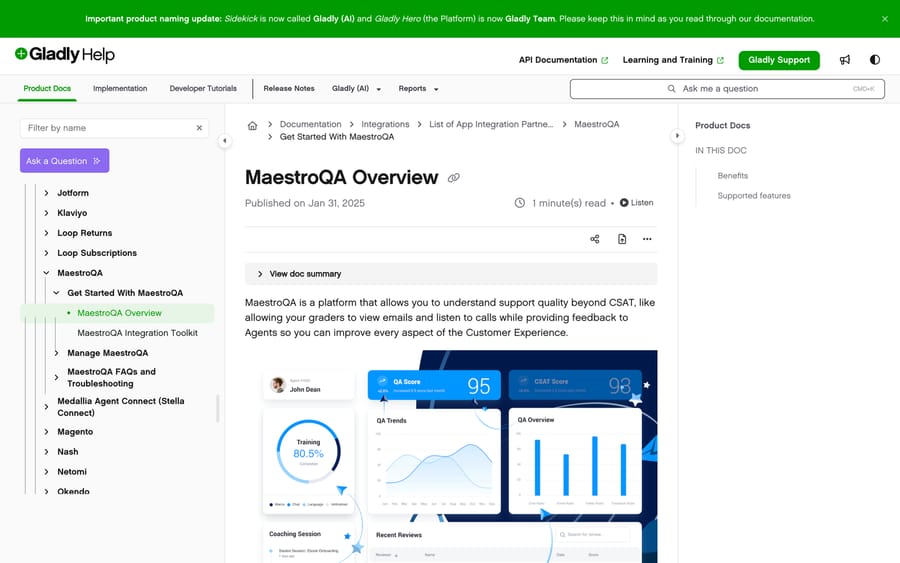
The mechanism that ties all three together is the scorecard: a team defines its own rubric, weights, and pass/fail thresholds, and MaestroQA applies that rubric consistently across every channel it can ingest, including email, chat, voice transcripts and even screen recordings. That's a meaningfully different approach from a vendor that ships a fixed, generic quality score a team can't edit.
Key features
- AutoQA across 100% of conversations, combining LLM-based, phrase-match and process-based scoring in one rubric.
- AskAI, a natural-language query layer over the full conversation dataset for root-cause and trend questions.
- Custom scorecard builder so QA categories match a team's actual policies instead of a fixed template.
- Calibration tools to check that different human graders are scoring the same conversation consistently.
- Coaching workflows linking scorecard weaknesses to specific 1:1 sessions and tracked improvement.
- Screen capture and call transcription, so a reviewer can see and hear the interaction the score is actually based on.
- Data warehouse and API ingest, for teams piping MaestroQA's output into Snowflake or another BI tool alongside integrations with Gladly, Freshworks, Salesforce and Qualtrics.
Pricing
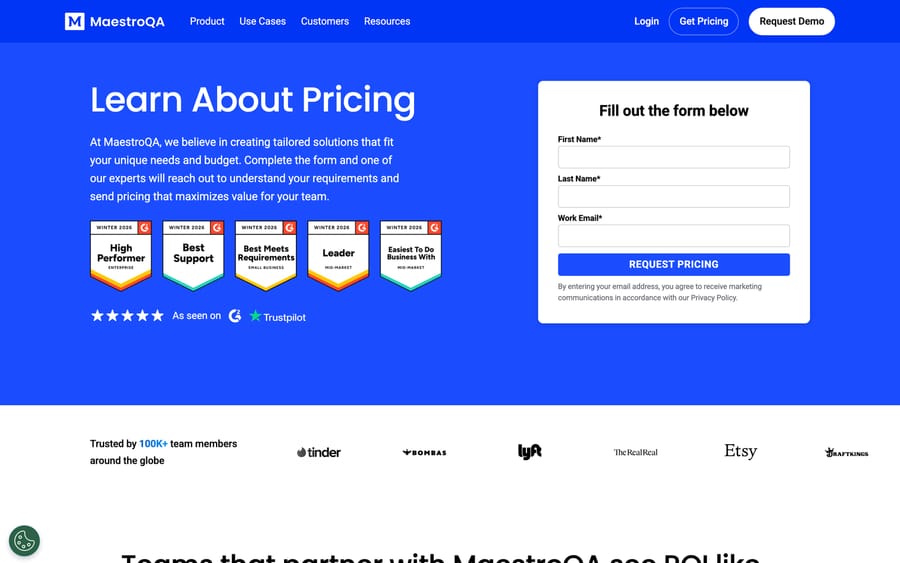
MaestroQA's own pricing page has no numbers on it. It reads: "we believe in creating tailored solutions that fit your unique needs and budget," and routes every visitor to a contact form. We checked it directly on 2026-09-18. There's a real incentive behind that structure for an enterprise-sales vendor: it lets MaestroQA charge a 100-agent contact center a meaningfully different rate than a 15-agent team, without either one seeing what the other pays.
Two very different numbers show up in public data. Capterra and GetApp both list a "$15 per user, per year" starting price, sourced from just three self-reported reviews. Vendr's aggregated real-contract data tells a different story: a median annual contract of $23,520 across 55 tracked deals, with small teams (5-25 agents) paying $6,000-$18,000 a year, mid-market (25-100 agents) paying $18,000-$60,000, and enterprise deployments (100+ agents) running $60,000-$200,000 or more. Vendr also reports typical negotiated savings around 16.5%, with multi-year commitments cutting another 15-25%. The $15/year figure doesn't reconcile with any of that, and doesn't reconcile with a company whose own pricing page routes everyone to sales, so we're treating Vendr's contract data as the credible number and flagging Capterra's as an outlier rather than averaging the two.
What users say
MaestroQA's Capterra listing shows a 5.0 out of 5 average, but from only 3 reviews, too small a sample to treat as representative. G2's review page returned a 403 error during this research pass, so we couldn't independently check its rating there, and MaestroQA has no listing on PeerSpot.
The three reviews we could read are still worth quoting, since they're attributed and specific. Manilka S., a Quality Analyst in e-learning, said "I like how the things are bifurcated between QA and agent" and gave it 10/10. Filippo S., a Support Specialist in IT, praised the "very simple interface that allows to easily manage scoring interactions" but noted "accessing scored tickets and reviews can be sometime more complex than it should be," scoring it 9/10. Gabriela D., in retail customer service, said it gives "a clear and precise view of customer service team performance" but flagged "an initial learning curve" before the benefits show up.
Three reviews isn't enough to call a pattern, but the shape lines up with what a scorecard-driven QA tool would produce: real value once it's configured, some setup friction getting there.
Pros and cons
Pros
- Grades 100% of conversations instead of a manual sample, so a QA team stops guessing which unreviewed tickets might be problems.
- Fully custom scorecards mean the AI grades against a team's own written policy.
- Calibration tooling addresses a real problem in human QA: two reviewers scoring the same call differently.
- Individually attributed customer results (Getaround, Aceable, Etsy) suggest real measured outcomes.
Cons
- No published pricing anywhere, and the two public data points that exist (Capterra's $15/year and Vendr's $23,520/year median) don't agree with each other.
- Independent review volume is thin. Three reviews on Capterra, a blocked G2 page, and no PeerSpot listing make it hard to verify satisfaction at scale from outside MaestroQA's own case studies.
- One reviewer flagged that finding scored tickets after the fact is harder than it should be, a workflow friction point worth asking about in a demo.
- It's a QA and coaching layer. MaestroQA measures how well agents (or bots) already handled a conversation; it doesn't handle the conversation itself.
Who MaestroQA is best for
MaestroQA fits a support organization of meaningful scale, real enterprise contracts start around 25 agents based on Vendr's tiers, that already has a defined quality process and wants to apply it consistently and automatically, across 100% of conversations instead of a random sample. It's a strong match for teams in regulated or reputation-sensitive spaces (Angi, DraftKings, financial services buyers show up in its case studies) where a missed compliance step or a bad-faith promise matters more than average CSAT.
It's a weaker starting point for a small team without an existing QA rubric, since the value depends on defining scorecard categories that mean something, and for any team looking for an AI to reply to customers rather than to grade the agents (or bots) who already did.
MaestroQA vs alternatives
| MaestroQA | Zendesk QA (formerly Klaus) | Level AI | Macha | |
|---|---|---|---|---|
| Model | Standalone QA platform: custom scorecards, AutoQA, coaching, root-cause analysis | QA built into Zendesk's own suite, scoring human and AI-agent interactions | Enterprise CX platform: proprietary scoring models plus AI voice agents | AI agent layer on your existing help desk |
| Scope | Any help desk via integration (Gladly, Freshworks, Zendesk, Salesforce) | Built into the Zendesk suite, requires Zendesk | Contact-center scale, Fortune 500-focused | Customer support, inside Zendesk, Freshdesk, Gorgias or Front |
| Pricing | Not published; Vendr shows a $23,520/year median, $6,720-$131,020+ range | Add-on to a Zendesk Support or Suite plan; not published standalone | Not published; enterprise sales | From $299/month for 750 tickets (about $0.40 per ticket), published |
| Trial | Demo only | Free trial via Zendesk | Demo only | $50 of free usage (about 125 tickets), no credit card, no time limit |
| Best for | Teams wanting a custom rubric independent of any one help desk | Teams already all-in on Zendesk who want QA in the same suite | Large contact centers wanting AI scoring plus AI voice agents | Teams wanting agents to act inside tickets, not just grade them |
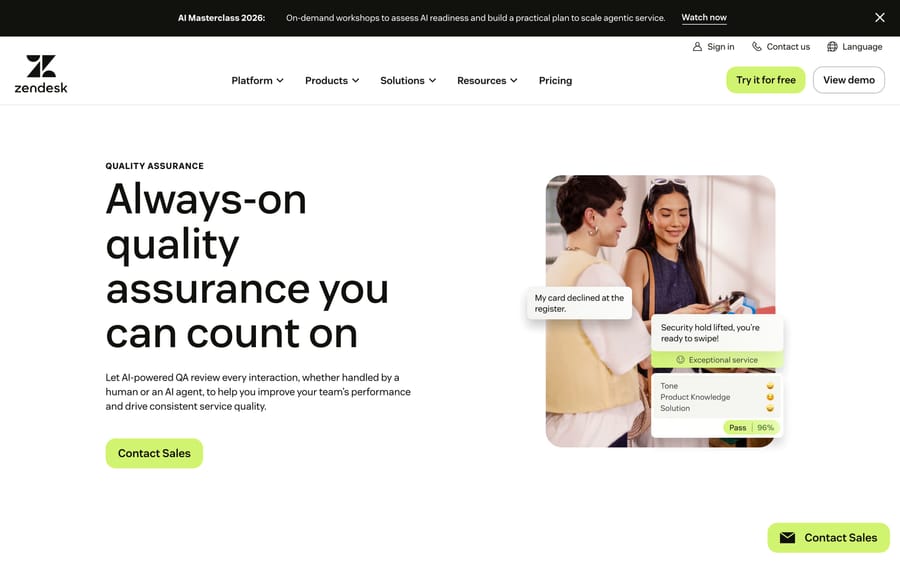
Zendesk QA is the more direct rival for a team already on Zendesk: it grades 100% of interactions with out-of-the-box categories like empathy, solution and tone, requires no separate contract to integrate, and Zendesk's own case studies cite up to 5% CSAT gains and an 80% cut in manual review time. The tradeoff is portability. Zendesk QA is built for Zendesk; MaestroQA works across whichever help desk a team runs, which matters for anyone who might switch help desks later or already runs more than one.
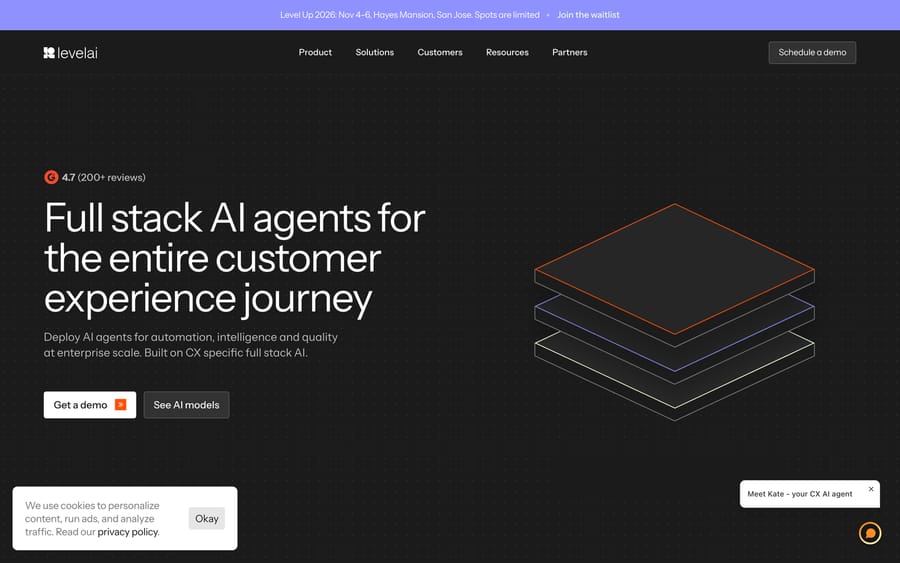
Level AI competes at a different scale, and openly: its homepage cites a 4.7 rating from 200+ G2 reviews, a far bigger sample than MaestroQA has anywhere we could verify. It combines QA scoring with AI voice agents in one platform, aimed at large, high-volume contact centers rather than a mid-market team that just wants better scorecards.
None of the three actually resolves a ticket. MaestroQA, Zendesk QA and Level AI all grade how a conversation went; they don't answer the customer. Macha fits teams that want the other half of the job: AI agents drafting and resolving tickets inside the help desk itself, priced $299/month for 750 tickets (about $0.40 per ticket). A team running Macha still needs a QA layer to check the agent's own output, and MaestroQA's AutoQA works on AI-agent transcripts the same way it works on human ones.
FAQ
How much does MaestroQA cost? MaestroQA doesn't publish pricing. Vendr's aggregated contract data shows a median of $23,520 a year, with small teams paying roughly $6,000-$18,000 and enterprise deployments running $60,000-$200,000+. A separate, much lower figure ($15/user/year) appears on Capterra and GetApp, sourced from just 3 reviews; we don't think it reconciles with the vendor's own sales-only pricing model.
Does MaestroQA have a free trial? No self-serve trial. Every path in runs through a demo request.
What's the difference between MaestroQA and Zendesk QA? Zendesk QA (formerly Klaus) is built into Zendesk's own suite and only works with Zendesk. MaestroQA integrates across multiple help desks, including Gladly, Freshworks and Zendesk itself, so it fits a team that isn't fully committed to one help desk.
Can MaestroQA grade AI agent conversations? Yes. AutoQA applies the same scorecard logic to any conversation transcript regardless of whether a human or a bot handled it, which is relevant for any team layering AI agents like Macha onto its help desk and wanting a QA check on what those agents actually said.
Is MaestroQA good, based on real reviews? The reviews we could verify are positive (5.0/5 on Capterra) but the sample is tiny, just 3 reviews. G2 blocked our fetch and PeerSpot has no listing, so treat "good reviews" as thinly supported rather than settled.
Who is MaestroQA best for? Support organizations of real scale, roughly 25 or more agents based on Vendr's contract tiers, with an existing or emerging quality process they want to apply automatically across every conversation instead of a manual sample.
Check current Macha pricing if the actual gap is agents to resolve tickets rather than a way to grade the ones already resolved, or start a trial to see how AI agents and a QA layer like MaestroQA work together instead of competing.
Sources:
- MaestroQA homepage
- MaestroQA pricing
- MaestroQA Auto QA feature page
- MaestroQA customers
- MaestroQA on Capterra (capterra.com/p/172800/MaestroQA) and GetApp — both block automated fetches, checked by hand 2026-09-18
- MaestroQA on Vendr
- MaestroQA on LinkedIn
- MaestroQA overview, Gladly Help
- Zendesk QA
- Level AI
Resolve tickets automatically with AI agents
Macha's AI agents work on top of the help desk you already use — no code.