


 Intercom
 Shopify
 Stripe
 Slack
Slack Notion
 Google Workspace
 Confluence

Neuron7: The Complete Guide (2026)


Neuron7 is an AI service agent built specifically for field service, technical support and complex-product companies, where a wrong fix means a truck roll, a returned device, or a safety issue. It builds what it calls a Service Expertise Graph from a company's own case history, product manuals and device logs, then gives technicians a specific, grounded resolution path instead of a generic suggestion. Neuron7 doesn't publish pricing; the clearest number we could verify is its funding, $44 million in a Series B led by Smith Point Capital in October 2024, more than $63 million raised in total. This guide covers what Neuron7 actually does, how its four agent types work mechanically, what's verified versus vendor-reported, the incentive behind its enterprise-only sales model, and how it compares to Aquant and Aisera.

We build AI agents for customer service ourselves, on the help-desk side of support rather than field service or hardware diagnostics, so we read Neuron7 as a specialist in a genuinely different problem: guiding a technician to the right physical fix.
What is Neuron7?
Neuron7 was founded in 2020 and has 51-200 employees according to its LinkedIn page. We checked its funding directly against a PR Newswire release rather than taking the homepage's own framing: a $44 million Series B closed on October 15, 2024, led by Smith Point Capital (founded by former Salesforce co-CEO Keith Block), with Nexus Venture Partners and Battery Ventures participating. Total funding to date is more than $63 million, and Neuron7 reported 300% year-over-year ARR growth around the time of that raise.
The company sells into enterprises that service physical products at scale: medical devices, industrial equipment, networking hardware, ATMs. Its argument is that a generic LLM trained on public data doesn't know a specific product line's actual failure modes and fixes, while a graph built from a company's own resolved cases does.
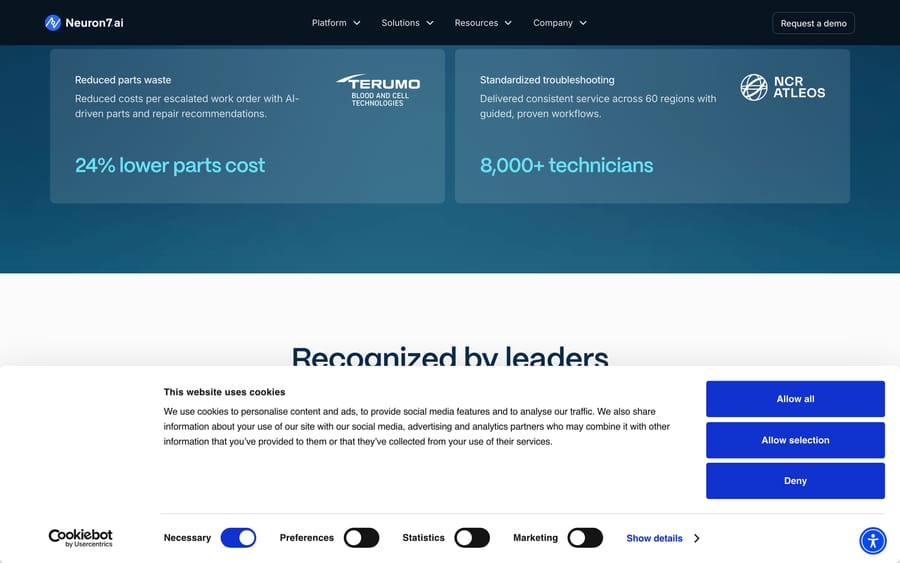
Customers named on Neuron7's site include NCR Atleos, Terumo BCT, Keysight, Medtronic, Ciena, Boston Scientific and Softtek, with individually attributed results: Softtek cut average call handle time from 7 minutes to 1 minute for a client running 1,500 restaurants, Ciena reports 46% faster resolutions, and NCR Atleos standardized troubleshooting for 8,000+ technicians across 60 regions.
How Neuron7's AI actually works
Neuron7 ships four specialized agents, all drawing on the same underlying Service Expertise Graph.
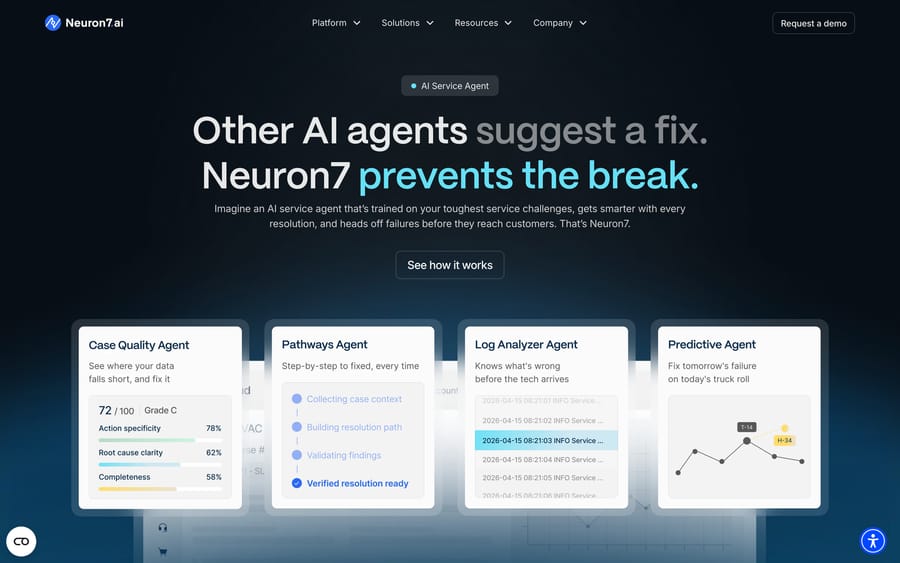
Case Quality Agent scores an existing support case against three dimensions, action specificity, root cause clarity and completeness, producing something like the "72/100, Grade C" score shown on Neuron7's own homepage. This is a QA mechanism aimed at the data itself: before an AI can generate good guidance, the historical cases it learns from need to be graded and cleaned up, and this agent does that grading automatically instead of a human auditing cases by hand.
Pathways Agent builds the step-by-step resolution path once a case is underway: collecting case context, building a resolution path, validating the findings, then marking a "verified resolution ready" once confidence clears a threshold Neuron7's own screenshot shows as a 98% match.
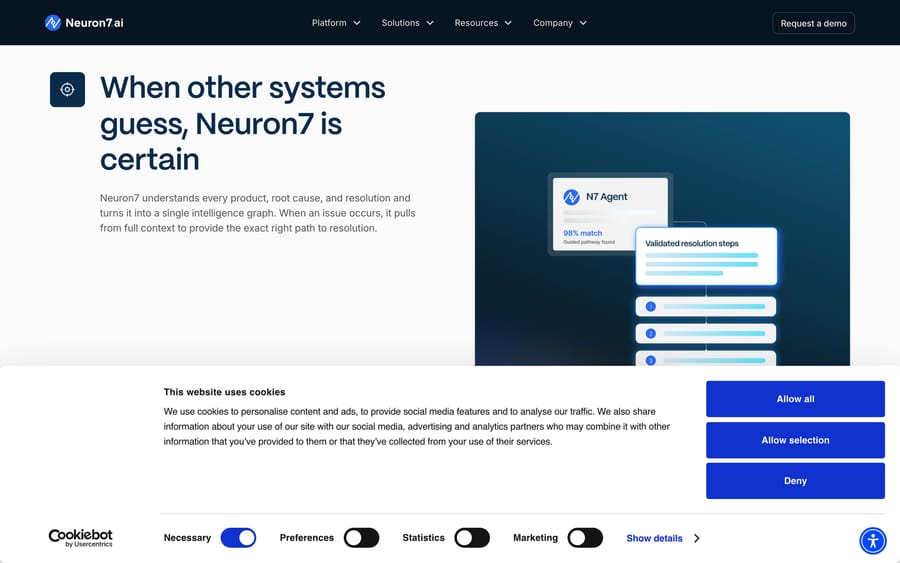
Log Analyzer Agent reads raw device or system logs line by line and highlights the specific timestamped entries relevant to the current issue, cutting out the manual work of scrolling a log file looking for the moment something broke.
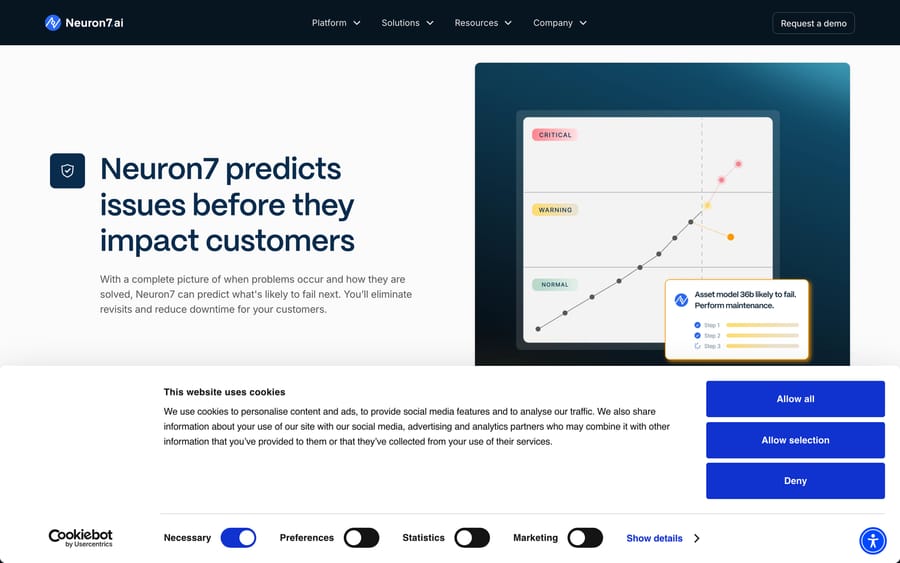
Predictive Agent is the most forward-looking piece: it plots a device's degradation pattern (normal, warning, critical) over time and flags a specific asset likely to fail before a technician arrives, so a truck roll can carry the right part on the first trip instead of a second visit after diagnosis.
The mechanism tying all four together is that none of them generate a fix from general knowledge. Every agent grounds its output in a specific company's own resolved cases, logs and product documentation, which is the core difference between Neuron7's pitch and a general-purpose LLM wrapper.
Key features
- Service Expertise Graph built from case history, manuals and logs, refreshed as new cases resolve.
- Four purpose-built agents: Case Quality, Pathways, Log Analyzer and Predictive, each addressing a different point in the service lifecycle.
- Pre-built connectors for Salesforce, ServiceNow, SAP and Microsoft platforms, with Neuron7 claiming deployment in a matter of weeks.
- Continuous learning that improves guidance with every resolved case instead of a static model.
- Predictive failure detection, aimed at cutting repeat truck rolls and unplanned downtime.
Pricing
Neuron7 doesn't publish pricing anywhere we could find, including its own /pricing page, which returns nothing beyond a "request a demo" call to action. Vendr's marketplace page for Neuron7 returned a 404 during this research pass, so we have no aggregated contract data to cite the way we could for some other vendors in this series. That's a genuine gap: we'd rather say we found nothing than invent a number.
The absence of a self-serve number lines up with who Neuron7 sells to: enterprises like Medtronic and Ciena, buying a platform meant to sit across a whole service organization. The incentive behind an enterprise-only sales motion is the same as most B2B platforms this large: pricing scoped to the deployment, discovered through a sales conversation, earns more from a big account than a fixed public rate ever would. Anyone serious about Neuron7 should expect that conversation and a scoped pilot before seeing a number.
What users say
Neuron7's own homepage cites a 4.7 out of 5 G2 rating. We tried to verify that independently and G2's review page returned a 403 during this research pass, and Neuron7 has no listing on PeerSpot, so we can't confirm the rating or review count from a source we control. We're reporting the vendor's own number here and flagging plainly that we could not check it ourselves.
The customer quotes on Neuron7's site come from named executives rather than anonymous reviewers: Bill Girzone at NCR Atleos, Rachael Castroverde at Terumo Blood and Cell Technologies, and John Page at Keysight all appear with photos, titles and company logos attached to their testimonials. That's a higher bar for fabrication than an anonymous quote, but it's still vendor-selected and vendor-published.
Pros and cons
Pros
- Purpose-built for physical-product service, a genuinely different and harder problem than chat-based customer support.
- Four distinct agents map to real, separate steps in a service workflow instead of one generic assistant doing everything.
- Verified, well-documented funding ($44M Series B, more than $63M total) from a named, credible lead investor.
- Individually attributed customer results (Softtek's 7-minute-to-1-minute handle time, Ciena's 46% faster resolutions) with the company's name attached to each figure.
Cons
- No pricing anywhere, and no third-party contract data (Vendr's page 404s) to estimate cost from.
- The 4.7/5 G2 rating is vendor-cited and we could not independently verify it; G2 blocked our fetch and Neuron7 has no PeerSpot listing.
- A narrow fit by design: this is not a tool for a company without a real base of historical service cases to build the graph from.
Who Neuron7 is best for
Neuron7 fits teams supporting complex physical products, medical devices, industrial equipment, networking gear, ATMs, where a technician needs a specific, high-confidence resolution path rather than a generic troubleshooting article. It's a strong match for a company with years of case history already sitting in Salesforce, ServiceNow or SAP, since that history is exactly what the Service Expertise Graph is built from.
It's a weak match for a company without that case history, a newer product line, or a business where support is mostly informational rather than physical repair. Neuron7 also isn't a customer-facing chat tool; it's built to sit behind a technician or support agent, guiding their next step.
Neuron7 vs alternatives
| Neuron7 | Aquant | Aisera | Macha | |
|---|---|---|---|---|
| Model | Service Expertise Graph powering four specialized agents (Case Quality, Pathways, Log Analyzer, Predictive) | Conversational AI guiding customers and technicians through physical product repairs | Agentic AI platform for enterprise IT, HR and customer service, now part of Automation Anywhere | AI agent layer on your existing help desk |
| Focus | Technician and agent-facing guidance for complex products | Customer-facing conversational repair guidance, phone and chat | Broad enterprise automation across departments | Customer support, inside Zendesk, Freshdesk, Gorgias or Front |
| Pricing | Not published; no third-party contract data found | Not published; free trial offered | Not published; enterprise sales | From $299/month for 750 tickets (about $0.40 per ticket), published |
| Trial | Demo only | Free trial available | Demo only | $50 of free usage (about 125 tickets), no credit card, no time limit |
| Best for | Enterprises with deep case history in complex, physical products | Companies wanting AI to talk a customer through a repair directly | Large enterprises wanting broad agentic automation | Teams wanting agents to act inside customer support tickets |
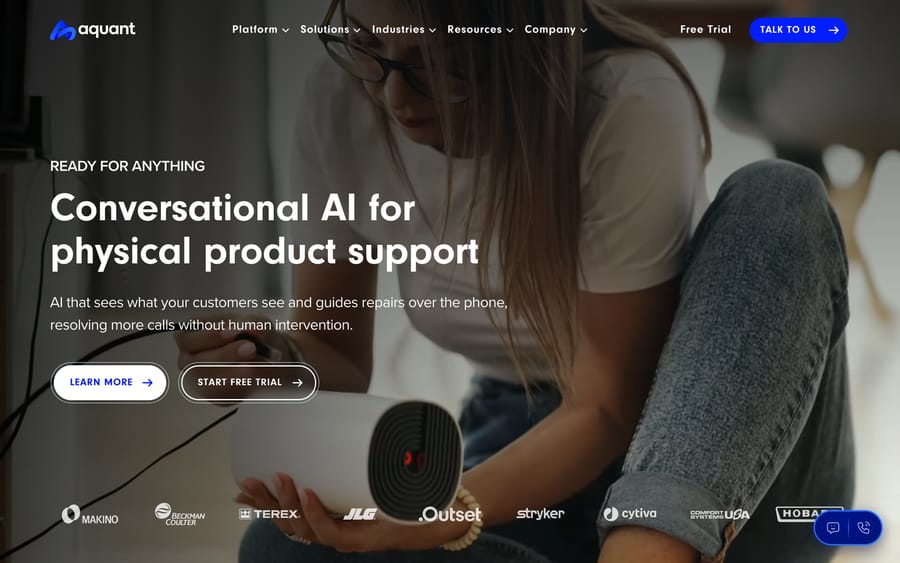
Aquant is the closer comparison on subject matter: both target physical-product service, both build from a company's own service data. The difference is who the AI talks to. Neuron7's agents sit behind the scenes guiding a technician or support rep, while Aquant's conversational AI talks directly to the end customer over the phone, aiming to resolve a repair without a human on the line at all.
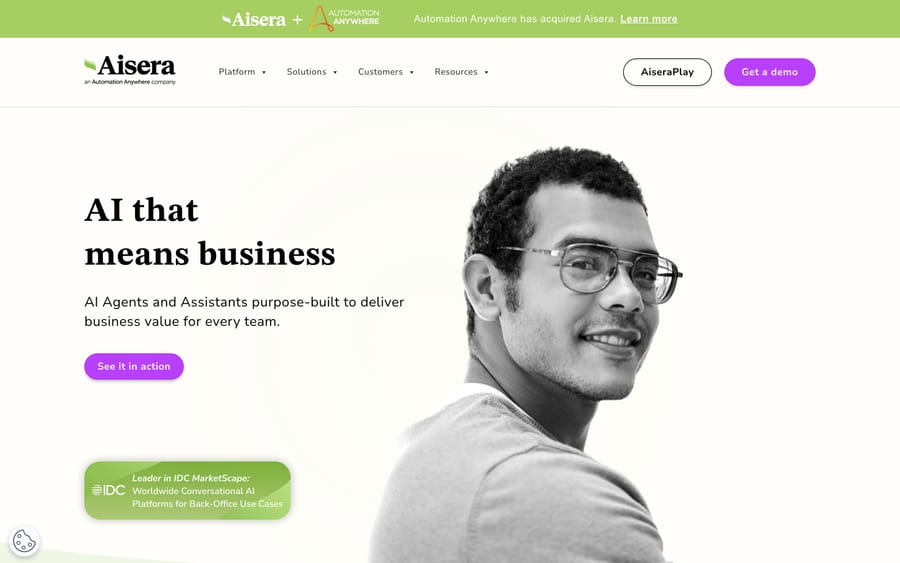
Aisera competes at a much broader scope. It's now part of Automation Anywhere (confirmed by the acquisition banner live on Aisera's own site) and covers IT, HR and customer service automation across an entire enterprise, a much wider net than the field-service specialization Neuron7 and Aquant both build around.
None of the three is built for the kind of ticket queue a Zendesk, Freshdesk, Gorgias or Front team runs day to day. If the actual need is agents drafting and resolving customer support tickets rather than guiding a field technician through a physical repair, Macha fits that job instead, priced $299/month for 750 tickets (about $0.40 per ticket).
FAQ
How much does Neuron7 cost? Neuron7 doesn't publish pricing, and we found no third-party contract data to estimate from (Vendr's marketplace listing 404s). Expect a sales conversation and a scoped evaluation before seeing a number.
How much funding has Neuron7 raised? More than $63 million total, including a $44 million Series B in October 2024 led by Smith Point Capital, verified against Neuron7's own PR Newswire release rather than a secondhand summary.
Is Neuron7's 4.7/5 G2 rating verified? We could not independently confirm it. It's the figure Neuron7 cites on its own homepage; G2's review page returned a 403 when we tried to check it directly, and Neuron7 has no PeerSpot listing to cross-check against.
What's the difference between Neuron7 and Aquant? Both target service for complex physical products, but Neuron7's agents guide a technician or support rep behind the scenes, while Aquant's conversational AI talks directly to the end customer, aiming to resolve the issue without a human on the call.
Is Neuron7 good for customer support tickets, like a help desk? Not really. Neuron7 is built for technician-facing guidance on physical products with deep case history behind them. A team running customer support tickets inside a help desk is better served by a tool built for that job, like Macha.
Who is Neuron7 best for? An enterprise servicing complex physical products, medical devices, industrial equipment, networking hardware, with years of resolved cases already sitting in a CRM or ticketing system for the Service Expertise Graph to learn from.
Check current Macha pricing if the actual need is customer support tickets rather than field-service diagnostics, or start a trial to see AI agents working inside a real help desk.
Sources:
Resolve tickets automatically with AI agents
Macha's AI agents work on top of the help desk you already use — no code.