Intercom
 Shopify
 Stripe
 Slack
Slack Notion
 Google Workspace
 Confluence

Rulebase: The Complete Guide (2026)


Rulebase is a YC-backed startup building AI that monitors every AI and human customer interaction at regulated financial companies, fintechs, banks, payment platforms, and surfaces the specific prompt, knowledge or process fix behind a failure instead of just a quality score. It's genuinely early: founded in 2024, a four-person team as of its Y Combinator listing, and a $2.1 million pre-seed round closed in September 2025. Rulebase doesn't publish pricing, and there's no independent review data yet on G2, Capterra or PeerSpot, so this guide leans on what we could verify directly: TechCrunch's own reporting, Rulebase's YC page, and the product itself.

We build AI agents for customer service ourselves, and Rulebase solves an adjacent problem: not answering the customer, but auditing every conversation, human or AI, after the fact to find where the outcome actually broke.
What is Rulebase?

Rulebase was founded by Gideon Ebose (CEO, formerly a product lead at Microsoft) and Chidi Williams (CTO, formerly at Goldman Sachs, and the creator of Buzz, an open-source speech-to-text tool with more than 300,000 downloads). TechCrunch reported the company's $2.1 million pre-seed round in September 2025, led by Bowery Capital with Y Combinator, Commerce Ventures, Transpose Platform VC and several angels participating. Rulebase went through YC's Fall 2024 batch and is based in New York.
The company sells specifically into regulated financial services: fintechs, banks, payment processors, where a QA miss isn't just a bad customer experience, it can be a compliance violation with a regulator attached. Its named customers include Rho (a U.S. business banking platform, the subject of a public case study), Lesaka Technologies (Nasdaq: LSAK), Interswitch, Kuda and Nala, alongside an unnamed Fortune 50 financial institution TechCrunch reported as a customer.
How Rulebase's AI actually works
Rulebase's core loop has three connected pieces, all built around auditing conversations after they happen instead of intervening during them. Under the hood, every conversation gets ingested, scored against a rubric, and written back as structured data the other two pieces read from.
Monitoring reviews every conversation across chat, voice and workflows, human agent or AI agent, and scores it for silent failures, quality gaps, policy breaches and emerging risk. Rulebase's own dashboard shows this as a ranked list of low- and high-scoring interactions, so a QA lead can see exactly which conversations need attention today instead of sampling at random.
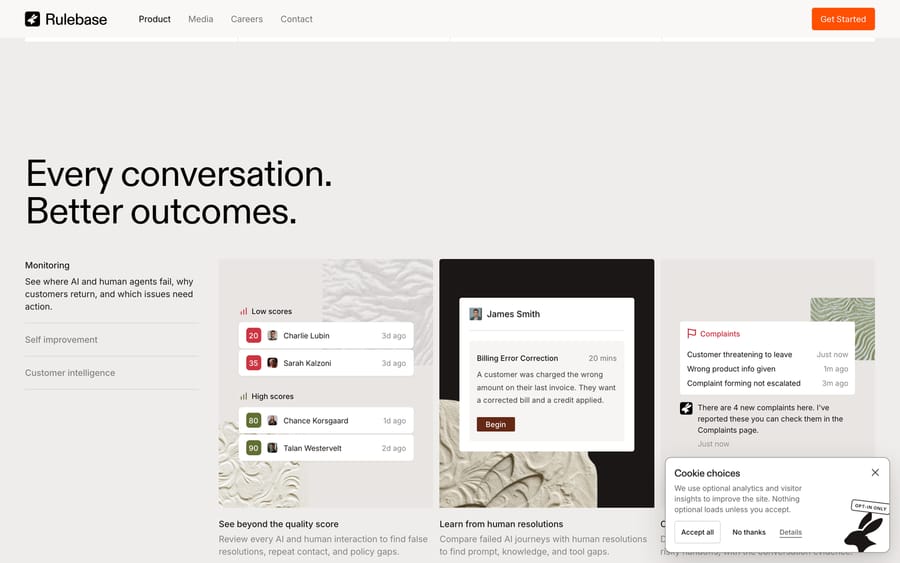
Self-improvement is the mechanism that turns a detected failure into an actual fix: a prompt correction, a knowledge base update, or a workflow change, then verifies whether that fix actually improved outcomes on later conversations rather than assuming it worked. This closes a loop most QA tools leave open: finding a problem is different from confirming the fix solved it, and Rulebase tracks the second half too.
Complaint and compliance tracking routes flagged interactions, like a payment dispute or a formal complaint, through a visible pipeline: received and classified, routed to the right team, resolution in progress with a deadline tracked automatically, customer notified. For a regulated company, having that trail documented automatically matters as much as catching the original issue.
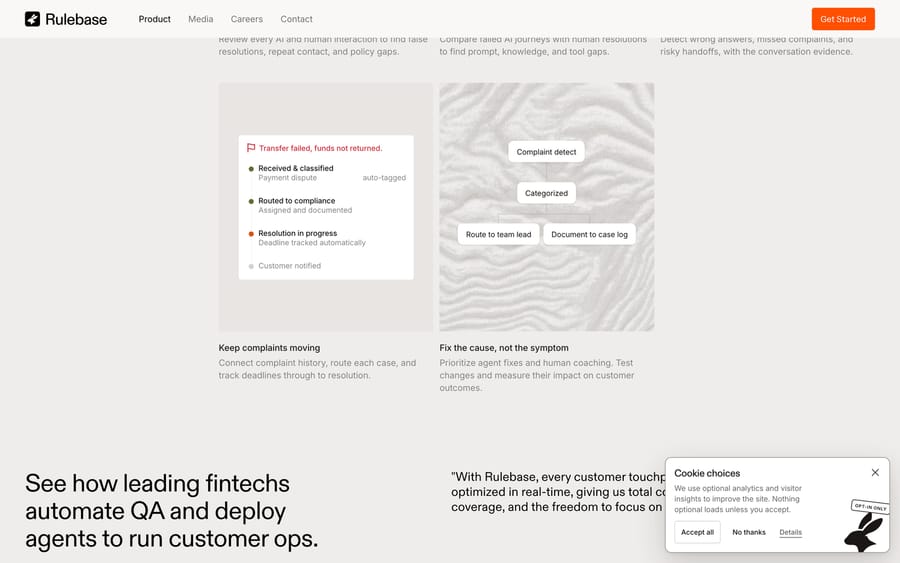
Rulebase's own numbers claim it evaluates 100% of interactions, versus the 3-5% manual sample most QA teams review by hand, the same full-coverage pitch several vendors in this series make. What's different here is the regulated-industry framing: SOC 2 Type II, GDPR, PCI DSS and AES-256 encryption are called out explicitly, aimed at a buyer whose legal team will ask about all four before signing anything.
Key features
- Full-coverage monitoring across chat, voice and workflow interactions, human and AI agents alike.
- Automated fix generation, converting a detected failure pattern into a specific prompt, knowledge or process change.
- Verified impact tracking, checking whether a shipped fix actually moved the outcome instead of trusting it did.
- Complaint and dispute pipelines with automatic deadline tracking, built for a regulated compliance workflow.
- Integrations with help desks (Zendesk, Freshdesk, Help Scout, Crisp) and contact-center platforms (Aircall, Five9, Genesys Cloud CX, NICE CXone, Avaya).
- Compliance certifications: SOC 2 Type II, GDPR, PCI DSS, AES-256 encryption.
Pricing
Rulebase doesn't publish pricing. Its /pricing and /case-studies/rho URLs both returned a 404 when we checked directly, so there's no self-serve number and no dedicated case-study page to pull a customer-specific rate from, only the homepage's summary stats. Y Combinator's own listing offers new YC companies two months free (up to 50 agents), which tells us pricing scales by agent count but not what that per-agent number actually is.
For a company this early, the incentive is straightforward: Rulebase is still closing deals one at a time with a four-person team, and a published price list would only get quoted against by competitors with more scale to discount from. Expect a sales conversation instead of a checkout page.
What users say
There's no third-party review data to cite here. Rulebase has no listing on G2, Capterra or PeerSpot, which is normal for a company a year out of its YC batch, but it does mean this section can't offer the independent rating other guides in this series can.
What we do have is a named, on-camera customer result: Stas Johnson-Chyzhykov, Chief Operating Officer of Rho, is credited on Rulebase's own site with a 95% reduction in manual reviews and 20 hours a week saved.

That's a named executive attached to a specific number, which is a meaningfully higher bar than an anonymous testimonial, but it's still one customer, filmed for Rulebase's own marketing. TechCrunch separately reported that Rho saw escalations cut by up to 30% and that Rulebase has posted double-digit month-over-month revenue growth since joining YC, both figures from the company itself.
Pros and cons
Pros
- Purpose-built for regulated financial services, with compliance certifications (SOC 2 Type II, PCI DSS) called out upfront as a selling point.
- Evaluates 100% of interactions instead of the 3-5% manual sample most QA processes actually cover.
- Closes the loop on fixes: it tracks whether a shipped change improved outcomes, not just that a problem was flagged.
- Founders with directly relevant, verifiable backgrounds: Microsoft product and Goldman Sachs engineering.
Cons
- No pricing published anywhere, and no case-study page live at the URL Rulebase itself references.
- Zero independent review data on G2, Capterra or PeerSpot; every result we can cite traces back to Rulebase or a single TechCrunch article.
- A four-person team and a $2.1 million pre-seed round mean real vendor-longevity risk that a buyer should ask about directly.
- Named customers are mostly smaller fintechs and one confirmed but unnamed Fortune 50 account; the customer base isn't broad yet.
Who Rulebase is best for
Rulebase fits teams already running customer operations at a regulated financial company, a fintech, bank or payment platform where a QA miss carries compliance exposure, not just a bad review, and who want every interaction reviewed automatically instead of a thin manual sample. It's a reasonable bet for an early-stage buyer comfortable working closely with a small, responsive vendor team.
It's a weaker match for a company outside financial services (no regulatory framing to justify the specialization), or a buyer who needs a proven track record and a large existing customer base before committing budget.
Rulebase vs alternatives
| Rulebase | Level AI | Zendesk QA | Macha | |
|---|---|---|---|---|
| Model | AI monitoring and self-improving QA for regulated fintech customer ops | Enterprise CX platform: proprietary scoring models plus AI voice agents | QA built into Zendesk's suite, scoring human and AI-agent interactions | AI agent layer on your existing help desk |
| Focus | Compliance-heavy QA and complaint tracking for financial services | Contact-center scale, Fortune 500-focused QA and automation | Native Zendesk QA for teams already on that suite | Customer support, inside Zendesk, Freshdesk, Gorgias or Front |
| Pricing | Not published; two months free via YC (up to 50 agents) | Not published; enterprise sales | Add-on to a Zendesk Support or Suite plan | From $299/month for 750 tickets (about $0.40 per ticket), published |
| Reviews | None yet on G2/Capterra/PeerSpot | 4.7/5 from 200+ G2 reviews (vendor-cited) | Part of Zendesk's own reviewed suite | N/A |
| Best for | Regulated fintech teams wanting compliance-grade QA | Large contact centers wanting AI scoring plus voice agents | Teams already on Zendesk wanting native QA | Teams wanting agents to act inside tickets, not just grade them |
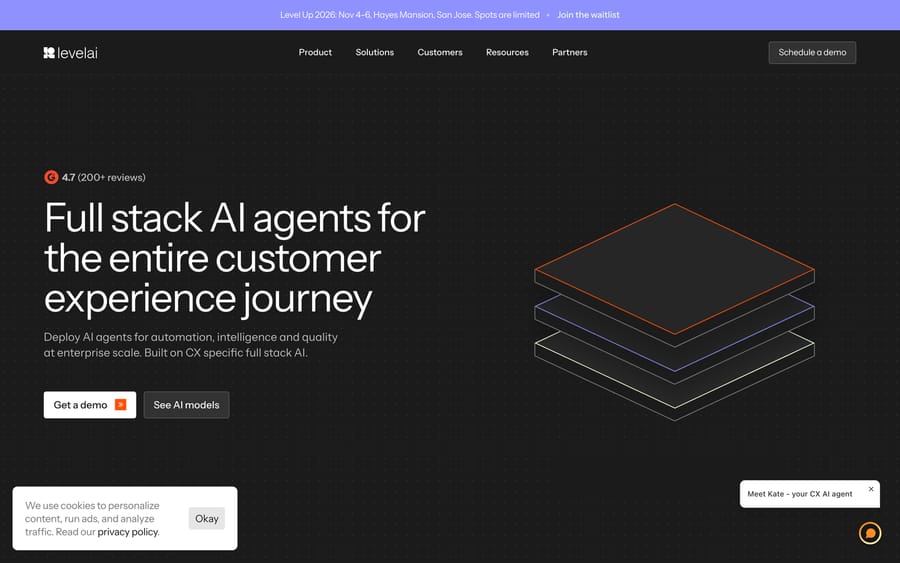
Level AI is the scale comparison: a much larger, better-reviewed company (its own homepage cites 4.7 stars from 200-plus G2 reviews) aimed at enterprise contact centers, versus Rulebase's early-stage, compliance-first focus on financial services specifically.
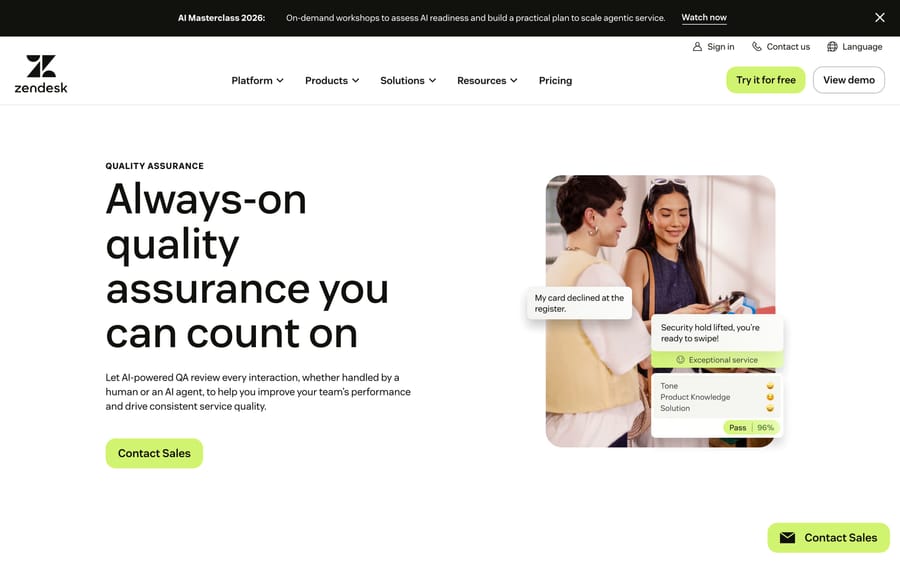
Zendesk QA is the platform-native comparison for any Rulebase prospect already running Zendesk: it grades every interaction with built-in categories and no separate contract to negotiate, though it lacks Rulebase's regulated-industry compliance framing and complaint-tracking pipeline.
None of the three resolves a ticket; all three grade or monitor how one was already handled. Macha sits on the other side of that line, an AI agent layer that drafts and resolves tickets inside Zendesk, Freshdesk, Gorgias, Front, HubSpot or Intercom, priced $299/month for 750 tickets (about $0.40 per ticket). A regulated fintech running Macha for resolution would still want a QA layer like Rulebase checking the agent's own output for compliance risk.
FAQ
How much does Rulebase cost? Rulebase doesn't publish pricing. Y Combinator's listing offers new YC companies two months free for up to 50 agents, which suggests per-agent pricing without revealing the actual rate. Expect a sales conversation.
Who founded Rulebase and how much funding has it raised? Gideon Ebose (CEO, ex-Microsoft) and Chidi Williams (CTO, ex-Goldman Sachs) founded Rulebase, which went through Y Combinator's Fall 2024 batch and raised a $2.1 million pre-seed round in September 2025 led by Bowery Capital, reported directly by TechCrunch.
Does Rulebase have reviews on G2 or Capterra? No listing exists yet on G2, Capterra or PeerSpot. The only public customer result is a named, on-camera testimonial from Rho's COO, not an independent review platform.
Is Rulebase only for financial services? Its product and compliance framing (SOC 2 Type II, PCI DSS, complaint-tracking workflows) are built specifically for regulated financial companies. A team outside that space would get less value from the compliance-specific parts of the product.
What's the difference between Rulebase and Level AI? Level AI is a much larger, more established platform serving enterprise contact centers broadly, with a public G2 rating from 200-plus reviews. Rulebase is an early-stage startup focused specifically on compliance-heavy QA for fintech and financial services.
Who is Rulebase best for? A customer operations team at a regulated financial company, fintech, bank or payment platform, that wants every interaction monitored automatically and is comfortable working with a small, early-stage vendor.
Check current Macha pricing if the actual need is agents resolving support tickets rather than monitoring how they were already handled, or start a trial to see AI agents working inside a real help desk.
Sources:
Resolve tickets automatically with AI agents
Macha's AI agents work on top of the help desk you already use — no code.