Intercom
 Shopify
 Stripe
 Slack
Slack Notion
 Google Workspace
 Confluence

Shelf: The Complete Guide (2026)


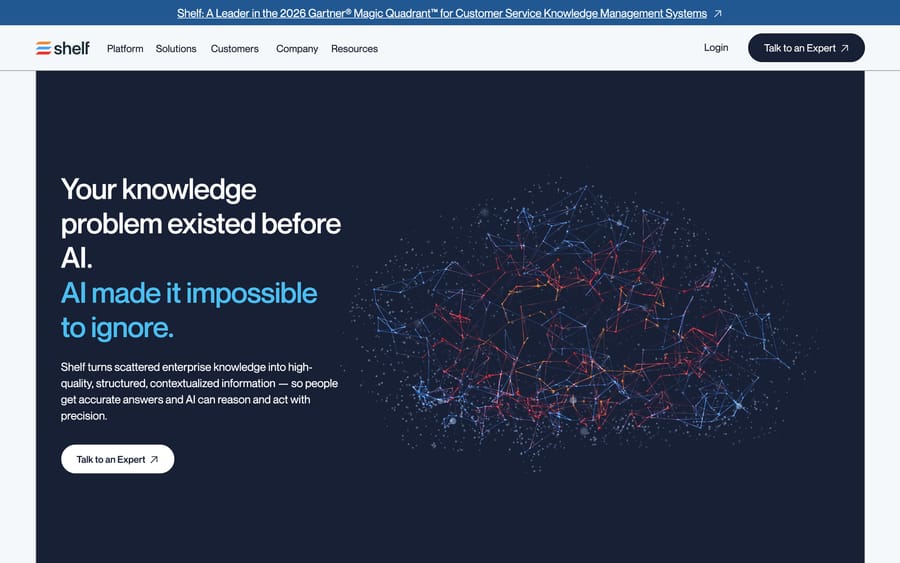
Shelf.io is an enterprise knowledge management platform that turns scattered documents, PDFs and wikis into structured, governed information that both people and AI systems can use reliably, positioned as a Leader in Gartner's 2026 Magic Quadrant for Customer Service Knowledge Management Systems. It doesn't publish pricing anywhere we could find; visiting /pricing routes straight to a "someone will contact you" confirmation page instead of a checkout. This guide covers what Shelf actually builds, how its Cortex platform works, what's verified against independent reporting versus vendor-only claims, and how it compares to Glean and Guru.

We build AI agents for customer service ourselves, and Shelf solves a piece of the same underlying problem from a different angle: making the knowledge an AI reads from trustworthy in the first place, rather than acting on top of it.
What is Shelf?
Shelf's clearest verified milestone is a $52.5 million Series B, reported directly by TechCrunch on August 23, 2021, led by Tiger Global and Insight Partners. At the time, Shelf had grown ARR 4x year over year, held 130% net dollar retention, and reported zero churn, with roughly 100 employees planning to double headcount within the year. We checked Shelf's own 2026 blog index for a newer funding announcement and found none, so treat 2021 as the last disclosed round.
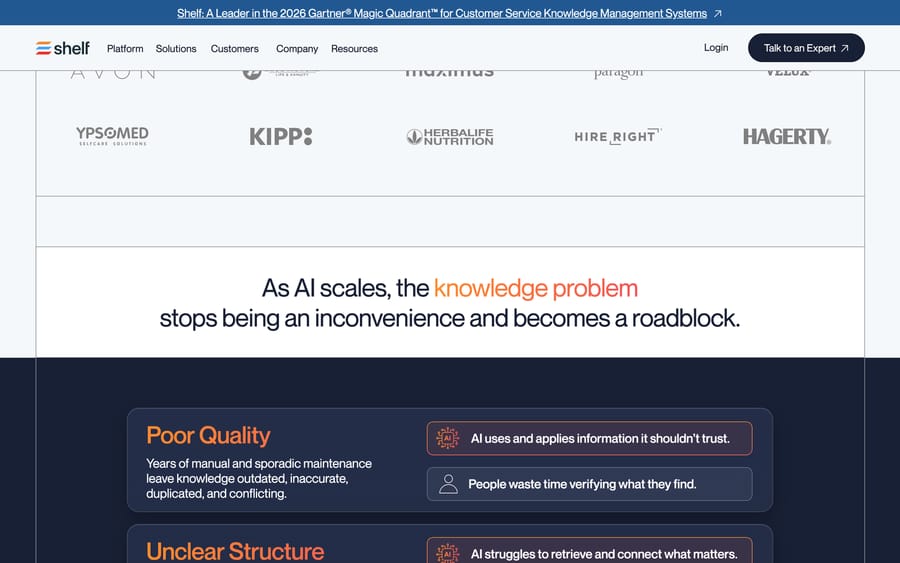
The company's pitch is that a knowledge base full of outdated, duplicated or conflicting documents was already a productivity drag before generative AI, and now it's worse: an AI system will confidently cite a wrong or stale answer with the same tone it uses for a correct one. Shelf's argument is that fixing the underlying knowledge, structuring it, tagging it with business context, governing who can see what, is the actual fix, not a better model on top of bad source material.
Customers named on Shelf's site include Amazon, Deliveroo, HelloFresh, Eventbrite, Nespresso, Roku, KeyBank and dozens more across insurance, retail and financial services. Individually attributed results: DSW cut handle time nearly 8% in one year, and HelloFresh reported a 20% reduction in average handle time.
How Shelf's AI actually works
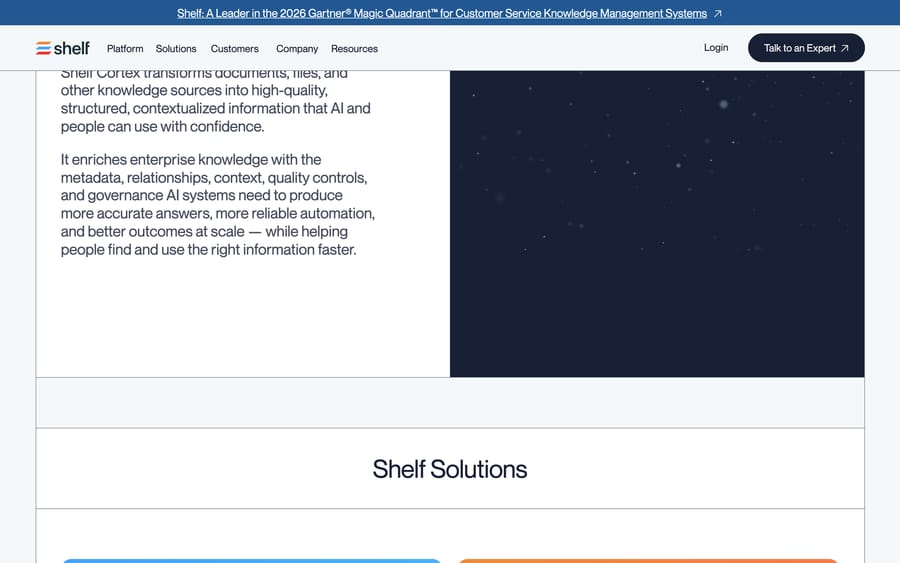
Shelf's platform, called Cortex, runs four connected steps on a company's existing content.
Translate and structure converts raw documents, PDFs, wikis and other formats into a structure an AI system can reliably parse, rather than treating every source as unstructured text to guess at.
Add business context attaches company-specific meaning to that structured content: what a specific product name refers to, which policy applies to which region, what an internal acronym means. This is the mechanism that separates Shelf from a generic document parser: the same sentence can mean something different depending on which team or product line it's attached to, and Cortex is built to carry that context along with the text.
Govern applies permissions, access controls and lifecycle rules, so outdated content gets flagged or retired instead of sitting in the index indefinitely, confidently cited by an AI that has no idea it's three years stale.
Continuously improve scans for duplicate, conflicting or outdated information on an ongoing basis, closing the loop that catches drift after the initial cleanup is done.
Shelf sells two entry points into this pipeline: AI Knowledge Management for teams that want the full experience layer, and Cortex as a Service for teams that already have their own application or AI layer and just want Shelf's structuring and governance underneath it.
Key features
- Cortex knowledge layer: translate, structure, contextualize and govern content from any source format.
- Content Intelligence scoring, flagging duplicate, outdated or conflicting documents automatically.
- Search Copilot and Answer Assist, surfacing governed answers to agents or customers directly.
- Integrations with Genesys, Five9, NICE inContact, Kustomer, Salesforce, Zendesk and Slack, among others.
- Cortex as a Service, letting a team plug Shelf's structuring layer under an existing AI application instead of adopting Shelf's full front end.
- Gartner Magic Quadrant Leader (2026) for Customer Service Knowledge Management Systems, a named, independently checkable industry recognition.
Pricing
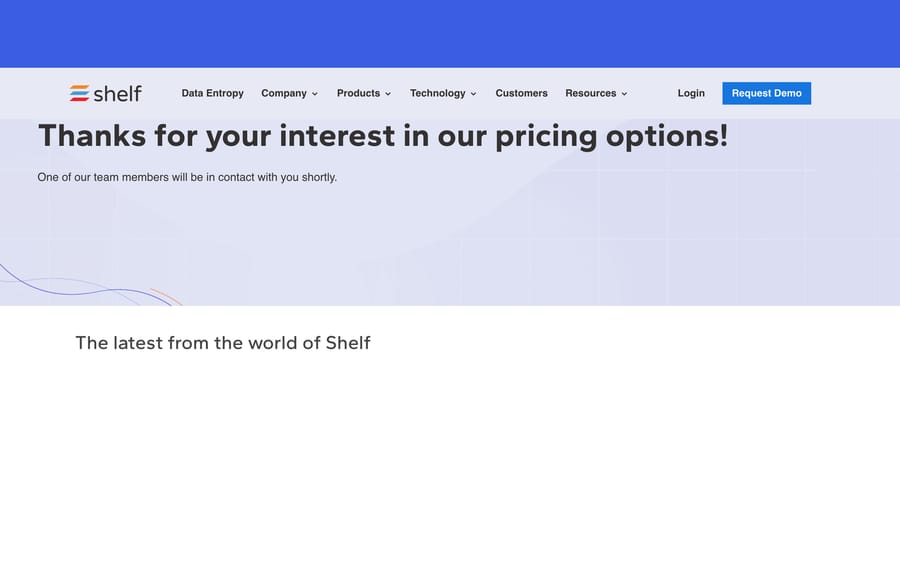
Shelf doesn't publish pricing. We checked /pricing directly on 2026-09-18 and found only a thank-you confirmation page ("one of our team members will be in contact with you shortly") instead of a tier list or calculator. There's no Vendr listing or third-party contract data we could find either, so we have nothing to estimate cost from beyond "expect a sales conversation."
That gap fits how Shelf sells: an enterprise knowledge platform integrating with contact-center systems like Genesys and NICE inContact is a multi-stakeholder purchase (IT, knowledge management, customer service leadership), and pricing that flexes to a specific integration scope earns more from a large account than a fixed public number would.
What users say
Shelf's own homepage cites a 4.7 out of 5 rating from 141 G2 reviews. We tried to verify that independently and G2's review page returned a 403 during this research pass. PeerSpot explicitly states it has "not yet collected reviews for Shelf," so there's no second source to cross-check against. We're reporting the vendor's own number and flagging plainly that we couldn't confirm it ourselves.
The customer quotes on Shelf's site come from named people at named companies: Brandon Dudley at Roku said Shelf gives "a best-in-class solution to our knowledge needs," and Vincent Lee at Granite Telecommunications said the product "greatly reduces time and improves efficiency because there is no confusion about outdated or incorrect material." Named quotes are a step up from anonymous ones, but they're still vendor-selected marketing copy.
Pros and cons
Pros
- A named, independently checkable industry recognition: 2026 Gartner Magic Quadrant Leader.
- Individually attributed customer results (DSW's 8% handle-time cut, HelloFresh's 20%) tied to specific companies.
- Cortex as a Service lets a team adopt the knowledge layer without replacing an existing AI front end.
- Broad integration list (Genesys, Five9, NICE inContact, Salesforce, Zendesk) covering both contact-center and help-desk stacks.
Cons
- No pricing published anywhere, and no third-party contract data to estimate from.
- The 4.7/141 G2 rating is vendor-cited and couldn't be independently verified; PeerSpot has zero reviews for Shelf.
- Real product UI is hard to find publicly: the product page is password-protected and the platform page 404s, so evaluating the actual interface requires a sales conversation.
- Last disclosed funding is from 2021; we found nothing newer, so recent financial health is hard to assess from public sources.
Who Shelf is best for
Shelf fits a large enterprise, the kind running Genesys or NICE inContact alongside a CRM, with years of accumulated documentation that's gone stale, duplicated or contradictory, and a genuine governance requirement around who can see and cite what. It's a stronger fit for a knowledge-management or IT buyer standing up infrastructure across departments than for a single support team solving one narrow problem.
It's a weaker fit for a smaller team without that scale of legacy content, or a buyer who wants to see the actual product interface before a sales call, since Shelf keeps that mostly behind a login. Shelf fits teams already running a contact-center platform like Genesys or NICE inContact who need governance across years of accumulated documentation.
Shelf vs alternatives
| Shelf | Glean | Guru | Macha | |
|---|---|---|---|---|
| Model | Cortex knowledge layer: translate, structure, govern content for AI and humans | Enterprise search, AI assistant and agent builder over a company-wide permissions graph | Governed knowledge layer verifying and structuring company knowledge | AI agent layer on your existing help desk |
| Focus | Contact-center and customer service knowledge specifically | Company-wide search across every internal tool and department | Knowledge governance other AI tools and people read from | Customer support, inside Zendesk, Freshdesk, Gorgias or Front |
| Pricing | Not published; no third-party contract data found | Not published; estimated $25-48/seat/month depending on size (third-party) | Published self-serve tier plus enterprise sales | From $299/month for 750 tickets (about $0.40 per ticket), published |
| Recognition | 2026 Gartner Magic Quadrant Leader (Customer Service KM) | Named 2026 CNBC disruptor; no Gartner KM placement found | N/A | N/A |
| Best for | Large contact centers with legacy, messy documentation | Company-wide knowledge sprawl across every department | Teams wanting a lighter, self-serve knowledge governance tool | Teams wanting agents to act inside tickets, not just find answers |
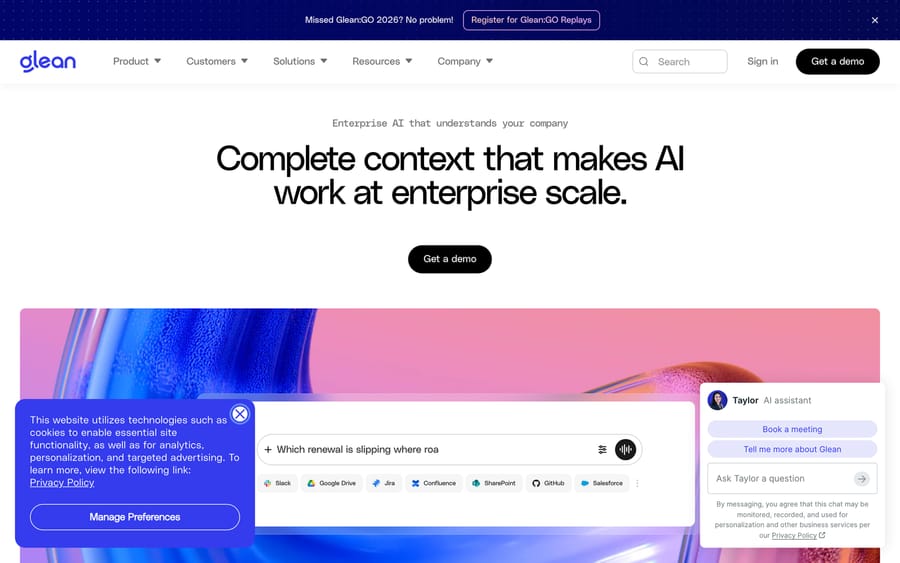
Glean is the broader comparison: while Shelf specializes in customer service and contact-center knowledge, Glean indexes everything a company owns, Slack, Drive, Salesforce, GitHub, for every department, not just support.
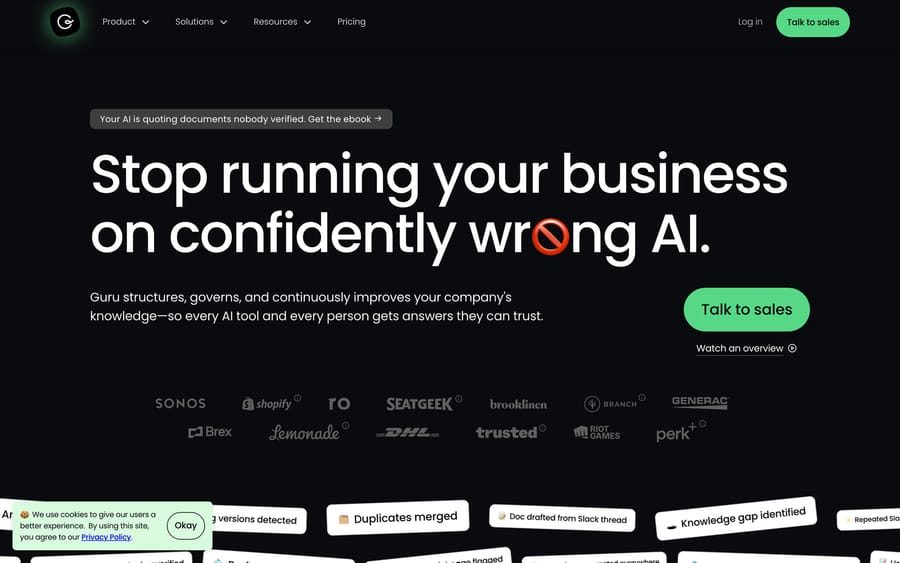
Guru is the lighter, cheaper comparison: it publishes a self-serve pricing tier and takes card payment, a path Shelf skips entirely in favor of a sales conversation, though Guru's scope is narrower than Shelf's full document-transformation pipeline.
None of the three drafts or resolves a customer support ticket; all three make the knowledge underneath one more trustworthy. Macha sits on the resolution side of that line: an AI agent layer that drafts and resolves tickets inside Zendesk, Freshdesk, Gorgias, Front, HubSpot or Intercom, priced $299/month for 750 tickets (about $0.40 per ticket). A support team running Macha still benefits from a governed knowledge base like Shelf's underneath it.
FAQ
How much does Shelf.io cost? Shelf doesn't publish pricing. Its /pricing page routes to a "we'll be in touch" confirmation instead of a tier list, and we found no third-party contract data to estimate from. Expect a sales conversation.
Is Shelf's 4.7 G2 rating verified? We could not independently confirm it. It's the number Shelf cites on its own homepage (141 reviews); G2's review page returned a 403 when we tried to check it directly, and Shelf has no PeerSpot reviews at all.
When did Shelf last raise funding? The most recent round we could verify is a $52.5 million Series B reported by TechCrunch in August 2021, led by Tiger Global and Insight Partners. We found no newer funding announcement in Shelf's own 2026 blog content.
What's the difference between Shelf and Glean? Shelf specializes in customer service and contact-center knowledge specifically, with a strong compliance and governance angle. Glean indexes a company's entire tool stack for every department, a broader but less specialized scope.
Can I see Shelf's actual product interface before a demo? Not easily. Shelf's /product page is password-protected and /platform returns a 404, so most of what's publicly visible is marketing copy rather than the interface itself.
Who is Shelf best for? A large enterprise, especially one running a contact-center platform like Genesys or NICE inContact, with years of accumulated documentation that needs structuring, governance and ongoing quality control.
Check current Macha pricing if the actual need is agents drafting and resolving tickets rather than governing the knowledge behind them, or start a trial to see AI agents working inside a real help desk.
Sources:
Resolve tickets automatically with AI agents
Macha's AI agents work on top of the help desk you already use — no code.