Intercom
 Shopify
 Stripe
 Slack
Slack Notion
 Google Workspace
 Confluence

Syllable AI: The Complete Guide (2026)


Syllable builds voice, SMS, and chat AI agents, mostly for healthcare call centers, and it does something rare in this guide series: it publishes exact, itemized pricing down to the fraction of a cent per component. This guide covers what the platform does, exactly how that pricing works and what it implies, the real customer results available, and how it compares to Hyro.

We build AI agents for customer service ourselves, for teams automating tickets, so treat this as an outside look at a neighboring category.
What is Syllable?
Syllable calls itself a "trusted neutral platform" for building, running, and optimizing AI agents, explicitly positioned against vendor lock-in: choose any underlying model, run on any cloud, switch providers without rebuilding the agent. It serves three kinds of users on one platform: domain experts who configure agents conversationally through a no-code Meta Agent builder, engineering teams who work with APIs and declarative configuration, and operations leaders who manage deployment and governance.
The company's own site doesn't list a founding date, named founders, or funding history, and we didn't find those details from an independent source either, so we're not guessing at them here. What is clear from its customer base is the vertical focus: named, verifiable healthcare customers include MemorialCare, Houston Methodist, and Virtua Health, alongside logos for Google, athenahealth, SurveyMonkey, and CancerIQ.
How Syllable's AI works
Syllable's platform splits into three parts it markets as Build, Run, and Optimize. Build centers on the Meta Agent, described as turning "plain-language intent into production-ready agent configurations": a domain expert describes what an agent should do, and platform guardrails constrain how it can act, so a non-engineer can configure a scheduling or intake flow without writing code.
Run is the infrastructure layer: multi-cloud deployment across AWS, GCP, Azure, and OCI, with policy-based routing and elastic scaling, plus a direct Epic EHR integration alongside Twilio and Salesforce connections, relevant given how much of its customer base is healthcare systems running Epic. Optimize covers distributed tracing, structured logging, and conversation analytics for improving agents continuously after they're live.
Key features
- Meta Agent Builder: no-code, conversational agent configuration for domain experts.
- Multi-cloud deployment: AWS, GCP, Azure, and OCI, with policy-based routing and elastic scaling.
- Direct Epic EHR integration, alongside Twilio SMS/SIP and Salesforce connections.
- Itemized usage-based billing across SIP connection, recording, transcription, LLM tokens, and text-to-speech, each priced separately.
- Compliance certifications: SOC 2 Type II, HITRUST e1, GDPR, and EU AI Act readiness.
- A Microsoft Marketplace listing, letting an enterprise buyer purchase Syllable against existing Azure commit spend.
Syllable pricing
Syllable is one of the few vendors in this guide series that actually publishes granular, itemized pricing instead of a "book a demo" wall.
There's a free trial capped at 3 minutes per call, and a metered pay-as-you-go plan that starts with a $150 prepayment. The platform's own infrastructure is priced per 60 seconds: SIP connection at $0.0040, SIP recording at $0.0025, and transcription at $0.0080, which totals roughly $0.0145 for 60 seconds, or about $0.87 an hour, before any AI model or voice cost. On top of that, Syllable passes through third-party LLM and text-to-speech costs "at cost with zero markup," and it publishes the actual rates: GPT-4.1 runs $2 per million input tokens and $8 per million output tokens, Claude Opus 4.6 runs $5 and $25, OpenAI's text-to-speech runs $15 per million characters, and ElevenLabs runs $120 per million characters, an eightfold difference worth knowing before you pick a voice provider by ear alone.
The incentive behind zero-markup pass-through
Naming the actual mechanism matters here: Syllable's margin lives entirely in its own infrastructure line items (SIP, recording, transcription), not in a markup on the AI models it routes to. That's a genuinely different incentive than a vendor that bundles everything into one opaque per-minute rate and pockets the spread between what the model actually costs and what it bills you. The tradeoff is that your total bill still depends heavily on which LLM and voice provider you pick, since Claude Opus and ElevenLabs alone can run many times the cost of GPT-4.1 and OpenAI's TTS for the same call volume, so the "zero markup" promise doesn't mean a low bill on its own. It means the model and voice choice, not Syllable's pricing, is what you're actually optimizing when you want to control cost.
Real customer evidence, since third-party reviews were out of reach
We tried G2 for a rating and it blocked every attempt, including through a headless browser, and this session's search budget was exhausted before a cached fallback could be tried. What we could verify instead were Syllable's own case studies.
MemorialCare's VP of Operations is quoted directly: "Syllable replaced our entire navigation center phone tree with AI agents in under eight weeks. We went from evaluating vendors to 100 percent of calls answered by AI, and the patient experience has never been better." Houston Methodist reports a greater-than-50% reduction in average handle time across multi-step scheduling workflows, and Virtua Health reports going live in three weeks. Across its published customer base, Syllable states 5 million-plus calls automated annually and 99.99% platform uptime. These are vendor-published case studies, and we're labeling them as such.
Pros and cons
Pros
- Genuinely itemized, published pricing down to the sub-cent per component, rare in this category.
- A specific, honest mechanism (zero markup on pass-through AI costs) rather than a vague "affordable AI" claim.
- Real, attributed healthcare case studies with named systems (MemorialCare, Houston Methodist, Virtua Health) and specific deployment timelines.
- Direct Epic EHR integration, relevant to its core healthcare customer base, plus a Microsoft Marketplace listing for Azure-committed buyers.
Cons
- No accessible third-party review data (G2 blocked every attempt) at the time of this research.
- No founding date, founder names, or funding history published anywhere we could find, unusual for a vendor this deep into healthcare deals.
- Total cost still depends heavily on LLM and TTS provider choice; "zero markup" doesn't mean cheap by default.
- The 3-minute free trial cap is thin for testing a real scheduling or intake conversation end to end.
Who Syllable is best for
Syllable fits healthcare systems and other regulated organizations that want a specific, auditable cost structure for their AI voice deployment and are comfortable choosing their own LLM and TTS providers to control that cost. If your team already has Epic and wants an AI agent that plugs into it directly, or you're evaluating vendors specifically because you want to see the actual per-minute math rather than trust an opaque quote, Syllable's transparency is the differentiator worth testing.
It's the wrong fit if you want a single all-in-one number without comparing model and voice providers yourself, since Syllable's real cost requires that comparison. It's also the wrong tool if your actual bottleneck is a support team's email and chat ticket queue. That's a help-desk automation problem, priced and built differently.
Syllable AI vs alternatives
| Syllable | Hyro | Macha | |
|---|---|---|---|
| Model | Multi-cloud voice/SMS/chat AI agents, pay-as-you-go by component | AI agents for healthcare call center, scheduling, and patient access | AI agent layer on your existing help desk |
| Best for | Healthcare systems wanting itemized, auditable AI costs | Health systems wanting a managed, demo-led deployment | Support teams on Zendesk, Freshdesk, Front, or Gorgias |
| Pricing | Published: itemized per-component rates, $150 prepayment to start | Not published; demo-gated | From $299/mo for 750 tickets (~$0.40/ticket), published |
| Self-serve trial | Yes, capped at 3 minutes per call | No | $50 of free usage, no credit card |
| Reviews | Not accessible at time of research | Not accessible at time of research | N/A (new category on G2) |
| Setup | Self-serve build tools plus enterprise deployment | Enterprise deployment with Hyro's team | Built, tested and monitored by the Macha team |
| Replaces your help desk? | Not applicable; not a help desk product | Not applicable; not a help desk product | No, it deliberately augments it |
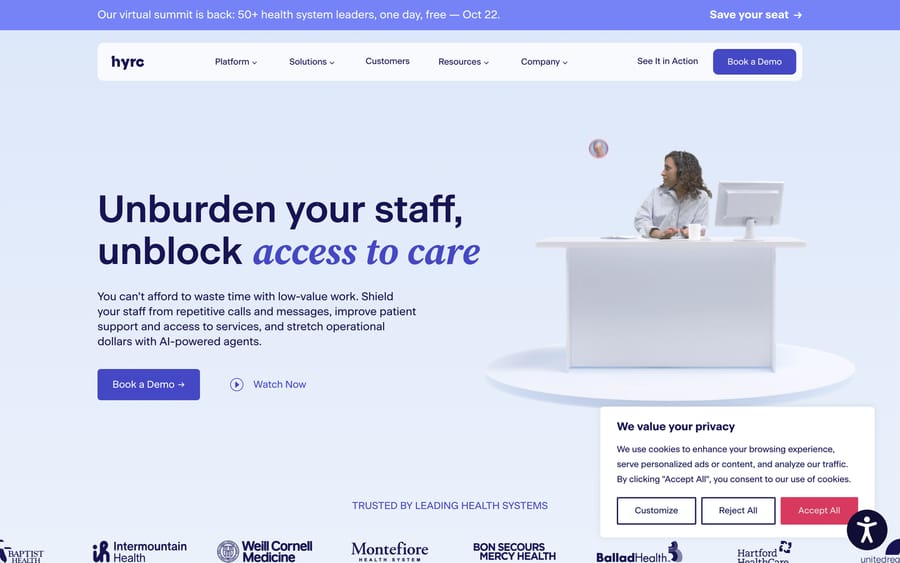
Hyro is the closer comparison on customer base: both sell AI agents into large health systems (Hyro names Intermountain Health, Weill Cornell Medicine, Montefiore, and Bon Secours Mercy Health), and both focus on call center and scheduling automation. The real difference is pricing philosophy: Hyro keeps every number behind a demo request, while Syllable puts its per-component rates on a public page. If transparent, auditable cost matters more to your evaluation than a fully managed sales relationship, that difference alone is worth raising early.
Neither vendor solves a support team's ticket backlog, which is a different problem. If your bottleneck is email and chat tickets, Macha runs as an agent layer on top of the help desk you already use, priced per ticket instead of per minute.
How we researched this
We pulled product and pricing claims directly from syllable.ai (home, /pricing, /customer-stories, /products/meta-agent-builder, and /company), fetched 2026-09-17. Syllable's Microsoft Marketplace listing and its G2 page both returned a 403 on direct access, including G2 through a headless browser; this session's WebSearch budget was used up before a cached-search fallback could be tried, so this guide relies on Syllable's own named case studies for customer evidence rather than an independent rating. Vendr's Syllable listing was checked directly and carries no pricing data, which tracks with Syllable already publishing its own rates. Hyro's homepage was captured via headless browser after a direct fetch attempt returned a 403.
FAQ
What is Syllable AI? A platform for building, running, and optimizing voice, SMS, and chat AI agents, positioned as vendor-neutral (any model, any cloud) and used mostly by healthcare call centers.
How much does Syllable cost? It publishes itemized rates: a free trial capped at 3 minutes per call, then pay-as-you-go starting with a $150 prepayment. Platform infrastructure runs roughly $0.0145 per 60 seconds, plus AI model and voice costs passed through at cost with zero markup.
What does "zero markup" actually mean for cost? Syllable doesn't add a margin on top of third-party LLM or text-to-speech costs, but those costs still vary a lot by provider. Claude Opus 4.6 and ElevenLabs cost several times more than GPT-4.1 and OpenAI's TTS for the same volume, so provider choice drives your real bill more than Syllable's own fee does.
Is Syllable good, based on reviews? We couldn't access G2 for a rating during this research. What's verifiable is Syllable's own case studies, including a named MemorialCare executive reporting 100% of navigation center calls handled by AI within eight weeks.
Does Syllable integrate with Epic? Yes, Syllable lists a direct Epic EHR integration alongside Twilio and Salesforce connections.
What are good alternatives to Syllable? Hyro serves a similar healthcare call-center and scheduling use case but keeps pricing behind a demo request instead of publishing it. Neither is a fit for a support team's email and chat backlog, which is a help-desk automation problem instead.
Who are Syllable's named customers? MemorialCare, Houston Methodist, and Virtua Health are named directly with specific case-study results; Google, athenahealth, SurveyMonkey, and CancerIQ appear as logos.
If your actual bottleneck is a support team's ticket queue, see how Macha's pricing works or start a trial.
Sources: Syllable AI, Syllable - Pricing, Syllable - Customer Stories, Syllable - Meta Agent Builder, Syllable - Company, Hyro, hyro.ai (blocks automated fetches, cited as text), G2 - Syllable reviews (blocks automated fetches).
Resolve tickets automatically with AI agents
Macha's AI agents work on top of the help desk you already use — no code.