Intercom
 Shopify
 Stripe
 Slack
Slack Notion
 Google Workspace
 Confluence

Talkdesk AI: The Complete Guide (2026)


Talkdesk sells AI agents as an add-on to its contact-center platform: multi-agent orchestration, an autonomous resolution agent called Autopilot, and a real-time assist tool called Copilot. This guide covers what those products actually do, what the base platform costs (published) versus what the AI layer costs (not published anywhere), the real customer evidence available, and how it compares to Five9.

We build AI agents for customer service ourselves, for teams automating tickets, so treat this as an outside look at a neighboring category.
What is Talkdesk AI?
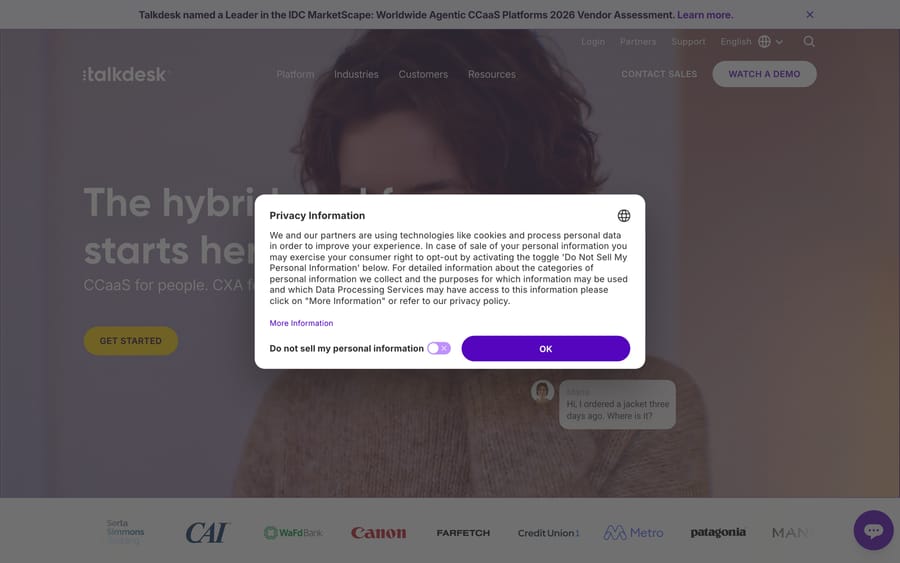
Talkdesk AI refers to the AI agent capabilities layered on top of Talkdesk's core contact-center-as-a-service (CCaaS) platform: Autopilot for autonomous resolution, Copilot for real-time human agent assistance, and a newer multi-agent orchestration layer that coordinates several specialized agents (an orchestrator, a rebooking agent, a refund agent, and so on) against one customer request. The company's own framing is a "hybrid workforce," splitting work so "humans focus on judgment and empathy" while "AI agents execute work end to end at speed and scale."
Talkdesk's own site describes the company as operating "for more than a decade" but doesn't publish a specific founding date, founder names, or funding history on its about page, and we couldn't independently verify those details either, so we're not stating them here. Named customers on its current site include Canon, Farfetch, Patagonia, Credit Union 1, and WaFd Bank.
How Talkdesk's AI works
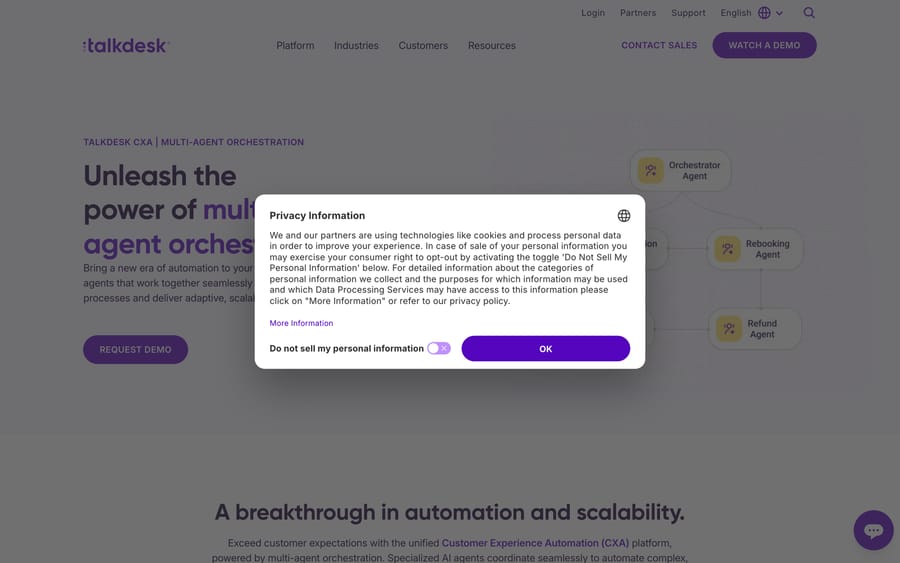
The newer piece is multi-agent orchestration: instead of one general-purpose bot, Talkdesk composes specialized agents (an Orchestrator Agent routing to a Rebooking Agent, a Refund Agent, and others) that coordinate on a shared goal, using what the company calls Multi-Context Protocol for interoperability with third-party AI and automation tools.
Autopilot is the customer-facing resolution layer: it handles routine requests like orders, returns, and billing autonomously across voice and digital channels in 59-plus languages, escalating to a human agent when it hits a case it can't resolve. Copilot sits on the human-agent side instead, assisting with real-time transcription, knowledge surfacing, and call summarization.
The clearest published result comes from Quadient, a named customer. Jackie James, Director of Global Operations at Quadient, is quoted directly: "When we launched Talkdesk, we immediately saw a 60% containment rate. This was amazing compared to what we launched before, which only had a 33% containment rate."
Key features
- Multi-agent orchestration: specialized agents (orchestrator, rebooking, refund, and more) coordinating on one customer request via Multi-Context Protocol.
- Autopilot: autonomous resolution across voice and digital channels in 59+ languages, with escalation to a human when needed.
- Copilot: real-time transcription, knowledge surfacing, and call summarization for human agents.
- Data Cloud: aggregates interaction data across systems to give agents (human and AI) shared context.
- CXA Operations Center: real-time monitoring of how AI agents are performing across live interactions.
- Industry Experience Clouds: pre-built modules for financial services, insurance, healthcare, retail, travel, and utilities.
Talkdesk AI pricing
Talkdesk publishes pricing for its base CCaaS platform, but not for the AI Agents capability specifically.
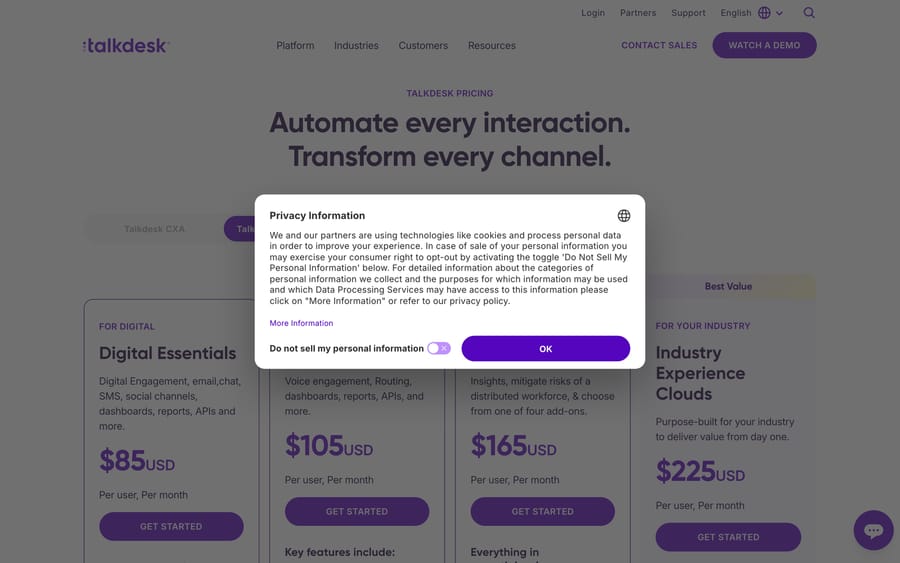
The published tiers: Digital Essentials at $85 per user per month (digital channels, CXA, Studio & routing), Voice Essentials at $105 (adds voice engagement and speech recognition), Elite at $165 (adds custom reporting, screen recording, and workforce management), and Industry Experience Clouds at $225 (adds industry-specific modules). A smaller Talkdesk Express plan exists for US and Canada businesses under 50 employees, bundling 25 licenses with $100 in free credit.
None of those tiers state whether AI Agents, Autopilot, or Copilot are included, an add-on, or usage-priced on top. Every AI-specific product page (multi-agent orchestration, Autopilot, Copilot) routes to "Request Demo" or "Contact Sales" with no plan reference at all. That's a real gap for a buyer trying to budget: you can price a Talkdesk seat to the dollar, but not the AI layer that's the actual reason you'd be reading this guide.
The incentive behind bundling AI into a sales conversation
Keeping AI Agents off the published price list while publishing seat pricing for everything else is a specific choice: it lets Talkdesk price the AI capability per deal, based on the containment volume and use cases a buyer actually needs, instead of committing to one number that either undercharges a heavy AI deployment or overprices a light one. The tradeoff lands on the buyer: you can't tell from Talkdesk's own site whether AI Agents will add 20% to your seat cost or 200%, so budget for a real conversation with sales instead of extrapolating from the published tiers.
Reviews: what we could and couldn't verify
Talkdesk is a large, long-established CCaaS vendor, and G2 almost certainly carries a substantial review base for it; we just couldn't reach it. G2 blocked every attempt during this research, including through a headless browser, and this session's WebSearch budget was used up before a cached-search fallback could be tried. What we could verify instead is Talkdesk's own published case study: Quadient's named executive reporting a jump from 33% to 60% containment after switching to Talkdesk. That's a real, attributed result, but it's one vendor-selected example, and there's no independent sample behind it.
Pros and cons
Pros
- Transparent, published seat pricing for the base platform across four clear tiers.
- A real architectural distinction in multi-agent orchestration: specialized agents coordinating on shared goals, not one generalist bot.
- A named, attributed customer result: Quadient, 33% to 60% containment, not only a vague claim.
- Broad channel and language coverage (59+ languages) plus industry-specific modules for regulated sectors.
Cons
- Zero pricing transparency for the AI Agents capability itself, the actual subject of this guide, despite transparent seat pricing everywhere else.
- No accessible third-party review data (G2 blocked every attempt) at the time of this research.
- No verifiable founding date, funding history, or company background published on Talkdesk's own about page.
- A 50-seat minimum on some plans and per-seat pricing structure that doesn't map cleanly onto ticket- or conversation-based automation the way some AI-first vendors do.
Who Talkdesk AI is best for
Talkdesk fits contact centers already running (or evaluating) its core CCaaS platform that want to add autonomous resolution and multi-agent orchestration on top, particularly in industries with a pre-built Experience Cloud (financial services, insurance, healthcare, retail, travel, utilities). If you're already comparing Talkdesk's $85-225/seat tiers for the base platform, adding AI Agents to that same sales conversation is the natural path.
It's the wrong fit if you want to price AI automation before talking to sales, since none of that pricing is public. It's also the wrong tool if your actual bottleneck is a support team's email and chat ticket queue. That's a help-desk automation problem, priced and built differently.
Talkdesk AI vs alternatives
| Talkdesk AI | Five9 | Macha | |
|---|---|---|---|
| Model | Multi-agent orchestration, Autopilot, and Copilot on the Talkdesk CCaaS platform | AI Agents, Intelligent Virtual Agent, and Agent Assist on the Five9 platform | AI agent layer on your existing help desk |
| Base platform pricing | $85-$225/user/month, published in four tiers | $119-$159/user/month published (Digital, Core); higher tiers by quote, 50-seat minimum | From $299/mo for 750 tickets (~$0.40/ticket), published |
| AI-specific pricing | Not published; sales conversation | Not published; sales conversation for advanced AI tiers | Same published per-ticket rate covers all AI usage |
| Reviews | Not accessible at time of research | Not accessible at time of research | N/A (new category on G2) |
| Self-serve trial | No | No | $50 of free usage, no credit card |
| Setup | Enterprise deployment with Talkdesk's team | Enterprise deployment with Five9's team | Built, tested and monitored by the Macha team |
| Replaces your help desk? | Not applicable; not a help desk product | Not applicable; not a help desk product | No, it deliberately augments it |
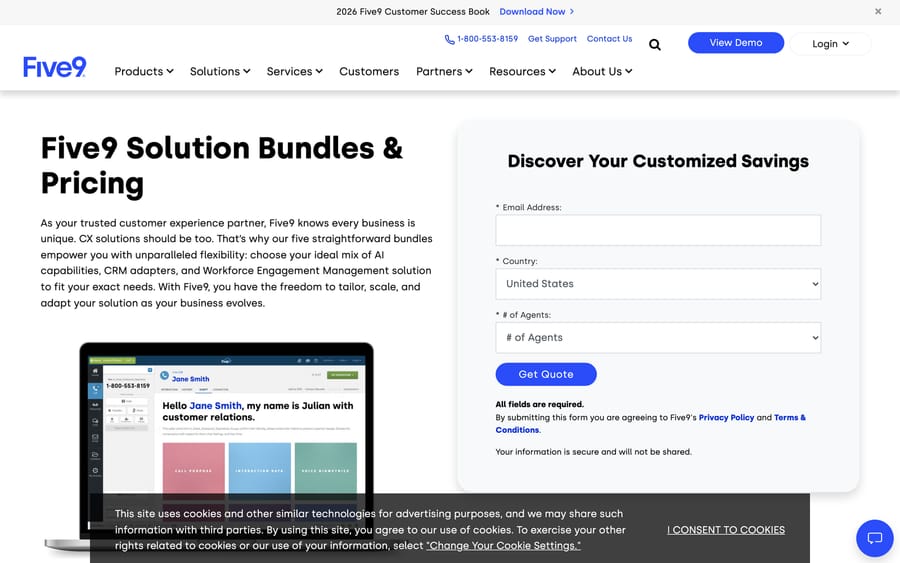
Five9 is the closer comparison structurally: both publish entry-level seat pricing ($85-105 versus $119-159) while keeping their more advanced AI tiers behind a sales quote, and both require a minimum seat count for the published plans. The practical difference in a bake-off is which vendor's AI agents you can actually pilot against your own call types before signing, since neither publishes enough to compare cost on paper alone.
Neither vendor touches a support team's ticket backlog, which is a different problem. If your bottleneck is email and chat tickets, Macha runs as an agent layer on top of the help desk you already use, with one published rate that already includes AI usage.
How we researched this
We checked talkdesk.com directly (home, /pricing/, /contact-center-platform/ai-agents/, and the Autopilot product page), fetched 2026-09-17. talkdesk.com/about carries no founding, founder, or funding details, and Wikipedia's Talkdesk page returned a 404, so this guide states none rather than guessing. We attempted G2 for a review rating; it returned a 403 on every attempt, including through a headless browser, and this session's WebSearch budget was used up before a cached-search fallback could be tried, so this guide relies on Talkdesk's own Quadient case study for customer evidence. Five9's pricing page was fetched directly.
FAQ
What is Talkdesk AI? The AI agent layer on top of Talkdesk's contact-center platform: multi-agent orchestration, an autonomous resolution product called Autopilot, and a human-agent assist tool called Copilot.
How much does Talkdesk AI cost? The base platform is published: $85 to $225 per user per month across four tiers. The AI Agents capability itself has no published price; every AI-specific page routes to a demo or sales conversation.
Is Talkdesk AI good, based on reviews? We couldn't access G2 for a rating during this research. What's verifiable is a named Quadient executive reporting a jump from 33% to 60% containment after adopting Talkdesk.
Does Talkdesk offer a free trial? No self-serve trial is listed for the AI Agents capability. Talkdesk Express offers 25 licenses with $100 in free credit for small US/Canada businesses on the base platform.
What's the difference between Autopilot and Copilot? Autopilot resolves customer requests autonomously across voice and digital channels. Copilot assists a human agent in real time with transcription, knowledge, and summarization rather than handling the conversation itself.
What are good alternatives to Talkdesk AI? Five9 is the closer structural comparison: published entry-level seat pricing, advanced AI tiers behind a sales quote. Neither is a fit for a support team's email and chat backlog, which is a help-desk automation problem instead.
Who are Talkdesk's named customers? Canon, Farfetch, Patagonia, Credit Union 1, WaFd Bank, and Quadient appear on its site, with Quadient providing a detailed, attributed case study.
If your actual bottleneck is a support team's ticket queue, see how Macha's pricing works or start a trial.
Sources: Talkdesk, Talkdesk pricing, Talkdesk - AI Agents, Talkdesk - Autopilot, Five9 pricing, G2 - Talkdesk reviews (blocks automated fetches).
Resolve tickets automatically with AI agents
Macha's AI agents work on top of the help desk you already use — no code.