Intercom
 Shopify
 Stripe
 Slack
Slack Notion
 Google Workspace
 Confluence

What Happened to Ultimate AI? Zendesk's AI Agents Explained (2026)


Zendesk announced its acquisition of Ultimate AI on March 13, 2024, and Ultimate's technology now runs Zendesk's AI agents, billed per automated resolution on top of Suite seats. Zendesk has since bought Forethought too, so the real choice in 2026 is Zendesk's own AI agents or an independent layer on top of your help desk.
Key takeaways
- Ultimate AI is no longer sold standalone: Zendesk announced the acquisition on March 13, 2024, and ultimate.ai now 301-redirects to Zendesk's AI agents page.
- Zendesk completed a second AI agent acquisition, Forethought, on March 26, 2026, and has sold Forethought AI agents as an add-on since June 4, 2026.
- Zendesk bills its AI agents per automated resolution in value tiers on top of Suite seats priced at $55 for Team and $115 for Professional per agent a month.
- Zendesk's pricing page lists $1.50 per automated resolution on committed volume and $2.00 pay as you go, on top of Suite seats.
- Ultimate was co-founded in late 2016 in Finland and raised about $20M in a December 2020 Series A co-led by OMERS Ventures before Zendesk bought it.

Ultimate AI no longer exists as a product you can buy: Zendesk announced its acquisition of Ultimate on March 13, 2024, the ultimate.ai domain now 301-redirects to Zendesk's AI agents page, and Ultimate's technology runs Zendesk's own AI agents. Zendesk then bought a second AI agent vendor, Forethought, and completed that deal on March 26, 2026, so a buyer looking for "Ultimate" in 2026 is really choosing between Zendesk's AI agents and the independent tools that sit on top of a help desk.
| Question | Answer (checked September 24, 2026) |
|---|---|
| Founded | Late 2016, Finland; offices in Helsinki and Berlin |
| Funding before the deal | $6.5M early round, then about $20M (€16.4M) Series A in December 2020 |
| Acquired by | Zendesk, announced March 13, 2024; terms not disclosed |
| Sold standalone today? | No. ultimate.ai redirects to zendesk.com/service/ai/ai-agents |
| What it became | The engine behind Zendesk's AI agents, included in every Suite and Support plan |
| How it's priced | Per automated resolution, in value tiers, with an allowance in the plan; $1.50 committed, $2.00 pay-as-you-go on Zendesk's pricing page |
| Zendesk Suite seats | Team $55, Professional $115 per agent a month billed yearly; Enterprise by quote |
| Zendesk's second AI agent line | Forethought AI agents by Zendesk, an add-on sold through sales since June 4, 2026 |
We build an AI support product ourselves, so we'll say where we fit near the end. Where we couldn't verify something, we say so.
What is Ultimate AI?
Ultimate is a customer-service automation platform: an AI layer that resolves support requests across chat, messaging and email. It was co-founded in late 2016 out of Tampere University in Finland by Reetu Kainulainen (CEO), Jaakko Pasanen, Markus Rautio and Sarah Al-Hussaini, and grew into one of Europe's best-known CX automation companies with headquarters in Helsinki and Berlin (Voiceflow, EU-Startups).
The core idea was resolution, not FAQ ping-pong. Ultimate's pitch was that its AI agents could automate "up to 80% of support requests" by understanding intent, pulling from connected knowledge sources, and either resolving the ticket or handing it cleanly to a human (Zendesk newsroom). What set it apart from generic chatbots was an integration-first, multilingual design: it sat on top of existing help desks and CRMs (Zendesk, Salesforce, Freshworks) and handled jargon-heavy, multi-step requests across 100+ languages.
Before the acquisition, Ultimate raised an early $6.5M round, then roughly $20M / €16.4M in a December 2020 Series A co-led by OMERS Ventures with HV Capital (Holtzbrinck), Maki.vc and Felicis (TechCrunch, Silicon Canals). That track record is why Zendesk came knocking.
What happened when Zendesk acquired Ultimate?
On March 13, 2024, Zendesk announced it would acquire Ultimate (Zendesk newsroom, TechCrunch, PRNewswire). The terms weren't disclosed. The logic was simple enough: Zendesk wanted autonomous AI agents next to its existing AI features, and buying a mature one was faster than building it.
Zendesk CEO Tom Eggemeier framed it this way: "AI is the future of CX and the next generation of AI agents are not just a tool, but a necessary and fundamental shift in how businesses will engage with their customers." Ultimate CEO Reetu Kainulainen added: "As part of Zendesk, we now have the scale to drive this transformation for every business" (Zendesk newsroom).
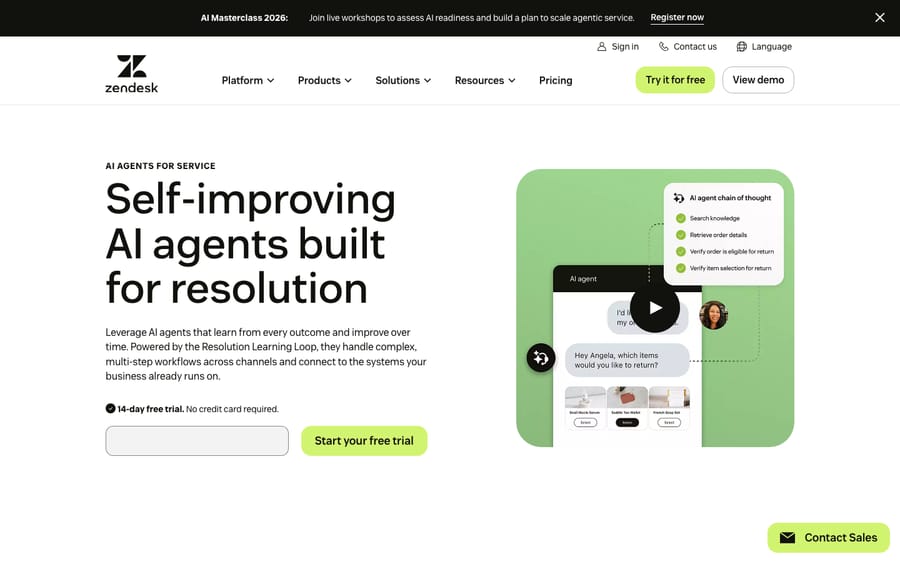
What it means in practice: Ultimate's technology became the foundation of Zendesk's autonomous AI agents. When we requested ultimate.ai on September 24, 2026, it returned a 301 redirect to Zendesk's AI agents page, and that page doesn't mention Ultimate at all. Ultimate's dialogue builder, no-code flows and resolution analytics now live inside Zendesk's platform under Zendesk's name.
Zendesk didn't stop there. It announced a deal for Forethought on March 11, 2026 and completed it on March 26, 2026, its largest acquisition in two decades (TechCrunch, PRNewswire). Since June 4, 2026, Zendesk sells "Forethought AI agents by Zendesk" as an add-on, and still sells Forethought to companies on other platforms (Zendesk help center). So Zendesk now owns two of the AI agent vendors that used to compete for its own customers.
The pattern runs across the category: help desk incumbents buying AI agents (Zendesk with Ultimate and Forethought, Salesforce with Fin). For buyers, "Ultimate AI" is no longer a vendor you evaluate on its own. It's a reason to evaluate Zendesk's AI agents. Our Zendesk AI explained guide breaks down every piece of that stack.
Update (September 2026): Salesforce completed its acquisition of Fin, the company formerly called Intercom, on September 10, 2026, after agreeing the deal on June 15, 2026 for about $3.6 billion. Salesforce says Fin keeps serving its existing customers (Salesforce). Worth weighing in any long-term Intercom or Fin decision.
A note on an old mix-up: some third-party write-ups conflated Ultimate with Forethought. They were different companies with different products. As of March 2026 both belong to Zendesk, but the Ultimate technology and the Forethought product are still sold as separate things.
How do Ultimate's AI agents work?
The technology Ultimate brought to Zendesk rests on a few ideas that still define how the agents behave.
Intent understanding and knowledge grounding
Ultimate uses natural-language understanding to map a customer's message to an intent, then grounds its answer in your connected knowledge: help center articles, macros, past tickets and back-end systems. That's what lets it handle phrasing it has never seen and still answer accurately, rather than matching exact keywords like a first-generation bot.
No-code dialogue flows and actions
Ultimate's builder lets non-engineers design conversation flows and wire in actions (looking up an order, checking a subscription, starting a return) through API integrations. Action-taking is the difference between "here's an article about refunds" and "I've processed your refund." In the Zendesk era, these capabilities sit in the AI agent builder: dialogue builder, generative procedures and authorized actions.
Multilingual, multichannel deflection
Multilingual support was always Ultimate's strongest card. It was designed for European, multi-market support teams from day one, covering chat, messaging and email across 100+ languages. The gap, then and now, is that this lineage is text-first. Voice wasn't Ultimate's core strength, and reviewers note it remains weaker than chat and email (Voiceflow).
Analytics and continuous improvement
Ultimate leaned on analytics to show automation rates and to surface where the AI was failing or escalating, so teams could feed those gaps back into knowledge and flows. That loop carries into Zendesk's resolution reporting.
Is Ultimate still sold standalone?
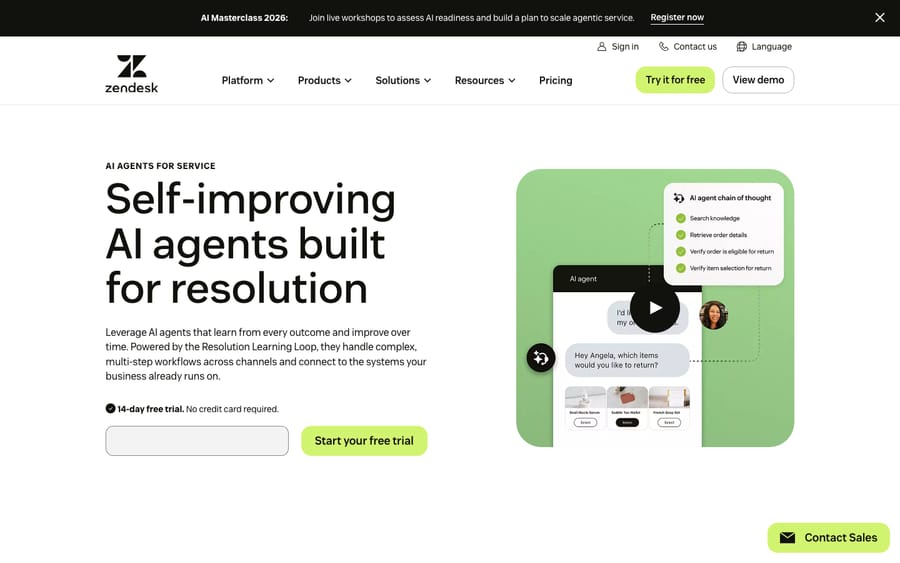
No. Since the 2024 acquisition, Ultimate is sold as Zendesk. There's no separate ultimate.ai signup and no independent pricing page. A new buyer in 2026 purchases Zendesk's AI agents, which Zendesk's pricing page says are "included in every Suite and Support plan," and Ultimate's technology is what runs underneath.
The corollary: because Ultimate is now native to Zendesk, its biggest historical strength (running on top of several help desks, including Salesforce and Freshworks) has narrowed. The capability is most at home inside the Zendesk ecosystem. Zendesk made a different call with Forethought, which it still sells to companies on other platforms.
How much does Ultimate AI cost in 2026?
There is no standalone Ultimate AI price. You pay Zendesk, in two layers, and only the first is published.
- Seats. Zendesk's pricing page lists Suite Team at $55 and Suite Professional at $115 per agent a month paid yearly, with Enterprise by quote (Zendesk pricing, checked September 24, 2026).
- Resolutions. Zendesk bills AI agents on "automated resolutions," meaning requests the AI agent resolved without escalating. Its AI agents page says resolutions are sorted into tiers "based on the value delivered," and that your plan includes an allowance you can spend on them. That page sends you to sales or an ROI calculator (Zendesk AI agents), but the plan comparison table on Zendesk's pricing page lists the rate.
- What the pricing page lists. Zendesk's pricing page lists $1.50 per automated resolution on committed volume and $2.00 pay as you go, and its plan table includes 5 automated resolutions per agent a month on Support Team and Suite Team and 10 on Suite Professional (up to 10,000 a year) (Zendesk pricing, checked September 25, 2026).
- The old add-on. Before the move to value-tiered resolutions, third-party teardowns cited an "Advanced AI agents" add-on at about $50 per agent a month on top of Suite Professional or Enterprise (eesel AI). Zendesk's current pricing page doesn't list that add-on, so don't budget on it.
The incentive is worth naming. Per-resolution billing means Zendesk earns more as your AI closes more tickets, and your bill rises exactly when support volume spikes. The same eesel teardown sketches a 10-agent Professional team running about 200 conversations a day landing near $10,000 a month all-in, with AI usage as most of the bill. That figure was built on the older rates, so rerun it with your own quote.
Bottom line on pricing: budget for Suite seats plus an AI usage layer billed by resolution, and get the tier rates in writing before you commit.
What do users say about Ultimate AI?
Ultimate earned a strong reputation in its independent years, though the evidence is harder to reach than it was. The customer stories that used to sit on ultimate.ai were folded into Zendesk after the acquisition: the Posti case study, for one, redirects to a generic Zendesk AI agents page, taking the named quotes with it. We removed two attributed testimonials from this guide in September 2026 because neither could be verified against a live source any more. The aggregator page they were credited to no longer resolves, and we'd rather carry less evidence than evidence nobody can check.
What can still be said is that published deflection figures for Ultimate customers ranged widely, roughly 35% to 80% depending on ticket mix. That spread is worth remembering when a vendor quotes you the top of it.
On the critical side, third-party review roundups surface the same themes: the AI needs a meaningful base of historical support data and good knowledge to perform, setup is more involved than a plug-and-play bot, pricing is opaque and quote-based, and gains can be modest when custom fields, sync behavior or knowledge gaps become bottlenecks (Voiceflow, Aissist). G2's Ultimate listing wasn't accessible when we wrote this, so we're summarizing review sentiment rather than inventing quotes.
What is Ultimate AI good at?
- Resolution, not just deflection. Ultimate was built to understand intent and take action through integrations, a real step beyond article-suggesting bots.
- Multilingual support. 100+ languages, designed for multi-market European teams. Still one of the best reasons to choose this lineage.
- No-code builder. Non-engineers can design flows and connect actions.
- Zendesk's scale behind it. As Zendesk's native AI agents, the technology has a major vendor's roadmap and first-party integration with the Zendesk help desk.
- Outcomes at real brands. Named customers like Posti reported high automation rates before the acquisition.
What are Ultimate AI's limitations?
- No longer independent. If you liked Ultimate because it sat on top of Salesforce or Freshworks, that flexibility has narrowed. The modern product lives inside Zendesk.
- Text-first; voice is weaker. The lineage is chat, messaging and email.
- Setup and data dependency. Reviewers say you need solid historical data, knowledge content and configuration time before deflection ramps.
- Opaque, usage-based pricing. Resolutions are billed in value tiers with no published rate, and costs rise with volume.
- Enterprise-leaning. Between Suite licensing and AI usage, this isn't a swipe-a-card starting point for a small team.
Who is Ultimate (now Zendesk AI agents) best for?
Best for: teams already on Zendesk (or moving there) with meaningful ticket volume, a multilingual customer base, decent knowledge content to ground the AI, and the budget for Suite plus per-resolution usage. For them, Ultimate's technology inside Zendesk is a strong, well-supported choice and the lowest-friction AI path.
Less ideal for: teams not on Zendesk, teams that need strong voice automation, very small teams wanting a low-commitment start, or anyone who needs predictable pricing. For how Zendesk's native agents compare with its older bot, see Zendesk AI agents vs Answer Bot.
What are the alternatives to Ultimate AI?
Since "Ultimate" now means "Zendesk's AI agents," the real question is what else to look at, especially if you want something that isn't owned by your help desk vendor.
- Zendesk's native AI agents. The direct continuation of Ultimate and the lowest-friction option if Zendesk is your stack.
- Forethought AI agents by Zendesk. Zendesk's second AI agent line since March 2026, sold as an add-on and still available to companies on other platforms.
- Intercom Fin. A strong AI agent with public per-outcome pricing, now owned by Salesforce.
- Decagon and Sierra. Well-funded enterprise platforms for high-volume, action-heavy support; sales-led and expensive.
- Ada and eesel. Automation-first players spanning mid-market and enterprise that layer onto an existing help desk, as Ultimate once did.
A note on where we fit, since we'd rather be upfront than pretend we're neutral. Macha is an AI agent layer that runs on top of your existing help desk: Zendesk, Freshdesk and the others on our integrations page. It isn't a help desk and it isn't a rip-and-replace platform. The contrast with post-acquisition Ultimate is simple: Ultimate is now the built-in AI inside Zendesk, whereas Macha is an independent layer that keeps the AI provider separate from the help desk vendor. You can start with $50 of free usage, no credit card required, and Macha bills per ticket: from $299 a month for 750 tickets, one charge however many steps the agent takes, with setup and monitoring by the Macha team included. If you're all-in on Zendesk, native agents are the path of least resistance. If you want an AI layer that isn't tied to one help desk's billing, that's the case for Macha. Our roundup of the best AI Zendesk alternatives lays out the trade-offs, and Macha on Zendesk covers how the layer model works.
For deeper reads on two of the names above, see our guides to Forethought, now part of Zendesk, and Ada, which targets the same enterprise buyer with its own automation platform.
How we researched this: Ultimate's history, funding and customer figures come from the sources linked inline, first gathered in June and July 2026. On September 24, 2026 we re-checked the parts that move: the ultimate.ai redirect, Zendesk's pricing and AI agents pages, the Forethought acquisition and the Salesforce and Fin deal. G2 and Capterra block scripted requests, so review sentiment was not re-pulled.
Frequently asked questions
What is Ultimate AI? Ultimate (ultimate.ai) is a customer-service automation platform founded in Finland in 2016 with offices in Helsinki and Berlin. Its AI agents resolve support requests across chat, messaging and email by understanding intent, grounding answers in your knowledge sources and taking actions through integrations. Zendesk acquired Ultimate in March 2024, and its technology now powers Zendesk's AI agents.
Did Zendesk buy Ultimate AI? Yes. Zendesk announced the acquisition on March 13, 2024. Ultimate's standalone brand has wound down, and ultimate.ai now 301-redirects to Zendesk's AI agents page.
Can I still buy Ultimate AI on its own? No. New buyers purchase Zendesk's AI agents, which Zendesk includes in every Suite and Support plan and bills per automated resolution. Ultimate's technology is what runs underneath.
How much does Ultimate AI cost? There's no separate Ultimate price. You pay Zendesk: Suite seats (Team $55, Professional $115 per agent a month paid yearly) plus automated resolutions billed in value tiers above your plan's allowance. Zendesk's pricing page lists $1.50 per committed resolution and $2.00 pay as you go. Get a written quote for your volume.
Is Forethought part of Zendesk now? Yes. Zendesk completed its acquisition of Forethought on March 26, 2026 and has sold "Forethought AI agents by Zendesk" as an add-on since June 4, 2026. It's a separate product from the Ultimate-based AI agents.
What were Ultimate AI's strengths? Multilingual support across 100+ languages, intent-based resolution with action-taking through integrations, a no-code builder and solid analytics. Customers like Posti reported automating 80%+ of certain ticket lines.
What are the alternatives to Ultimate AI? Intercom Fin, Decagon, Sierra, Ada and eesel are common peers, alongside Zendesk's own Forethought line. For teams that want an independent AI agent layer on top of an existing help desk, rather than the help desk's built-in option, Macha is an alternative.
Should you choose Zendesk's AI agents or an independent layer?
For practical purposes in 2026, "Ultimate" is Zendesk's AI agents. That's a good outcome if you're on Zendesk and want capable, multilingual, action-taking automation from a major vendor, and Zendesk now offers Forethought's agents as a second option.
The trade-offs are just as real. The independence that made Ultimate distinctive is gone; it's text-first with weaker voice; setup needs data and tuning; and pricing is usage-based with no published rate. If you're committed to Zendesk, those are reasonable costs. If you want an AI layer that stays independent of your help desk vendor, or you run a different help desk, that's the gap an independent layer fills. Match the tool to your stack and your appetite for lock-in.
Last checked September 24, 2026 against the ultimate.ai redirect, Zendesk's pricing and AI agents pages, Zendesk's Forethought announcements and Salesforce's Fin announcement. The per-resolution rates come from Zendesk's pricing page, rechecked September 25, 2026.
Add AI agents to your Zendesk
Macha reads the ticket, drafts the reply and takes the action, inside the Zendesk you already run.