Intercom
 Shopify
 Stripe
 Slack
Slack Notion
 Google Workspace
 Confluence

Zendesk AI Agents vs. Answer Bot: What Changed


If you set up "Answer Bot" in Zendesk a few years ago and recently went looking for it, you've probably noticed it's gone — or rather, renamed, restructured, and quietly turned into something fundamentally different. The deflection widget that used to suggest a help-center article is now marketed as an AI agent, and as of mid-2026 even the tier structure that defined it has been collapsed. The label change is the least interesting part. What changed underneath is a shift from matching a question to an article to generating an answer and, increasingly, taking action — a different technology, a different billing model, and a different set of things that can go wrong.
Key takeaways
- Zendesk folded Answer Bot into its AI agents branding in 2024, shifting from retrieval based article suggestions to generative, conversational replies that can take actions.
- Zendesk is removing the Essential and Advanced AI agent tiers in a phased rollout from May 11 to June 12, 2026, folding advanced capabilities into all Suite and Support plans.
- Legacy Essential and Answer Bot functionality stops development on August 31, 2026, and reaches full end-of-life and shut-off on December 10, 2026.
- Answer Bot's deflection was bundled into the plan, while modern AI agents are billed per automated resolution, a metered charge based on outcome rather than a flat fee.
- Third-party estimates put real-world full-resolution rates for knowledge-base-grounded AI agents around 30 to 50 percent for general support volume, not the 80 to 90 percent sometimes implied.

This guide is the focused before-and-after: what Answer Bot actually did, what Zendesk AI agents do now, the Essential-vs-Advanced tiers and why they no longer exist, the pricing-model shift that came with the change, and what stayed exactly the same (spoiler: it still lives or dies by your knowledge base). The evolution here is verified against Zendesk's own documentation and its 2026 packaging announcement. If you want the deep history of the original tool, see Zendesk Answer Bot explained; if you want the full map of Zendesk AI, start at the Zendesk AI hub.
The two eras at a glance
Here's the core of it before we unpack each piece:
| Answer Bot (the old era) | AI agents (today) | |
|---|---|---|
| Core mechanism | Retrieval — matches an incoming question to existing help-center articles | Generative — composes a written answer from your knowledge, in its own words |
| What it does | Suggests / deflects — surfaces an article and hopes it answers | Resolves — replies conversationally and can close the loop |
| Conversation | Single-shot or shallow, flow-based prompts | Multi-turn; holds context across a back-and-forth |
| Actions | None — read-only article recommendations | Increasingly takes API-backed actions (look up an order, check status) — on the advanced capabilities |
| Channels | Web form, email, messaging | Messaging, email, web, voice |
| Pricing model | Bundled deflection (included/low-cost) | Per automated resolution (outcome-based) |
| Depends on | A good knowledge base | A good knowledge base (this never changed) |
Everything below explains why each row moved.
What Answer Bot actually was
Answer Bot, in its classic form, was a retrieval-based deflection tool. When a customer typed a question — in a web form, an email, or the messaging widget — Answer Bot scanned your published help-center articles, found the closest matches, and surfaced them: "Here are some articles that might help." If one of them answered the question and the customer didn't go on to open a ticket, that counted as a deflection.
That's the key mental model. Answer Bot didn't understand the question and write a reply — it matched the question to content you'd already written and handed it over. It was, essentially, a smart search box bolted to the front of your support queue. Where it ran flows, those flows were scripted and branching, not improvised. It worked well for high-volume, repetitive questions that mapped cleanly to a single article ("How do I reset my password?") and poorly for anything phrased unusually, spanning two topics, or not covered by an article at all.
It was genuinely useful, and for a deflection tool it was priced accordingly. But it had a ceiling: it could only ever point at content, never compose an answer, and never do anything. For the full anatomy of the original tool and where it fell short, see Answer Bot explained.
What changed: from retrieval to generation
The headline shift is retrieval → generation. Zendesk folded Answer Bot into the "AI agents" branding in 2024, and the capability underneath moved from finding the right article to writing the right answer. A modern Zendesk AI agent reads the customer's message, pulls relevant facts from your connected knowledge, and generates a conversational reply in its own words — then keeps the thread going if the customer follows up.
Three things genuinely changed:
- Generative answers, not article links. Instead of "here are 3 articles," the agent writes a direct answer synthesized from your knowledge base. The customer gets a response, not a reading assignment.
- Multi-turn conversation. The old bot was largely single-shot. An AI agent holds context across a conversation — it can ask a clarifying question, take the answer, and continue, the way a person would.
- Actions, not just answers. This is the biggest leap and the one that defines the word "agent." On the advanced capabilities, the AI agent can call external APIs to do things — look up an order, check a subscription status, trigger a workflow — rather than only describing how the customer could do it themselves. That's the line between answering a question and resolving a request.
The honest caveat: "resolution" is doing a lot of work in the marketing. Generation is more capable than retrieval, but it's also less predictable — it can produce a fluent answer that's subtly wrong if your knowledge is thin or contradictory. More on that below.
The Essential and Advanced tiers (and why they're going away)
For most of this era, Zendesk split AI agents into two tiers, and understanding the split explains a lot of the confusion:
- AI agents – Essential was the direct descendant of Answer Bot. Over time it gained generative replies pulled from your connected knowledge base, so it could answer questions in its own words — but it couldn't run scripted dialogue flows, couldn't take authorized actions, and couldn't call third-party APIs. It was the "answer questions from the KB" tier.
- AI agents – Advanced was a different lineage entirely. It came from Ultimate.ai (which Zendesk acquired in March 2024) and now sits under the Forethought name. This is the tier with the visual dialogue builder, branching and goal-oriented flows, generative procedures, multi-step reasoning, and — crucially — external API integrations. This is where "the agent can actually take actions" lived.
So when people argued about whether Zendesk's AI could "really do things," they were usually talking past each other: Essential couldn't, Advanced could. (eesel's Essential-vs-Advanced breakdown is a good third-party reference on the distinction.)
The mid-2026 consolidation
That two-tier structure is now being dismantled. In its 2026 announcement, "Announcing expanded access to AI agent capabilities for all Zendesk customers," Zendesk confirmed it is removing the Essential/Advanced distinction and folding the advanced capabilities — agentic reasoning, multi-step procedures, and external API integrations — into all Zendesk Suite and Support plans. The dates, verified against the announcement:
- Phased rollout: May 11 – June 12, 2026. New and trial customers first (May 11–15), then existing Essential/basic users (May 25 – June 12); Advanced customers move onto a separate onboarding timeline.
- Development stops for Essential/legacy: August 31, 2026 (critical bug fixes only after that).
- End-of-life and full service shut-off: December 10, 2026.
The practical upshot: the capabilities that used to require the Advanced add-on — the actually-agentic ones — are becoming standard across Suite/Support plans, while the old Essential/legacy path is being retired. If your AI agent is still running on Essential or legacy Answer Bot configuration, that's now a clock you need to watch.
The pricing-model shift
The quieter but equally important change is how you pay. Answer Bot's deflection was effectively bundled — it came with your plan, and a deflection didn't carry a per-event charge. Today's AI agents are billed on an outcome: the automated resolution (AR). When the agent successfully handles an interaction (by Zendesk's definition — a generative reply, AI relevance verification, and a window with no human reply and positive-or-no negative feedback), that's a metered, billable AR.
That's a structural change, not a price tweak. You've gone from "deflection is free-ish, included in the plan" to "every successful AI resolution is a line item," typically alongside the Copilot agent-assist add-on. Two teams on the same plan can now see very different AI bills depending on volume. We don't repeat the numbers here — the exact AR definition, the Copilot add-on, allowances, overage rates, and worked cost examples live in Zendesk AI pricing explained, which is the post to read before you budget.
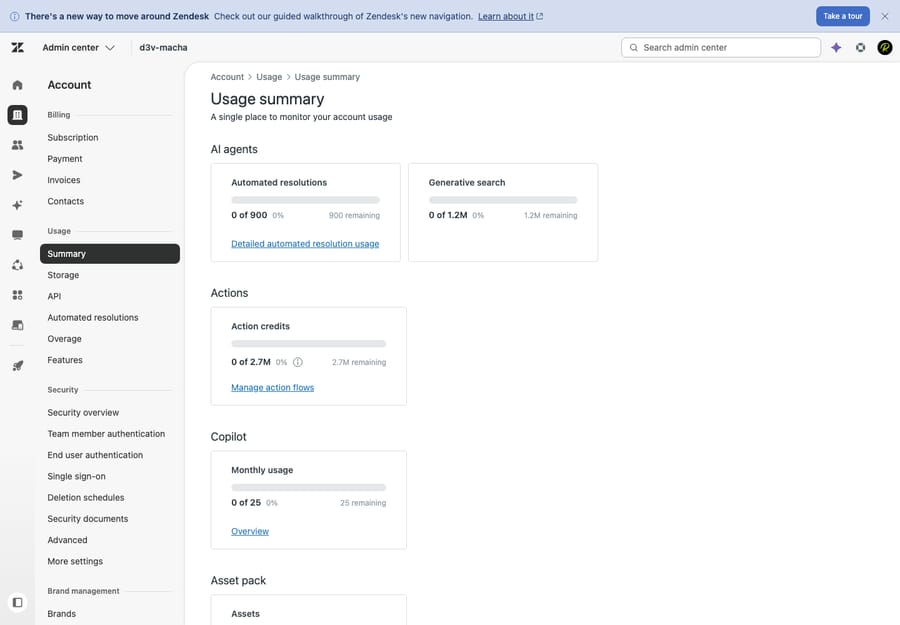
(The AI-agent builder and configuration screens are login-walled on our test instance, so they're described rather than shown; the usage-metering view above is from our Zendesk developer account.)
What stayed exactly the same
For all the change, one thing didn't move an inch: it still lives or dies by your knowledge base. Answer Bot needed good help-center articles to retrieve. AI agents need good knowledge to generate from. If anything, the dependency got sharper — a retrieval bot that finds a mediocre article just looks unhelpful, but a generative agent reasoning over thin, outdated, or contradictory content can produce a confident, fluent answer that's wrong. Garbage in, fluent garbage out.
So the prep work is identical to the Answer Bot era, just higher-stakes: clean, current, well-structured articles; clear coverage of your top question types; and a deliberate decision about what the agent is allowed to answer versus escalate. The technology changed; the homework didn't.
An honest look at resolution rates
Vendor marketing talks about AI agents "resolving" tickets, and it's worth being clear-eyed about what that means in practice. Independent and third-party estimates commonly put real-world full-resolution rates for KB-grounded AI agents in the ~30–50% range for general support volume — not the 80–90% sometimes implied — and the figure swings hard with the quality of your knowledge base and the complexity of your tickets. (Treat that band as a third-party estimate, not a Zendesk-published guarantee; your mileage will vary.)
That's not a knock — deflecting or resolving a third to a half of routine volume is a real win. It's a calibration: budget for the AR model assuming a realistic resolution rate, and design for graceful handoff on everything the agent can't close, so an unresolved case becomes a normal ticket with full context intact rather than a dead end.
Where an AI agent layer fits
If your read on all this is "the capability is real but the per-resolution billing and the KB-dependency make it hard to predict," that's the honest read. It's also why some teams add a separate AI agent layer on top of Zendesk rather than relying solely on the native path.
Macha is one such layer — to be clear, it's not a help desk and not a Zendesk replacement; it runs on top of your existing Zendesk and connects to your tickets and knowledge. Because the query "Zendesk AI agents" is an AI/automation intent, it's fair to be direct here: Macha can do the generative, conversational, action-taking work this whole post is about — draft and send replies, triage and route, look up data in connected systems, and resolve routine tickets — while anything it can't handle stays a normal ticket for a human.
The two honest watch-outs: it's another vendor and integration to run, and like every AI on this page it only performs as well as the knowledge and rules you give it. The one structural difference worth knowing is the billing philosophy. Where Zendesk meters per automated resolution (one kind of outcome), Macha bills per ticket — one conversation, charged once, whether the agent summarizes, tags, routes, looks up data, drafts a reply or resolves it outright, and whichever model it runs on. The reasoning: most useful automation isn't a "resolution," it's work done along the way, so a bill keyed to an outcome definition you don't control is the wrong unit. Pricing starts at $299 a month for 750 tickets, about $0.40 each. If you want to see it on your own tickets, you can try it free — $50 of free usage, no credit card required.
Frequently asked questions
What happened to Zendesk Answer Bot? Zendesk folded Answer Bot into its "AI agents" branding in 2024 and shifted the underlying technology from retrieval-based article deflection to generative, conversational answers. The Answer Bot lineage became the "AI agents – Essential" tier, which since gained generative replies. As of the mid-2026 packaging change, the Essential/legacy path is being retired — development stops August 31, 2026, with full end-of-life on December 10, 2026.
What's the difference between Answer Bot and Zendesk AI agents? Answer Bot matched a question to existing help-center articles and suggested them (retrieval/deflection). A Zendesk AI agent generates a written answer from your knowledge in its own words, holds a multi-turn conversation, and — on the advanced capabilities — can call external APIs to take actions like looking up an order. The shift is from "here are some articles" to "here's your answer, and here's the thing done."
Are Zendesk AI agents Essential and Advanced still separate? No — not for long. Zendesk announced it is removing the Essential/Advanced distinction in a phased rollout (May 11 – June 12, 2026), folding advanced capabilities like agentic reasoning, multi-step procedures, and external API integrations into all Suite and Support plans. Essential/legacy functionality reaches end-of-life on December 10, 2026.
Do Zendesk AI agents cost more than Answer Bot did? The pricing model changed, which usually means yes for active users. Answer Bot deflection was effectively bundled into the plan; modern AI agents are billed per automated resolution (an outcome-based meter), typically alongside the Copilot agent-assist add-on. Cost now scales with how much the AI resolves. See Zendesk AI pricing explained for the AR definition and worked examples.
Do AI agents still need a knowledge base? Yes — more than ever. Answer Bot needed good articles to retrieve; AI agents need good knowledge to generate accurate answers from. Thin, outdated, or contradictory content makes a generative agent produce confident but wrong replies, so a clean, current help center is the single biggest factor in how well it performs.
What if I set up "Answer Bot" years ago — do I need to do anything? Probably. If your configuration is still on the Essential or legacy Answer Bot path, it's on a retirement timeline (dev stops August 31, 2026; shut-off December 10, 2026). You'll want to migrate to the current AI agents setup, re-check which channels and actions you've enabled, and revisit your knowledge base, since the generative model leans on it harder than the old retrieval bot did.
The bottom line
The move from Answer Bot to Zendesk AI agents isn't a rename — it's a change in kind. The old tool retrieved and suggested; the new one generates, converses, and increasingly acts, and you pay for it per resolved outcome instead of as a bundled deflection. The Essential/Advanced tiers that defined the middle years are being collapsed in 2026, with advanced capabilities rolling into standard Suite/Support plans and the legacy path retiring by December. What didn't change is the foundation: a strong, current knowledge base is still the thing that makes any of it work, and a realistic resolution rate (think a third to a half of routine volume, not all of it) is still the number to plan around. Get the knowledge right, watch the retirement dates if you're on legacy Answer Bot, and read the pricing breakdown before you budget — then decide whether the native path or an AI agent layer on top of Zendesk fits how you actually work.
Evolution and dates verified against Zendesk's official documentation and 2026 packaging announcement, June 2026. Zendesk updates its product and timelines periodically — confirm specifics in your own account before relying on them.
Add AI agents to your Zendesk
Macha reads the ticket, drafts the reply and takes the action, inside the Zendesk you already run.