Intercom
 Shopify
 Stripe
 Slack
Slack Notion
 Google Workspace
 Confluence

Aissist: The Complete Guide (2026)


If you've been comparing AI agents for customer support in 2026, Aissist (the product at aissist.io) probably surfaced with an eye-catching promise: 2X performance at 50% cost, plus a free tier of 1,000 tickets every month. It's one of a growing crop of AI agents that install on top of your existing helpdesk — Zendesk, Intercom, Gorgias, Front, HubSpot — and handle conversations autonomously. But the pitch is bold, the pricing model is unusual (it charges per interaction, not per resolution), and the company is small — which makes the obvious questions harder to answer: what is Aissist, what does it really cost, and is it right for your team?
Key takeaways
- Aissist markets a headline claim of 2X performance at 50% cost compared with other automation tools, and offers a free tier of 1,000 tickets a month with no credit card required.
- Aissist bills per AI interaction rather than per resolution, with rates of roughly $0.12 on Starter, $0.10 on Growth, and $0.08 on Enterprise, all approximate and volume-tiered.
- Aissist claims an average 83% automation rate, with up to 98% cited for its AgentMesh layer on combined sales and service workloads, plus a 4.8+ CSAT.
- A competitor's teardown reportedly describes Aissist as seed-stage with fewer than 10 employees and no SOC 2 certification as of its writing, a single third-party source rather than a confirmed fact.
- On G2, Aissist holds a rating of 5.0 out of 5 across roughly 26 reviews, a positive but small sample.

This is our honest, researched attempt at that answer. We'll cover what Aissist does, how its "Digital Employees" and the newer AgentMesh layer work, what it actually costs, where it's strong, where it isn't, and how it compares to the alternatives. Full disclosure: we build an AI support product ourselves (Macha), and Aissist is a direct peer of ours — so we'll be upfront about that. The goal here is a genuine guide to Aissist, not a pitch, and where we can't verify a claim we say so.
What is Aissist?
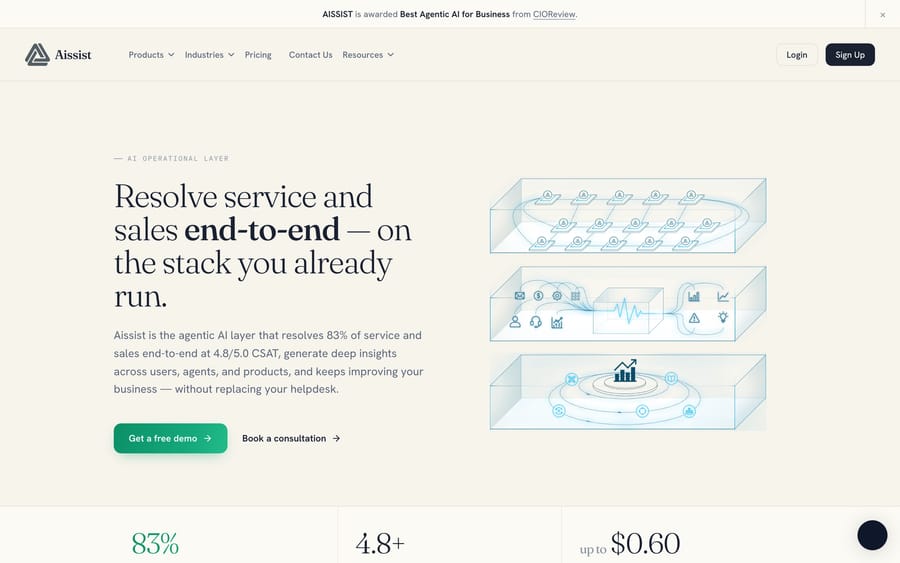
Aissist.io's homepage — an AI agent layer for support and sales teams.
Aissist is a multi-agent AI platform for customer support and sales. Rather than shipping a single chatbot, it frames its product as a set of specialized "Digital Employees" that live inside the helpdesk you already run and take on real support work (aissist.io). The headline promise across its marketing is blunt: 2X performance at 50% cost compared with other automation tools.
Architecturally, Aissist sits in the same category as Macha, Intercom Fin, and Decagon: it's an AI agent layer that connects to your existing helpdesk rather than a helpdesk replacement. It plugs into Zendesk, Intercom, Front, Gorgias, HubSpot, Kustomer, Salesforce, and Freshdesk, and answers from your knowledge base, website content, and connected data (myaskai teardown). Two things separate it from the pack rhetorically: it markets itself for both support and sales (most peers pick one lane), and it leans hard on a "human-parity" framing — the idea that its agents don't just answer, they complete work the way a human teammate would.
That framing crystallized in AgentMesh, which Aissist positions as its AI Operations Layer: a mesh of specialized agents that collaborate to resolve a case end to end rather than a single monolithic bot (AgentMesh). We unpack the mechanics below — but the short version is that Aissist wants to be judged against a human agent's throughput, not a deflection chatbot's.
One important fact to keep in mind throughout: Aissist is an early-stage company. A competitor's teardown reportedly describes it as seed-stage, with fewer than 10 employees and no SOC 2 certification as of its writing (eesel AI) — a single third-party source, so treat it as indicative rather than confirmed. That doesn't make it a bad product — plenty of good tools start small, and being small can mean faster iteration and more hands-on onboarding — but it's a material consideration for larger or regulated buyers, so we flag it up front.
How Aissist's AI works
Under the hood, Aissist is a GPT-based multi-agent platform — it uses large language models (OpenAI-family models, per its materials) grounded in your own content and connected systems, rather than a rules-and-decision-tree bot. It organizes its capabilities into three pillars — a Digital Agent, an AI Manager, and an AI Assistant — and, more recently, wraps the autonomous piece in the AgentMesh orchestration layer described above.
Digital Agent — autonomous conversations
The Digital Agent is the autonomous piece. It handles conversations end to end across your connected helpdesk — reading the customer's message, grounding its answer in your knowledge, and responding without a human in the loop (aissist.io). It supports multimedia inputs across text, images, video, and voice and 65+ languages, and adapts to your brand voice.
The distinctive design choice is that the Digital Agent is deployed like a human teammate rather than a widget bolted onto the side. Instead of living only in a chat bubble, it monitors inboxes, reacts to assignments and routing, and acts on internal notes inside the platform your team already uses — so a manager can, in effect, "assign a ticket to the AI" the same way they'd assign it to a person (AgentMesh). Aissist claims AgentMesh is engineered to handle both complex, policy-heavy procedures and simple FAQs — multi-step logic and cross-system tasks, not just canned answers — and, in its own marketing, claims up to 98% automation on combined sales and service workloads. As with all such figures, treat that as a vendor-reported ceiling under favorable conditions, not a guaranteed baseline.
AI Manager — analytics and quality
The AI Manager is the oversight layer: analytics, quality assurance, and continuous-learning monitoring so you can see how the agent is performing and where it's falling short (myaskai). Features here include Smart Tagging (auto-categorization of tickets), insight generation, and sentiment analysis.
AI Assistant — a copilot for human agents
The third pillar is a copilot for your human agents. Rather than replacing them, the AI Assistant gives in-note commands — drafting replies, translating, and summarizing — directly inside the tools your team already uses (myaskai). This "agent-assist" mode is a sensible bridge for teams not ready to hand full conversations to automation.
Smart Actions — doing, not just answering
Beyond answering, Aissist can execute real workflows through Smart Actions: order lookups, refund processing, returns, and appointment booking via Shopify, WooCommerce, Adobe Commerce, and custom REST/GraphQL endpoints (myaskai). This action-taking — pulling live order status, cancelling an order, or initiating a return mid-conversation — is what separates a true agent from a deflection chatbot that only points people at help articles. The e-commerce coverage in particular (Shopify plus Adobe Commerce/Magento and WooCommerce) signals where Aissist has invested: DTC and retail support, where "where's my order?" and refund requests dominate the queue. For anything outside those native connectors, the REST/GraphQL path lets you wire the agent into your own backend — though that's a developer task, not a no-code toggle. If you want the mechanics of wiring an agent up to your own systems, our guide to custom tools for AI agents walks through the pattern.
AgentMesh — the orchestration layer
Layered over these pillars, AgentMesh is Aissist's attempt to move from "one smart agent" to "a coordinated AI workforce." Aissist describes it as many specialized agents collaborating — one gathering context, one following procedure, one taking the action across systems — so that ambiguous, multi-step cases get routed through the right internal steps instead of hitting a single model's limits. Practically, the promise is reliability on hard tickets: policy exceptions, cross-system lookups, and cases that a human would normally escalate. Whether a mesh of specialized agents genuinely outperforms a single well-grounded agent is an open architectural debate across the industry, and Aissist's own benchmarks are the main evidence today — so weigh the claim, but verify it on your own ticket sample during a trial.
The vendor's performance claims
Aissist markets on outcomes: an average 83% automation rate (with up to 98% cited for AgentMesh on combined sales and service), 2X performance at 50% cost, and a 4.8+ CSAT (aissist.io). Treat these as vendor-reported figures, not independently audited benchmarks. Your real results will depend heavily on ticket mix, knowledge quality, and how much of your workflow you actually automate — a support queue full of nuanced, account-specific issues will not automate at the same rate as a queue full of order-status questions.
Deployment: what standing Aissist up actually looks like
The honest reality of any AI support agent is that the demo is easy and the deployment is where teams get surprised, so it's worth setting expectations.
Getting started with Aissist is comparatively light-touch: you connect your helpdesk (an OAuth/app install for Zendesk, Intercom, Gorgias, Front, HubSpot, Kustomer, Salesforce, or Freshdesk), point it at your knowledge sources — help center articles, website content, and connected data — and configure brand voice and guardrails. The free tier means you can do all of this without a purchase order, which materially lowers the barrier to a real pilot.
Where the work concentrates is the same place it does with every agent in this category: content quality and action wiring. The Digital Agent is only as good as the knowledge it's grounded in, so the first real task is auditing and cleaning up your help content. Smart Actions that go beyond answering — refunds, cancellations, custom lookups — need to be configured and, for anything past the native Shopify/WooCommerce/Adobe Commerce connectors, built against your REST/GraphQL endpoints by someone technical. Budget for a tuning period: launching in agent-assist (copilot) mode, watching the AI Manager analytics, and progressively handing over conversation types as confidence builds is the low-risk path most teams should take rather than flipping full autonomy on day one.
For a small vendor, hands-on onboarding can be a genuine advantage here — you're more likely to talk to someone who knows the product. The flip side is the vendor-risk consideration we keep flagging: less documentation, a smaller support org, and a shorter track record than an incumbent.
Aissist pricing (2026)
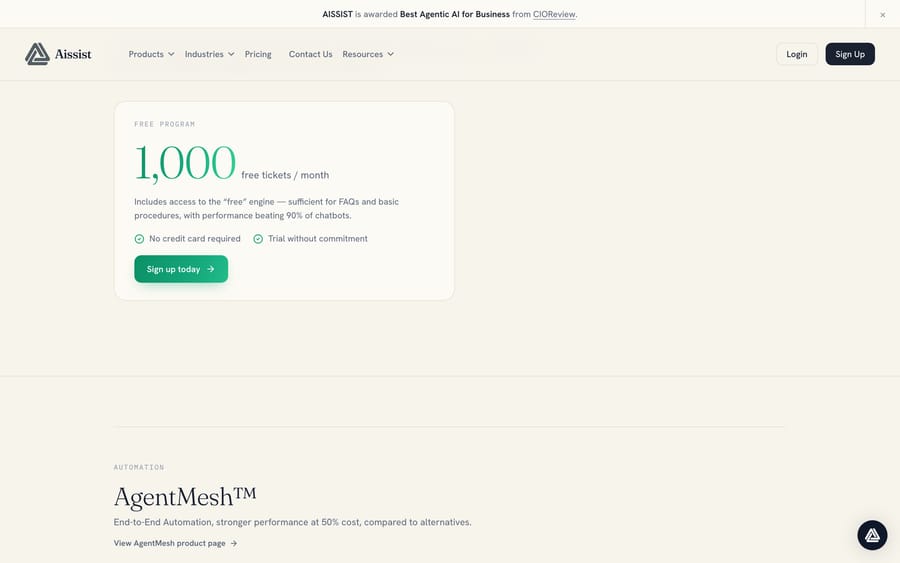
Aissist's pricing page, led by a free 1,000-tickets/month tier.
Aissist's pricing model is its most distinctive — and most scrutinized — feature. Unlike vendors that charge per resolution, Aissist bills per interaction, which it defines as a unit of AI work rather than a whole conversation (aissist.io/pricing).
As of mid-2026, the public structure looks like this (all figures fast-moving — confirm directly with Aissist):
| Plan | Price | Notes |
|---|---|---|
| Free | $0 | 1,000 tickets/month, no credit card required |
| Starter | ~$0.12 / interaction (approx.) | pay-as-you-go, up to ~30,000 interactions |
| Growth | ~$0.10 / interaction (approx.) | ~30,000–300,000 interactions |
| Enterprise | ~$0.08 / interaction (approx.) | high-volume / unlimited, custom terms |
A few honest caveats. First, treat the per-interaction figures above as approximate. They match Aissist's live pricing page (roughly $0.12 Starter, $0.10 Growth, $0.08 Enterprise), but third-party teardowns have cited lower numbers at times (eesel AI), and the rate is genuinely volume-tiered and moves over time — so confirm live numbers before you model a budget.
Second, and more importantly, per-interaction billing is hard to forecast. Aissist defines an "interaction" as a unit of AI work, not a whole conversation — so a single support ticket that involves a clarifying question, a knowledge lookup, and an action can burn several interactions. That makes your bill scale with AI activity rather than with resolved tickets, which is harder to reason about than a per-resolution or per-seat model and can produce surprises at volume (eesel AI). The upside of usage-based pricing is that you only pay for what the AI actually does; the downside is that a chatty agent on complex tickets costs more than the headline per-interaction figure suggests.
On the credit side of the ledger: the free tier of 1,000 tickets/month with no credit card is genuinely generous for this category and makes a real pilot easy, and Aissist deserves credit for publishing public pricing at all when many competitors hide behind "contact sales." If you want to compare unit models directly, our own pricing is built per ticket (one charge per thread, from $299/month for 750 tickets) — a different unit that some teams find easier to map to a monthly plan.
Pros and cons
Pros
- Generous free tier — 1,000 tickets/month with no credit card is unusually open for this category, making Aissist easy to trial.
- Public, usage-based pricing — transparent per-interaction rates, no forced annual commitment on the lower tiers.
- Three-in-one design — autonomous agent, analytics/QA, and an agent copilot in one platform, so you can start with agent-assist and grow into automation.
- E-commerce-friendly actions — native Shopify, WooCommerce, and Adobe Commerce plus REST/GraphQL for order lookups, refunds, and returns.
- Strong integration coverage for a small vendor — Zendesk, Intercom, Front, Gorgias, HubSpot, Kustomer, Salesforce, and Freshdesk.
- Dual support + sales use — the same platform is pitched for sales conversations, not just deflection, which is unusual among support-first agents.
- "Deployed like a teammate" model — the agent works inbox assignments and internal notes inside your helpdesk, which fits existing routing workflows rather than forcing a separate chat surface.
Cons
- Small, early-stage company — reportedly seed-stage with fewer than 10 employees per a competitor's teardown, which (if accurate) affects support depth, roadmap certainty, and vendor risk (eesel AI).
- No SOC 2 (reportedly, per a single third-party review at time of writing) — a likely blocker for security-conscious or regulated buyers; confirm current compliance status directly.
- Hard-to-forecast bills — per-interaction pricing is less predictable than per-resolution or seat-based models.
- Thin, cautious review base — a 5.0/5 on G2 across roughly 26 reviews (G2) is positive but a small sample, and a perfect 100% five-star score (with some G2-invited reviews) warrants a grain of salt.
- Vendor-reported performance claims — the 83% automation, up-to-98% AgentMesh, and 4.8+ CSAT figures aren't independently audited; real-world rates hinge on your ticket mix and content quality.
- Custom actions need engineering — beyond the native e-commerce connectors, wiring Smart Actions to your own systems via REST/GraphQL is a developer task, not a no-code toggle.
Who Aissist is best for
Aissist is a reasonable fit if you're a small-to-mid-sized support or e-commerce team that wants to experiment with AI automation cheaply and quickly, values a large free tier, and runs a helpdesk it supports (Zendesk, Intercom, Gorgias, Front, HubSpot). The agent-assist copilot is a low-risk entry point for teams that aren't ready to hand full conversations to AI.
It's a weaker fit if you're an enterprise or regulated business that needs SOC 2 and a larger vendor behind you, or if you need predictable budgeting — per-interaction pricing can surprise you at scale.
Aissist vs alternatives (including Macha)
| Aissist | Macha | Intercom Fin | |
|---|---|---|---|
| Model | AI layer on your helpdesk | AI agent layer on your helpdesk | AI agent (native to Intercom) |
| Helpdesks | Zendesk, Intercom, Front, Gorgias, HubSpot, Kustomer, Salesforce, Freshdesk | Zendesk, Freshdesk, Front, Intercom, Gorgias | Intercom (best), plus others |
| Pricing unit | Per interaction (~$0.08–$0.12) | Per ticket (from $299/mo for 750 tickets, ~$0.40/ticket) | Per resolution (~$0.99) |
| Build agents | Multi-agent "Digital Employees" / AgentMesh | Plain-English agent builder | Content + workflow builder |
| Use case | Support and sales | Support automation & workflows | Support deflection |
| Actions | Shopify, WooCommerce, Adobe Commerce, REST/GraphQL | Custom tools + connectors | Intercom-native + apps |
| Free tier | 1,000 tickets/mo | $50 of free usage, no credit card | Limited |
| Best if you want | Biggest free tier for an e-commerce pilot | Plain-English agents, per-ticket pricing, Zendesk/Freshdesk | You already live in Intercom |
| Company stage | Seed / small | Growth | Large (Intercom) |
Where Macha differs: we're also an AI agent layer that runs on top of the helpdesk you already use, but we let you build agents in plain English and bill per ticket (one charge per thread, however many replies) rather than per interaction — a unit some teams find easier to reason about. We won't claim Macha does everything a given platform does; the honest framing is fit. If your priority is the biggest possible free tier for a quick e-commerce experiment, Aissist is worth a look. If you want a transparent, ticket-priced AI agent for customer service that plugs into Zendesk or Freshdesk and is built in plain English, that's our lane — see our pricing. And if you're deep in Intercom's ecosystem, Fin is the incumbent to compare against; the closest like-for-like to Aissist's “layer on the helpdesk you already run” model is eesel AI.
How we researched this
Everything here comes from Aissist’s own site — its pricing page, integration list and product documentation — plus its public marketplace listings on the help desks it plugs into; the plan and per-interaction figures were last verified against Aissist’s own pricing page in the month this guide was written. On September 21, 2026 we re-checked the internal links in this post and added the comparisons above, but we did not re-price the plans on that pass. We have not run Aissist on a live queue ourselves, and we did not re-open G2 on that pass — it blocks scripted requests — so treat the rating quoted above as the figure from the original research rather than a September reading.
Frequently asked questions
What is Aissist? Aissist (aissist.io) is a multi-agent AI platform for customer support and sales. It installs on top of helpdesks like Zendesk, Intercom, Gorgias, Front, HubSpot, Kustomer, Salesforce, and Freshdesk and provides autonomous "Digital Employees" plus analytics and an agent copilot.
What is AgentMesh? AgentMesh is Aissist's "AI Operations Layer" — a mesh of specialized agents that collaborate to resolve a case end to end (gathering context, following procedure, taking actions across systems) rather than a single bot. Aissist positions it as being deployed "like a human teammate" inside your helpdesk and claims up to 98% automation on combined sales and service; treat that ceiling as vendor-reported.
Which helpdesks and platforms does Aissist integrate with? Aissist integrates with Zendesk, Intercom, Front, Gorgias, HubSpot, Kustomer, Salesforce, and Freshdesk, and connects to e-commerce systems including Shopify, WooCommerce, and Adobe Commerce. Custom actions can be wired to your own backend via REST/GraphQL.
How much does Aissist cost? Aissist bills per AI interaction. There's a free tier of 1,000 tickets/month, and paid rates run roughly $0.08–$0.12 per interaction (approximate) depending on tier and volume. Because a conversation can span multiple interactions, bills can be harder to forecast — confirm current pricing with Aissist.
Is Aissist per resolution or per interaction? Per interaction, not per resolution. This differs from vendors like Intercom Fin (per resolution) and Macha (per ticket, one charge per thread).
Is Aissist SOC 2 certified? Third-party reviews reported no SOC 2 certification as of their writing, and describe Aissist as an early-stage company. If security compliance matters to you, confirm the current status directly with Aissist.
Can Aissist handle sales as well as support? Yes — unlike most support-first agents, Aissist markets itself for both service and sales conversations, and its automation claims cover the combined workload. If you want a single AI layer spanning pre-sale questions and post-sale support, that dual-use framing is a differentiator worth testing.
Does Aissist replace my helpdesk? No. Aissist is an AI agent layer that runs on top of the helpdesk you already use (Zendesk, Intercom, Freshdesk, and others) — it works your inbox assignments and internal notes inside that tool rather than replacing it. The same is true of Macha.
What are the best Aissist alternatives? Common alternatives include Macha (plain-English AI agents on your existing helpdesk, per-ticket pricing), Intercom Fin (best if you're already on Intercom), and eesel AI. The right pick depends on your helpdesk and how you prefer to be billed.
Thinking about an AI agent that runs on the helpdesk you already use, is built in plain English, and bills per ticket instead of per interaction? See how Macha compares — explore Macha's pricing or read our overview of AI agents for customer service.
Resolve tickets automatically with AI agents
Macha's AI agents work on top of the help desk you already use — no code.