Intercom
 Shopify
 Stripe
 Slack
Slack Notion
 Google Workspace
 Confluence

What Is Intercom? The Customer-Service Platform, Its Pricing and New Owner (2026)


Intercom is customer-service software that combines a chat Messenger, a ticketing inbox, a Help Center and an AI agent called Fin, sold per seat plus $0.99 per Fin outcome. Salesforce completed its acquisition of the company, which renamed itself Fin in May 2026, on 10 September 2026.
Key takeaways
- Intercom is AI-first customer-service software that bundles a chat Messenger, a shared inbox with ticketing, a Help Center, outbound messaging and the Fin AI agent in one platform.
- Intercom seats cost $29 on Essential, $85 on Advanced and $132 on Expert per seat per month on annual billing, as listed on 24 September 2026.
- Fin, Intercom's AI agent, is billed at $0.99 per outcome and at most once per conversation, while a sales qualification costs $9.99.
- Salesforce agreed to buy Fin, the company formerly called Intercom, for about $3.6 billion on 15 June 2026 and completed the deal on 10 September 2026.
- Salesforce reports that Fin serves more than 30,000 companies with an average resolution rate of 76%, a vendor figure that depends on help content quality.

Intercom is AI-first customer-service software: a chat Messenger, a shared inbox with ticketing, a Help Center and an AI agent called Fin that resolves questions on its own, priced at $29, $85 or $132 per seat per month plus $0.99 per Fin outcome (intercom.com/pricing, checked 24 September 2026). The company renamed itself Fin on 12 May 2026, and Salesforce completed its acquisition of it on 10 September 2026. If you meant the buzzer by your front door, that's a different product that shares the name.
| Question | Answer (24 Sept 2026) |
|---|---|
| What it is | Customer-service platform: Messenger, Inbox and tickets, Help Center, outbound messaging, Fin AI agent |
| Founded | 2011, Dublin, Ireland; headquartered in San Francisco |
| Owner | Salesforce (acquisition completed 10 September 2026, about $3.6 billion) |
| Seat prices | Essential $29, Advanced $85, Expert $132 per seat/month, billed annually |
| AI pricing | Fin: $0.99 per outcome; sales qualification $9.99 |
| Best fit | Product-led SaaS and tech companies whose customers live inside an app |
Who makes Intercom?
Intercom was founded in 2011 in Dublin, Ireland by Eoghan McCabe, Des Traynor, Ciaran Lee and David Barrett, and is headquartered in San Francisco. It stayed private and never went public, unlike Zendesk or Freshworks. Since 10 September 2026 it has been part of Salesforce.
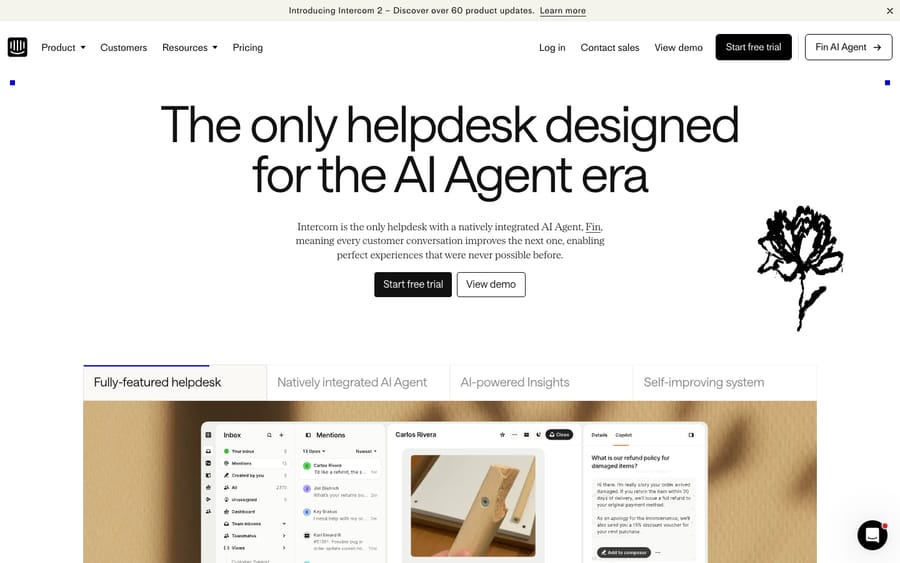
The history explains the product. Intercom started as a messenger-first tool: live, in-app chat and targeted messages shown to people while they used your product, instead of routing everything through email tickets. For years it called itself "the business messenger." When generative AI arrived, Intercom bet the company on it, launching Fin, its AI support agent, in 2023 and repositioning around AI-first customer service. It now markets itself as "the only helpdesk designed for the AI agent era."
Two separate events, a month apart: on 12 May 2026 the company renamed itself from Intercom to Fin (Intercom's announcement); CEO Eoghan McCabe framed it as a move "to cap our transformation." On 15 June 2026 Salesforce agreed to buy it. Most people still call the platform Intercom and search for it that way, so we use "Intercom" for the platform and "Fin" for the AI agent.
What does Intercom do?
Intercom bundles a customer-messaging front end, a help desk, an AI agent, self-service and outbound engagement into one platform. Here's what's inside.
1. The Messenger
The Messenger is Intercom's signature product: the chat widget on your website or inside your app. It can surface help articles, run bots, collect leads, show product news and hold the whole customer conversation in context. That in-app, real-time base is what historically set Intercom apart from email-ticket-first help desks.
2. Inbox, Help Desk and Tickets
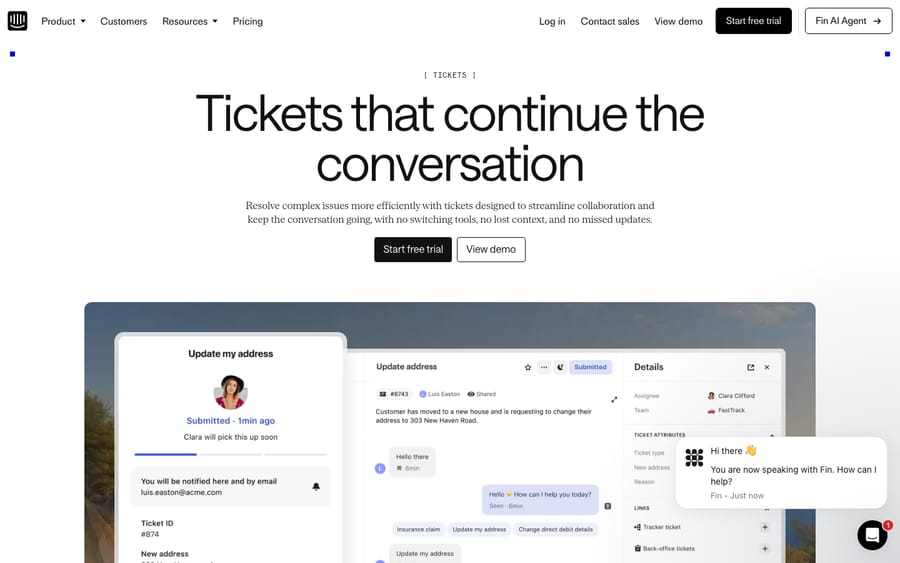
Behind the Messenger sits the Inbox, the agent workspace where conversations land. It's a shared inbox with a built-in help desk and ticketing: conversations become tickets that can be assigned, prioritized, tagged and worked to resolution, with internal notes and collaboration. Agents run side conversations, see full customer context and move work between team inboxes. This is where anything Fin can't resolve gets handed off.
3. Fin AI Agent
Fin is the center of modern Intercom: an autonomous AI agent that resolves customer questions across live chat, email, WhatsApp, SMS, phone, Slack and more. Instead of only deflecting with a help article, Fin can read and write to connected systems, answer multi-step questions and complete workflows such as a refund or an account update, escalating to a human when it isn't confident. Intercom says it runs on its own support-specific model, branded Apex.
When Salesforce closed the deal, it described Fin as serving more than 30,000 companies with an average resolution rate of 76% (Salesforce, 10 September 2026). Read that as a vendor average, not a promise: your rate depends on the quality of your help content and how repetitive your ticket mix is. For how Fin works and what it costs in detail, see our Intercom Fin AI explained guide.
Intercom keeps building around Fin: Fin Voice (an AI agent that answers phone calls), Copilot (below) and Operator, an AI agent that analyzes Fin's conversations and drafts changes to its settings, help content and workflows for a human to approve. Operator opened in early access on 15 May 2026 and became generally available in the summer, according to Compare the Cloud's August 2026 report.
4. Copilot (agent assist)
Fin faces the customer; Copilot faces the agent. It sits inside the Inbox and gives human reps answers, suggested replies, summaries and context from your knowledge so they close tickets faster. It costs $29 per agent per month on annual billing, or $35 month to month.
5. Help Center (self-service)
Intercom includes a Help Center: a public knowledge base, private and multilingual on higher plans, where customers find answers themselves. The same articles are the source material Fin draws on, so a thin help center means a weaker Fin.
6. Outbound messaging, Series and Product Tours
This part comes from Intercom's messenger roots, and it's what separates it from a pure help desk. Intercom can message customers proactively, not only react to them:
- Outbound messages, Posts and Banners: targeted in-app and email messages to specific user segments.
- Series: a visual builder for multi-step, behavior-triggered onboarding and engagement journeys.
- Product Tours: interactive in-app walkthroughs of features.
- Checklists and Surveys: onboarding checklists and in-context surveys, including CSAT and NPS.
These tools are sold as the Proactive Support Plus add-on ($99 a month including 500 messages), not as part of the core support seat.
7. Workflows, reporting and Topics Explorer
A visual Workflows builder handles routing, lead capture, bot logic and survey triggers without code. Reporting covers volume, response and resolution times, CSAT and team performance, plus Topics Explorer, which uses AI to cluster conversations into topics so you can spot volume drivers without manual tagging.
How much does Intercom cost?
Intercom charges in two parts, which is what makes it different from a flat per-agent help desk: a per-seat subscription plus a per-outcome fee for Fin. Prices per seat per month, billed annually, on intercom.com/pricing on 24 September 2026:
| Plan | Price (per seat/mo, annual) | Best for |
|---|---|---|
| Essential | $29 | Solo founders and small teams: Messenger, Inbox, tickets, public Help Center, Fin |
| Advanced | $85 | Growing teams: multiple inboxes, Workflows, round robin, private and multilingual Help Center; 20 free Lite seats |
| Expert | $132 | Larger teams needing advanced security, SLAs and management controls; 50 free Lite seats |
Essential has been inside a live pricing test: it showed $19 on 20 September and $29 on 24 September, so check the page on the day you buy.
On top of seats, Fin is available on every plan and billed at $0.99 per outcome, at most once per conversation. An outcome is counted when the customer confirms the issue is solved, stops following up after Fin replies, or Fin completes a workflow. A Procedure you set up to hand off to a human is also billed at $0.99, and a sales qualification costs $9.99. A conversation that simply passes to your team with no outcome is not charged. Other add-ons: Copilot at $29 per agent per month, Proactive Support Plus at $99 a month, and a Pro add-on at $99 a month that covers analysis of 1,000 conversations and credits for Operator. Lite seats let occasional collaborators in without a full seat.
The incentive is worth naming: Intercom earns more as Fin answers more, so your bill tracks conversation volume more than headcount. That's a good deal when Fin resolves cheap, repetitive questions, and an unpredictable line item at high volume. A team resolving 3,000 conversations a month with Fin pays about $2,970 for Fin alone before a single seat. We work through the edge cases in Intercom pricing explained.
Who is Intercom for?
Intercom suits digital-first, product-led companies: SaaS and tech businesses whose customers live inside a web or mobile app and expect to chat in real time. If in-app messaging, proactive onboarding and AI-first resolution are central to how you run support and growth, it's built for you.
It's a strong fit if you:
- Run a product where customers are in the app, not only emailing you.
- Want one tool that spans support, onboarding and proactive engagement.
- Are ready to make AI the default first responder.
It's a weaker fit for a high-volume, email-and-phone-first operation on a tight, predictable budget. Seats plus per-outcome billing is harder to forecast than a flat per-agent plan, and teams that don't need proactive messaging pay for breadth they won't use.
What are Intercom's strengths and limits?
Where Intercom is strong: a best-in-class Messenger and in-app experience; Fin, one of the most capable AI agents on the market; support and engagement in one platform; and a fast, well-designed product that ships often.
Where it draws criticism: cost and cost predictability come up most. Per-outcome Fin billing on top of seats makes budgeting harder than a flat plan, and add-ons stack up. Teams also say the proactive and marketing features are overkill if you only want a help desk, and pricing has shifted repeatedly as the company reorganized around AI, including a live test on the Essential seat price in September 2026.
What does the Salesforce acquisition mean for Intercom customers?
On 15 June 2026, Salesforce signed a definitive agreement to acquire Fin, the company formerly known as Intercom, for roughly $3.6 billion, and it completed the acquisition on 10 September 2026. Salesforce plans to bring Fin's technology and team into its Agentforce and AI work; Fin keeps serving existing customers, and CEO Eoghan McCabe stays on (agreement press release, completion press release, TechCrunch).
In practice, the standalone product continues and Fin's $0.99 rate was unchanged two weeks after the close. The roadmap, packaging and integration priorities now answer to Salesforce, though. If you sign a multi-year Intercom contract in 2026, ask what price protection you get if the packaging changes.
Can you add an AI agent layer to Intercom?
Yes. A platform's native AI is good at deflecting repetitive questions and helping agents, but plenty of teams want autonomous resolution on a help desk they already run and don't want to rip out.
That's the category Macha sits in: an AI agent layer on top of an existing help desk. It reads the customer's question, draws on your connected knowledge and past conversations, and resolves the ticket in-thread, escalating to a human with full context when it isn't confident. Macha connects to Zendesk, Freshdesk, Gorgias, Front, HubSpot or Intercom, so it can run on your Intercom inbox, but it is not a replacement for Intercom itself, and like any AI agent it's only as good as the knowledge you connect. Pricing is one plan by ticket volume, from $299 a month for up to 750 tickets, billed per ticket rather than per message, with setup and monitoring by the Macha team included. Intercom's Fin is the built-in version of the same idea, bundled into the platform instead of layered on. If most of your tickets are repetitive questions your help center could answer, you can try Macha with $50 of free usage and no credit card.
What are the alternatives to Intercom?
The right choice depends on your channel mix and budget. The usual comparisons are Zendesk (structured, ticketing-led, built for volume), Freshdesk (cheaper, simpler), Help Scout and Front (lighter, email-centric) and Gorgias (e-commerce). For who each fits and current pricing, see the best Intercom alternatives.
Frequently asked questions
What is Intercom in simple terms? Intercom is AI-first customer-service software. It gives a business a chat Messenger, a shared inbox and ticketing help desk, a self-service Help Center, outbound messaging and an AI agent (Fin) that resolves customer questions automatically, all in one tool. It is not a door buzzer or building intercom system; that's a different product with the same name.
What does Intercom do? It manages customer conversations across live chat, email and messaging from one place: real-time chat through the Messenger, ticketing and a shared inbox for agents, autonomous AI resolution through Fin, a knowledge base for self-service, proactive onboarding (tours, checklists, campaigns), workflow automation and reporting.
Who owns Intercom? Salesforce. Intercom was founded in 2011 in Dublin and is headquartered in San Francisco. It renamed itself Fin on 12 May 2026; on 15 June 2026 it agreed to be acquired by Salesforce for about $3.6 billion, and the acquisition completed on 10 September 2026. The rename and the acquisition are separate events.
How much does Intercom cost? Seats cost $29 (Essential), $85 (Advanced) and $132 (Expert) per seat per month billed annually, as of 24 September 2026; Essential has been inside a pricing test that also showed $19. On top of seats, Fin costs $0.99 per outcome (a resolution or a Procedure set to hand off), with sales qualifications at $9.99; a conversation passed to your team with no outcome isn't billed. Copilot ($29 per agent per month) and Proactive Support Plus ($99 a month) cost extra. See Intercom pricing explained.
What is Fin? Fin is Intercom's AI agent and, since May 2026, the company's name. It resolves customer queries across channels, completes workflows and escalates to humans when needed. Salesforce reports a 76% average resolution rate across its customers; treat that as a vendor figure.
Is Intercom the same as Zendesk? No. Both are customer-service platforms, but Zendesk was built as structured, multi-channel ticketing for support at volume, while Intercom grew from an in-app messenger into an AI-first conversational platform. They overlap heavily today, but they started from different places and price differently.
Should you choose Intercom in 2026?
Choose Intercom if you're a product-led company whose customers live in your app and you want to push AI resolution hard. Budget for seats ($29 to $132 each) plus $0.99 per Fin outcome, which rewards results but makes the bill harder to predict. Then factor in the owner: since 10 September 2026 Intercom belongs to Salesforce, so expect packaging and roadmap to move toward Agentforce over the life of your contract.
Checked against intercom.com/pricing, fin.ai/pricing and Salesforce's press releases on 24 September 2026. Intercom revises packaging and pricing often; confirm current figures before relying on them.
Add AI agents to your Intercom
Macha reads the conversation, drafts the reply and takes the action, inside the Intercom you already run.