
 Shopify
 Stripe
 Slack
Slack Notion
 Google Workspace
 Confluence

Zendesk vs Gorgias for Ecommerce (2026): Which Fits a Shopify Store?


Gorgias fits most Shopify-first stores because agents can edit, refund and cancel orders inside the ticket and pricing follows ticket volume, not headcount. Zendesk fits larger or multi-line operations that need a 1,800+ app marketplace, included telephony and per-seat scale.
Key takeaways
- Gorgias is the better help desk for most Shopify-first stores, because agents can edit, duplicate and create Shopify orders from inside the ticket.
- Gorgias helpdesk plans cost $10, $60, $360 and $900 a month for 50, 300, 2,000 and 5,000 tickets, while Zendesk charges US$19, US$55 and US$115 per agent.
- Zendesk's Shopify integration now lets agents process refunds and cancellations inside a ticket, but editing an order still happens in Shopify Admin.
- At 2,000 tickets a month, Zendesk Suite Team is cheaper than Gorgias Pro up to six agents, and Gorgias is cheaper from seven agents up.
- Gorgias prices each AI Agent interaction at $0.90 on annual plans or $1.00 on monthly, and each interaction also counts as a helpdesk ticket.

Gorgias is the better help desk for most Shopify-first stores, because agents can edit, duplicate and create Shopify orders from inside the ticket and the helpdesk is priced by ticket volume (from $10/mo for 50 tickets). Zendesk is the better pick for larger or multi-line operations that need its 1,800+ marketplace apps, telephony in every Suite plan and per-seat scale from US$19/agent/mo. Both can now refund and cancel a Shopify order without leaving the ticket, so the gap is narrower than it was in 2024.
How do Gorgias and Zendesk compare at a glance?
| Gorgias | Zendesk | |
|---|---|---|
| Best for | Shopify and DTC brands that want store actions inside the ticket | Larger or multi-line operations that need marketplace breadth and scale |
| Pricing entry | Helpdesk Starter $10/mo for 50 tickets and 3 seats; $40/mo with AI Agent | Support Team US$19/agent/mo, billed annually |
| Billing meter | Tickets per month, plus AI Agent interactions | Agents per month, plus automated resolutions |
| Shopify actions in the ticket | Refund, cancel, edit, duplicate, create order, edit shipping address | View, refund and cancel; no order editing |
| AI / automation | AI Agent on every plan, $0.90 to $1.00 per interaction | AI agents on Suite plans; Copilot add-on US$50/agent/mo |
| Channels | Email, chat, social, help center; Voice and SMS are add-ons | Email, messaging, social; telephony included from Suite Team |
| Marketplace | 100+ integrations, mostly ecommerce | 1,800+ apps, partners and integrations |
How does Gorgias pricing compare with Zendesk pricing?
These tools bill on different meters, and that difference matters more than any single number.
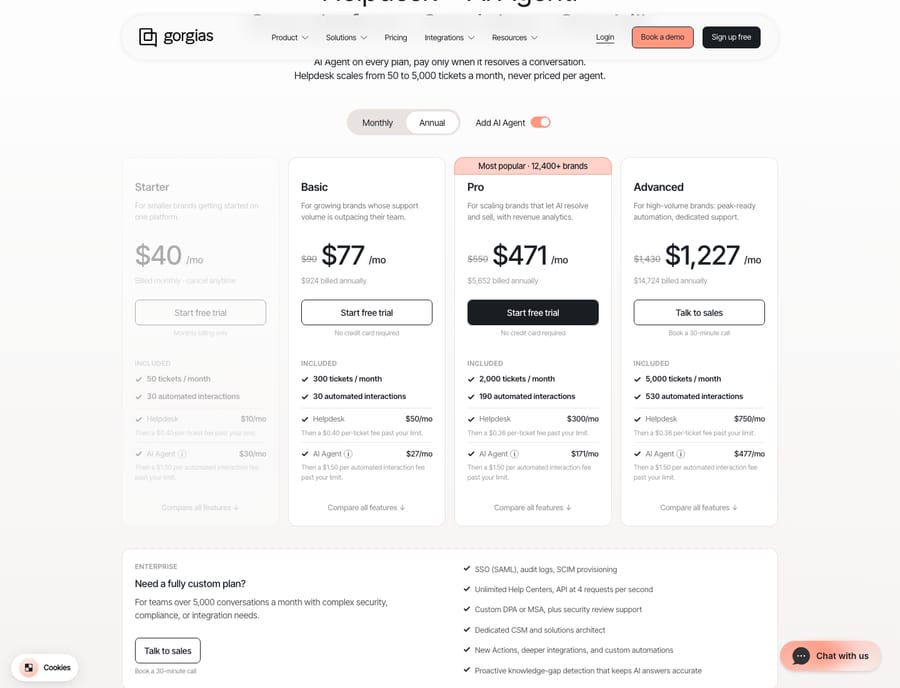
Gorgias charges by ticket volume. The Gorgias pricing page (checked 24 September 2026) lists four helpdesk plans on monthly billing: Starter $10/mo for 50 tickets, Basic $60/mo for 300, Pro $360/mo for 2,000 and Advanced $900/mo for 5,000, with overage at $0.40 a ticket on Starter and Basic and $0.36 on Pro and Advanced. Seats are not the constraint they are on Zendesk, but they aren't unlimited either: Starter caps at 3 user seats and the other plans at 500. The headline prices Gorgias shows with AI Agent bundled are Starter $40/mo, Basic $77/mo, Pro $471/mo and Advanced $1,227/mo (billed annually for the last three). Gorgias's own FAQ prices each AI Agent interaction at $0.90 on annual plans or $1.00 on monthly, and each one also counts as a helpdesk ticket, so an automated conversation is billed twice. We break the tiers down further in Gorgias pricing explained.
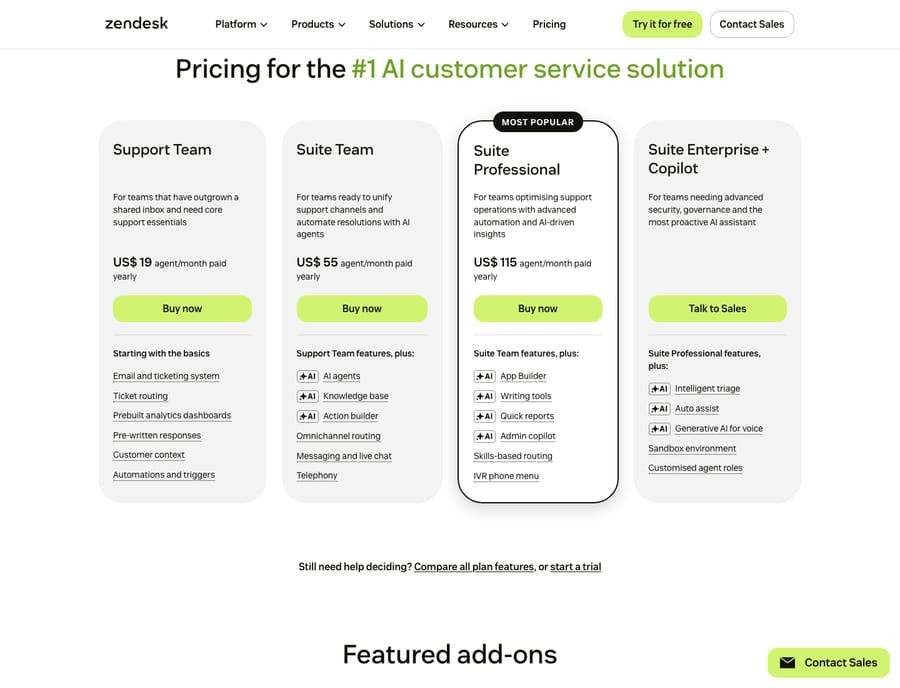
Zendesk charges per agent, per month. The Zendesk pricing page lists Support Team at US$19/agent/mo, Suite Team at US$55, Suite Professional at US$115 (all billed annually) and Suite Enterprise plus Copilot on contact-sales. Copilot is US$50/agent/mo. AI agents are included and billed per automated resolution; the same page lists $1.50 committed and $2.00 pay-as-you-go, and 5 included automated resolutions per agent a month on Support Team and Suite Team and 10 on Suite Professional. Zendesk's help center describes that allowance as a small monthly dollar amount per seat ($2, $5 or $10 by plan since 18 May 2026, capped at $5,000 a year).
Run the arithmetic at 2,000 tickets a month. Three agents on Zendesk Suite Team cost 3 × $55 = $165/mo, well under Gorgias Pro's $360. Eight agents cost $440/mo on Zendesk, and twenty cost $1,100, while Gorgias Pro stays at $360 whatever the headcount. Six agents cost $330, seven cost $385, so the crossover sits between six and seven agents at that volume. Each vendor's meter tells you what it's optimizing for: Zendesk earns more as you hire, Gorgias earns more as customers write in. A lean team drowning in tickets usually pays less on Zendesk; a store with many seats and manageable volume usually pays less on Gorgias. Model both against your own numbers before you sign.
Which has deeper Shopify and ecommerce features?
Gorgias still goes further inside the store. Per its Shopify Actions documentation, an agent can create a new order, duplicate one, cancel it, refund it, edit it (fulfilled or not), build a draft order, edit the shipping address, sync tags and check remaining stock, all from the ticket sidebar. Gorgias lists 100+ integrations, weighted toward the ecommerce stack (Recharge, Klaviyo, Loop Returns, Yotpo), and tracks revenue attribution, tying support conversations back to purchases.
Zendesk's Shopify integration is no longer the read-only sidebar it used to be. Zendesk's help center says agents can view orders and process refunds and cancellations inside a ticket, on any Suite plan or on Support with Chat. What's missing is order editing, duplicating and draft orders, so an address change or a swapped item still means a trip to Shopify Admin. With the Copilot add-on, auto assist can suggest the cancel or refund for the agent to approve. Zendesk's counter is breadth: 1,800+ apps, partners and integrations against Gorgias's ~100, which matters when the operation stretches into inventory, billing, distributors and vendors.
If your day is 200+ tickets of order edits and address changes, Gorgias saves real tab-switching. If most store tickets are "where is my order" and the occasional refund, Zendesk now covers them in the ticket too.
How do their AI agents differ?
Gorgias puts AI Agent on every plan and bills per automated interaction; it can resolve tickets and take Shopify actions such as cancellations and refunds with order context. Read more in Gorgias AI agent explained. Zendesk includes AI agents from Suite Team, bills per automated resolution, and layers Copilot on top for agent assist and auto assist. Zendesk's automation is broader across channels; Gorgias's is tighter around the store. For a pure ecommerce team, the Gorgias agent fits more naturally. For a mixed support org, Zendesk's general-purpose AI plus its reporting depth can be more useful. Either way, it's worth understanding the wider category of AI agents for customer service before you commit.
Which covers more channels, including phone?
Zendesk edges this. Every Suite plan from Suite Team up includes messaging and telephony, with IVR and skills-based routing on Suite Professional. Gorgias covers email, chat, social and help center on every plan, but Voice and SMS are add-ons priced by call and text volume. If phone is central to your support, Zendesk's included telephony is a real advantage; if you're mostly email, chat and social, the gap is small.
Which is easier to set up?
Gorgias is usually faster to stand up for a Shopify store: the integration is no-code and most of the ecommerce value is there on day one. Zendesk is more configurable and therefore more work, with deeper routing, macros and reporting, a longer setup, and usually an admin who owns it. On the Shopify App Store, Gorgias rates 4.3/5 across 705 reviews, with most reviewers praising the AI Agent and support; Zendesk's Shopify listing sits at 3.5/5 across 92 reviews, with complaints about setup and interface. For a fuller picture, see our Gorgias review and what is Gorgias.
What are the pros and cons of each?
Gorgias pros: full Shopify order actions inside the ticket, including edits; 100+ ecommerce integrations; revenue attribution; pricing that doesn't scale with headcount; fast no-code onboarding. Cons: AI interactions also count as tickets, so automation is billed twice; Voice and SMS cost extra; Starter caps at 3 seats; thinner for non-ecommerce or enterprise use.
Zendesk pros: 1,800+ app marketplace; refunds and cancellations in the ticket; telephony included from Suite Team; mature reporting, routing and omnichannel scale. Cons: no order editing from the ticket; per-seat pricing gets expensive as you add agents; AI resolutions add $1.50 to $2.00 each; longer, more complex onboarding.
Which should you choose?
- Shopify or DTC brand with lots of order edits: pick Gorgias. Editing, duplicating and re-addressing orders in the ticket pays for itself.
- Lean team, very high ticket volume: lean Zendesk, where a few seats cover a lot of tickets, but price the AI resolutions.
- Many agents, moderate volume: lean Gorgias, where headcount doesn't move the bill.
- Larger or multi-line operation (store plus wholesale, inventory, vendors): pick Zendesk for marketplace breadth, omnichannel scale and reporting.
- Phone-first support: lean Zendesk for included telephony.
If neither feels right, it's worth scanning the wider field; we keep a running list of the best Gorgias alternatives.
Can you add a separate AI agent to either help desk?
Yes. The help desk choice and the AI agent choice are separate decisions. Macha isn't a third help desk; it runs on top of Zendesk, Freshdesk, Gorgias, Front, HubSpot or Intercom, reading and writing the same tickets, drafting or resolving with grounded answers and taking store actions through its Shopify connector. It bills per ticket, not per resolution or per message: one conversation is one charge however many replies it takes, from $299/mo for up to 750 tickets, with setup and monitoring by the Macha team included. So you can keep the help desk that fits your store and add the agent layer over it. The Macha + Gorgias integration shows how that works in practice.
FAQ
Is Gorgias or Zendesk better for a Shopify store? For most Shopify-first stores, Gorgias, because agents can edit, duplicate and create orders inside the ticket as well as refund and cancel. Zendesk's Shopify integration handles refunds and cancellations in the ticket but not edits. Zendesk wins when the operation is bigger than the storefront and needs marketplace breadth and omnichannel scale.
How does Gorgias pricing compare to Zendesk pricing? They bill on different axes. Gorgias charges by ticket volume: helpdesk plans run $10, $60, $360 and $900 a month for 50, 300, 2,000 and 5,000 tickets, with AI Agent interactions at $0.90 to $1.00 each. Zendesk charges per agent: US$19, US$55 and US$115 per agent per month, billed annually. At 2,000 tickets a month, Zendesk Suite Team is cheaper up to six agents ($330 against $360).
Does Zendesk have a native Shopify integration? Yes. It shows Shopify orders in the ticket and lets agents process refunds and cancellations there, on any Suite plan or on Support with Chat. Editing an order still happens in Shopify Admin. With the Copilot add-on, auto assist can suggest the refund or cancellation for the agent to approve.
Which has more integrations? Zendesk, by a wide margin: its pricing page cites 1,800+ apps, partners and integrations against Gorgias's 100+. Gorgias's list is more tightly focused on the ecommerce stack (Recharge, Klaviyo, Loop Returns, Yotpo).
Can I add AI to whichever help desk I choose? Yes. An AI agent layer like Macha connects to either Gorgias or Zendesk and works on your existing tickets, so you can pick the help desk that fits your store and choose the agent separately.
Ready to see it on your own tickets? Start a free trial of Macha and connect it to the help desk you already use.