Intercom
 Shopify
 Stripe
 Slack
Slack Notion
 Google Workspace
 Confluence

Zendesk vs. Front (2026): Ticketing at Scale vs. Shared Inbox


Zendesk and Front represent two philosophies of customer support. Front is a collaborative shared inbox — email, chat, SMS, and social in a team workspace that feels like a shared email client, where replies look personal and teammates collaborate on threads. Zendesk is structured ticketing built for scale — statuses, SLAs, routing, self-service, and automation that run hundreds of tickets a day. Most "vs" articles you'll find quote Front's old four-tier pricing; this one uses Front's current three-tier structure and stays neutral.

Short version: Front for collaborative, personal, relationship-driven support on a smaller team; Zendesk for high-volume, structured support with deep self-service and automation.
The 30-second verdict
| If you are… | Pick |
|---|---|
| A team that wants a collaborative shared inbox with a human touch | Front |
| Ops / logistics / B2B / professional services, email-heavy | Front |
| Under ~50 seats and value simplicity over depth | Front |
| Running high-volume, structured support (100s of tickets/day) | Zendesk |
| Needing robust self-service / knowledge base + deflection | Zendesk |
| Scaling to 100+ agents with deep automation & voice | Zendesk |
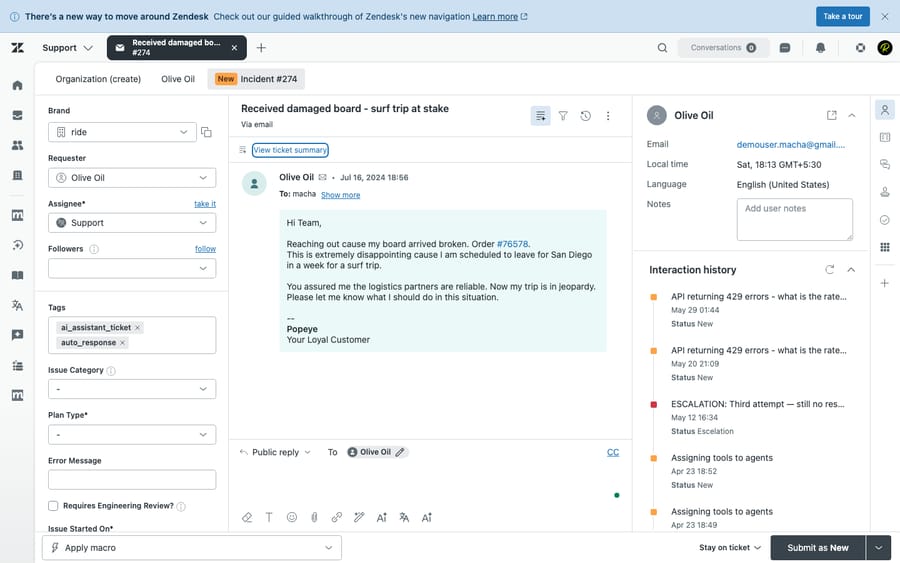
How we compared: Zendesk pricing is verified against its official page (June 2026); Front's is verified against its current three-tier pricing page, and we flag the Autopilot per-conversation vs. per-resolution discrepancy. Features are checked against the products — and we ran Zendesk hands-on in a live test account (screenshot below). User sentiment comes from real G2, Capterra, and TrustRadius reviews. Macha is our own product — we flag that wherever it comes up.
Pricing: current numbers (not the old four tiers)
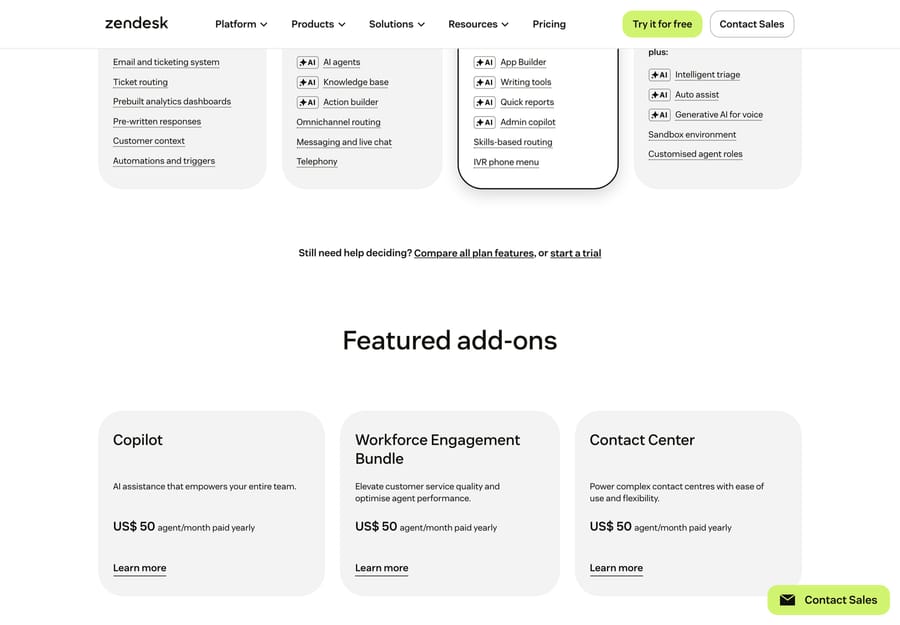
Zendesk Suite (per agent/month, annual): Support Team $19, Suite Team $55, Suite Professional $115, Enterprise contact sales; Copilot add-on $50/agent; AI agents ~$1.50–$2.00 per automated resolution. Source: Zendesk pricing.
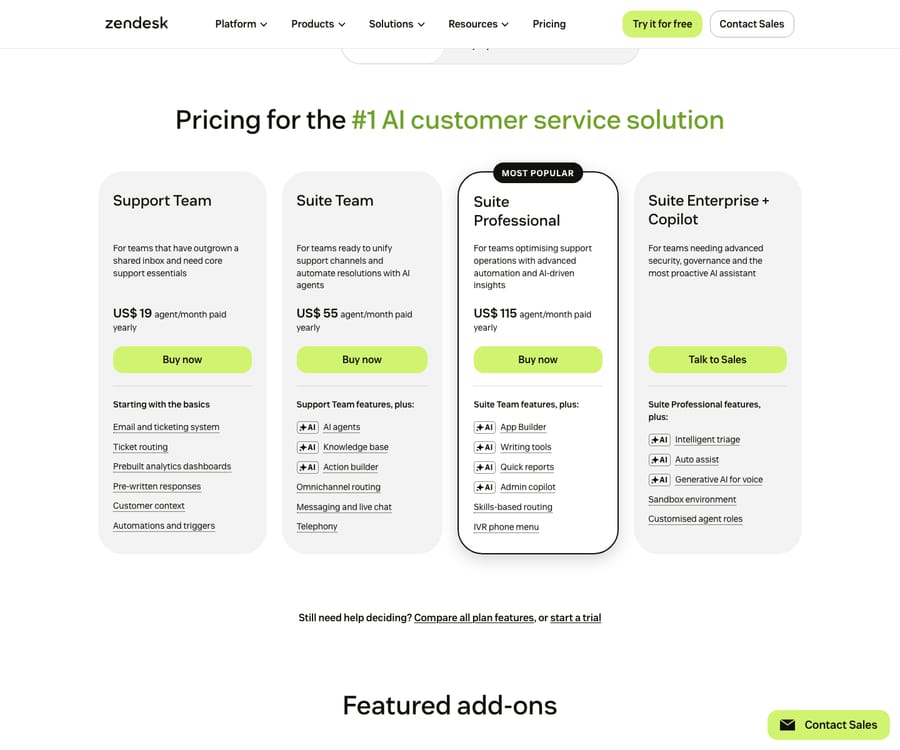
Beyond the per-seat plans, Zendesk’s AI and CX capabilities are sold as separate add-ons — each priced per agent on top of your base plan:
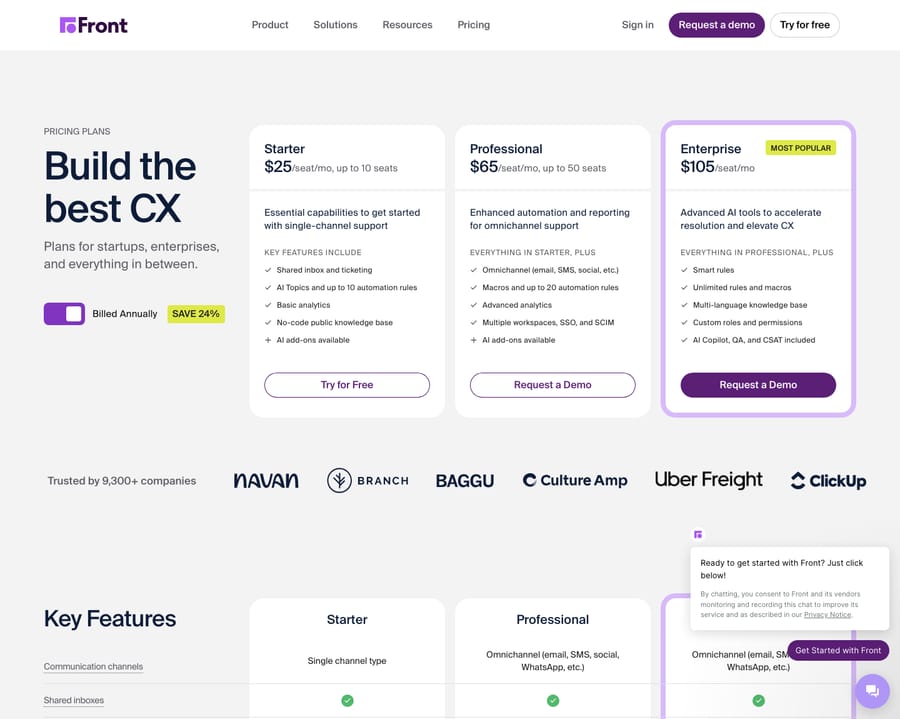
Front (per seat/month, annual) — now three tiers:
| Plan | Per seat | Seats | Channels |
|---|---|---|---|
| Starter | $25 | up to 10 | single channel (email or chat or SMS) |
| Professional | $65 | up to 50 | omnichannel, advanced analytics |
| Enterprise | $105 | unlimited | unlimited rules; Copilot + Smart QA + Smart CSAT included |
Source: Front pricing. Front consolidated from its old four-tier plan ($19/$59/$99/$229) — articles still citing those numbers are out of date.
A few things to know:
- Front's entry is higher than Zendesk's ($25 vs $19), and Starter is single-channel and capped at 10 seats — omnichannel or a growing team pushes you to Professional ($65) fast.
- Both meter AI on top of seats. Front's Autopilot (autonomous resolution) is listed officially at "from $0.05 per conversation," though several secondary sources report a per-resolution rate around $0.70–$0.89 — different models, so get a Front quote before relying on a number. Front Copilot (assistive) is $20/seat, with Smart QA ($20) and Smart CSAT ($10) as add-ons (all included at Enterprise). Zendesk meters AI via the $50/agent Copilot add-on plus ~$1.50–$2.00 per resolution.
Neither is cheap once AI is switched on — model both at your real volume.
Feature-by-feature: who wins what
| Capability | Winner | Why |
|---|---|---|
| Shared inbox & collaboration | Front | Internal comments, @mentions, shared drafts, comment-before-send, clean handoffs — a team email client, not a ticket queue |
| Ticketing & workflow at scale | Zendesk | Mature ticket objects, statuses, triggers, SLAs, multi-brand, skills-based routing |
| Omnichannel | Zendesk | Voice, email, chat, social, SMS in one workspace; deeper at volume (Front's voice is weaker) |
| Automation / rules | Zendesk at scale / Front for simplicity | Front's visual rules are easy but capped per tier; Zendesk's triggers + automations + AI triage go deeper |
| Native AI | Zendesk (breadth/maturity) | AI agents, intelligent triage, generative voice; Front's Copilot/Autopilot are solid but newer and narrower |
| Knowledge base & self-service | Zendesk (clear) | Robust multi-brand help center + AI content tools; Front's KB is materially lighter — its biggest gap |
| Reporting / analytics | Zendesk | Custom dashboards (Explore) go deeper; Front's are good for team productivity |
| Integrations | Zendesk | ~1,600+ marketplace apps vs Front's ~100+ |
| Ease of setup | Front | Email-client familiarity = fast onboarding, minimal admin |
| Voice / SLA / CSAT | Zendesk | Native voice/IVR + mature SLA/CSAT across tiers; Front's are lighter or add-on/Enterprise-gated |
The contrast in one line: Front makes a small team's shared email feel effortless and personal; Zendesk makes a large operation's ticket flow structured and scalable.
Strengths & weaknesses, honestly
Front — strengths: best-in-class collaborative shared inbox; personal, non-robotic customer experience (replies read like real emails, not ticket #s); fast setup; clean rule builder; great for relationship-driven/B2B/ops workflows. Front — weaknesses: lighter knowledge base/self-service; fewer integrations (~100); weaker native voice; rule/seat caps on lower tiers force upgrades; analytics less deep; AI newer with per-outcome pricing that's hard to predict; not built for very high ticket volume.
Zendesk — strengths: scales to high volume; deep automation, routing, SLA, multi-brand; strongest self-service KB + AI content management; 1,600+ integrations; mature omnichannel including voice; broad AI suite. Zendesk — weaknesses: complexity and admin overhead; expensive once add-ons (Copilot, per-resolution AI, WFM, voice) stack; can feel impersonal/ticket-y; longer implementation; overkill for small collaborative teams.
What real users say
Both score well overall, but the base size and the recurring complaints tell the real story. (Observed June 2026.)
| G2 | Capterra | TrustRadius | |
|---|---|---|---|
| Zendesk | 4.3 / 5 (~6,000+) | 4.4 / 5 (4,081) | 8.7 / 10 |
| Front | 4.7 / 5 (~2,400+) | 4.5 / 5 (286) | 9.1 / 10 (119) |
Front's averages edge Zendesk's, but on a much smaller base — its Capterra (286) and TrustRadius (119) bases are a fraction of Zendesk's, so treat the gap as directional, not decisive.
- Front — praised for the collaborative shared-inbox experience and clean, email-like feel: "Being on the front line on customer services it assist in channeling communication directly to customers, creates a friendly platform to chat, send messages and files and engage the right agents on time" (Nancy W., Customer Care Representative, Capterra, Jun 2025). The recurring knocks are cost for small teams and integration gaps — notably a weakened Outlook sync: "The Outlook integration is no longer a true two-way sync. Emails are pulled into Front, but actions taken in Front don't sync back to Outlook, leaving shared and personal mailboxes full of unread messages" (Grey H., Director, Capterra, Feb 2026).
- Zendesk — praised for feature breadth and value at scale: "Zendesk Suite offers strong value for money considering the wide range of features included — ticketing, automation, analytics, and omnichannel support" (Ifra S., Zendesk Developer, Capterra, Dec 2025). The two dominant complaints are add-on/pricing creep and, pointedly, Zendesk's own support quality: "Their support is some of the worst I've ever experienced and keeps getting worse" (Katie Y., Head of Customer Success, Capterra, Mar 2025).
The themes mirror the model split: Front reviewers love the inbox feel but hit cost and integration ceilings; Zendesk reviewers value the depth but grumble about stacked pricing and inconsistent vendor support.
Who each is genuinely for
- Front → smaller-to-mid CX teams (well under 50 seats) that want a collaborative shared inbox with a personal touch — ops, logistics, B2B account management, professional services, e-commerce relationship teams; email-heavy collaboration where several people touch the same threads; teams that value setup speed and simplicity over deep ticketing and self-service.
- Zendesk → teams running high-volume, structured support (hundreds of tickets a day), planning 100+ agents, needing robust self-service/deflection, deep automation and routing, multi-brand, native voice, advanced analytics, and a large integration ecosystem.
It's genuinely a use-case choice, not a winner: shared inbox vs. ticketing-at-scale. Pick the model that matches how your team works.
The AI question — and Front's KB gap
Zendesk's AI is broader and more mature (AI agents, triage, generative voice) but expensive and stacked, and it lives inside the Zendesk walled garden. Front's AI (Copilot for assist, Autopilot for autonomous resolution, plus Smart QA/CSAT) is a real 2026 step up — but it's newer, narrower, and bounded by Front's thinner knowledge base. Autopilot can only deflect as well as the KB behind it, and self-service is exactly where Front is lightest.
That makes an independent AI agent layer especially compelling for Front teams. A layer like Macha sits on top of either help desk, ingests knowledge the native bots can't reach (external docs, sites, CRM context, past tickets), and drives autonomous, KB-grounded resolution — adding the deflection muscle Front lacks natively without ripping out the collaborative inbox you chose Front for. It's helpdesk-agnostic and priced per action rather than per vendor-defined resolution. The honest caveat: a layer is another vendor and integration to manage, it only resolves as well as the knowledge you connect, and per-action pricing isn't free at high volume — it's additive, not a free win. (More: native AI vs. an AI layer and connecting a knowledge base to an AI agent.)
Before you switch: migration realities
There's no native Zendesk↔Front connector, so moves rely on APIs, CSV export/import, or third-party migration tools. The bigger issue is the model mismatch:
- Front conversations ≠ Zendesk tickets. Front→Zendesk means mapping conversations/comments to tickets, statuses, and tags; Zendesk→Front means flattening structured ticket fields and SLA logic into a conversation model (expect some metadata loss).
- Knowledge base: going to Zendesk usually means building self-service, not just porting it (Front's is light).
- Automation rewrite: triggers/automations/macros (Zendesk) and rules (Front) don't translate 1:1.
- Budget for agent retraining (email-client vs. ticket-queue paradigms) and historical/CSAT/SLA continuity during cutover.
Frequently asked questions
What's the real difference between Zendesk and Front? Front is a collaborative shared inbox (email-client feel, personal replies, team collaboration); Zendesk is structured ticketing built for scale, automation, and self-service. Different models for different teams.
Is Front cheaper than Zendesk? Not at entry — Front starts at $25/seat vs Zendesk's $19, and Front's Starter is single-channel and capped at 10 seats. Front's mid-tier ($65) undercuts Zendesk Suite Professional ($115) but with far less ticketing depth. Both meter AI on top.
Does Front have a knowledge base like Zendesk? It has one, but it's much lighter. Robust self-service and deflection are a clear Zendesk strength and a Front weakness.
Which is better for a small, relationship-driven team? Front — the shared inbox and personal touch fit ops, logistics, B2B, and professional-services teams well.
Can I add strong AI deflection to Front? Yes — an AI agent layer like Macha adds autonomous, KB-grounded resolution on top of Front (or Zendesk), reaching knowledge Front's native bot can't, priced per action.
The bottom line
Choose Front if you want a collaborative shared inbox with a personal touch for a smaller, relationship-driven team — fast to set up and pleasant to use. Choose Zendesk if you run high-volume, structured support and need deep automation, self-service, voice, and scale. And because Front's weak spot is self-service/AI deflection, an AI layer on top is an especially good way to get autonomous resolution without giving up the inbox you chose Front for.
On Front and want real AI deflection on top? See how Macha layers KB-grounded AI agents over your help desk, priced per action. 7-day free trial, no credit card required. Start Trial.
Add AI agents to your Zendesk
Macha reads the ticket, drafts the reply and takes the action, inside the Zendesk you already run.