Intercom
 Shopify
 Stripe
 Slack
Slack Notion
 Google Workspace
 Confluence

Assembled: The Complete Guide (2026)


Assembled is workforce management software built to plan and schedule a support team that increasingly isn't just people: in-house agents, outsourced BPO staff, and AI agents all sit in the same dashboard, with AI layered on top of scheduling, forecasting, and now ticket resolution itself. This guide covers what Assembled actually does, how its AI Agents and AI Copilot work alongside the older WFM product, real modular pricing, and how it compares to alternatives.

We build AI agents for customer service ourselves, so we read Assembled's claims the way a buyer evaluating both products would: what's a real mechanism, what's a case-study number, and what's marketing.
What is Assembled?
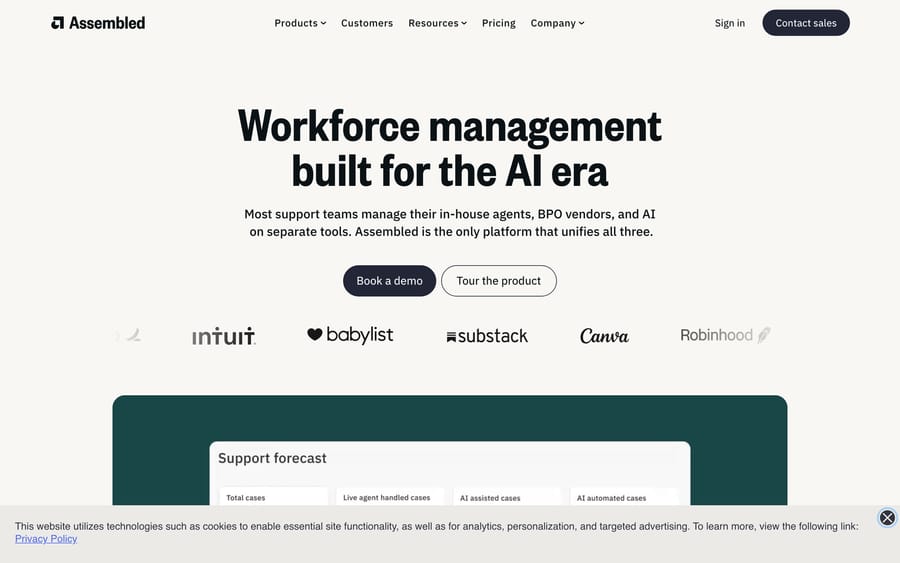
Assembled's homepage, positioned as "workforce management built for the AI era."
Assembled was founded in March 2020 by Brian Sze (CEO), John Wang, and Ryan Wang, all previously at Stripe, and launched with a $3.1 million seed round led by Stripe itself. The company later raised a $51 million Series B in 2022, led by Emergence Capital with Basis Set Ventures, SignalFire, and NEA also participating.
Assembled started as pure workforce management software, the scheduling and forecasting tool a support operations team uses to figure out how many agents it needs on Tuesday afternoon. It has since expanded into AI Agents and AI Copilot, which puts it in a different conversation than a traditional WFM vendor: Assembled now sells the scheduling layer and a chunk of the automation layer together, under the pitch that managing a blended team of humans, BPO vendors, and AI needs one shared view instead of three disconnected tools. Named customers include Flexcar, ClassPass, Lyra Health, and GoFundMe.
How Assembled's AI works
Assembled's AI is split into two separate, separately priced products that sit on top of the original WFM core:
AI Agents handle autonomous, multi-channel resolution across chat, email, SMS, and voice. The feature set includes agentic workflows (multi-step tasks, not single-turn replies), smart handoffs to a human when the agent hits its limits, escalation rules, custom style guides so the tone matches the brand, and built-in QA tooling to check what the AI actually said.
AI Copilot is the assist layer for human agents rather than a replacement for them: it drafts replies, offers real-time translation, summarizes long threads, and applies tone modifiers so a rushed draft still reads professionally before a rep sends it.
The mechanism that ties both back to the original product is the workforce management core itself, which now includes AI schedule generation and ML-based forecasting. In practice, this means the same system that decides how many humans to staff on Thursday can also factor in how much volume AI Agents is expected to absorb, which is a genuinely different scheduling problem than a WFM tool built before AI resolution existed. A support operations leader planning headcount for next quarter needs to know not just how many tickets are coming, but how many of those tickets AI will handle before a human ever sees them.
Key features
- AI Agents: autonomous multi-channel resolution (chat, email, SMS, voice) with agentic workflows, smart handoffs, escalation rules, and QA tools.
- AI Copilot: draft replies, real-time translation, summaries, and tone modifiers for human agents.
- Workforce management: scheduling templates, time tracking, real-time adherence, AI schedule generation, and ML forecasting.
- Vendor management: BPO capacity planning, scheduling integrations, coverage heatmaps, and billing reports across outsourced teams.
- Integrations: Slack, Okta, Five9, Shopify, and other enterprise tools named on the site.
Assembled pricing (published)
Assembled prices its products modularly, meaning you can buy pieces separately instead of one bundled plan. We checked assembled.com/pricing directly:
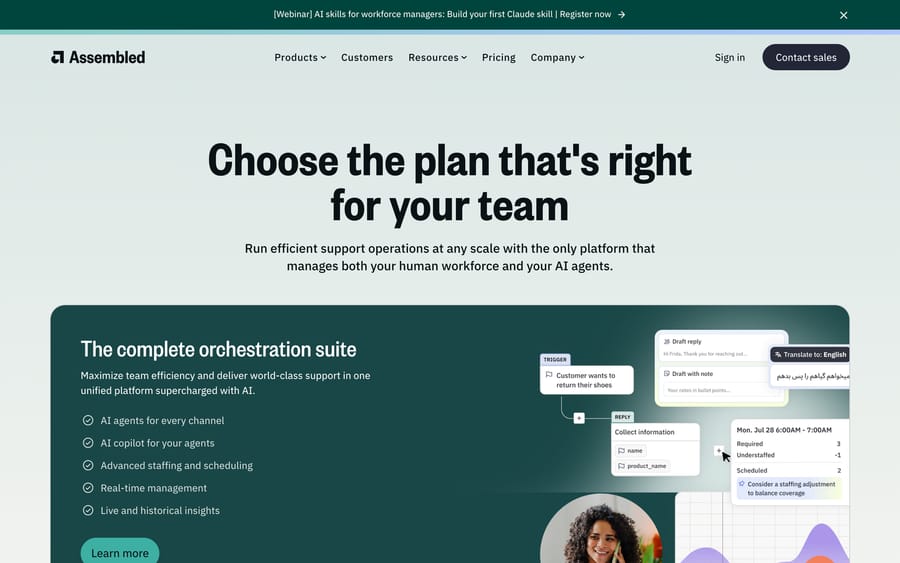
Assembled's pricing page, framing AI Agents and AI Copilot alongside staffing and scheduling as one orchestration suite.
- AI Agents: starts at $0.65 per conversation, covering autonomous resolution, agentic workflows, and QA tools.
- AI Copilot: starts at $35/month per seat for draft assistance and translation.
- Workforce Management: three tiers, priced per agent per month plus a platform fee. Core is $25/month (scheduling templates, time tracking, adherence, historical reporting), Pro is $45/month (adds AI schedule generation, ML forecasting, automated PTO, shift swaps), and Enterprise is $75/month (adds custom APIs, white-glove onboarding, and a dedicated account manager).
- Vendor Management: an add-on to WFM, priced on request, covering BPO capacity planning and coverage heatmaps.
Worth doing the arithmetic on what a mid-sized deployment actually costs, since modular pricing makes the total easy to underestimate. A 50-agent team on WFM Pro ($45/agent/month) pays $2,250/month before touching AI at all. Add AI Copilot for those same 50 seats at $35/month and that's another $1,750/month. If AI Agents then autonomously resolves 5,000 conversations a month at $0.65 each, that's a further $3,250/month. The total, roughly $7,250/month, is a genuinely different number than any single line item suggests, and it's the kind of total a buyer only sees after adding up three separate quotes rather than reading one price.
Multi-year contracts get a discount, typical implementation takes about a month, and no free trial is stated on the pricing page. Charging per conversation for AI Agents while charging per seat for WFM and Copilot is a deliberate split, and it carries a clear incentive: Assembled earns more as automation volume grows, even on an account whose headcount, and therefore its WFM seat count, is shrinking because of that same automation. That's worth naming plainly since it means the WFM savings from automating tickets don't fully offset the new AI Agents line item.
Pros and cons
Pros
- Genuinely modular pricing: buy AI Agents, Copilot, or WFM independently instead of one all-or-nothing bundle.
- The scheduling and forecasting core now accounts for AI-handled volume, solving a real planning problem that pure automation tools don't touch.
- Vendor management gives visibility across BPO partners that most AI-agent vendors don't offer at all.
- Established company with a real funding history and known customers (ClassPass, GoFundMe), the profile of a mature vendor.
Cons
- No published free trial; evaluating the AI Agents or Copilot product means a sales conversation.
- Per-conversation AI Agents pricing plus per-seat WFM pricing means the total bill has multiple moving parts to model.
- Vendor Management pricing isn't published at all, so budgeting for the full platform requires a quote.
- The product's roots are in scheduling, not conversational AI, so a team that only wants ticket automation is buying into a broader operations platform.
Who Assembled is best for
Assembled fits teams whose support operations leader manages a genuinely blended workforce: in-house agents, one or more BPO vendors, and AI agents, and who needs one system forecasting and scheduling across all three instead of reconciling three separate tools by hand. If BPO vendor management and shift scheduling are already part of your job, Assembled's combined view is solving a real, specific problem that a pure AI-agent vendor doesn't address at all.
It's a weaker fit for a smaller team that doesn't manage outsourced staff or complex shift scheduling and just wants AI resolving more tickets inside the help desk it already runs. That team is paying for workforce-management depth it won't use.
Assembled vs alternatives
| Assembled | Level AI | Macha | |
|---|---|---|---|
| Model | Workforce management + AI Agents + Copilot, modular | AI-powered QA and coaching for contact centers | AI agent layer on your existing help desk |
| Best for | Teams managing in-house, BPO, and AI agents together | Contact centers focused on QA and agent coaching | Teams on Zendesk, Freshdesk, Gorgias, or Front |
| Core strength | Scheduling/forecasting that accounts for AI-handled volume | Conversation intelligence and QA scoring | Building and running agents in plain English |
| Pricing | Modular: $0.65/conversation (AI Agents), $35/mo (Copilot), $25-75/agent/mo (WFM), published | Custom, sales-quoted | From $299/month for 750 tickets (about $0.40 per ticket), published |
| Self-serve trial | Not stated | No | Yes, $50 of free usage (about 125 tickets), no credit card, no time limit |
| Replaces your help desk? | No, sits alongside it as an ops layer | No | No, built to run on top of it |
Assembled and Macha solve different layers of the same problem, so this isn't really an either/or choice for most teams. If your job is workforce planning across a mixed team, Assembled's WFM core plus its AI Agents module is a reasonable single-vendor answer. Macha doesn't do scheduling or BPO vendor management at all; it's narrower by design, an AI agent layer that runs on top of the help desk you already use and focuses only on resolving tickets, priced per ticket rather than per conversation or per seat. A team already using Assembled for WFM could still run Macha for the agent layer itself, or use Assembled's own AI Agents product; which makes more sense depends on whether you want ticket automation bundled with your scheduling tool or kept separate. Compare against Macha's pricing for the ticket-automation piece specifically.
FAQ
What is Assembled? Assembled is workforce management software, founded in 2020, that has expanded into AI Agents and AI Copilot, letting a support team plan, schedule, and now automate across in-house staff, BPO vendors, and AI in one system.
How much does Assembled cost? Pricing is modular: AI Agents starts at $0.65 per conversation, AI Copilot starts at $35/month per seat, and Workforce Management runs $25 to $75 per agent per month depending on tier. Vendor Management is priced on request.
Does Assembled have a free trial? No free trial is stated on its pricing page; evaluating the platform involves a sales conversation.
What's the difference between Assembled's AI Agents and AI Copilot? AI Agents resolves conversations autonomously across chat, email, SMS, and voice. AI Copilot assists a human agent by drafting replies, translating, and summarizing, rather than replying on its own.
Does Assembled replace a help desk? No. It's a workforce management and automation layer that sits alongside whatever ticketing system or help desk a team already uses.
Who uses Assembled? Named customers include Flexcar, ClassPass, Lyra Health, and GoFundMe.
How much funding has Assembled raised? A $3.1 million seed round led by Stripe in 2020, followed by a $51 million Series B in 2022 led by Emergence Capital.
What are good alternatives to Assembled? For AI-powered QA and agent coaching specifically, Level AI is a common comparison. For a team that just wants an AI agent layer resolving tickets inside its existing help desk, without the workforce-management scope, Macha is a narrower, ticket-priced alternative.
Sources: Assembled homepage, Assembled pricing, Assembled about, TechCrunch: Assembled raises $3.1M led by Stripe.
Resolve tickets automatically with AI agents
Macha's AI agents work on top of the help desk you already use — no code.