Intercom
 Shopify
 Stripe
 Slack
Slack Notion
 Google Workspace
 Confluence

Atomicwork: The Complete Guide (2026)


Atomicwork builds "AI Coworkers" that sit inside Slack and Microsoft Teams and handle IT service management work directly, from password resets to incident triage. This guide covers what it actually does, its published (and unusual) pricing model, the AI stack behind it, and how it stacks up against Moveworks if you're evaluating agentic IT service platforms.

We build AI agents for customer service ourselves, so we know what a vendor's claimed deflection numbers usually leave out, and we checked Atomicwork's own case studies to see whether its numbers held up.
Atomicwork was founded in 2022 by Vijay Rayapati (CEO), Kiran Darisi (CTO), and Parsuram Vijayasankar, and is headquartered in San Francisco with an engineering office in Bengaluru. On January 28, 2025, it closed a $25M+ Series A co-led by Khosla Ventures and Z47, with Battery Ventures, Peak XV Partners, Blume Ventures, Neon Fund, and Storm Ventures also participating. Named customers on its site include Deutsche Telekom, Tesco, Dexcom, DXC, FIS, BlueCross BlueShield Nebraska, and Zuora.
What is Atomicwork?
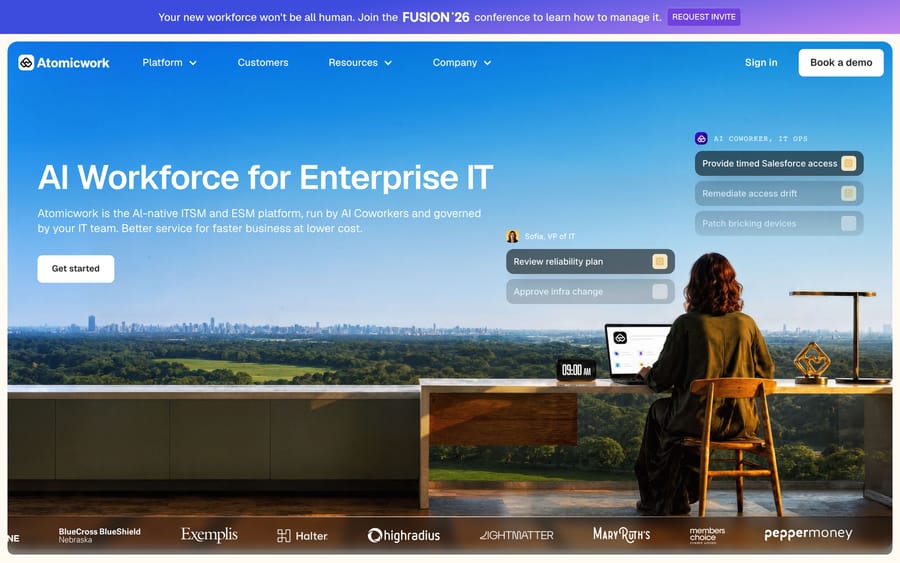
Atomicwork calls itself an "AI-native ITSM and ESM platform," positioned explicitly as a modern alternative to legacy service management tools like ServiceNow. Instead of one general chatbot, it deploys role-based AI Coworkers, persistent agents built for specific jobs: an Incident Manager, a DevOps Specialist, a Security Engineer, an Onboarding Manager. Each one works across the tools a team already runs (ServiceNow, Jira Service Management, Slack, Teams, and 100+ other integrations) rather than requiring a rip-and-replace of the underlying ticketing system.
The company's own framing is that IT should "run the AI Workforce instead of just workflows." That's a real distinction from most competitors: Atomicwork sells persistent agents with defined roles and access. A rules engine that fires scripted automations doesn't get you that.
How Atomicwork's AI works
Atomicwork's technical architecture is unusually well documented, thanks to case studies both Microsoft and Cohere published about it directly. Per Microsoft's own customer story, Atomicwork built its agent, called Atom, as an ensemble: Azure OpenAI Service for core language generation, Cohere's Rerank model to prioritize the most relevant retrieved results, and Cohere's Command model for structured tasks like form completion. Cohere's own case study adds that switching to Command R+ and Rerank produced a 20% accuracy improvement from Rerank alone and a 75% reduction in response latency compared to what the team ran before, with a 168% accuracy gain measured against GPT-3.5 specifically.
That's a genuinely useful data point for evaluating any AI vendor's claims. Atomicwork picked a retrieval-and-reranking pipeline because raw generation without a strong reranker returned confidently wrong answers often enough to hurt deflection numbers, and it says so in a vendor-authored case study, not a marketing spec sheet. The same Microsoft case study reports the resulting deflection rate started at 20% at initial rollout and grew to 65% within six months, with 80% projected by year end, at one enterprise customer. Those are figures for one specific deployment. Treat them as a plausible ceiling, not a guarantee for every account.
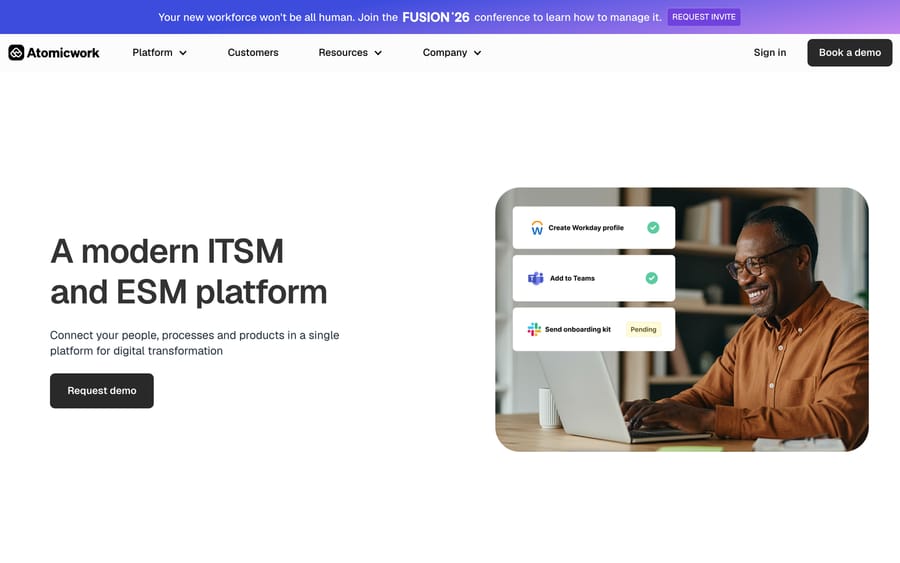
On governance, Atomicwork runs what it calls a "moderation and validation pipeline" with content checks before a response reaches an employee. It supports multiple underlying models too: Claude, ChatGPT, and Gemini are all options, so a customer isn't locked to one vendor's model.
Key features
- Role-based AI Coworkers: dedicated agents for incident management, DevOps, security, and onboarding, each with its own scope instead of one generalist bot handling everything.
- Enterprise company graph: an internal knowledge layer that connects organizational and employee context to inform agent decisions.
- 100+ integrations: ServiceNow, Jira Service Management, Slack, Teams, SharePoint, Okta, Azure, GitHub, Salesforce, and Oracle among them.
- Multi-model support: Claude, ChatGPT, Gemini, and other models all work on the platform, so a customer isn't tied to a single proprietary LLM.
- AI governance layer: a control plane for managing agent lifecycles, access, and budgets across a growing number of deployed agents.
- Compliance: SOC 2, GDPR, HIPAA, CSA STAR, and ISO 42001 certifications, plus ISO 27701/27017/27018 achieved via a full audit instead of a lighter renewal.
Atomicwork pricing
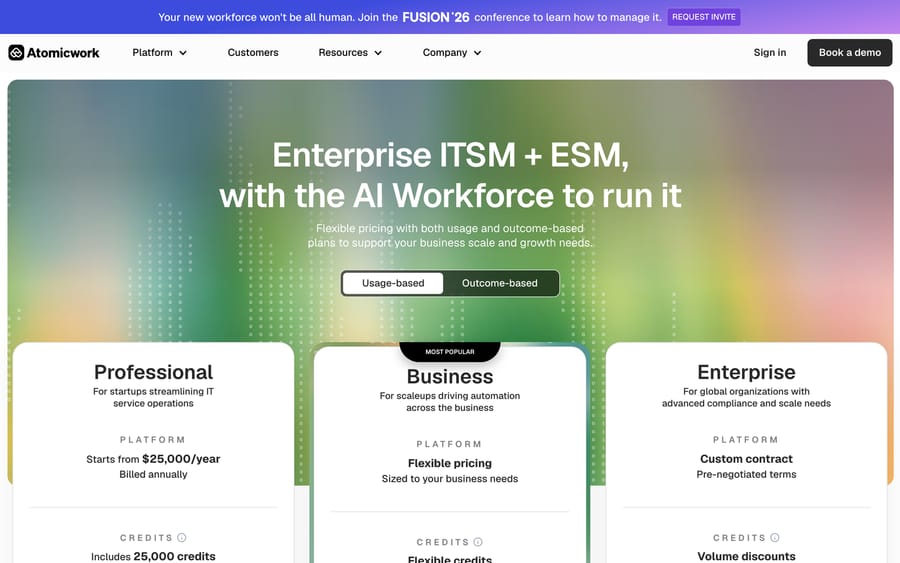
Atomicwork is unusual among the vendors in this series: it actually publishes numbers, and it offers two different pricing philosophies side by side.
Usage-based plans:
- Professional: starts from $25,000 a year, billed annually, including 25,000 credits. Aimed at startups.
- Business: flexible pricing sized to volume, with 5 AI Coworkers and flexible credits, for scaleups.
- Enterprise: custom contract with pre-negotiated terms and volume discounts.
Outcome-based pricing (pay only when the AI actually resolves something):
- Knowledge support: $1 per resolved query.
- Access automation: $2 per handled request.
- Service resolution: starting from $3 per outcome.
Two more wrinkles worth knowing before a sales call. First, Atomicwork offers a "Bring Your Own Platform" option for teams already running ServiceNow or Atlassian JSM: no platform fee at all, just the per-outcome charge. Second, its full-platform outcome pricing carries an additional charge described as "25+% of net spend" on top of the per-outcome rate, which is the kind of detail that changes a back-of-envelope estimate significantly. Ask about it directly instead of assuming from the headline numbers.
The incentive worth naming here: outcome-based pricing means Atomicwork earns more only when its agents actually close tickets, which aligns the vendor's revenue with the buyer's stated goal in a way flat per-seat software never does. It also means a slow rollout costs the customer less than a instant one, which is the opposite of a flat annual license.
Pros and cons
Pros:
- Publishes real pricing, including per-outcome rates, which is rare for enterprise agentic AI and makes budgeting easier before a sales call.
- The Azure and Cohere case studies give concrete, third-party-published numbers: 75% latency reduction, 65% deflection at six months for one customer, not just self-reported marketing claims.
- Role-based agents with defined scope (Incident Manager, DevOps Specialist) are a clearer mental model than one do-everything bot.
- Outcome-based pricing ties vendor revenue to actual resolutions instead of seats or licenses.
Cons:
- The Professional plan's $25,000/year floor puts it out of reach for genuinely small IT teams, even though the site markets it toward "startups."
- The "25+% of net spend" surcharge on full-platform outcome pricing needs a direct conversation to model accurately; it isn't broken out with a worked example anywhere public.
- We could not find an independent third-party review aggregate: G2 and TrustRadius blocked automated access, and Software Advice showed only a single unrated review as of this check. That's a real gap for a company that raised a $25M+ Series A and claims Fortune 500 customers, and buyers should ask Atomicwork directly for reference calls.
- Founded in 2022, which means less operating history than incumbents like Moveworks (founded 2016) when it comes to large-scale, multi-year deployments.
Who Atomicwork is best for
Atomicwork fits an enterprise IT organization that already has (or is willing to build) the budget for a $25,000+/year platform and wants agents with clearly scoped roles rather than one monolithic assistant. Teams already running ServiceNow or Atlassian JSM specifically benefit from the Bring Your Own Platform pricing, since it removes the platform fee entirely. It's a weaker fit for a company evaluating its very first AI investment in IT, given the price floor and the thin public review record.
Atomicwork vs alternatives
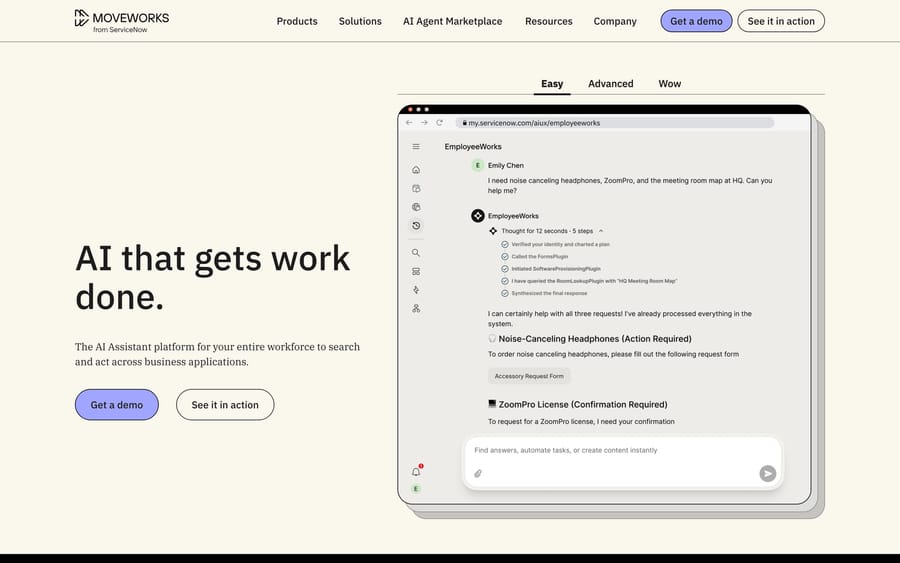
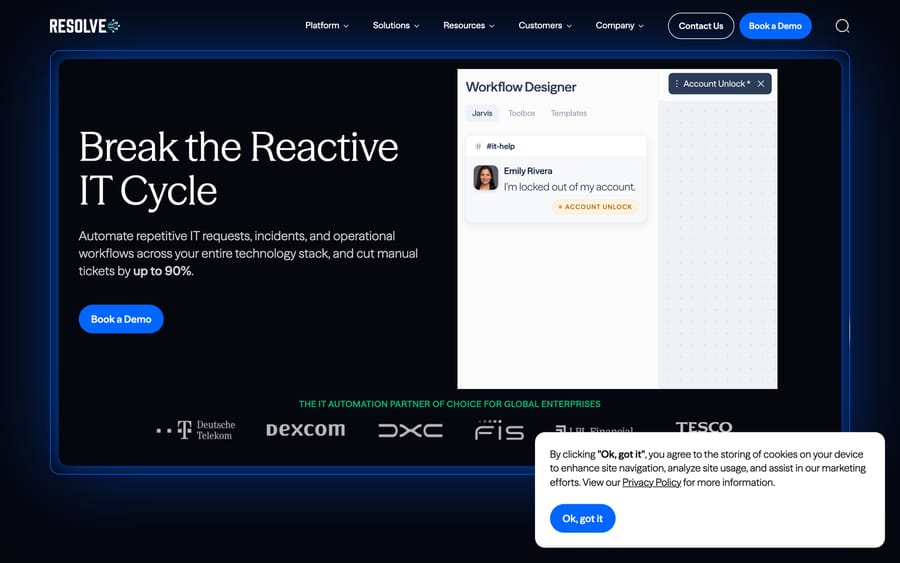
Atomicwork's closest competitor is Moveworks, now part of ServiceNow, which sells a similar AI-assistant-for-the-whole-workforce pitch with a much longer operating history. Resolve (the company formerly at espressive.com, which now 301-redirects to resolve.io) is a second reasonable comparison for IT-specific automation, though its rebrand means older reviews and case studies referencing "Espressive" describe the same company under a different name. Macha is a different category entirely: an AI agent layer for customer-facing support tickets, not internal IT service management.
| Atomicwork | Moveworks | Macha | |
|---|---|---|---|
| Model | Role-based AI Coworkers for IT/ESM, deployed via Slack/Teams | AI assistant platform for the whole workforce, now part of ServiceNow | AI agent layer on your existing customer-facing help desk |
| Best for | Enterprises replacing or augmenting ServiceNow-style ITSM | Enterprises already invested in the ServiceNow ecosystem | Support teams on Zendesk, Freshdesk, Gorgias or Front |
| Pricing | Published: from $25,000/yr, or $1-3 per outcome | Not published; enterprise sales only | From $299/mo for 750 tickets (~$0.40/ticket), published |
| Setup | Vendor-led implementation | Vendor-led enterprise onboarding | Built, tested and monitored by the Macha team |
| Trial | Demo only, no public trial | Demo only | $50 free usage |
Macha fits teams whose actual bottleneck is a customer support queue in Zendesk or Freshdesk, not internal IT tickets. If that's the real problem, Macha's AI agent layer and its published pricing are worth comparing directly against whatever quote Atomicwork or Moveworks send back, because you'll actually have a number to compare against.
How we researched this
This guide draws on Atomicwork's own homepage, pricing page, platform page, and company page (fetched 2026-09-18), its Series A announcement post for founding and funding facts, and the independently published Microsoft and Cohere customer case studies for technical architecture and performance numbers. We could not find a usable third-party review aggregate: G2 and TrustRadius blocked automated access outright, and Software Advice returned only one unrated review, so this guide states that gap rather than substituting a number we couldn't verify.
FAQ
What is Atomicwork used for? Atomicwork deploys role-based AI Coworkers, agents like an Incident Manager or Onboarding Manager, that automate IT service management and enterprise service tasks inside Slack, Teams, and connected systems like ServiceNow and Jira.
How much does Atomicwork cost? Atomicwork publishes pricing: a Professional usage-based plan starting from $25,000/year, or outcome-based pricing from $1 per resolved query up to $3+ per service resolution outcome. A "Bring Your Own Platform" option removes the platform fee for teams already on ServiceNow or Atlassian JSM.
Who founded Atomicwork and when? Atomicwork was founded in 2022 by Vijay Rayapati, Kiran Darisi, and Parsuram Vijayasankar, and is headquartered in San Francisco.
How much funding has Atomicwork raised? Atomicwork raised a $25M+ Series A in January 2025, co-led by Khosla Ventures and Z47, with participation from Battery Ventures, Peak XV Partners, Blume Ventures, Neon Fund, and Storm Ventures.
What AI models does Atomicwork use? Per Microsoft's and Cohere's own published case studies, Atomicwork's Atom agent runs an ensemble of Azure OpenAI Service for generation plus Cohere's Rerank and Command models for retrieval and structured tasks. The platform also supports Claude, ChatGPT, and Gemini.
What are the best Atomicwork alternatives? Moveworks (now part of ServiceNow) is the closest direct competitor for enterprise IT and employee-support AI. If the real problem is a customer support queue, an AI agent layer like Macha fits that job better than any ITSM platform built for internal IT.
Is there a free trial for Atomicwork? No public self-serve trial. Atomicwork sells through demos and custom quotes, though its published pricing means you can estimate cost before that call.
What happened to Espressive? Espressive's domain now redirects to resolve.io, indicating a rebrand to Resolve. Older reviews and case studies under the Espressive name describe the same company.
Whichever ITSM or employee-support platform you're evaluating, ask for the outcome-based number worked out against your actual ticket volume before comparing it to a flat license fee. And if the tickets piling up are customer-facing, see how Macha's agents work on your existing help desk.
Sources:
- https://www.atomicwork.com
- https://www.atomicwork.com/pricing
- https://www.atomicwork.com/platform
- https://www.atomicwork.com/company
- https://www.atomicwork.com/blog/atomicwork-series-a-funding
- https://www.microsoft.com/en/customers/story/21861-atomicwork-azure-ai-foundry
- https://cohere.com/customer-stories/atomicwork
- https://www.moveworks.com
- https://www.espressive.com (redirects to resolve.io)
Resolve tickets automatically with AI agents
Macha's AI agents work on top of the help desk you already use — no code.