Intercom
 Shopify
 Stripe
 Slack
Slack Notion
 Google Workspace
 Confluence

Avoca AI: The Complete Guide (2026)


Avoca AI builds AI phone and text agents specifically for home service businesses, plumbing, HVAC, electrical, roofing, and similar trades, and it has grown fast enough to raise more than $125 million across its Seed, Series A and Series B rounds at a reported $1 billion valuation. This guide covers what Avoca actually automates, the real customer results it publishes, what it likely costs since Avoca doesn't publish pricing, and how it compares to Podium and Macha for teams weighing phone automation against ticket automation.

Avoca is not a general-purpose voice AI platform. Every feature, every case study, and every named customer on its site is a plumbing, HVAC, electrical, or similar home-service business, and that focus is the whole pitch.
What is Avoca AI?
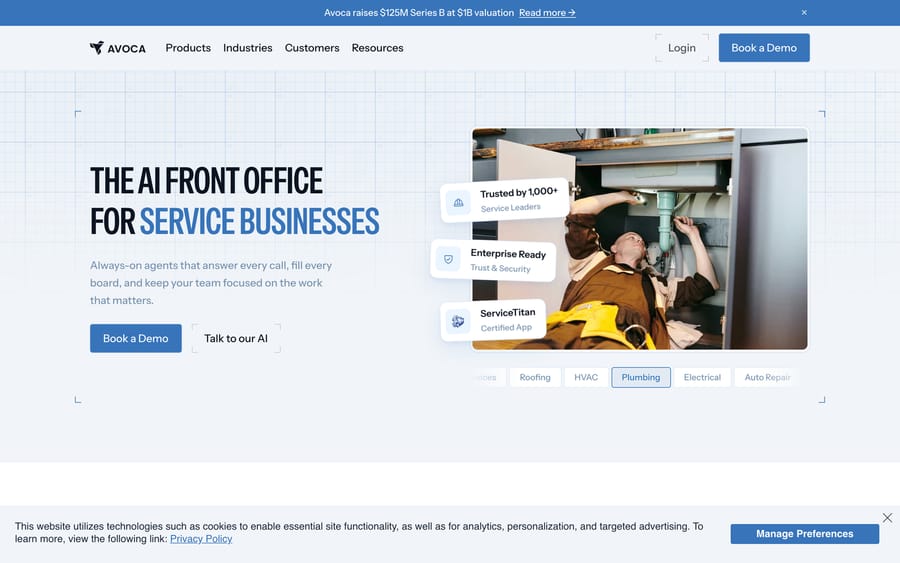
Avoca AI describes itself as "the AI front office for service businesses," selling always-on AI agents that answer calls, texts, and web chat, book jobs, and run outbound campaigns to re-engage past customers. It's a certified ServiceTitan app, which matters because ServiceTitan is the dominant field-service management platform in the trades, and Avoca's positioning depends on plugging directly into a CRM its target customers already run. Avoca states it's trusted by more than 1,000 service businesses across 13-plus sectors, including HVAC, plumbing, electrical, auto repair, pest control, roofing, garage doors, energy delivery, remodeling, junk removal, moving, and restoration.
The product is organized around three jobs: Convert (answer every call, text, and chat, and book jobs around the clock), Nurture (multi-channel SMS and call drip campaigns to re-engage past customers), and Coach (score every call and surface missed opportunities for managers). That third piece is worth noticing: Avoca isn't only automating the call, it's grading the calls humans still take.
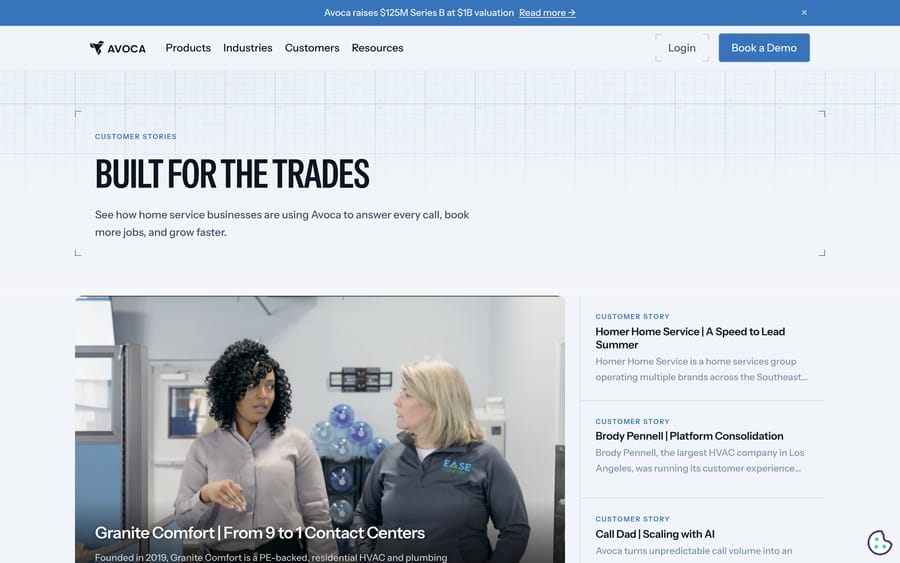
Avoca's customer-stories page backs the pitch with specific, named results rather than generic testimonials. Granite Comfort, a PE-backed HVAC and plumbing group, consolidated nine separate contact centers into one and eliminated nine after-hours answering vendors; one of its brands, Yost & Campbell, reports 20% year-over-year revenue growth that Avoca attributes to calls the team was previously losing. Brody Pennell, the largest HVAC company in Los Angeles, reports its booking rate climbing from 70% to 90% after consolidating four disconnected platforms onto Avoca. Homer Home Service reports its speed-to-lead dropping from as long as a week at peak to roughly 30 seconds, with booking rates up 25-30% across its brands.
How Avoca's AI works
Avoca's AI sits between the phone line (and text/chat channels) and the CRM, primarily ServiceTitan, and is built around a few concrete mechanisms rather than one generic "AI receptionist" layer:
- Fees and rulesets: Avoca can quote real, configured pricing on a call, after-hours fees, member versus non-member rates, and holiday-specific overrides, pulled from rules a business sets up once in its dashboard instead of a script the AI improvises.
- Booking configuration per holiday or event: a business can set specific dates to "No Booking," "Regular Booking," or "Emergency Only Booking," with call-transfer behavior configured separately, so the AI's behavior on July 4th or during a weather event is a deliberate setting.
- Capacity and technician-skill awareness: the platform routes booking against real technician availability and skills instead of filling a calendar blind.
- Human-in-the-loop escalation: Granite Comfort's case study specifically names "Human-in-the-Loop" as a deployed capability, meaning a live person can be pulled into a call or takes over a dispatch decision the AI shouldn't make alone.
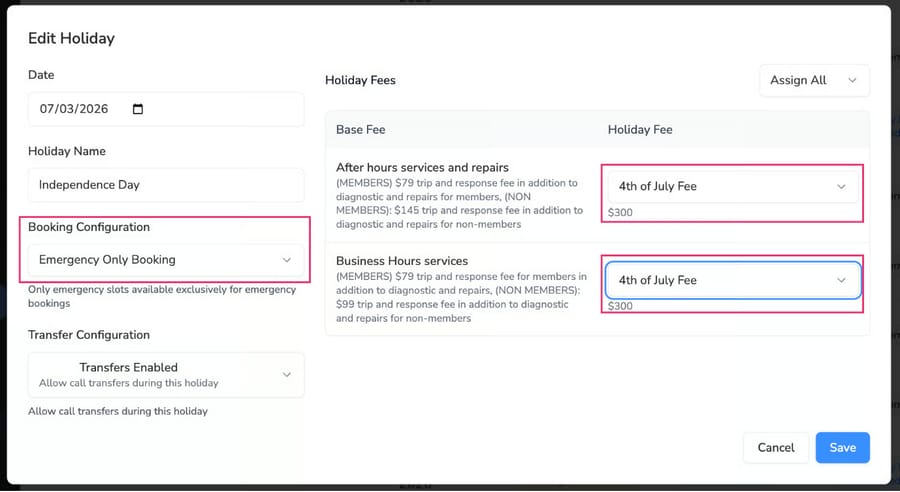
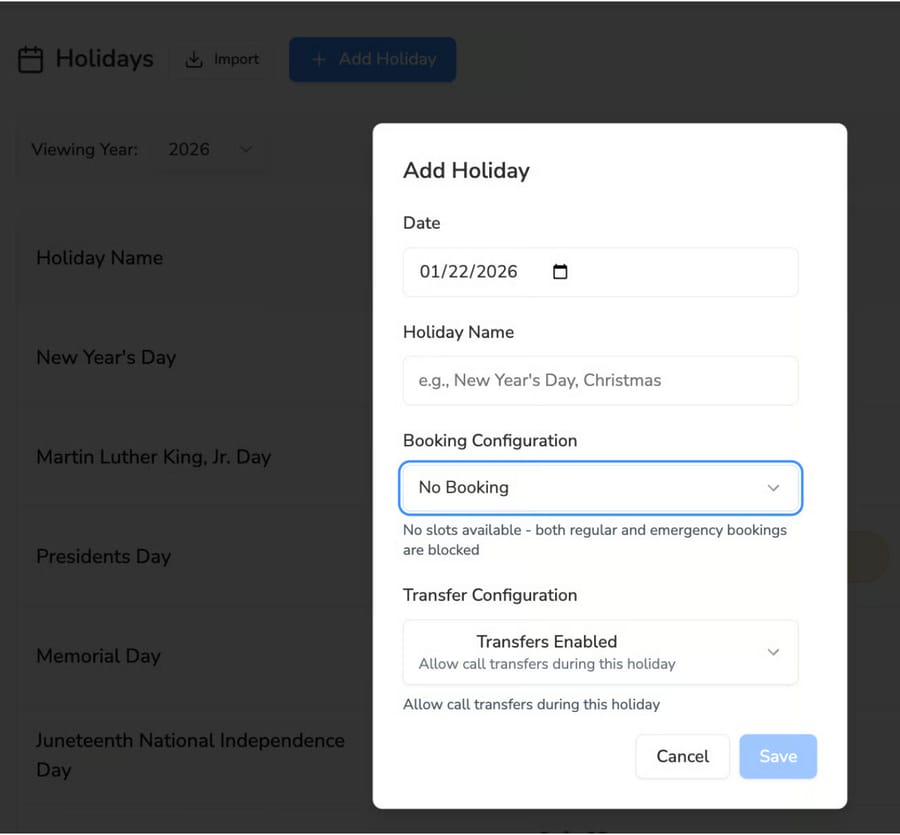
That fee and holiday configuration is a more specific piece of engineering than most voice AI vendors expose publicly, and it reflects who Avoca actually builds for: a plumbing company that charges differently for an after-hours emergency call than a scheduled Tuesday appointment needs the AI to know that difference, not just sound polite on the phone.
Key features
- Omnichannel intake: calls, texts, and web chat handled by the same AI layer, with the same booking and fee logic.
- Outbound nurture campaigns: SMS and call drips aimed at past customers, to fill a technician's schedule instead of only reacting to inbound demand.
- Call scoring and coaching: every call, AI-handled or human-handled, gets scored, giving managers visibility into missed opportunities without listening to every recording.
- ServiceTitan certification: a direct, certified integration rather than a generic CRM webhook, which is the primary reason home-service operators trust it with real booking and fee data.
- Configurable fees and holiday rules: real pricing logic, not a flat script, including after-hours and member-versus-non-member rates.
Avoca AI pricing
Avoca does not publish pricing. As of this guide's research date, avoca.ai/pricing returns a 404, there's no pricing link in the site navigation, and every call to action leads to "Book a Demo." We checked further before writing that off: Avoca has no listing on AWS Marketplace, Azure Marketplace, or Google Cloud Marketplace, no G2 or Capterra reviews or pricing page, and no Trustpilot page. That's a genuinely closed pricing picture; we checked before writing it off as one.
Third-party estimates from vendor-comparison sites put the cost at roughly $1,000 to $3,500 a month, scaling with call volume, CSR seat count, integration depth into ServiceTitan, and contract length. Billing is reported to run per-minute of AI conversation, which means a busy month, the exact scenario Avoca is sold to handle, is also the expensive month. A mid-market operator (around $5 million in revenue, six CSRs, roughly 1,200 calls a month) is estimated around $1,000–$3,000/month; a $20 million-revenue operator with 15-plus CSRs is estimated toward $2,500–$3,500/month. Treat these as third-party estimates, not Avoca-published rates, and get an exact quote before budgeting.
The incentive worth naming: per-minute billing on an inbound-heavy product means Avoca earns more precisely when a business's call volume spikes, which is also when that business has the least slack to absorb a surprise invoice. That's a reasonable trade for a company buying reliability during a heat wave or cold snap, but it's worth modeling against your peak month, not your average one.
Pros and cons
Pros
- Deep, named case studies with specific before/after numbers (booking rate, speed-to-lead, contact-center consolidation), not just testimonial quotes.
- Real pricing logic, after-hours fees, holiday overrides, member rates, built for how trades businesses actually price work.
- Certified ServiceTitan integration, which is the CRM most of its target market already runs.
- Well capitalized (more than $125M raised across Seed, Series A and Series B at a $1B valuation, per its April 2026 press release), which matters for a vendor a trades business is trusting with every missed call.
Cons
- No published pricing anywhere, including third-party marketplaces, so every buyer starts a sales cycle blind on cost.
- Per-minute billing means the cost is hardest to predict exactly when call volume is highest.
- No independent review platform (G2, Capterra, Trustpilot) carries Avoca reviews; the only public testimonials are vendor-curated on Avoca's own site.
- Narrow by design: it automates calls and texts for trades businesses. It has no ticket queue and nothing that resembles help-desk-style support automation.
Who Avoca AI is best for
Avoca fits teams at a home-service business running real call volume through ServiceTitan, HVAC, plumbing, electrical, roofing, and similar trades, where a missed call is a missed job and where pricing genuinely varies by time of day, holiday, and membership status. The named case studies (Granite Comfort, Brody Pennell, Homer Home Service) are all multi-location or multi-brand operators consolidating a messy answering setup, which is the shape of business Avoca is built to win.
It's the wrong choice if you're not in the trades or not running ServiceTitan, since the fee logic and integration depth that make Avoca valuable are specific to that world. It's also a poor fit if you want to see a price before booking a demo call; a solo operator or a two-truck shop is unlikely to be a fit for a platform priced in the low thousands a month with no published entry tier.
Avoca AI vs alternatives
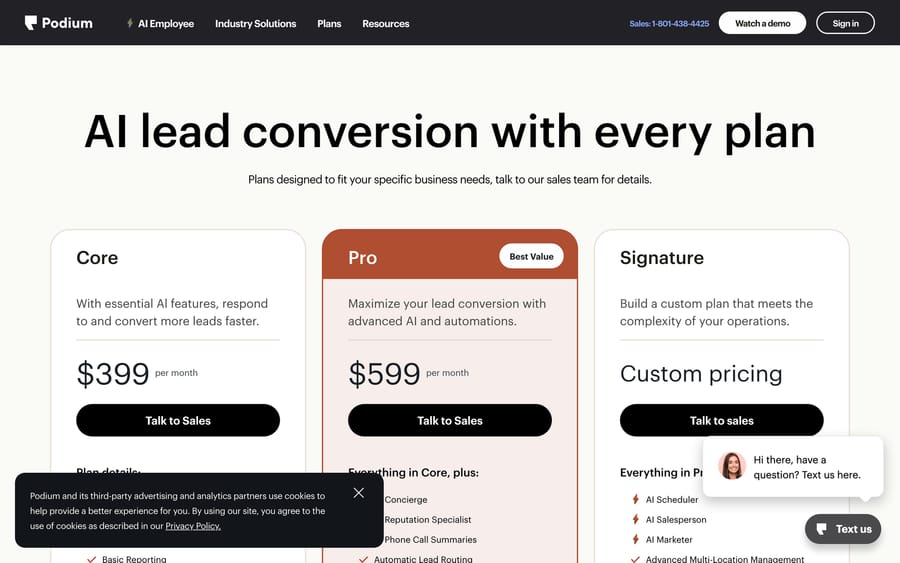
The closest comparison is Podium, which sells an "AI Employee" (branded Jerry) for local service businesses on top of its messaging platform. Podium no longer publishes prices: as of September 19, 2026, its pricing page shows no plan figures and routes buyers to a demo or a sales call, so it's quote-first like Avoca. Podium's own case studies cite similar-shaped wins to Avoca's, Budget Blinds reports a 33% higher close rate, Mountaineer Heating and Cooling reports $96K in additional monthly revenue, which suggests this category of AI-front-office tool for home services has real, if vendor-reported, upside across multiple vendors.
| Avoca AI | Podium | Macha | |
|---|---|---|---|
| Model | AI front office for trades: calls, texts, chat, coaching | AI Employee (Jerry) layered on messaging platform | AI agent layer on your existing help desk |
| Best for | ServiceTitan-run HVAC, plumbing, electrical, and similar trades | Local service businesses on Podium's messaging platform | Teams on Zendesk, Freshdesk, Gorgias, or Front |
| Pricing | Unpublished; ~$1,000-$3,500/mo estimated, per-minute | Not published; quote via demo or sales | From $299/mo for 750 tickets (~$0.40/ticket), published |
| CRM integration | Certified ServiceTitan app | Own platform plus integrations | Zendesk, Freshdesk, Gorgias, Front, Shopify, Slack, and more |
| Real-user rating | No independent platform; 4.8/5 from vendor-curated references | Not independently verified for this guide | N/A (newer platform) |
| Replaces your help desk? | No, phone and text for trades dispatch | No, messaging and lead conversion | No, sits on top of Zendesk, Freshdesk, Gorgias, Front, HubSpot or Intercom |
Avoca and Podium both compete to be the AI answering every call and text for a local service business. Neither touches a ticket queue, so a business that also runs a support inbox through a help desk needs a second tool for that side of the operation. That's where Macha fits: an AI agent layer inside Zendesk, Freshdesk, Gorgias, Front, HubSpot or Intercom, built for the ticket queue instead of the phone-and-text front office Avoca and Podium cover. For more on how phone-first AI compares to ticket-based agents, see our guide to AI agents for customer service, and for another enterprise voice AI comparison, see our guide to Parloa.
How we researched this
We fetched Avoca's homepage and customer-stories page directly on 2026-09-17. Avoca's pricing page returns a 404, and we confirmed no listing exists on AWS, Azure, or Google Cloud Marketplace, and no G2, Capterra, or Trustpilot review page, before relying on third-party cost estimates. Real-user evidence comes from FeaturedCustomers.com's aggregated testimonials (4.8/5 from 326 references), which we flag here as vendor-curated: no negative review was findable anywhere public. We re-checked podium.com/pricing on September 19, 2026; it no longer shows plan prices. We could not verify Avoca's exact per-minute rate or seat pricing; get a written quote before budgeting against the third-party estimates cited here.
FAQ
What is Avoca AI? Avoca AI builds AI phone, text, and chat agents specifically for home service businesses (HVAC, plumbing, electrical, roofing, and similar trades), integrated with ServiceTitan to answer calls, book jobs, run outbound campaigns, and score call quality.
How much does Avoca AI cost? Avoca doesn't publish pricing. Third-party estimates put it around $1,000 to $3,500 a month, billed per minute of AI conversation and scaling with call volume, seat count, and integration depth. Get a direct quote for your business before budgeting against these estimates.
Is there a free trial? No self-serve trial is published. Every path to pricing runs through a booked demo.
Does Avoca AI only work with ServiceTitan? Avoca is a certified ServiceTitan app and that's its primary, deepest integration, but the fetched site content doesn't rule out other CRM connections; confirm your specific system during a sales call.
What results do Avoca customers report? Granite Comfort consolidated nine contact centers into one and reports 20% year-over-year revenue growth on one brand; Brody Pennell reports its booking rate rising from 70% to 90%; Homer Home Service reports speed-to-lead dropping from up to a week to roughly 30 seconds. These are vendor-published case studies.
What are good alternatives to Avoca AI? Podium is the closest comparison for local service businesses, selling a similar AI Employee concept on top of its messaging platform; like Avoca, it no longer publishes prices. For phone-heavy support outside the trades, voice AI infrastructure platforms are a different category worth comparing separately.
Does Avoca AI replace a help desk? No. Avoca automates phone, text, and chat for dispatch and booking in home services. It has no ticket queue, so a business running a separate support inbox needs a help-desk-native tool alongside it.
Why doesn't Avoca AI publish reviews on G2 or Capterra? We could not find a review presence on any independent platform (G2, Capterra, Trustpilot) as of 2026-09-17. The only public testimonials are curated case studies and quotes on Avoca's own site and on FeaturedCustomers.com.
Ready to automate the ticket queue instead of the phone queue? See how Macha's pricing works or start a trial on top of the help desk you already run.
Sources: Avoca AI, Avoca AI customer stories, Avoca help center: configure fees and holidays, FeaturedCustomers: Avoca reviews, Podium pricing.
Resolve tickets automatically with AI agents
Macha's AI agents work on top of the help desk you already use — no code.