







 Shopify
 Stripe
 Slack
 Notion
 Google Workspace
 Confluence


Best AI Agents for Intercom (2026): 9 That Work in Intercom, Scored


Nine AI agents work inside an Intercom inbox in November 2026, and we scored each on five public criteria. Macha scores 10 of 10 because the Macha team builds and runs the agent for you. Fin, Intercom's own agent at $0.99 an outcome, ties on 8 with eesel, Fini, My AskAI and Quickchat. Pluno scores 7, Aissist 6 and Gradient Labs 4. Every one keeps Intercom as your inbox; none asks you to migrate.
Key takeaways
- Macha scores 10 of 10 for Intercom teams: it replies, adds internal notes, tags, assigns and closes conversations, and the Macha team builds, tests and runs the agent.
- Fin costs $0.99 per outcome on Intercom's pricing page, checked November 21, 2026, and an outcome is charged once per conversation however many questions Fin answers.
- My AskAI charges $199 a month for 1,000 tickets on its Pro plan and can run in internal-note mode inside Intercom before it answers customers directly.
- The Intercom App Store list we pulled had 735 listings, and most of its AI apps score QA, analyze feedback or sync knowledge, so nine customer-facing agents made the cut.
- Fini prices by resolved ticket, from $0.89 on Growth to $0.49 on Enterprise, and includes implementation on every plan.

The nine AI agents for Intercom at a glance
| # | Agent | Score | How it works with Intercom | What it does in Intercom | Who builds it | Price (checked Nov 21, 2026) |
|---|---|---|---|---|---|---|
| 1 | Macha | 10/10 | Built-in Intercom connector, sign-in | Replies, internal notes, tags, assigns, closes, plus Shopify and Stripe lookups | The Macha team, on the trial and every plan | about $0.40 per ticket, $299/month for 750 tickets |
| 2 | eesel AI | 8/10 | Intercom App Store, OAuth | Replies, internal notes, tags, fields, routing, Shopify and Stripe actions | You; a dedicated person on Enterprise | $299 a month for 500 credits |
| 2 | Fin (by Intercom) | 8/10 | Native | Answers on every Intercom channel, runs Procedures, hands off | You, in Intercom | $0.99 per outcome, plus seats from $29 |
| 2 | Fini (Sophie AI) | 8/10 | Intercom App Store | Resolves and escalates with context, calls your APIs | Fini, implementation on every plan | $0.89 to $0.49 per resolved ticket |
| 2 | My AskAI | 8/10 | Intercom App Store | Internal-note drafts, direct replies, tags, handoff, API tasks | You; white-glove on Enterprise | $199 a month for 1,000 tickets, then about $0.12 |
| 2 | Quickchat AI | 8/10 | Intercom App Store | Answers chat and email, AI Actions, routes to a teammate or team, auto-closes | You; implementation on Enterprise | $9 to $999 a month in credits |
| 7 | Pluno Deflection AI | 7/10 | Intercom App Store, a dedicated or shared seat | Answers, closes, escalates with context | You, with onboarding included | €249 a month platform fee plus €0.90 per resolved ticket |
| 8 | Aissist | 6/10 | Intercom App Store | Resolves and hands over, runs procedures such as refunds and subscriptions | You | $0.20 to $0.60 per resolution, free tier of 1,000 tickets |
| 9 | Gradient Labs | 4/10 | Intercom App Store | Answers from day 1; procedures after an integration project | A joint project team | Outcome-based, contact sales |
Scores use the rubric below and only what each vendor publishes. We make Macha and rank it first; its entry explains the scores, and every other score links to the page it came from.
How did we score AI agents for Intercom?
Each agent gets 0, 1 or 2 points on five criteria, for a total out of 10. Ties are ordered alphabetically.
- Works inside Intercom. 2 = acts on the conversation itself (replies plus at least one of internal notes, tags, assignment or closing). 1 = answers in the Messenger or inbox and hands off to a teammate. 0 = no documented Intercom connection.
- Actions beyond answering. 2 = documents calls to outside systems such as orders, billing or your own API. 1 = changes the conversation only, or lists actions without saying how they reach Intercom. 0 = answers only.
- Implementation: who builds it. 2 = the vendor's team builds and tests the agent for you on every plan. 1 = the vendor builds it only on a top tier or as a project, or it's native to Intercom with no integration step. 0 = you build and connect it yourself.
- Ongoing management after go-live. 2 = the vendor's team monitors and changes the agent for you on every plan. 1 = a named person on a top tier, or built-in analytics and suggestions your team acts on. 0 = you watch and tune it yourself.
- Published price. 2 = a full public price list. 1 = a partial or "from" price. 0 = contact sales.
Criteria 3 and 4 reward a vendor whose team builds and runs the agent for you. That's how Macha works and why it scores top there; on criteria 1, 2 and 5, eesel, Fin, My AskAI and Quickchat tie Macha at 6 of 6. We listed only agents with a public page showing a working Intercom connection today. For the eight third-party tools, that's an Intercom App Store listing, and we count what a listing says as documentation for every criterion, the same as a vendor's own docs. Macha connects through its own Intercom connector, and Fin is built in.
We pulled the App Store's full public list, 735 listings, and filtered it to apps that answer customers with AI. Most AI apps on it are something else: QA scoring, feedback analysis, translation, voice calls or knowledge sync for Fin. Of the customer-facing agents left, we scored the ones that publish both a price and what they do in the conversation.
Which AI agents work inside Intercom?
1. Macha: the agent the Macha team builds and runs inside your Intercom, 10/10
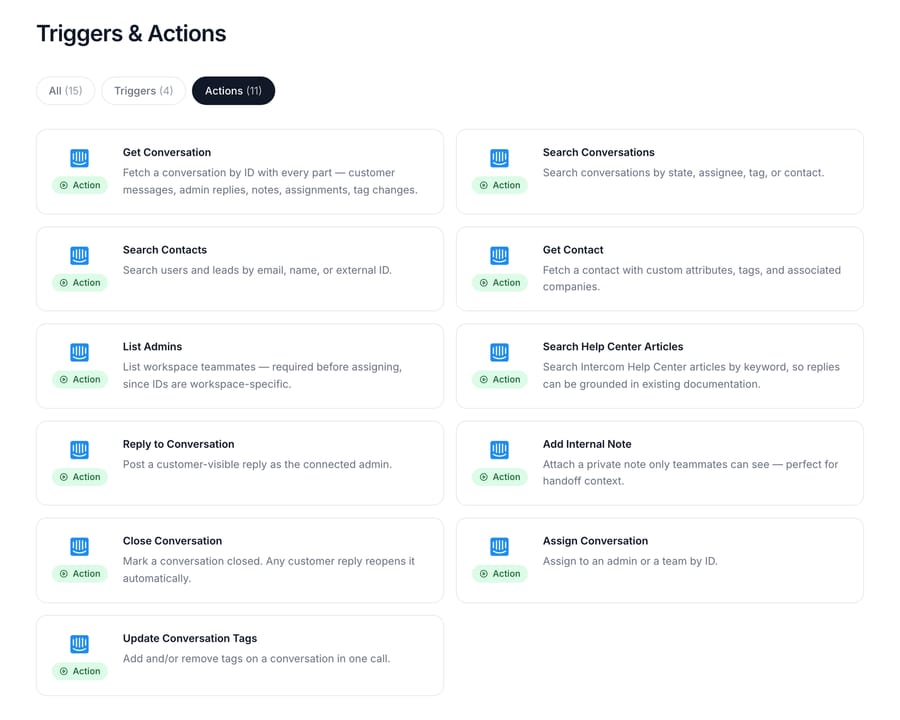
Macha runs AI agents inside the help desk a team already uses, and Intercom is one of Zendesk, Freshdesk, Gorgias, Front, Gladly, Crisp, HubSpot or Intercom. You connect Intercom by signing in, and the connector gives an agent 11 tools. Six read: get a conversation with every part, search conversations by state, assignee, tag or contact, search contacts, get a contact with custom attributes and companies, list admins, and search Help Center articles. Five write: reply to the customer as the connected admin, add an internal note, close a conversation, assign it to an admin or team, and add or remove tags in one call. Four triggers start the agent: the first customer message, every customer message, a conversation being assigned, or a conversation being closed.
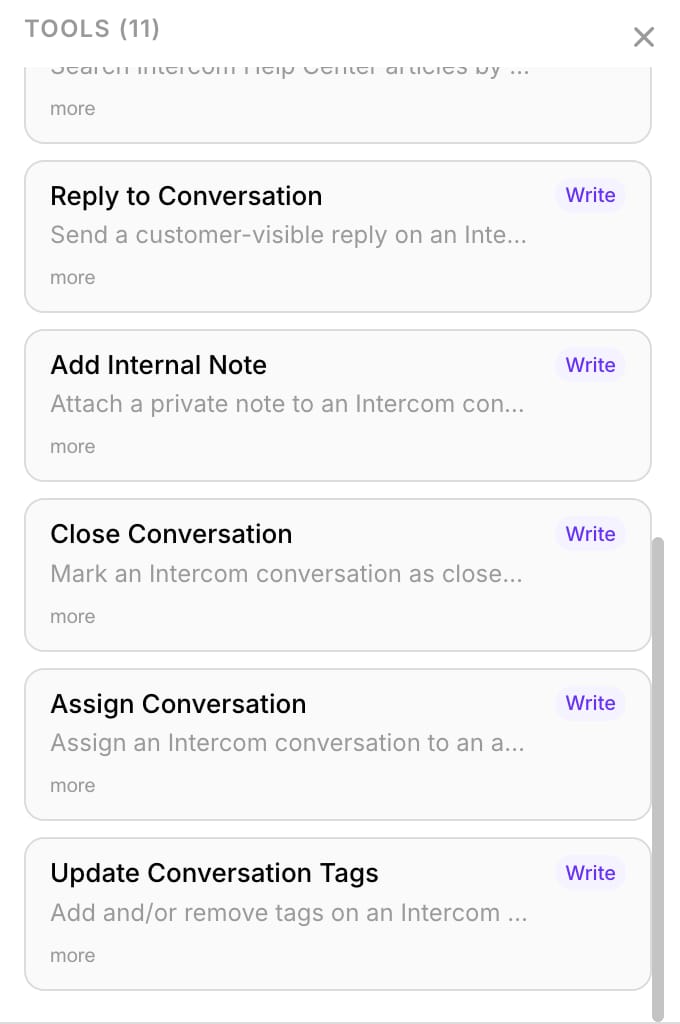
That tool list earns the first criterion. A typical setup reads the new conversation, pulls the contact's plan and company, looks the order up through Macha's built-in Shopify connector or the subscription through Stripe, drafts the answer as an internal note, tags the conversation billing, and assigns refunds to the billing team. The triage use case walks through the first half of that, and our post on automating refunds in Intercom covers the second. Anything else with an API connects through a custom API tool that Macha's team sets up during onboarding.
The other four points come from who does the work. The Macha team analyzes about a month of your past Intercom conversations, builds the knowledge base and the agent, tests it on a sample of those conversations, and runs it in safe mode, with drafts as internal notes, until you're happy with them. After go-live a dedicated success manager handles your changes: a new category, a new instruction, a new tool. That's included on the trial and every plan at about $0.40 per ticket, one charge per conversation however many messages it takes. Pricing starts at $299/month for 750 tickets, and the trial is $50 of free usage (about 125 tickets), no credit card, no time limit. More on the done-for-you setup, how Macha runs on Intercom, the Intercom connector's tools and the pricing tiers.
Scores: works inside Intercom 2, actions 2, implementation 2, ongoing management 2, price 2.
Best for: an Intercom team that wants AI on its conversations without anyone writing prompts, testing answers or watching a dashboard. It's the wrong fit if you only want the cheapest possible FAQ bot on a small widget.
2. eesel AI: a self-serve agent with drafts, routing and app actions, 8/10
eesel's Intercom page says it connects by OAuth, imports your Help Center, past conversations and saved replies, and then replies, adds internal notes with drafted answers, updates fields and tags, and routes conversations to teammates. You can limit it by topic, segment or page URL and run simulations on past conversations before it goes live. Its App Store listing adds that it can "look up live information and take actions in Shopify, Stripe, Jira and other apps," which earns 2 on actions.
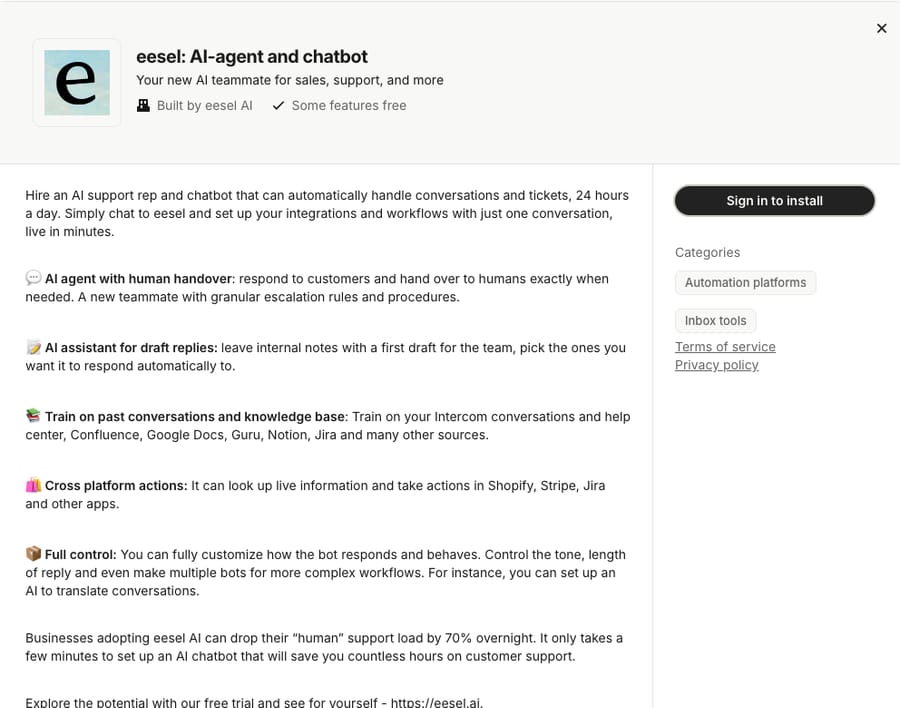
eesel's pricing starts at $299 a month for 500 credits, where one Intercom conversation uses one credit, up to $1,749 for 5,000. Extra credits are $0.80 if you turn overage on. A dedicated person looks after setup on the Enterprise add-on ($1,000 a month); otherwise you build it.
Scores: works inside Intercom 2, actions 2, implementation 1, ongoing management 1, price 2.
Best for: a team that wants drafts and routing in Intercom and is happy to configure it in plain language itself. At 500 tickets eesel is $0.60 a ticket; at 750, Macha is $299/month for 750 tickets with the setup done for you.
2. Fin: Intercom's own AI agent, 8/10
Fin is built into Intercom, so there's nothing to install. It answers on live chat, email, WhatsApp, SMS, phone and Slack, runs multi-step Procedures that can call your systems, and hands the conversation to your team when it stops. Salesforce, which completed its acquisition of the company on September 10, 2026, cites a 76% average resolution rate across more than 30,000 customers. That's a vendor average, and your rate depends on how clean your help content is.
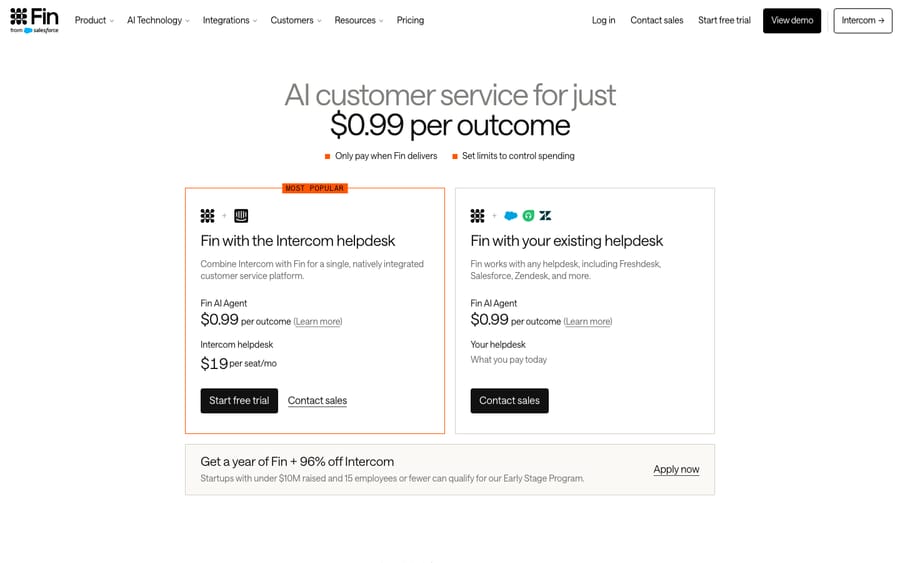
Intercom's pricing page sets Fin at $0.99 per outcome on top of seats at $29, $85 or $132 a month billed annually. An outcome is counted when the customer confirms the issue is resolved, doesn't ask for more help after Fin responds, or Fin completes a Procedure, including handoffs, and you're charged once per conversation. Fin's own pricing page adds that qualifications cost $9.99 each and that conversations passed to your team without an outcome aren't charged. You set Fin up yourself in Intercom; contracts with Premier onboarding are available, and Intercom keeps a partner directory for hands-on help.
Scores: works inside Intercom 2, actions 2, implementation 1 (native), ongoing management 1 (built-in reporting and the $100-a-month Pro add-on's analysis), price 2.
Best for: a team with a well-kept help center that wants the deepest native agent and is happy to tune it in-house. The bill grows with every success, so model it at your volume first; our Fin pricing breakdown does that.
2. Fini (Sophie AI): per-resolution pricing with implementation included, 8/10
Fini lists its agent on the Intercom App Store as Sophie AI. Its docs name Intercom among the help desks it deploys to, say Actions "let it call your APIs," and describe escalation to your team with the trace and context attached. The docs don't spell out whether Sophie writes notes or tags inside Intercom specifically, which is why it takes 1 on the first criterion.
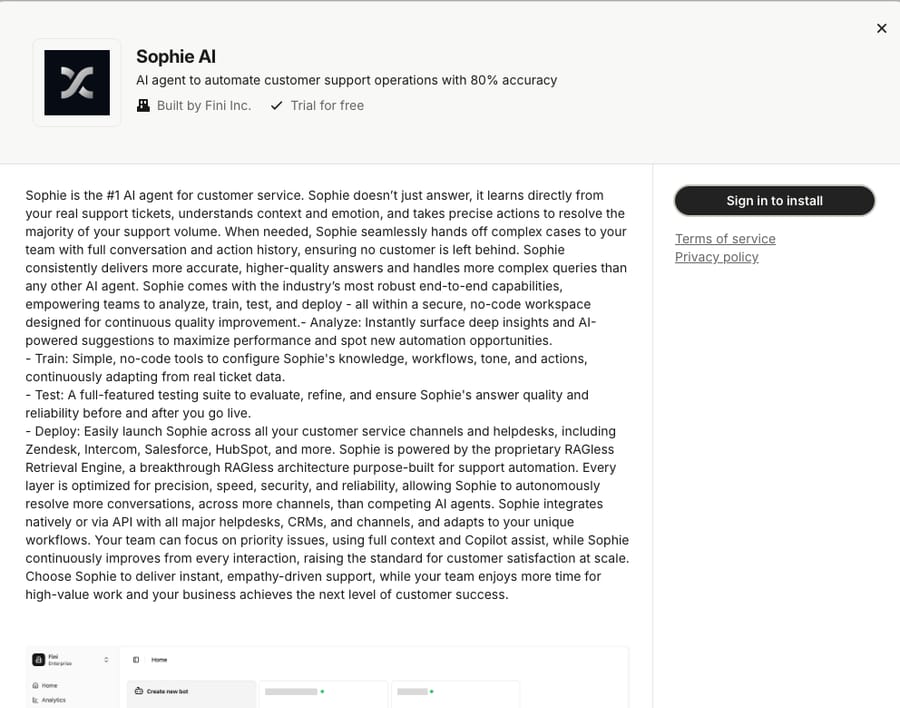
Fini's pricing page charges per resolved ticket: $0.89 on Growth (up to 3,000 tickets a month), $0.69 on Scale (up to 10,000) and $0.49 on Enterprise, with no usage minimums. Implementation is included on Growth; Scale adds white-glove onboarding and a dedicated AI engineer. Eligible new Enterprise customers get a 90-day guarantee: if Fini doesn't reach 90% resolution in 90 days, they pay nothing.
Scores: works inside Intercom 1, actions 2, implementation 2, ongoing management 1 (a dedicated AI engineer from Scale up), price 2.
Best for: a team with enough volume to reach Scale that wants a vendor to build the agent and is comfortable with per-resolution billing, which, like Fin's, earns the vendor more as the agent succeeds.
2. My AskAI: the cheapest per-conversation agent with a notes mode, 8/10
My AskAI's App Store listing is one of the few flagged to work in the inbox conversation, the inbox sidebar and the Messenger. Its Intercom page describes a rollout that starts with drafts as private notes ("Human agents see AI replies as private notes. They approve, edit, send"), then switches chosen topics to direct replies. AI tagging costs $0.05 a tag, and the page says you can connect CRMs, ERPs and APIs for account, order and subscription answers, with refunds and upgrades as example tasks. Your own team may need to build the API endpoints.
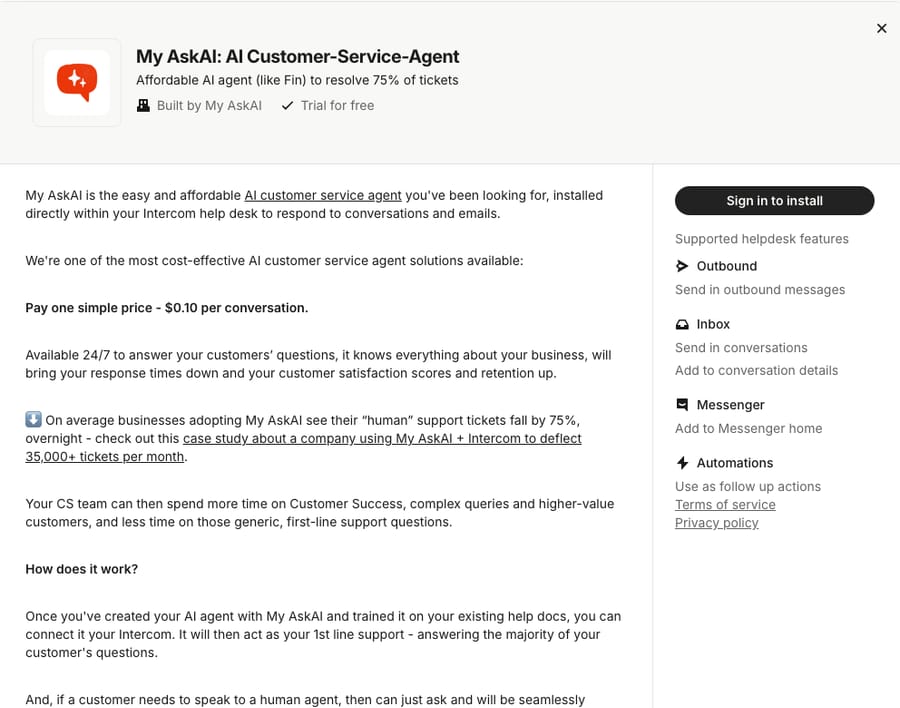
My AskAI's pricing is $199 a month for 1,000 tickets on Pro (extra tickets about $0.12) and $499 for 2,000 on Scale (about $0.10), with a 30-day trial and no card. Setup is self-serve; white-glove setup, a dedicated success manager and a monthly audit come with Enterprise, from $999 a month.
Scores: works inside Intercom 2, actions 2, implementation 1 (white-glove on Enterprise), ongoing management 1 (success manager on Enterprise), price 2.
Best for: a cost-sensitive team that wants to trial a Fin replacement in notes mode alongside Fin before switching, and has someone to build and tune it.
2. Quickchat AI: a low entry price, with actions and routing, 8/10
Quickchat's listing says it adds an AI agent to your Intercom inbox that answers live chat and email as a dedicated teammate and imports your Help Center in one click. It lists AI Actions that "look up an order, check a subscription" or call your own tools, a handoff that "routes the conversation to the right teammate or team," and auto-close for inactive chats. Its docs cover AI Actions and MCP actions.
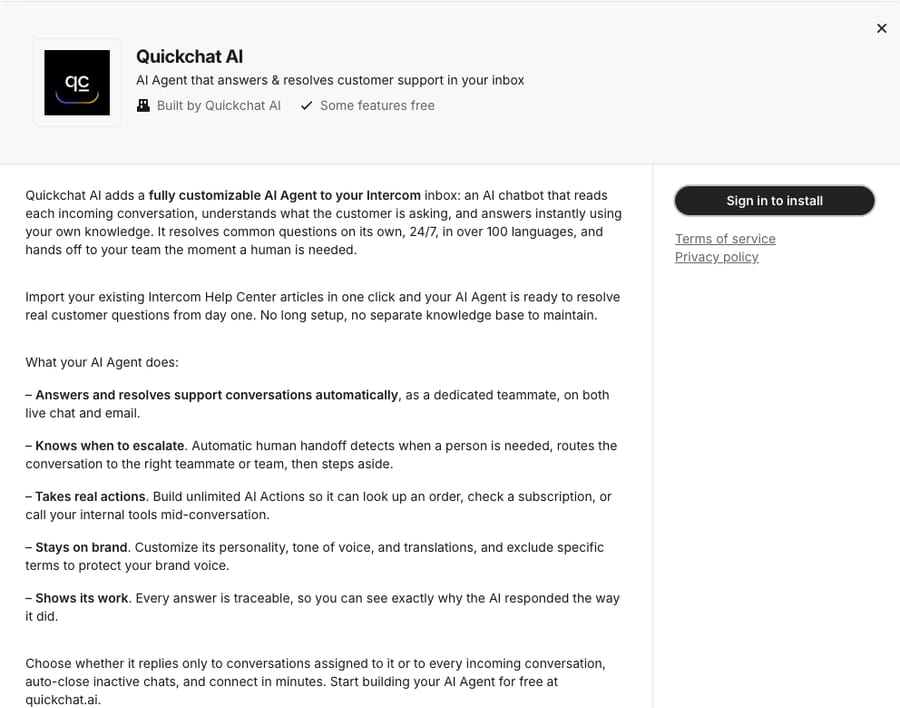
Quickchat's pricing runs from $9 to $999 a month in AI credits, with Intercom available on every plan, and Enterprise from $0.50 per resolution with "Professional development and implementation of your AI Agent." Below Enterprise you build it yourself.
Scores: works inside Intercom 2, actions 2, implementation 1 (Enterprise), ongoing management 1 (account manager on Enterprise), price 2.
Best for: a small team testing AI on Intercom for less than the price of one seat.
7. Pluno Deflection AI: pay only when it closes the ticket, 7/10
Pluno's listing says Deflection AI "integrates into Intercom via a dedicated or shared seat," picks out tickets and chats suitable for self-service, answers from past resolutions, docs and the Help Center, and escalates the rest with full context. Its pricing page says "You only pay when Pluno fully closes the ticket," at €0.90 each, on top of a platform fee from €249 a month (up to 500 tickets) to €3,799 (up to 20,000). Onboarding is included with no setup fee, and there's a 14-day trial.
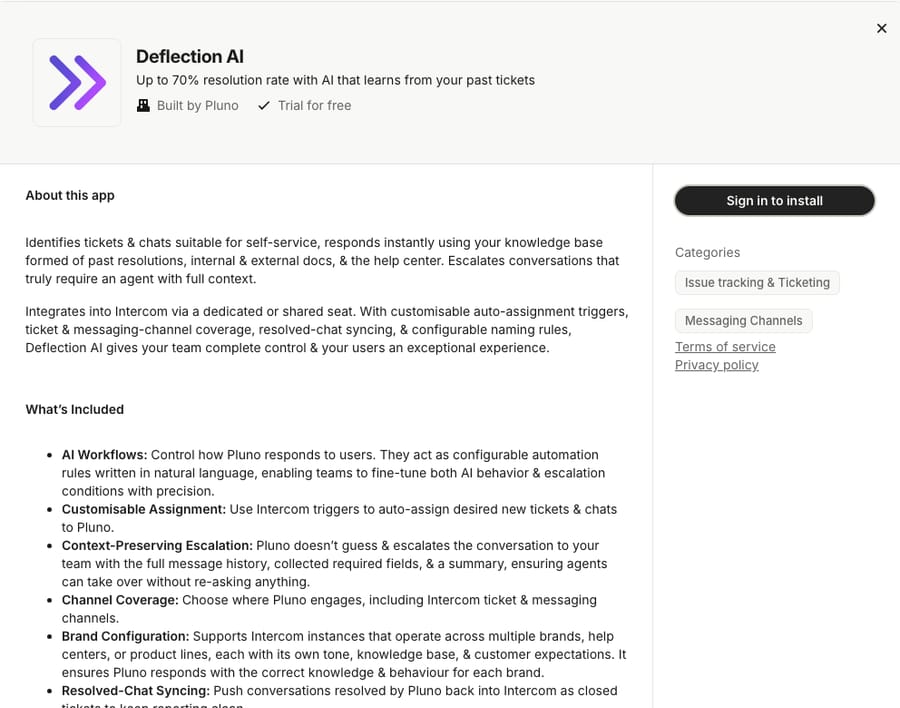
Scores: works inside Intercom 2, actions 1, implementation 1, ongoing management 1 (built-in reporting, as for Fin and Aissist), price 2. Implementation takes 1 rather than Fini's 2 because Pluno's pricing page includes onboarding but doesn't say its team builds or tests the agent, where Fini's says "implementation included" on every plan.
Best for: a European SaaS team that wants deflection priced on closed tickets, and that also wants Pluno's agent Copilot (€49 a seat) in the same contract.
8. Aissist: metered pricing with a free tier, 6/10
Aissist's listing says its specialist agents run procedures such as troubleshooting, refunds, subscriptions and lead qualification, and keep "your helpdesk, CRM, orders and billing up to date." It's flagged to add to the conversation details panel in the inbox. Its docs list Intercom as a "gateway" alongside Zendesk, Front, Gorgias and HubSpot, without Intercom-specific detail on notes, tags or assignment.
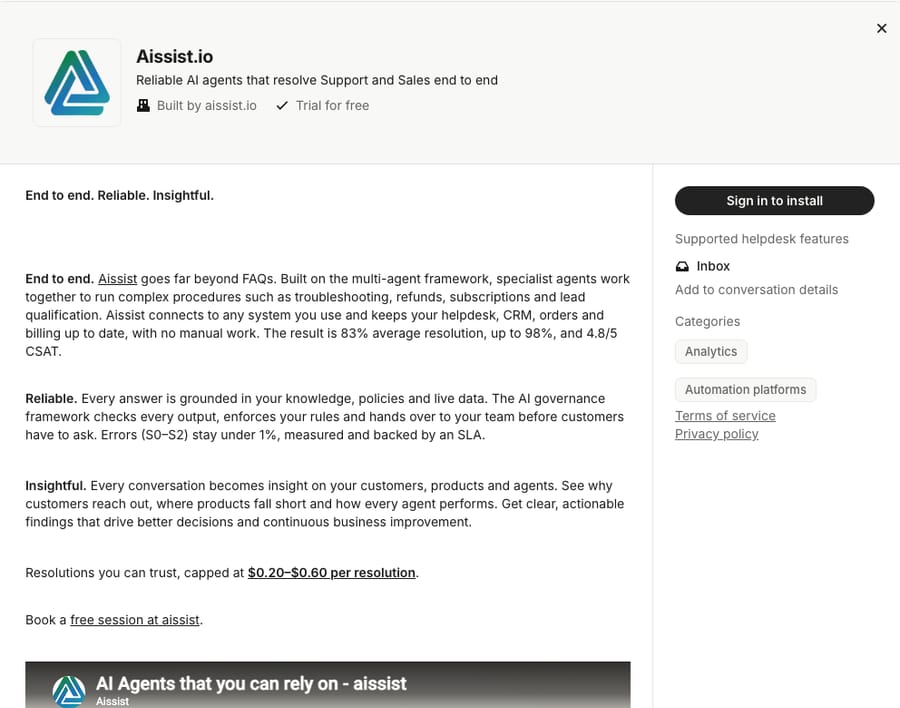
Aissist's pricing meters $0.09 per AI interaction, capped at $0.60 per resolution for chat and an estimated $0.25 for email, with a free tier of 1,000 tickets a month and "no installation charges." Its optimization module is included.
Scores: works inside Intercom 1, actions 2, implementation 0, ongoing management 1, price 2.
Best for: a team that wants to try an agent on real volume before paying anything.
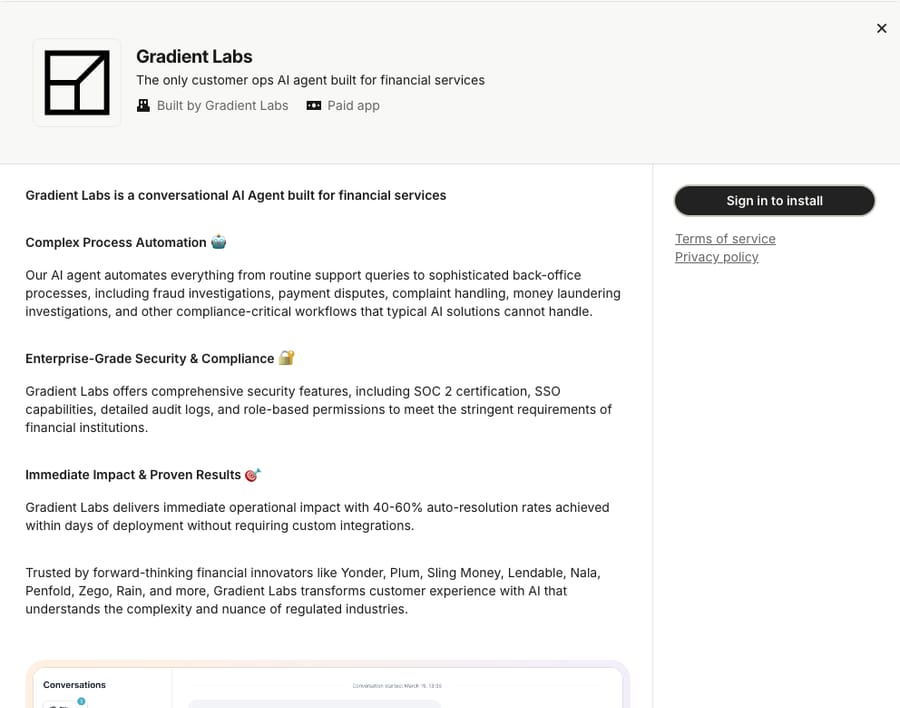
9. Gradient Labs: built for financial services, 4/10
Gradient Labs builds an agent for banks and fintechs. Its pricing page says Intercom teams can start on day 1 without technical integrations at an estimated 20% to 50% resolution on the easiest queries, and that reaching 80% to 90% of handling time means defining procedures and integrating your systems with Gradient Labs as a project team. Pricing is outcome-based with no platform fee, but there's no public rate.
Scores: works inside Intercom 1, actions 2, implementation 1 (project team), ongoing management 0, price 0.
Best for: a regulated financial-services team on Intercom that needs compliance-heavy workflows such as disputes and fraud checks.
Which AI apps on the Intercom App Store didn't make the list?
Several listings answer customers with AI but didn't publish enough to score. Siena AI has a listing, but its Intercom setup page didn't load on November 21 and its pricing page doesn't mention Intercom. Ordemio, Asyntai, Moveo, Ryklen and Snoooz list Intercom agents with little public detail on what they do in the conversation. The Ultimate and Forethought listings now belong to Zendesk; we cover them in our Fin alternatives roundup, which also includes agents such as Decagon and Sierra that sell enterprise implementations instead of App Store installs.
A lot of the remaining AI apps make Fin better rather than replace it: QA scoring of Fin's answers, knowledge sync, feedback clustering. If Fin answers badly from your docs, our guide to Fin not answering from your content is a cheaper first stop than a new agent.
How do you choose an AI agent for Intercom?
Start with the billing unit, because it decides who benefits when the agent improves. Fin, Fini, Pluno and Gradient Labs charge per outcome or resolution, so the vendor earns more the more conversations the agent closes. Macha, My AskAI and eesel charge per conversation handled, so a better agent doesn't raise the price per conversation.
Here's the arithmetic at 2,000 conversations a month with a 60% resolution rate, using each page's list price and leaving seats out:
| Agent | Billing unit | Monthly cost at 2,000 conversations, 60% resolved |
|---|---|---|
| Fin | $0.99 per outcome (1,200 outcomes) | about $1,188, plus seats |
| Fini Growth | $0.89 per resolved ticket | about $1,068 |
| Pluno | €999 platform fee (1,000 to 3,000 tickets) + €0.90 × 1,200 | about €2,079 |
| My AskAI Scale | $499 for 2,000 tickets | $499 |
| Macha | one plan priced on ticket volume | $1,199 (the 3,000-ticket tier on Macha's pricing page), setup and success manager included |
That comparison leaves out the biggest cost, which is staff time. A self-serve agent needs someone to write instructions, review drafts, fix knowledge gaps and retest after every change. Price that at a few hours a week of a senior agent's time and the cheapest line stops being the cheapest. That's the gap Macha's price covers: about $0.40 per ticket includes the setup and a dedicated success manager who handles your changes.
Then check three things on your own conversations:
- Does it act on the conversation? Notes, tags, assignment and closing decide whether the agent fits your Intercom workflows or sits beside them.
- Can it run in notes mode first? Macha, My AskAI and eesel document drafts as internal notes. That's the safest way to test any agent on live traffic, including alongside Fin.
- What happens when it's unsure? Ask for the handoff behavior in writing, and test it on your messiest topics.
What do Intercom teams say about AI agents on Reddit?
The complaint that comes up most is the size of the Fin bill. In an r/intercom thread from June 2026, a team said its Fin bill had roughly tripled in 14 months as volume tripled, and several replies advised auditing what Fin actually resolved before switching; one said a large share of its paid resolutions were article lookups. A thread from October 2026 asked which third-party agents work with Intercom at all, saying the App Store's AI category was hard to browse. Most replies across these threads come from vendors, which is worth knowing when you read them.
Where does Macha fit if you already pay for Fin?
You don't have to choose on day one. Macha can run in safe mode, drafting internal notes on the categories Fin handles worst, while Fin keeps answering everything else. When the drafts are right, that category moves to public replies, and you can narrow Fin's audience so the two agents don't answer the same conversation.
Our Intercom AI implementation guide compares running Fin yourself, hiring a partner and having it done for you.
Common questions
What is the best AI agent for Intercom?
On our rubric, Macha scores 10 of 10 because it acts on the conversation (replies, notes, tags, assignment, closing) and the Macha team builds and runs it, at about $0.40 per ticket with setup and a dedicated success manager included. eesel, Fin, Fini, My AskAI and Quickchat score 8. Fin is the best fit if you want a native agent and will tune it yourself.
Can you use a different AI agent in Intercom instead of Fin?
Yes. The agents above install from the Intercom App Store or connect through Intercom's API and reply in the same conversations. Fin only bills when it reaches an outcome, so a conversation you route to another agent instead isn't charged as a Fin outcome.
Is Fin included in Intercom plans?
Every Intercom plan includes access to Fin, but Fin isn't free: each outcome costs $0.99 on top of seats, per Intercom's pricing page on November 21, 2026.
Which Intercom AI agent is cheapest?
By list price per conversation, My AskAI is the cheapest scored agent: $199 for 1,000 tickets on Pro, with extra tickets at about $0.10 to $0.12. Quickchat ($9 a month) and Aissist (a free tier) have the lowest entry points. None of those prices include someone building and tuning the agent for you.
Can an AI agent leave internal notes in Intercom?
Yes. Intercom's API lets an admin post a reply with message_type set to note, which only teammates see. Macha, My AskAI and eesel use this to draft replies for review before anything reaches the customer.
Are you listed here?
AI vendors can send corrections or a missing Intercom integration page to [email protected]. We fix facts within a week. Scores follow the rubric above, not requests.
How we researched this
On October 29, 2026 we downloaded the Intercom App Store's public app list (735 listings). On November 21 we checked it again, filtered it to apps that answer customers with AI, and captured each scored listing ourselves. Fin's pricing comes from intercom.com/pricing and fin.ai/pricing, and Salesforce's figures from its September 10, 2026 completion release, all read November 21. Every other price, plan limit and Intercom behavior comes from the vendor's own pricing page, Intercom page or docs, read the same day; Pluno publishes in euros. Macha's tools and triggers come from Macha's own Intercom connector and its public integration page. We didn't install the third-party apps, so their scores rest on what their pages document. The cost table multiplies list prices at a stated volume and is not a measured bill. Reddit threads are paraphrased. We make Macha, and nobody was paid to be listed.
The fastest way to see Macha on your own Intercom is to start a trial: you connect Intercom once and the Macha team takes it from there.