







 Shopify
 Stripe
 Slack
 Notion
 Google Workspace
 Confluence


Gorgias WISMO Auto-Reply Stopped Working? Why It Ended and What Replaces It (2026)


If your Gorgias "where is my order" auto-reply went quiet this year, it isn't a bug. Gorgias retired its Autoresponder Rules: accounts created after September 2024 never got them, and older accounts could use them only until January 30, 2026, when the feature stopped working. Gorgias's own deprecation notice tells Shopify brands to move automated replies to AI Agent, which bills per automated interaction. You have three other options: a regular Rule built on the order-status intent and Shopify variables, the Track Order self-service screen, or an AI agent from outside Gorgias that works inside your helpdesk. This guide covers what changed, how to confirm it's the cause, and the cost and trade-offs of each replacement.
Key takeaways
- Gorgias Autoresponder Rules stopped working on January 30, 2026, and accounts created after September 2024 never had access to them.
- The deprecated autoresponders already required an active AI Agent subscription, and Gorgias now points Shopify brands to AI Agent for automated order-status replies.
- A regular Gorgias Rule can still answer order status by checking the shipping/status intent and the last order tracking number, then replying with Shopify variables.
- Gorgias's pricing page lists AI Agent at $0.85 to $1.00 per included automated interaction and $1.50 per interaction above the plan's allowance, on top of the ticket fee.
- An internal note doesn't make a Gorgias ticket billable, so drafting WISMO replies as notes for review adds no Gorgias ticket fee until someone sends one.

| Option | What answers the customer | Plan or add-on | What it costs in Gorgias | Handles exceptions? |
|---|---|---|---|---|
| Old Autoresponder Rules | AI-intent rule from the library | Needed AI Agent | Gone since January 30, 2026 | No |
| Order-status Rule with Shopify variables | Your fixed template plus tracking link | Rules, intents on all Helpdesk plans | Ticket fee on every reply it sends | No, it only branches on the conditions you build |
| Track Order (Order Management) | Self-service tracking screen in chat or Help Center | Automation features | Automation fee may apply when it resolves | No |
| Gorgias AI Agent | Gorgias's AI, using Shopify data | Included on every plan | Ticket fee plus the automated-interaction allowance, then $1.50 each | Some, through skills, actions and handover |
| Macha agent inside Gorgias | Agent built by Macha's team, reads Shopify | Separate, about $0.40 per ticket | Ticket fee only when a reply goes out | Yes, by instruction: hands over or drafts a note |
Why did my Gorgias WISMO auto-reply stop working?
Gorgias's help center still hosts the old feature's page, now titled Autoresponder Rules 101 (deprecated). Its notice is short: Autoresponder Rules "are no longer available for any new Gorgias accounts created after September 2024." Accounts created before that could use them "until January 30, 2026. After this date, the feature will stop working." Brands with Shopify stores "should use AI Agent to automate responses instead."
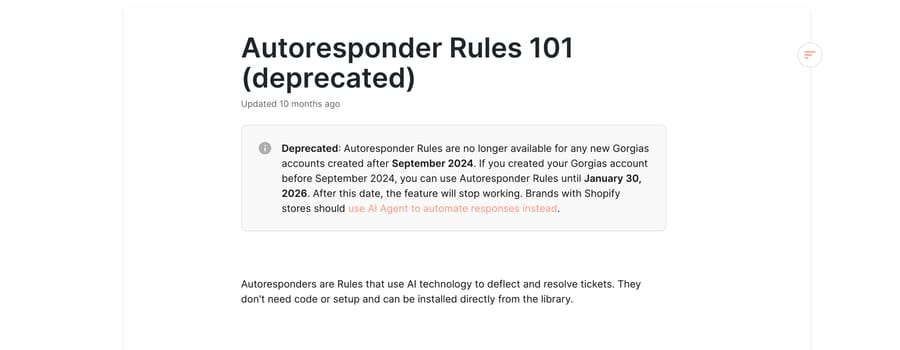
These weren't ordinary Rules. Gorgias describes autoresponders as "Rules that use AI technology to deflect and resolve tickets," installed in one click from a library. They needed an active AI Agent subscription, Lead, Admin or Owner permissions, and a Shopify, BigCommerce or Magento store. The "Send tracking information" autoresponder, the one most teams think of as the WISMO auto-reply, worked only on Shopify. The return-request email autoresponder, which sent your returns portal link when Gorgias detected a return/request intent, carries the same deprecation notice.
So there are three common situations behind "my order-status reply stopped":
- You were on an account from before September 2024 and used the library autoresponder. It stopped on January 30, 2026, and the old Rule no longer fires.
- Your AI Agent subscription changed or lapsed before that date. The autoresponder required it, so it would have stopped earlier.
- You built your own Rule, and something else broke it. That's a different problem: a conflicting auto-reply, a loop, or a condition that no longer matches. Our guide to fixing Gorgias auto-reply loops and auto-close misfires covers those.
To tell which one you're in, open Settings, then Rules, and look at the Rule that used to send the reply. If it came from the Autoresponders library, it's the deprecation. If it's a custom Rule you or a teammate wrote with a Reply to customer action, it's still supported and the cause is elsewhere.
Why did Gorgias move WISMO replies to AI Agent?
Order status is the largest single topic for most Shopify stores, and it's the easiest one to automate, because the answer sits in Shopify: shipped or not, and the tracking number if it has one. A free library rule that answered it was giving away the most valuable automation on the platform.
Gorgias bills AI Agent per outcome. Its billing documentation says an automation fee applies "when AI Agent resolves a ticket without handing over the conversation to a human agent," and that the ticket fee applies too, so one resolved ticket counts toward both. Moving WISMO from a rule to AI Agent turns the most common ticket into the most common billable automation. That's a coherent business decision, and the incentive is worth naming because it shapes the advice you get from Gorgias: the recommended path is the one that earns per interaction.
Merchants have noticed. A February 2026 thread on r/shopify about WISMO costs (thread) has the original poster surprised that Gorgias and Zendesk charge extra each month for automation on a question the store's own data already answers. A June 2026 post on r/CustomerSuccess (thread) from a seven-figure Shopify store says the opposite problem is the real one: basic automation handles "where is my order" fine, and things fall apart on partial refunds and shipping exceptions with a third-party warehouse.
How do you rebuild an order-status auto-reply with Gorgias Rules?
You can still send a WISMO reply with a regular Rule, no AI Agent needed. Gorgias's Auto-reply Rule best practices article shows the pattern under "Auto-replies with Shopify variables":
- WHEN ticket created
- IF message intents contains one of shipping/status
- AND message intents does not contain any of the other intents (refund, return, cancel, damaged order and so on), so a ticket that mixes WISMO with a complaint doesn't get a cheerful tracking link
- THEN, IF customer order count is greater than or equal to 1 AND last order tracking number is not empty
- THEN reply to customer, with the tracking link inserted from Shopify variables
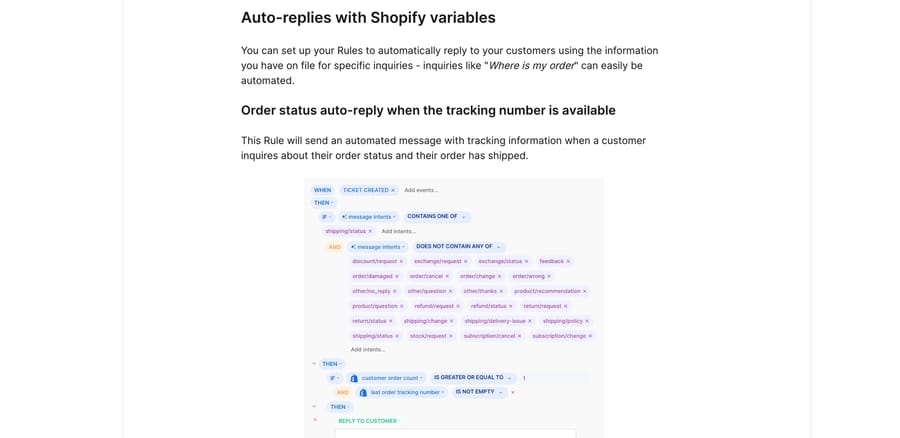
The same article has a second Rule for orders that haven't shipped yet but are still inside your processing window: it replies with the order status URL instead. Gorgias also ships a "Shopify Order Status" template in its Auto-Reply common Rule templates. The template sends a tracking link and closes the ticket for a purchase under 20 days old with tracking, sends a "still processing" reply and closes the ticket for one under 6 days old without tracking, sends nothing and tags the ticket urgent/not-shipped for an order older than five days with no tracking, and asks for more information when the customer has no orders.
The intent conditions are what make this work, and they're available broadly. Gorgias's Intents and sentiments explained article lists them for all Helpdesk plans and says Rules can use an intent "to tag, route, prioritize, or reply to tickets automatically." Our step-by-step guide to setting up Rules in Gorgias walks through the Rule builder itself.
Four limits to plan for:
- It's a template, not an answer. The Rule picks from the branches you built. "My tracking says delivered but it isn't here" matches shipping/status and gets the tracking link it already has.
- "Last order" is literal. A customer asking about an older order, or one with two open orders, gets the most recent one.
- Every reply is billable. Gorgias counts a ticket as billable once a message is sent from the helpdesk, "whether the message comes from a human agent, AI Agent, or an automatic reply from a Rule."
- Rules run before AI Agent. Gorgias's Use rules with AI Agent article warns that a Rule with a reply action and AI Agent can both answer the same ticket, so the customer gets two messages. If you run both, exclude one from the other.
For how the auto-reply, auto-close and AI Agent patterns fit together in general, see our explainer on Gorgias auto-responders.
Does Track Order replace the auto-reply?
Partly. Track Order is part of Order Management. Gorgias's Configure Track Order option article says it shows the shopper the journey of a shipped item, with time and date stamps for placed, confirmed and shipped, "pulled directly from Shopify." You turn it on under Workflows, then Tools, then Order management, and you can add a custom message, which Gorgias suggests using to state your shipping timeframes.
The difference is where it lives. Track Order is self-service in chat and the Help Center. It doesn't answer an email that already arrived. Gorgias's billing article also says an automation fee "may also apply when a customer inquiry is resolved by an automation feature like Flows, Order Management or Article Recommendations," so it isn't free either.
What does Gorgias AI Agent cost for order-status tickets?
Gorgias's pricing page (served in US dollars when we checked) now bundles AI Agent into every plan, with an allowance of automated interactions per tier:
| Plan | Monthly price | Tickets included | Automated interactions included | Listed rate per interaction |
|---|---|---|---|---|
| Starter | $40 | 50 | 30 | $1.00 |
| Basic | $90 | 300 | 30 | $0.90 |
| Pro | $550 | 2,000 | 190 | $0.90 |
| Advanced | $1,430 | 5,000 | 530 | $0.85 |
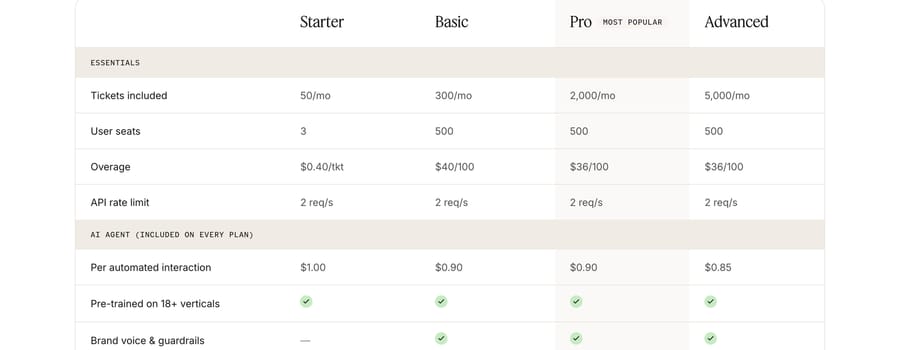
The listed rate is what the included allowance works out to: Pro's AI Agent line is $190 a month for 190 interactions, and the $0.90 matches the annual price. Interactions above the allowance cost more. The same page's structured data says "Overage above the plan's included allowance is billed at $1.50 per interaction," and that "each automated interaction also counts as one helpdesk ticket."
The arithmetic for a Pro store with 1,000 WISMO tickets a month that AI Agent resolves without handover: 190 interactions are included, and the other 810 bill at the $1.50 overage rate, 810 × $1.50 = $1,215 a month on top of the $550 plan. Those 1,000 tickets also use 1,000 of the plan's 2,000 helpdesk tickets. At that volume, moving up a tier is usually cheaper than paying overage, which Gorgias's pricing FAQ says it will recommend when it's more cost-effective. Accounts created before May 28, 2025 may still be on legacy pricing, which Gorgias's billing article says is billed differently. For the full plan breakdown, see our Gorgias pricing guide, and for how AI Agent's skills, handover and actions work, our Gorgias AI Agent explainer.
What you get for that fee: AI Agent reads the Shopify order, answers in your configured tone, and can take Shopify actions on supported plans (Gorgias's pricing table lists Actions as not included on Starter). It hands over when it isn't confident, and a handed-over ticket pays the ticket fee only.
How does Macha answer WISMO inside Gorgias?
Macha is an AI agent layer that runs inside the help desk you already use, and Gorgias is one of the desks it connects to. An order-status agent on Gorgias works like this:
- A new ticket starts the run. Macha's Gorgias connector has Ticket Created and New Message Added triggers, plus a Custom Webhook trigger you can attach to a Gorgias HTTP integration if you want Gorgias's own conditions to decide which tickets reach the agent.
- The agent reads the ticket with Get Ticket, then looks up the order in Shopify with Get Order or the customer's orders, so it answers about the order the customer asked about, not only the most recent one.
- It writes the answer from the order data and your policy: shipped with tracking, still processing, delayed past your window, or delivered but missing.
- It acts on the ticket: an internal note for review, or a public reply once you've approved that category, plus tags, status, priority or assignment.
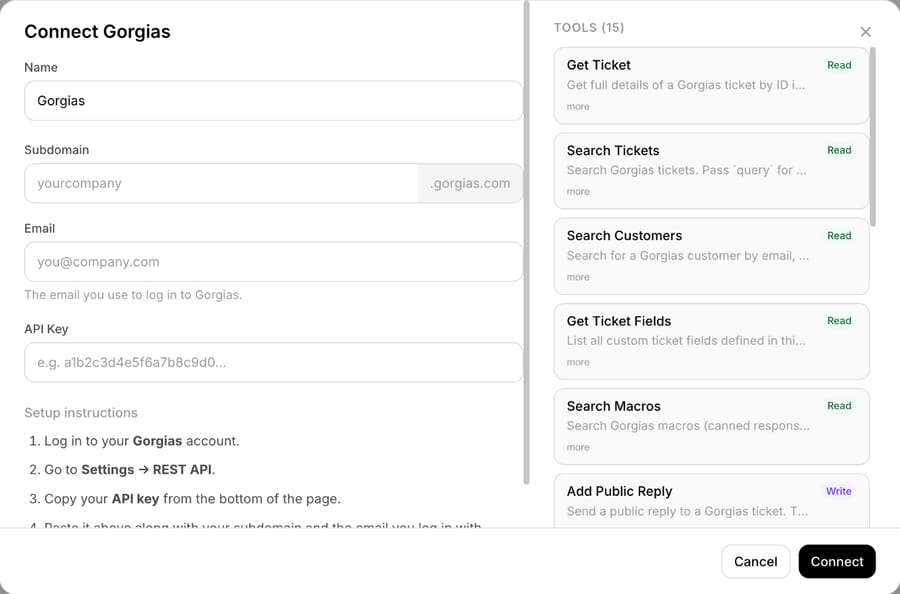
The Shopify side is Macha's Shopify connector. The tools below belong to a returns agent in the Macha demo workspace that runs on our Zendesk sandbox; the same Shopify tools attach to an agent on Gorgias.
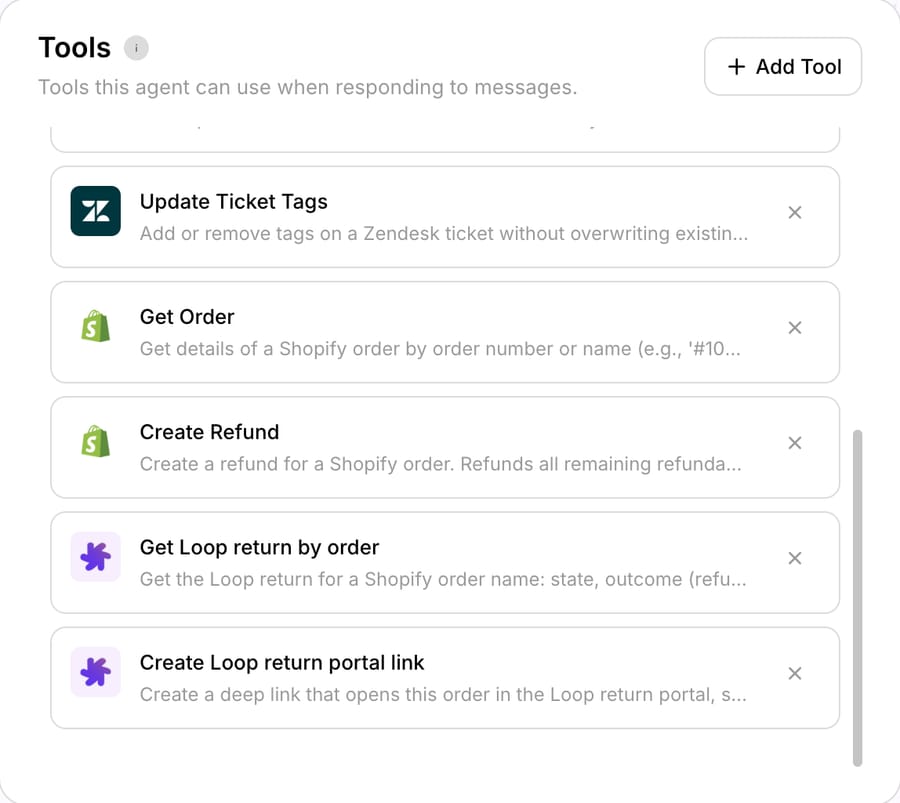
The part that matters for the Reddit poster above is the exception handling. "Delivered but not here," "the tracking hasn't moved in a week" and "can you send it to my new address" are written into the agent's instructions with what to do: answer with the carrier's status and your policy, hand over to a person with a note explaining why, or tag it for your warehouse team. Our WISMO automation guide for Gorgias compares the native and third-party options for that in more detail.
Safe mode first. Macha starts every category with drafts posted as internal notes. Gorgias's billing article says changes that don't include a reply to the customer, including "an internal note," don't make a ticket billable, so the review period adds no Gorgias ticket fees from Macha's side. A person reads the draft, sends it, and the ticket bills as a normal human reply. When the drafts are consistently right, order status moves to public replies, and expect each reply Macha sends to count as a billable Gorgias ticket, as a reply from your team would.
Who builds it. Macha's team does the setup: it analyzes about a month of your past tickets, builds the knowledge base, writes the agent's instructions from how your team already answers WISMO, and tests the agent on past tickets before it touches a live one. The promise is "live in safe mode within 7 days, or your first month is free." Macha charges about $0.40 per ticket, which includes the setup and a dedicated success manager who handles your changes after go-live; pricing lists the volume tiers, and the trial is $50 of free usage (about 125 tickets), no credit card, no time limit. The use case for auto-resolving Gorgias inquiries, the Gorgias integration page and Macha on Gorgias show the workflow, and done-for-you setup explains the rollout.
Which replacement should you choose?
| Your situation | Best fit | Why |
|---|---|---|
| Low volume, most WISMO tickets are "where is it" with tracking | Order-status Rule with Shopify variables | No extra fee beyond the ticket, and the template covers the common branches |
| Lots of chat traffic from shoppers who want to check themselves | Track Order | Self-service before a ticket exists, pulled live from Shopify |
| You want Gorgias's own AI and accept per-interaction billing | Gorgias AI Agent | Native, configured in Gorgias, handover built in |
| High volume, many exceptions, and nobody free to build and tune an AI agent | Macha | Built and run by Macha's team inside Gorgias, starts in safe mode, priced per ticket |
Macha fits teams already running Gorgias on a Shopify store that get enough exceptions ("delivered but missing", stalled tracking, address changes) that a Rule's branches don't cover them, and that would rather not spend their own time building and tuning an AI agent. It's the wrong fit if you only get a few dozen WISMO tickets a month: the free Rule is enough.
You can also combine them: a Rule for the plain "here's your tracking" case, and an agent for the tickets the Rule excludes. If you do, tag the tickets the Rule answers and exclude that tag from the agent's trigger, so the two never reply to the same ticket.
Common questions
When did Gorgias Autoresponder Rules stop working?
On January 30, 2026. Gorgias's Autoresponder Rules 101 (deprecated) article says accounts created before September 2024 could use them until that date, after which "the feature will stop working." Accounts created after September 2024 never had access to them.
Can I still send a where-is-my-order auto-reply in Gorgias without AI Agent?
Yes. Build a regular Rule: trigger on ticket created, check that message intents contain shipping/status, check that the last order tracking number isn't empty, and reply with Shopify variables. Gorgias's Auto-reply Rule best practices article and its Shopify Order Status template show the setup.
Does a Gorgias Rule auto-reply count as a billable ticket?
Yes. Gorgias's billing documentation counts a ticket as billable when at least one message is sent from the helpdesk, including "an automatic reply from a Rule." Auto-close without a reply, tags and internal notes don't make a ticket billable.
How much does Gorgias AI Agent charge per resolved order-status ticket?
Each plan includes an allowance (30 interactions on Starter and Basic, 190 on Pro, 530 on Advanced), listed at $0.85 to $1.00 per interaction. Above the allowance, Gorgias's pricing page says interactions bill at $1.50 each. Each automated interaction also counts as a helpdesk ticket.
Why is my new order-status Rule not replying?
Check three things: that the ticket's intent is shipping/status and not one of the excluded intents, that the customer has a Shopify order with a tracking number, and that no other Rule closed or answered the ticket first. Gorgias also says auto-reply Rules can't be applied to ChannelReply tickets or tickets with only an internal note.
Can an AI agent outside Gorgias answer WISMO tickets inside Gorgias?
Yes. Gorgias's API lets an outside agent read tickets and post replies or internal notes. Macha connects to Gorgias with an API key, reads the ticket and the Shopify order, and posts a draft note or a reply, with its team doing the setup.
How we researched this
Every statement about Gorgias features in this article comes from Gorgias's public help center and pricing page, read on November 21, 2026: Autoresponder Rules 101 (deprecated), Automate return request emails (deprecated), Auto-reply Rule best practices, Auto-Reply common Rule templates, Configure Track Order option, Intents and sentiments explained, Use rules with AI Agent, and How you're billed for using Gorgias. The pricing page served US dollar prices from our location; we didn't need a Wayback copy. The $1,215 figure is our arithmetic: (1,000 − 190) × $1.50, using the overage rate in the pricing page's structured data; the $0.90 listed rate covers only the included allowance. We didn't test Gorgias Rules or AI Agent in a Gorgias account for this article. Reddit threads are paraphrased and linked, without usernames. The Macha workflow is described from Macha's Gorgias connector (its tools and triggers) and from screens captured in Macha's demo workspace, where the agent shown runs on our Zendesk sandbox, not a customer's account.