Shopify
 Stripe
 Slack
Slack Notion
 Google Workspace
 Confluence

The Best AI Chatbot for Freshdesk (2026)


Every Freshdesk team eventually asks the same question: which AI chatbot should actually answer our customers? Freshworks has its own answer built in — Freddy — and a crowded field of third-party tools all claim to deflect more tickets for less money. The honest truth is that "best" depends on what you're optimizing for: raw deflection on your busiest FAQs, genuine end-to-end resolution that touches your other systems, or coverage across more than one help desk. This roundup walks through what native Freddy does well, where it stops, how its session pricing really works, and which alternatives are worth a look — then makes the case for a dedicated AI agent layer that resolves tickets rather than just deflecting them.

What "AI chatbot for Freshdesk" actually means in 2026
The phrase covers three different things that get lumped together, and picking the wrong one wastes money.
- Deflection means the bot answers a question from your knowledge base so the customer never files a ticket — great for "where's my invoice" and "how do I reset my password," useless for anything requiring an account lookup.
- Resolution means the bot fully closes the customer's request end to end, including reading their specific order or account and taking or drafting the correct action. This is the hard part, and it's where most "chatbots" quietly hand off to a human.
- Automation means the bot orchestrates a workflow across tools — checking a subscription, applying a policy, updating a record — rather than just replying with text.
A good buyer's evaluation scores each candidate on all three, not just the deflection number on the marketing page. Keep that framing as you read the rest of this.
Native Freddy AI: genuinely useful, and worth crediting
Freshdesk's own AI, Freddy, is not a checkbox feature — it's a real product with three distinct pillars, and for a lot of teams it's the right starting point. We break the whole thing down in Freshdesk Freddy AI explained, but the short version:
- Freddy AI Agent is the customer-facing bot. It handles chat and email inquiries autonomously by drawing on your connected knowledge sources, and it deflects routine questions without a human touching them.
- Freddy Copilot is the agent-assist layer that lives inside the ticket: it drafts replies, summarizes long threads, adjusts tone, and translates — with a human always approving before anything sends.
- Freddy Insights is the analytics layer for managers, surfacing proactive alerts and root-cause patterns.
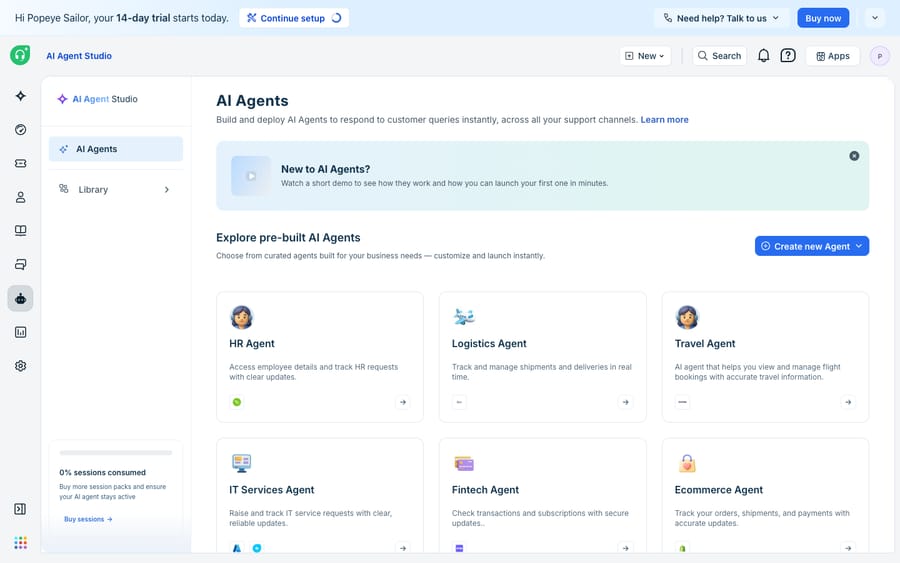
The advantages of going native are real. Freddy is already inside Freshdesk, so there's nothing to connect. It shares your knowledge base and ticket data by default, the billing is on one invoice, and Freshworks maintains it. If your support is mostly FAQ deflection on one help desk and you want the lowest-friction on-ramp, Freddy is a completely reasonable first move. Freshworks even ships a set of pre-built agents you can start from rather than building a bot from a blank canvas.
The honest limits — and how the pricing really works
Crediting Freddy where it's good means being just as clear about where it stops.
It's priced per session, not per outcome. Per eesel's 2026 Freddy pricing breakdown, the Freddy AI Agent is billed by session: roughly $49 per 100 sessions ($0.49 each) on classic Freshdesk email, and around $100 per 1,000 sessions ($0.10 each) for web chat on Freshdesk Omni. A session is every interaction between one end-user and the bot inside a rolling window — 72 hours from a customer's first email, or 24 hours for a chat. Pro and Enterprise plans include 500 free sessions, but as a one-time, non-recurring allocation — not 500 a month. The classic Growth plan gets none. The catch that trips up buyers: you pay for the session whether or not the bot actually resolves anything. If your resolution rate is around 25%, you're consuming roughly four sessions per genuinely resolved ticket, so the effective cost per resolution is several times the headline number.
Copilot is a separate per-seat cost. Freddy Copilot is a per-agent add-on available only on Pro and Enterprise, at roughly $29/agent/month billed annually (~$35 monthly) — so agent-assist and the customer-facing bot are two different line items.
The integrations are often read-only. As buyer guides like myAskAI's and gominimal's roundups point out, most of Freddy's e-commerce and third-party integrations are read-only — the bot can see order data but can't process the refund, cancel the order, or update the subscription. That's the wall between deflection and true resolution: it can explain your return policy, but it can't run the return.
So native Freddy is strong on deflection, decent on agent assist, and weak on automation and end-to-end resolution that reaches into other systems. That gap is exactly what the alternatives compete on.
The alternatives worth evaluating
There are two honest camps here. Some tools ask you to replace Freshdesk; others layer on top of it. For most established teams, ripping out the help desk is the far more expensive and disruptive path, so weigh that first.
| Tool | Model | Pricing shape | Where it fits |
|---|---|---|---|
| Native Freddy AI Agent | Built into Freshdesk | Per session (~$0.49 email / ~$0.10 chat) | Lowest friction; FAQ deflection on one help desk |
| eesel AI | Layer on top of your help desk | Per-resolution, no per-seat | Teams keeping Freshdesk, want outcome-based billing |
| Tidio (Lyro) | Chat widget + AI | Per-conversation tiers | SMB live chat; Lyro runs on Claude, claims high resolution |
| My AskAI | Layer / bolt-on | Per-resolution | Lightweight deflection, internal-note replies |
| BunnyDesk | Bolt-on | Flat monthly fee | Predictable spend regardless of volume |
| Zoho Desk (Zia) | Full help-desk switch | Per-agent, AI bundled | Only if you're leaving Freshdesk entirely |
| Macha | AI agent layer on top of Freshdesk | Per AI action (credits) | Real resolution + multi-help-desk, keep Freshdesk |
The tools that make you switch help desks (Zoho, and the various Freshdesk alternatives roundups) can look cheap on a spreadsheet, but the migration cost — re-training agents, moving history, rebuilding automations — is rarely worth it just to change your bot. The more interesting question is: which layer actually resolves tickets rather than deflecting them?
Where a dedicated AI agent layer leads
This is the case for Macha, and it's worth being precise about what it is and isn't. Macha is an AI agent layer that runs on top of the Freshdesk you already use — it connects as a native connector using your subdomain and API key, reads and writes the same tickets, and does not replace your help desk. (Macha's connector is for Freshdesk specifically — not Freshchat, Freshservice, or Freshcaller.) If you want the deeper walkthrough, see Macha for Freshdesk and how to automate Freshdesk with AI.
Two things separate a resolution-first layer from a deflection bot.
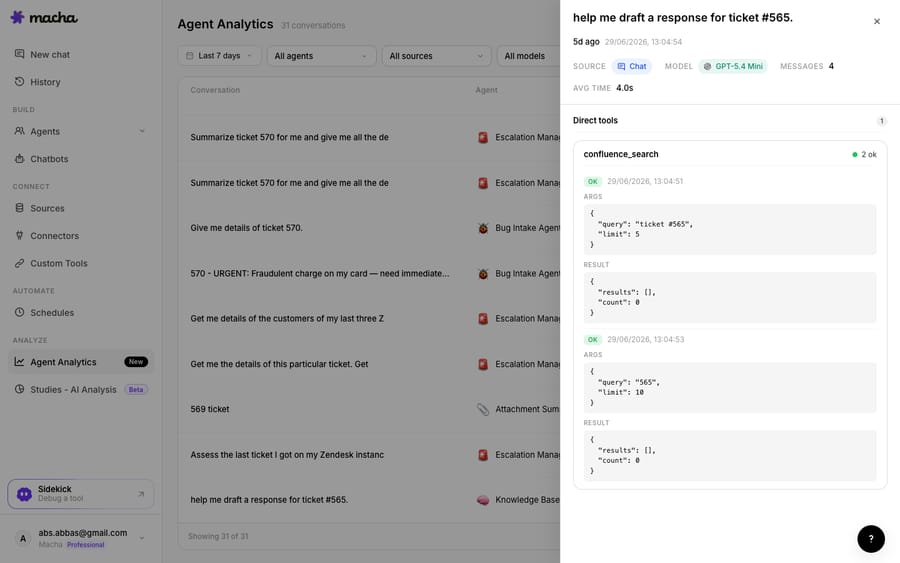
First, it actually resolves — with grounding you can inspect. The screenshot below is a real request from the Macha demo org: the Knowledge Base Agent working ticket #565, grounding its answer by calling confluence_search against connected knowledge, with the live tool arguments and results visible. That's the difference between a bot that guesses from a static FAQ and an agent that reasons over your real knowledge, calls a tool, and closes the loop. Where Freddy's third-party integrations are frequently read-only, an agent layer built around custom tools can turn a REST API into an action the agent can take — look up an order, apply a policy, post the update.
Second, it isn't locked to one help desk. Because the agent layer sits above the help desk rather than inside it, the same agents and knowledge can run across Freshdesk and other help desks like Zendesk — so a multi-brand or multi-tool org isn't rebuilding its AI per platform. That's the multi-help-desk edge a native, single-vendor bot structurally can't match.
On pricing, the philosophy is different too. Macha's credits are consumed per AI action, not per resolution or per deflection — because automation and orchestration produce varied outcomes, and charging per "resolution" quietly penalizes the hard, multi-step tickets that need the most help. There are no hard-coded prices to memorize here; see the pricing page for the current breakdown. If you're weighing a home-grown bot against a platform, our build-versus-buy guide and the broader primer on AI agents for customer service are the honest starting points — and if you specifically want to go beyond Freddy without leaving Freshdesk, that's the exact seam Macha fills.
How to actually choose
Score your shortlist against your real support mix, not the demo:
- Deflection depth — can it answer your top 20 questions from your knowledge base, not a canned one?
- True resolution — can it read a specific order or account and take (or draft) the correct action, or does it hand off?
- Automation reach — can it call your systems through tools, or are its integrations read-only?
- Pricing sanity — is the meter aligned with value (per action / per resolution), and do you understand what a busy month actually costs?
- Help-desk coverage — one platform today, but what about next year's acquisition or second brand?
- Switching cost — does the "cheap" option secretly require ripping out Freshdesk?
Freddy scores well on 1 and reasonably on 4 if your volume is low; a resolution-first layer like Macha is built to win on 2, 3, and 5 while leaving your Freshdesk exactly where it is.
FAQ
What is the best AI chatbot for Freshdesk in 2026? It depends on your goal. For low-friction FAQ deflection on a single help desk, native Freddy AI Agent is a reasonable default. For genuine end-to-end resolution that reads your systems and works across more than one help desk, a dedicated AI agent layer like Macha — which runs on top of Freshdesk rather than replacing it — has the edge.
How much does Freshdesk's Freddy AI Agent cost? Freddy AI Agent is billed per session: roughly $49 per 100 sessions ($0.49 each) for classic Freshdesk email, and about $100 per 1,000 sessions ($0.10 each) for web chat on Freshdesk Omni. Pro and Enterprise include a one-time 500 free sessions. Freddy Copilot is a separate per-agent add-on (~$29/agent/month annually) on Pro and Enterprise. Always confirm against your own plan.
Does an AI chatbot replace Freshdesk? Not the good ones. The most sensible option for an established team is an AI agent layer that connects to Freshdesk and works the same tickets, leaving your help desk as the system of record. Tools that require switching help desks add migration cost that rarely pays off just to change your bot.
What's the difference between deflection and resolution? Deflection means answering a question so no ticket is filed. Resolution means fully closing the customer's request — including reading their specific account and taking the right action. Many chatbots deflect FAQs well but hand off the moment real resolution is needed, which is where an agent that can call tools pulls ahead.
Can I add an AI agent to Freshdesk without leaving Freshdesk? Yes. Macha connects to Freshdesk as a native connector using your subdomain and API key, runs AI agents on top of your existing tickets, and consumes credits per AI action rather than per resolution — so you keep Freshdesk and add a resolution-first agent layer over it.
Ready to see an agent resolve a real ticket instead of just deflecting one? Start a free trial of Macha and connect it to your Freshdesk in minutes.
Add AI agents to your Freshdesk
Macha reads the ticket, drafts the reply and takes the action, inside the Freshdesk you already run.