Shopify
 Stripe
 Slack
Slack Notion
 Google Workspace
 Confluence

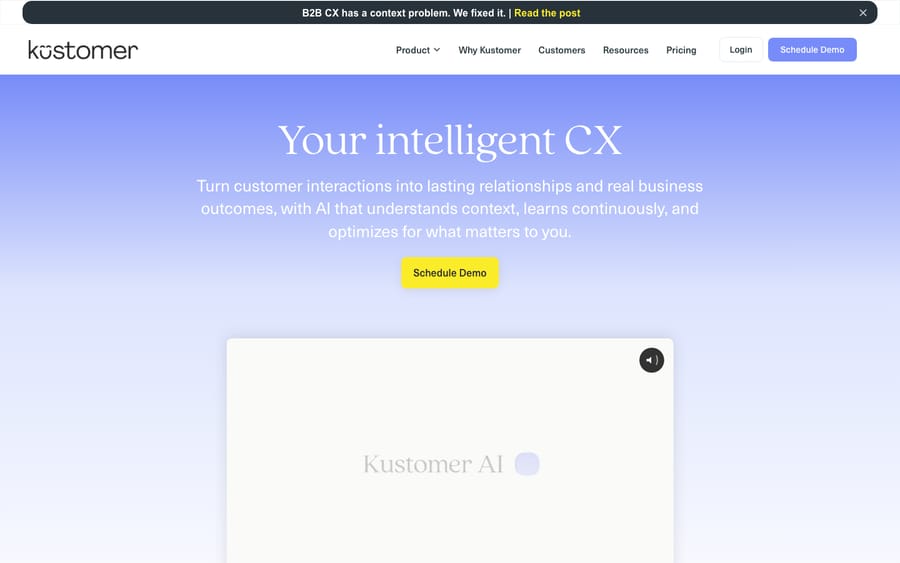
What Are the Best Kustomer Alternatives in 2026? 9 Options With Prices


Kustomer no longer publishes prices, and trackers still report $89 to $139 a seat with an 8-seat minimum, so most teams shopping around are reacting to cost, contract terms or fit. These nine alternatives, from Zendesk and Gorgias to Re:amaze and Zoho Desk, fix different versions of that problem.
Key takeaways
- The best Kustomer alternatives in 2026 are Zendesk, Gorgias, Gladly, Intercom, Freshdesk, Front, Help Scout, Re:amaze and Zoho Desk, each fixing a different reason for leaving.
- Kustomer's pricing page no longer lists prices, while third-party trackers still report $89 and $139 seats billed annually with a minimum of 8 seats.
- Gorgias bills the help desk by monthly ticket volume from $10 a month, and its AI Agent costs $0.90 per automated interaction on most plans.
- Re:amaze offers a flat Starter plan at $59 a month capped at 500 responded conversations, or per-user plans from $29 to $69.
- Zoho Desk is the cheapest full alternative at roughly $7 an agent a month billed annually, with a free plan for 3 users.

The best Kustomer alternatives in 2026 are Zendesk (from $19 an agent a month), Gorgias (from $10 a month, billed by ticket volume), Gladly, Intercom ($29 a seat billed annually on Essential), Freshdesk, Front, Help Scout, Re:amaze and Zoho Desk (from about $7 an agent). Which one fits depends on why you're leaving: Kustomer no longer publishes prices at all, and older trackers put its seats at $89 to $139 a user with an 8-seat minimum. Prices below were checked on each vendor's page on 24 September 2026; ratings are mid-2026 readings. (New to the platform itself? Start with what is Kustomer.)
Which Kustomer alternatives are worth shortlisting?
| Tool | Rating | Starting price | Best for | vs Kustomer |
|---|---|---|---|---|
| Zendesk | G2 4.3/5 (~6,700) | $19–$115/agent/mo | Scaling teams wanting depth + ecosystem | More extensible, bigger marketplace; AI also costs extra |
| Gorgias | G2 4.6/5 (~555) | from $10/mo (ticket-based, help desk only) | Shopify / DTC ecommerce | Ecommerce-native, ticket-priced; not for non-retail |
| Gladly | G2 4.7/5 (~1,091) | quote (trackers: ~$180+/agent/mo) | Premium, people-first B2C brands | Same customer-centric model, higher-touch; pricier |
| Intercom (Fin) | G2 4.5/5 (~2,900) | $29 to $132/seat + Fin at $0.99/outcome | SaaS / digital-first, chat-led | Stronger AI agent + messenger; usage-priced AI |
| Freshdesk | G2 4.4/5 (~3,700) | $19–$119/agent/mo (no free plan) | Budget omnichannel ticketing | Cheaper, simpler; no 8-seat floor |
| Front | G2 4.7/5 (~2,000) | $25–$105/seat/mo | Collaborative, email-heavy ops | Shared-inbox feel; less classic CRM timeline |
| Help Scout | G2 4.4/5 (~435) | Free for 5 users; $25/user/mo | Small/mid teams wanting simplicity | Far simpler and cheaper; less configurable |
| Re:amaze | G2 4.7/5 · Capterra 4.8/5 | $29/user/mo or $59 flat | SMB ecommerce on a budget | Ecommerce-native at a fraction of the price |
| Zoho Desk | G2 4.4/5 (~6,500) | Free for 3 agents; ~$7–$40/agent/mo | Budget teams (esp. Zoho stack) | Much cheaper; deep but busier UI |
Update (September 2026): Salesforce completed its acquisition of Fin, the company formerly called Intercom, on 10 September 2026 in a deal worth about $3.6 billion. Fin is still sold at $0.99 per outcome, and Salesforce cites a 76% average resolution rate. Worth weighing in any long-term Intercom/Fin decision.
Prices checked on vendor pages on 24 September 2026; G2 and Capterra ratings are approximate mid-2026 readings. Verify before buying.
Why do teams look for a Kustomer alternative?
Kustomer isn't broken. It threads email, chat, SMS and social into one timeline around the customer, which is why fast-growing consumer brands adopted it (Meta bought it in 2022 and spun it out as an independent company in 2023). But a few recurring, fair reasons push teams to look elsewhere, and it's worth naming yours before you switch, because some are solvable without leaving.
- Opaque pricing, a seat floor and annual billing. Kustomer's pricing page now says it doesn't "post one-size-fits-all pricing" and sends you to a two-minute assessment and a demo; only Kustomer Voice (talk, SMS, transcription) and WhatsApp are listed as pay as you go. Third-party trackers such as Gorgias's Kustomer pricing breakdown still report an Enterprise plan at $89/user/month and Ultimate at $139/user/month, billed annually with a minimum of 8 seats. If that floor holds for your quote, small and mid-sized teams pay for capacity they don't need yet.
- AI is a separate, stacking cost. The same trackers report that base seats don't include AI: AI for Reps (agent assist) at about $40/user/month and AI for Customers (the self-service agent) at roughly $0.60 per engaged conversation. Kustomer doesn't confirm these figures publicly, so ask for them in writing. As with most of this category, the sticker seat price is rarely the real bill.
- Cost vs. alternatives. The single most consistent theme in Kustomer reviews is value: capable platform, premium price. One verified Capterra reviewer put it bluntly: "It's on the expensive side. They only take on companies that can purchase 8+ seats, so it's not suitable for smaller businesses."
- Fit. Kustomer is excellent for high-volume, omnichannel B2C — but if your support is overwhelmingly Shopify order questions, or you're a lean team that wants ticket-volume pricing, or you simply want a cheaper omnichannel desk, a more specialized tool may fit better.
None of this makes Kustomer a bad choice. It makes it a specific one — strong for established, high-volume consumer brands that want a customer-centric timeline, weaker if your bottleneck is price, team size, or an ecommerce-native workflow. Keep your real reason in mind as you read; it determines which alternative below actually fixes your problem.
How did we compare the alternatives?
We focused on established, currently-selling platforms a Kustomer team could realistically migrate to, weighted toward the high-volume B2C and ecommerce use cases Kustomer is known for. For each we pulled live pricing from the vendor's own pages (or cited third-party trackers where pricing is quote-only), the current G2 or Capterra star rating and approximate review count as a real-user signal, and we read through G2, Capterra and community sentiment for recurring praise and complaints. G2's review pages are bot- and login-walled (they return a 403 to automated fetches), so verbatim quotes are sourced from Capterra or from G2 review summaries that serve publicly. Prices were re-checked on each vendor's page on 24 September 2026; ratings and review counts are mid-2026 readings. Confirm on each vendor's page before you sign.
What does each Kustomer alternative cost, and who is it for?
1. Zendesk — the enterprise-grade workhorse
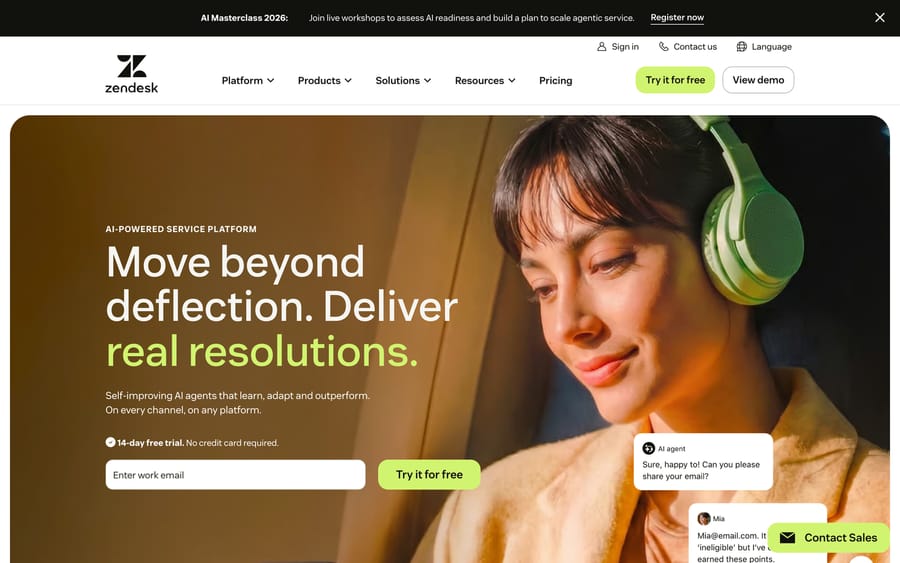
What it is: The category's most extensible support platform — omnichannel ticketing, a mature app marketplace, robust reporting, and native AI agents (built partly on the acquired Ultimate and Forethought technology; Zendesk completed the Forethought acquisition on 26 March 2026). Who it wins for: Scaling teams — including high-volume B2C — that want maximum configurability, reporting horsepower and a vast ecosystem, and have the budget for it. Pricing model: Per agent. Support Team starts at $19; the omnichannel Suite shows $55 (Team) and $115 (Professional) per agent/month billed annually, with Enterprise quote-only (the pricing page no longer shows a Suite Growth card). Copilot is $50/agent/month on Suite Professional and above. AI agents are included and billed per automated resolution; Zendesk's pricing page lists $1.50 committed or $2.00 pay-as-you-go. Rating: G2 4.3/5 across ~6,700 reviews — one of the largest review bases in the category. Reviewers note satisfaction tracks with usage: teams that lean on the omnichannel workspace, routing and reporting find the cost reasonable; email-only teams often don't. How it differs from Kustomer: More extensible and with a far bigger marketplace, but ticket-centric by default rather than customer-timeline-first. No 8-seat minimum, and monthly billing is available. Pricier than the budget picks, and its AI carries its own usage cost much like Kustomer's does.
2. Gorgias — the ecommerce specialist
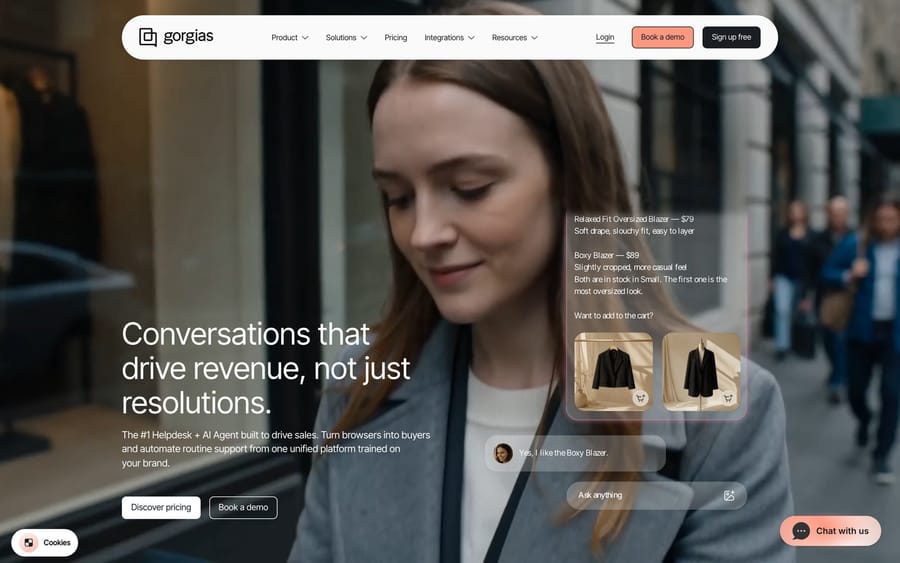
What it is: The dominant Shopify-era helpdesk, purpose-built for ecommerce. It pulls order, refund and subscription data into the conversation, and its AI Agent resolves WISMO, returns and product questions natively. Who it wins for: Shopify, BigCommerce and DTC brands whose support is mostly order-related — a very common reason teams leave a general-purpose CRM like Kustomer. Pricing model: Billed on monthly ticket volume, not seats — help desk only, Starter from $10/month (50 tickets), then Basic $60, Pro $360, Advanced $900 billed monthly for rising ticket allowances. The AI Agent costs $0.90 per automated interaction on most plans and $1 on Starter, with $1.50 over the allowance, and each AI interaction also counts as a help desk ticket (gorgias.com/pricing). Rating: G2 4.6/5 across ~555 reviews. Because it bills by ticket rather than seat, reviewers like that the whole team can use it — one Capterra reviewer noted the model "allowed nearly everyone in our company to use it." The flip side: AI-agent fees can make bills unpredictable at high volume. How it differs from Kustomer: Far better for retail conversations out of the box, and the ticket-based pricing rewards lean teams with high volume. It's a poor fit if you're not in ecommerce — a specialist, not a general-purpose Kustomer replacement.
3. Gladly — the people-first B2C platform
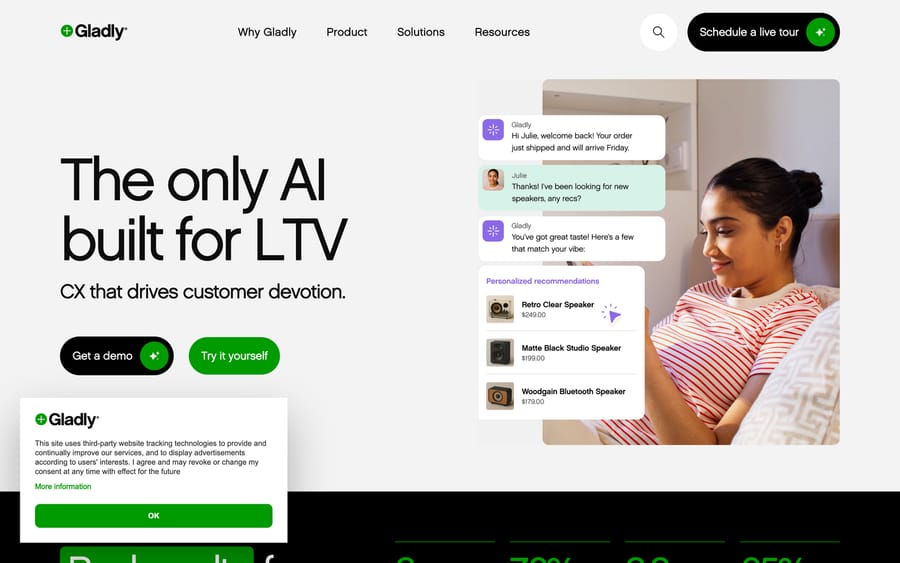
What it is: The closest philosophical cousin to Kustomer — a CX platform built around a single lifelong customer conversation across voice, email, chat, SMS and social, with the Sidekick AI agent layered in. Like Kustomer, it puts the customer, not the ticket, at the center. Who it wins for: Premium, high-touch consumer brands (retail, travel, hospitality) that treat support as a relationship and want voice and messaging unified in one timeline. Pricing model: Quote-only; Gladly doesn't publish tiers. Third-party trackers (Hiver, eesel) estimate Hero at about $180 and Superhero at about $210 per agent/month billed annually, with seat minimums and a per-conversation Sidekick charge, so model your real cost with their sales team. Rating: G2 4.7/5 across ~1,091 reviews (Capterra 4.8/5, ~138) — among the highest-rated tools here. Reviewers praise the unified customer view and Sidekick's human-like responses; common gripes are report customization, occasional voice/call-transfer glitches, and cost. How it differs from Kustomer: Very similar customer-centric model, often even more voice- and relationship-led — but it's a lateral move on price (premium either way), so it makes most sense when you specifically prefer Gladly's people-first philosophy over Kustomer's CRM depth.
4. Intercom (with Fin AI) — the AI-first, chat-led platform
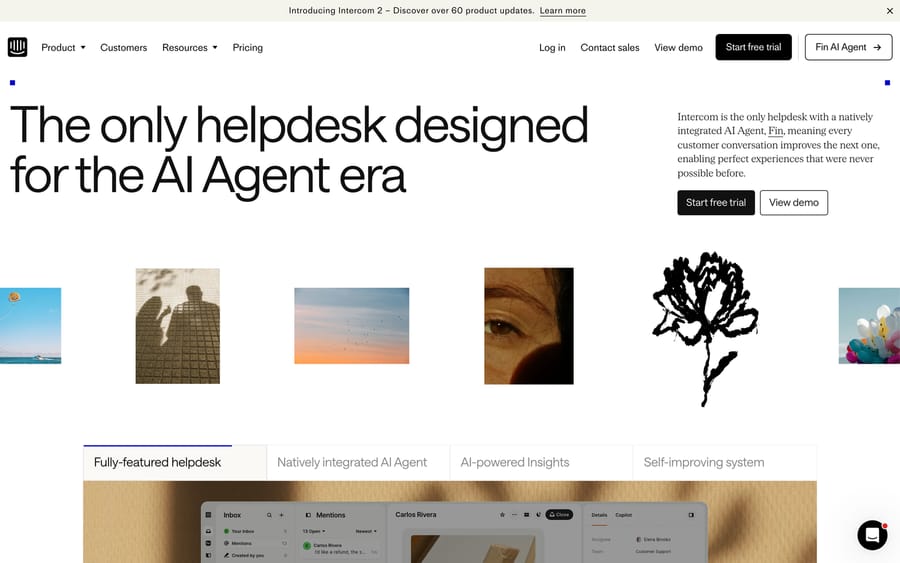
What it is: A messenger-first support and engagement platform whose Fin AI agent is one of the most-cited per-resolution products on the market. Strong at proactive in-app messaging, chat and product-led support. Who it wins for: SaaS and digital-first companies whose support skews to in-app chat and email rather than phone, and who want best-in-class AI deflection. Pricing model: Seats run $29 (Essential), $85 (Advanced), $132 (Expert) a seat billed annually (Intercom has also shown $19 for Essential in a pricing test), and Fin costs $0.99 per outcome on top, so your real bill scales with volume. The 50-outcome monthly minimum applies only when Fin runs on a help desk other than Intercom. Rating: G2 4.5/5 across ~2,900 reviews. Reviewers from software and SaaS report the strongest satisfaction, frequently citing 50–80% deflection; the most common complaint is that the $0.99-per-outcome model gets "unpredictable and expensive at scale." How it differs from Kustomer: A stronger messenger and a more capable AI agent, but a more digital/chat-led posture than Kustomer's voice-and-omnichannel B2C focus. The modular, usage-based pricing is hard to predict, the same watch-out as Kustomer's per-conversation AI.
5. Freshdesk — the budget omnichannel option
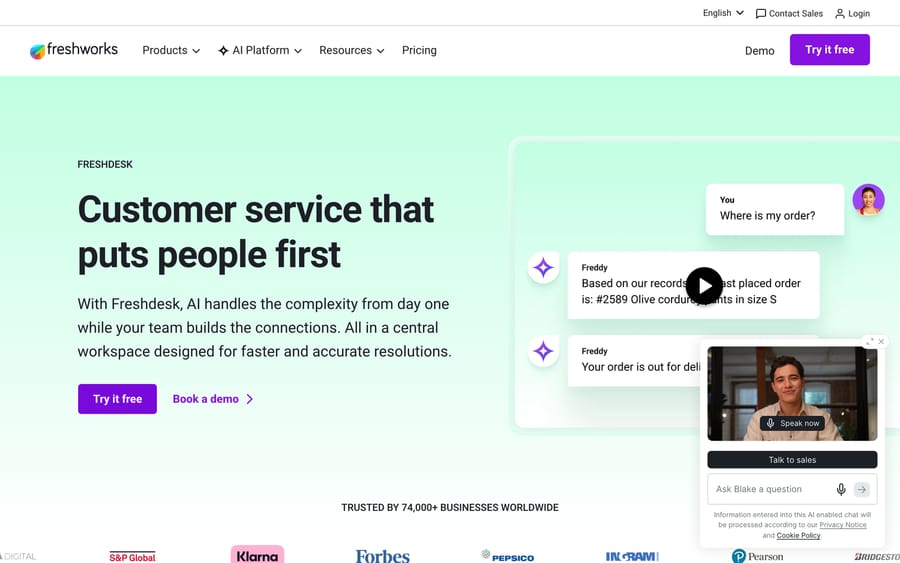
What it is: Freshworks' affordable, quick-to-deploy helpdesk with omnichannel ticketing, automation and the Freddy AI add-on. Millions of tickets a year flow through it. Who it wins for: Cost-conscious teams that want solid omnichannel ticketing without a premium per-seat price or an 8-seat floor. Pricing model: Per agent. Email-and-ticketing plans run $19 (Growth) / $55 (Pro) / $89 (Enterprise); the omnichannel Omni tiers are $29 / $79 / $119, all annual. Freddy AI is a separate add-on: the 500 Freddy AI Agent sessions are a one-time allowance per account, then $49 per 100 sessions. There's no free plan on the pricing page; a Free program covers up to 2 agents for 6 months. Rating: G2 4.4/5 across ~3,700 reviews. Reviewers praise the clean interface, automation and value at the entry tier; the recurring complaint is that deeper reporting and customization sit in higher tiers. How it differs from Kustomer: Cheaper, simpler, with no minimum-seat lock-in and monthly billing — but more ticket-centric and less of a unified customer CRM. A pragmatic downshift if Kustomer's price is the real issue. For a wider field, see our best help desk software roundup.
6. Front — the collaborative shared inbox
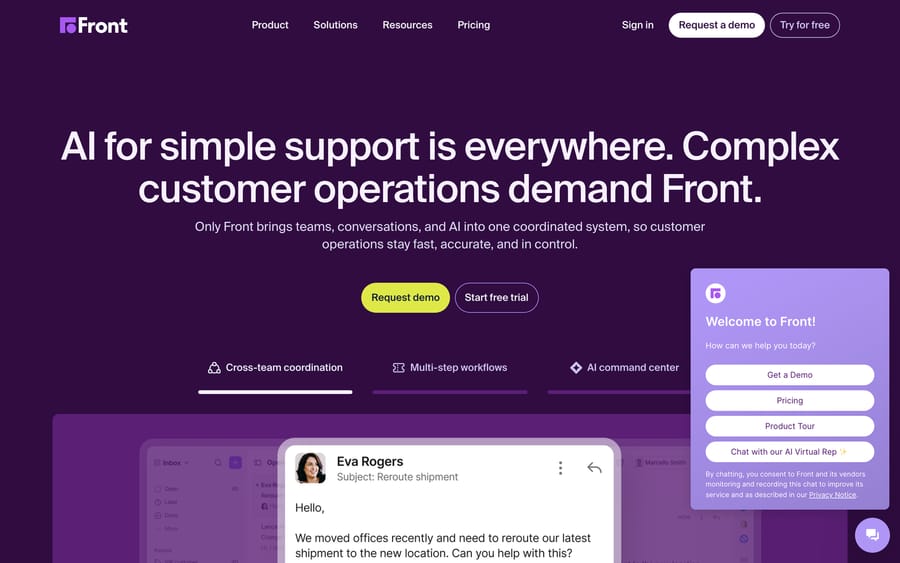
What it is: A shared-inbox platform that blends email, chat, SMS and social into one collaborative workspace with internal comments, assignments and shared drafts, plus AI features layered on top. Who it wins for: Operations-heavy and high-touch teams (logistics, finance, B2B services) where support is a team sport and conversations need real collaboration. Pricing model: Per seat: Starter $25, Professional $65, Enterprise $105 per seat/month billed annually, with Copilot and Smart QA as $20/seat add-ons on Starter and Professional, and Autopilot on tiered outcome pricing that starts at $0.05 per conversation (front.com/pricing). Rating: G2 4.7/5 across ~2,000+ reviews — among the highest here. Reviewers love the shared-inbox collaboration; the most common gripe is cost and add-on stacking for smaller teams. How it differs from Kustomer: Feels like a souped-up shared inbox rather than a customer-CRM timeline, which collaborative teams love and process-heavy B2C shops may miss. Excellent for email-dominant, collaborative operations.
7. Help Scout — the simpler, human-first inbox
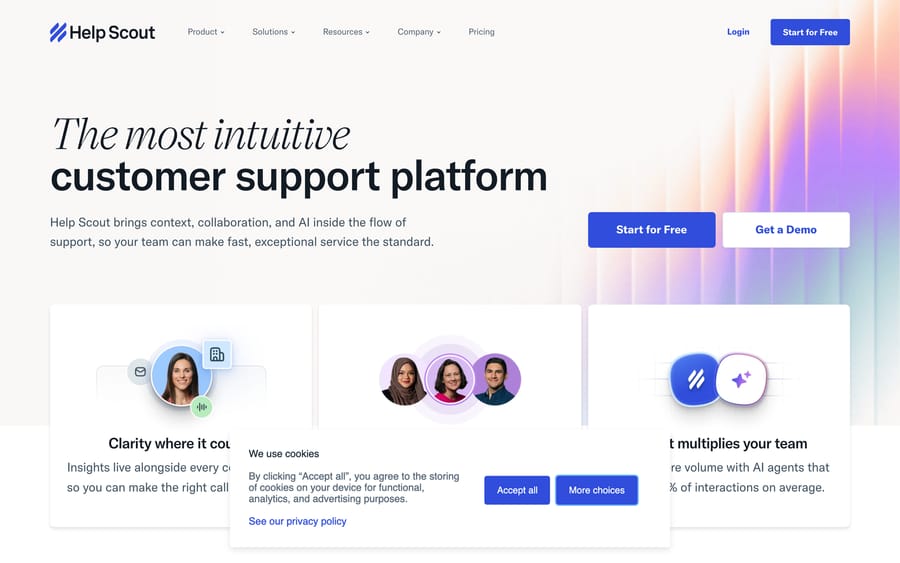
What it is: A clean, conversation-style helpdesk built around a shared inbox, knowledge base (Docs) and live chat (Beacon), with AI features layered in. It deliberately hides the "ticket" machinery to feel more like email. Who it wins for: Small to mid-sized teams — especially SaaS and services — that find Kustomer's CRM heavy and want fast onboarding with a warm customer experience. Pricing model: Per user — Standard $25, Plus $45, Pro $75 per user/month — with AI Answers at $0.75/resolution and a Free plan for up to 5 users (helpscout.com/pricing). Rating: G2 4.4/5 across ~435 reviews — consistently praised for ease of use; reviewers note advanced reporting and complex-workflow customization are where it's thinner than the heavyweights. How it differs from Kustomer: Far simpler and cheaper, with no 8-seat floor — but less configurable and not a customer-360 CRM. The right move when your real frustration is complexity and cost, not capability.
8. Re:amaze — the SMB ecommerce value pick
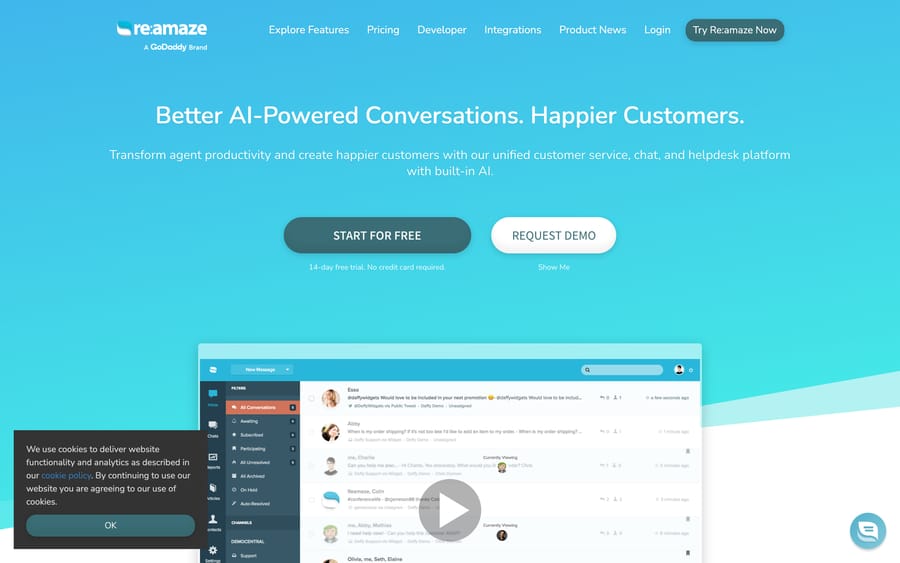
What it is: A helpdesk and customer-messaging platform built for stores and apps, unifying live chat, email, social, SMS and FAQ knowledge bases, with native Shopify, BigCommerce and WooCommerce integrations that surface order data in the conversation. Who it wins for: SMB ecommerce teams that want Gorgias-style order context without Gorgias-style bills. Pricing model: Per user — Basic $29, Pro $49, Plus $69 per user/month — or a flat Starter at $59/month regardless of seats (capped at 500 responded conversations/month), with a 14-day trial (reamaze.com/pricing). Rating: G2 4.7/5 and Capterra 4.8/5 (~53 reviews). Reviewers praise ease of use and responsive support across channels; the most common ask is a better search function. How it differs from Kustomer: Ecommerce-native at a fraction of the price and with no seat minimum — but a smaller ecosystem and less enterprise depth than Kustomer. A strong value swap for smaller retail teams.
9. Zoho Desk — the budget powerhouse
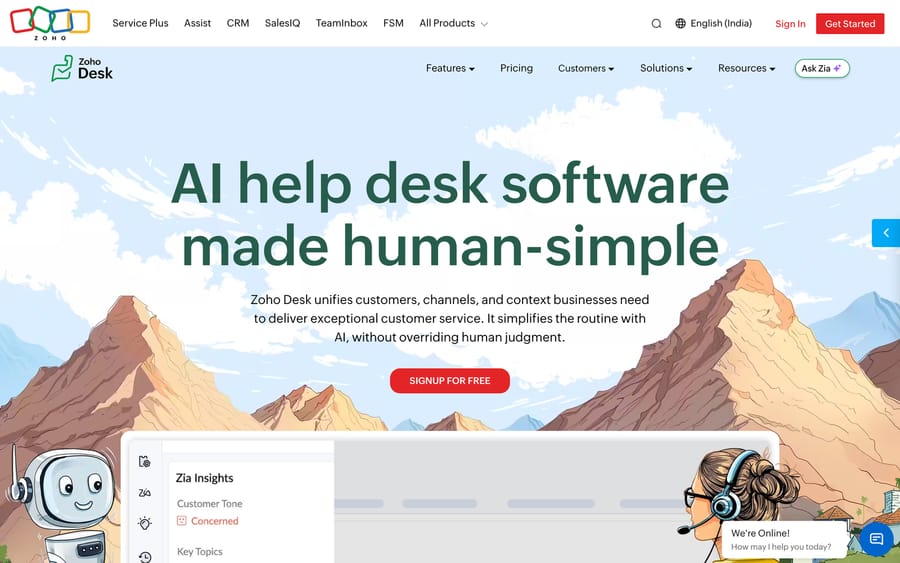
What it is: A feature-rich, omnichannel helpdesk that punches well above its price, with strong automation, the Zia AI assistant and tight integration into the broader Zoho suite. Who it wins for: Cost-conscious teams that want a lot of capability per dollar, and especially anyone already running Zoho CRM or Zoho One. Pricing model: Per agent: roughly Express $7, Standard $14, Professional $23, Enterprise $40 per agent/month billed annually (monthly billing costs more), with a free plan for 3 users. Zoho's pricing page serves prices by region, so confirm the USD figures on zoho.com/desk/pricing. Rating: G2 4.4/5 across ~6,500 reviews — another of the largest review bases here. Reviewers praise ease of use and automation; the recurring note is that the UI can feel cluttered for newcomers. How it differs from Kustomer: Dramatically cheaper with a free entry point and no seat minimum, and arguably deep in raw features — but the UI is busier and the ecosystem pull is strongest if you're already in Zoho.
What if you only want better AI, not a new help desk?
One disclosure, because we make it: Macha is not a Kustomer alternative. It's an AI agent layer that runs on top of a helpdesk, and it connects to Zendesk, Freshdesk, Gorgias, Front, HubSpot or Intercom, not Kustomer. So if you stay on Kustomer, Macha isn't relevant to you, and we won't pretend otherwise.
It's worth mentioning for one reason: a chunk of teams shopping for a "Kustomer alternative" are really shopping for better, cheaper AI deflection, not a different inbox. If that's you and you'd consider one of the desks Macha supports from the list above, the AI layer is a different path — you keep the helpdesk and add agents that read the customer's question, pull from your connected order/CRM data and help center, and resolve routine tickets inside the existing workflow. Macha has one plan priced by ticket volume, starting at $299 a month for up to 750 tickets, billed per ticket rather than per message, with setup and monitoring by the Macha team included. If your real problem is Kustomer's platform (fit, price, team size), then one of the nine alternatives above is the right move, full stop. You can see how the layer works on Zendesk, or start with $50 of free usage, no credit card required.
What do real users say about these tools?
Ratings tell you the average; the reviews tell you the why. A few representative, sourced signals:
"It's on the expensive side. They only take on companies that can purchase 8+ seats, so it's not suitable for smaller businesses." — Verified reviewer on Kustomer, Capterra
Ticket-based pricing "allowed nearly everyone in our company to use it." — Verified reviewer on Gorgias, Capterra
Across 900+ G2 reviews, 100% of users rate Gladly 4 or 5 stars and 94% would recommend it — with praise for the unified customer view and Sidekick AI, and gripes around report customization and call quality. — Aggregate Gladly sentiment, G2
Reviewers cite 50–80% deflection with Fin, but warn the per-resolution model "becomes unpredictable and expensive at scale." — Aggregate Intercom/Fin sentiment, G2
Users praise the clean interface and automation but note "deeper reporting, customization, or advanced workflows may require a higher tier." — Aggregate Freshdesk sentiment, G2
Reviewers consistently praise ease of use and responsive support across channels, while asking for a better search function. — Aggregate Re:amaze sentiment, G2/Capterra
Read together, the themes are consistent with why teams shop around: premium pricing and seat minimums on Kustomer and Gladly, unpredictable usage-based AI on Intercom and Gorgias, and feature-gating on the cheaper desks. There's no free lunch — just the trade-off that fits your queue.
How do you choose the right Kustomer alternative?
- Name your real reason for leaving. Price and seat minimum? Look at Zoho Desk, Re:amaze, Freshdesk or Help Scout. Want the same customer-centric model? Gladly. Ecommerce-native? Gorgias or Re:amaze. Maximum depth and ecosystem? Zendesk. Chat- and AI-led? Intercom.
- Match the tool to your channel mix and segment. Heavy voice + omnichannel B2C? Gladly or Zendesk. Shopify order questions? Gorgias or Re:amaze. Collaborative, email-heavy ops? Front. Simple and warm? Help Scout.
- Model the total cost, including AI. Kustomer taught everyone this: the seat price is rarely the real bill. Add the AI cost — per seat (Kustomer AI for Reps, Zendesk Copilot), per resolution (Intercom Fin, Gorgias, Help Scout), or per conversation (Kustomer AI for Customers) — and any channel fees, then compare like-for-like at your volume.
- Watch the contract terms. Kustomer's reported 8-seat minimum and annual billing are real constraints, so ask for them in your quote; several alternatives here offer monthly billing, free tiers, or flat-rate plans that suit smaller or seasonal teams.
- Pilot on a real slice of your queue. Whatever you shortlist, run it on live tickets and measure resolution rate, CSAT and time-to-first-response against your Kustomer baseline before you commit.
Frequently asked questions
What is the best Kustomer alternative in 2026? There's no single winner — it depends on why you're leaving. Zendesk is the strongest upgrade for depth and ecosystem; Gorgias owns Shopify ecommerce; Gladly is the closest people-first match to Kustomer's model; Intercom leads on chat and AI; Freshdesk, Zoho Desk and Re:amaze are the value picks; Front wins for collaborative email ops; and Help Scout is the simplicity choice.
Why do teams leave Kustomer? The most common reasons are the reported 8-seat minimum and annual billing, the premium seat price (trackers report $89–$139/user/month), and AI that's billed on top (reported at about $40/user/month for AI for Reps and $0.60 per engaged conversation for AI for Customers). Smaller teams and ecommerce-only shops often find a more specialized or affordable tool fits better.
What is the cheapest Kustomer alternative? Zoho Desk (from roughly $7/agent/month, with a free plan for 3 users) is the most budget-friendly full helpdesk, followed by Freshdesk (from $19) and Re:amaze (from $29/user or a $59 flat plan). Help Scout is free for 5 users and $25/user after that. Remember to add AI costs when comparing — the base price is rarely the final number.
What's the best Kustomer alternative for ecommerce? Gorgias is the leading Shopify-native helpdesk and the most common destination for ecommerce teams leaving a general CRM, with order data and an AI Agent built in. Re:amaze offers similar order context for SMB stores at a much lower, flatter price.
Does Kustomer publish its prices? No. Kustomer's pricing page says it doesn't post one-size-fits-all pricing and routes you to a two-minute assessment and a demo. Only Kustomer Voice and WhatsApp are described as pay as you go. The $89 and $139 seat figures you'll see online come from third-party trackers, not from Kustomer.
Is Kustomer better than Zendesk? They're built differently. Kustomer is a customer-timeline CRM tuned for high-volume B2C; Zendesk is a more extensible, ticket-centric platform with a far bigger marketplace, published prices and no seat minimum. Kustomer can feel more unified for relationship-led support; Zendesk wins on configurability, reporting and ecosystem. It comes down to model fit and contract flexibility.
Which Kustomer alternative should you pick?
The best Kustomer alternative is the one that fixes your specific reason for looking. Zendesk is the extensible heavyweight; Gorgias the ecommerce specialist; Gladly the people-first twin; Intercom the AI- and chat-led platform; Freshdesk, Zoho Desk and Re:amaze the value picks; Front the collaborative inbox; and Help Scout the simplicity choice. Pin down your segment and channel mix, model the total cost including AI, check the contract terms, and pilot on real tickets before you migrate. And if your real frustration turns out to be AI deflection rather than the platform, and you'd move to one of the desks Macha runs on, remember an AI layer on top of your helpdesk is a different way to solve that one.
Prices re-checked on vendor pages on 24 September 2026; ratings are mid-2026 readings. Customer-service and AI pricing in this category changes fast, so confirm current terms on each vendor's site before buying.