



 Shopify
 Stripe
 Slack
 Notion
 Google Workspace
 Confluence


Best Moveworks Alternatives in 2026: 10 Options for Employee and Customer Support


Moveworks now belongs to ServiceNow and costs a median $130,000 a year, so many teams are pricing alternatives. The right shortlist depends on whether you are automating internal employee IT and HR requests or external customer support.
Key takeaways
- The best Moveworks alternatives for internal employee support are Aisera, Espressive, Leena AI and ServiceNow Virtual Agent, with Coworker as a newer context-layer option, while Ada, Forethought and Macha serve customer support.
- ServiceNow completed its $2.85 billion acquisition of Moveworks on 15 December 2025, and Vendr puts the median Moveworks contract at $130,000 a year.
- Ownership has shifted across the category: Resolve bought Espressive, Automation Anywhere is acquiring Aisera, and Zendesk completed its Forethought acquisition in March 2026.
- Aisera's AI Service Desk is listed on Azure Marketplace at $200,000 a year for up to 1,000 users and $1,200,000 for up to 10,000 users.
- Vendr puts Ada's median contract at $72,000 a year and Forethought's at $74,483, while Macha starts at $299 a month for up to 750 tickets.

The best Moveworks alternatives in 2026 are Aisera, Espressive, Leena AI and ServiceNow's own Virtual Agent for internal employee support, and Ada, Forethought or Macha if what you actually need is external customer support. Moveworks has been part of ServiceNow since the $2.85 billion deal closed on 15 December 2025, and Vendr puts the median Moveworks contract at $130,000 a year across 31 purchases. Several alternatives have changed hands too: Automation Anywhere is buying Aisera, Resolve bought Espressive, and Zendesk now owns Forethought. Coworker, a newer context layer that runs agents across 50+ work tools, rounds out the employee-support group.
How do the Moveworks alternatives compare?
| Tool | Primary use case | Pricing reality | Delivery |
|---|---|---|---|
| Aisera | Broad enterprise service automation (IT/HR/CX) | Quote-only; $200,000/yr for up to 1,000 users on Azure Marketplace | Slack/Teams/portal |
| Espressive (Resolve) | IT/HR employee self-service | Quote-only, headcount-based | Slack/Teams/portal |
| Leena AI | Autonomous HR/IT/finance agent | Quote-only, headcount-based | Slack/Teams |
| ServiceNow Virtual Agent / Now Assist | ServiceNow-first shops | Bundled into Now Platform licensing | ITSM portal |
| Kore.ai | Build-your-own conversational AI | Quote-only; pricing page offline | Multi-channel |
| Guru | Knowledge layer feeding an assistant | Custom pricing; no per-seat price published | Slack/Teams/browser |
| Coworker | Context layer plus agents across work tools, all teams | Quote-only; single Enterprise plan, no list price | Coworker apps, Slack, or inside Claude/ChatGPT/Cursor via MCP |
| Ada | Customer support automation | Quote-only; Vendr median $72,000/yr | On Zendesk/Salesforce |
| Forethought (Zendesk) | Customer support automation | Quote-only; Vendr median $74,483/yr | On your help desk |
| Macha | Customer support automation | From $299/mo for 750 tickets | On top of your help desk |
The dividing line: the first seven are employee/internal-IT tools. The last three (Ada, Forethought, Macha) are customer-support tools. Read the "How to choose" section before you shortlist; getting this split right eliminates half the list immediately.
Why are teams looking for Moveworks alternatives in 2026?
First, ServiceNow completed its $2.85 billion acquisition of Moveworks on 15 December 2025 (see the ServiceNow announcement). If you're not a ServiceNow shop, that raises real questions: will Moveworks keep investing in deep integrations with the ITSM platform you actually run, or will the roadmap increasingly favor the Now Platform? Buyers who chose Moveworks partly because it was help-desk-agnostic are the ones most unsettled by the deal.
Second, the pricing. Moveworks is priced on total company headcount, not active users, because the platform is meant to serve everyone. Vendr's deal data puts the median annual contract at $130,000 across 31 purchases, with a range of $89,500 to $271,333. Vendr also reports per-employee pricing of roughly $15 to $45 a year, annual contracts of $200,000 to $600,000 for 1,000 to 5,000 employees, and implementation of $50,000 to $200,000 on top, a range the teardowns from Unthread and Workativ also cite. Headcount pricing gives the vendor an incentive to count every employee, since it gets paid for the ones who never open the tool, and it prices out almost anyone who isn't a large enterprise.
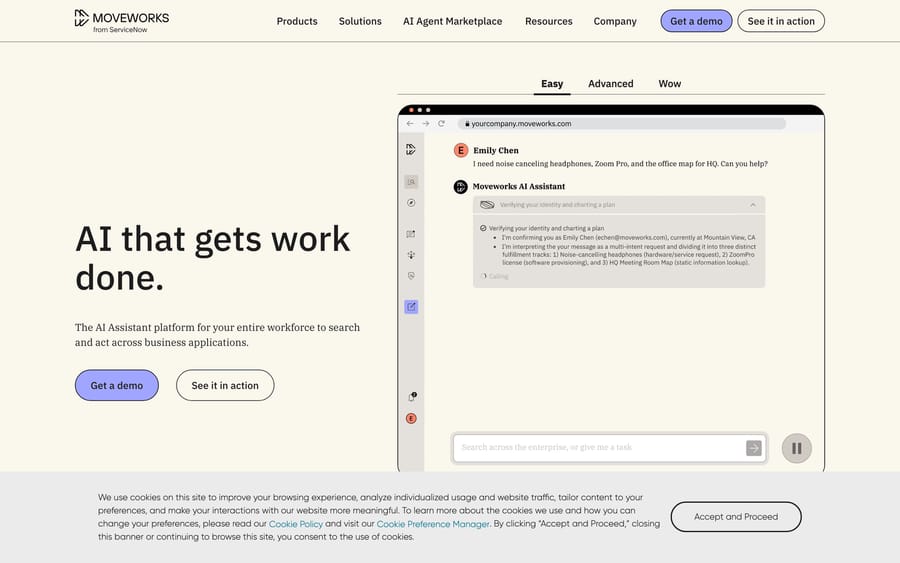
Third, scope. Moveworks is an enterprise AI assistant for internal employee support (IT, HR, finance and facilities) delivered mostly in Slack and Microsoft Teams. A meaningful slice of people searching "Moveworks alternatives" don't want an employee assistant at all; they want to automate customer support and landed here because Moveworks is the loudest name in enterprise AI. Those are two different problems, and the right shortlist depends on which one you have.
Most of the tools below are internal-support platforms of broadly similar shape; Coworker is the exception, since it is a context layer with agents on top and has no service-desk module. Three of them (Ada, Forethought and Macha) solve the customer support problem instead, and belong on your list only if that's what you need. We say which is which throughout.
Which alternatives replace Moveworks for internal employee support?
These are the like-for-like replacements if your problem is the one Moveworks was built for: deflecting employee IT, HR and finance tickets inside Slack or Teams.
1. Aisera
Aisera is the alternative most often named alongside Moveworks, and the closest in ambition. It's an enterprise AI platform for automating service across IT, HR, customer support and other domains, built around prebuilt workflows it calls "Hyperflows" plus domain-specific templates for faster deployment. Reviewers praise its automation depth and its integrations with ServiceNow and Microsoft Teams. One ownership note: Automation Anywhere announced it was acquiring Aisera on 4 November 2025, with no price disclosed, so Aisera is heading into a larger automation company much as Moveworks went into ServiceNow.
Strengths: broadest multi-domain coverage of any tool here; strong prebuilt-workflow library; agentic actions, not just answers.
Best for: large enterprises that liked Moveworks specifically for its breadth and want one platform spanning IT, HR and finance.
Pricing reality: quote-only. The one public data point is the Azure Marketplace listing, where Aisera's AI Service Desk is listed at $200,000 a year for up to 1,000 users and $1,200,000 a year for up to 10,000 users on a one-year term (eesel teardown). That works out to $120 to $200 per employee per year: the same enterprise weight class as Moveworks.
Limitations: heavyweight implementation; opaque pricing; an ownership change in progress; likely overkill (and over budget) below true enterprise scale.
2. Espressive
Espressive is the closest head-to-head with Moveworks in pure internal employee support. Its differentiator is the Employee Language Cloud, NLP tuned on how employees actually phrase internal requests rather than a generic model, which it argues yields higher first-contact accuracy for the messy way people ask IT and HR questions. Its Barista virtual agent lives in Slack, Teams and a web portal. Resolve acquired Espressive on 10 September 2025 to fold its conversational AI into Resolve's "Zero Ticket IT" automation platform; no price was disclosed, and the announcement doesn't say how Barista will be sold going forward.
Strengths: purpose-built for employee-request understanding; strong out-of-the-box IT/HR intent coverage; lighter-touch than the broadest platforms.
Best for: enterprises focused squarely on IT/HR self-service that value employee-language accuracy over multi-domain breadth, and are comfortable buying from Resolve.
Pricing reality: quote-only and headcount-based, in the same enterprise range as Moveworks. No public list price.
Limitations: narrower than Aisera; still an enterprise sale with implementation services attached; product packaging may change under Resolve.
3. Leena AI
Leena AI offers an autonomous agent for automating complex HR, IT and finance tasks, with a headline self-service claim and integrations into enterprise systems like Workday and ServiceNow. Reviewers call out an intuitive builder.
Strengths: deep HR system integrations (Workday, SAP SuccessFactors); agentic workflows; good fit where HR volume rivals IT.
Best for: organizations where HR-heavy internal support sits alongside IT, not just an IT service desk.
Pricing reality: custom, headcount-based, quote-driven, with no standard tables. PricingNow's teardown flags that headcount pricing plus modules makes total cost hard to forecast for mid-market teams. Verify any self-service percentage against your own ticket mix before you sign.
Limitations: enterprise-oriented; forecasting spend is difficult; validate the automation claims on your categories.
4. ServiceNow Virtual Agent / Now Assist
Worth naming explicitly, because it's the elephant in the room: Moveworks is now part of ServiceNow. If you already own ServiceNow, the native Virtual Agent plus Now Assist agentic AI may cover much of what you'd have bought Moveworks for, without a second vendor relationship, a second data pipeline or a second integration project.
Strengths: zero net-new integration if ServiceNow is your system of record; conversational deflection wired directly into your ITSM workflows, catalog and knowledge base; consolidates vendors.
Best for: ServiceNow-committed enterprises whose employee tickets already flow through the Now Platform.
Pricing reality: bundled into ServiceNow licensing (Now Assist is a paid add-on on top of platform subscriptions), so cost depends on your existing ServiceNow contract rather than a standalone per-employee figure.
Limitations: deepens single-vendor lock-in, the very thing that makes non-ServiceNow shops nervous about the acquisition; weaker fit if your service desk lives on Jira Service Management, Freshservice or similar.
5. Kore.ai
Kore.ai is a different animal: a low-code/no-code conversational AI platform for building your own bots rather than a packaged employee assistant. It's known for advanced NLP, multi-channel deployment and heavy customization, carries a G2 rating around 4.6, and launched its Artemis edition of the Kore.ai Agent Platform in May 2026. Kore.ai itself publishes a Moveworks-alternatives guide, so it competes here directly.
Strengths: maximum flexibility; deploy across web, voice, Slack, Teams, WhatsApp and more; strong for teams that want to own the design of the experience.
Best for: teams with builder capacity that want to construct custom conversational experiences across many channels, not buy a turnkey assistant.
Pricing reality: quote-driven for enterprise. Kore.ai's pricing page returned a 404 when we checked in September 2026; third-party breakdowns describe starter credits and usage-based platform plans, but enterprise deals are bespoke.
Limitations: it's a platform, not a solution. You (or an SI) do the building, the intent design and the maintenance. Faster time-to-value tools exist if you don't want that lift.
6. Guru (the knowledge layer, not a full assistant)
A candid inclusion. Guru is not a like-for-like Moveworks swap. It's an AI-powered knowledge management and enterprise-search layer that surfaces verified answers in Slack, Teams and the browser. We include it because a common reason Moveworks projects underperform is bad or fragmented knowledge, and some teams discover their real need is a governed knowledge base feeding a lighter assistant, not a six-figure agentic platform.
Strengths: knowledge verification workflows so answers stay current; strong Slack/Teams surfacing; a narrower, and usually smaller, purchase than an agentic platform.
Best for: teams whose employee-support pain is mostly "people can't find the answer" rather than "we need automated multi-step resolution."
Pricing reality: Guru used to publish per-user prices; it no longer does. Its pricing page now says pricing is "tailored to your organization's scale, knowledge complexity, and AI maturity" and routes you to sales, with discounted pricing for eligible nonprofits.
Limitations: it answers and surfaces knowledge; it doesn't autonomously execute multi-system IT workflows (password resets, provisioning) the way Moveworks or Aisera aim to. Pair it with a workflow tool if you need actions.
7. Coworker (a context layer with agents on top)
Coworker is the newest tool on this list and the least like Moveworks in shape. It's a context layer for employee-facing agents. You connect it to your work tools (it lists 50+ connectors, all read and write, including Slack, Jira, Salesforce, HubSpot, Google Drive, Notion, GitHub and Zendesk), it builds what it calls OM2, a knowledge graph of your company that inherits the access controls already set on each tool, and agents then act on that graph: a scheduled agent that posts pipeline-hygiene summaries to Slack, a ticket update in Jira, a lookup in Salesforce. You can run those agents inside Coworker's own apps or inside Claude, ChatGPT, Perplexity and Cursor through its MCP server. Coworker's own comparison page puts the difference bluntly: Moveworks is built for IT and HR, Coworker covers every team. It is an employee-support tool in the broad sense, since anyone in the company can ask it to get work done across systems. Password resets and provisioning flows, the packaged service-desk work Moveworks sells, are agents you would have to build yourself.
Strengths: a permission-aware company graph that reads each tool with the asking user's own access rights; agents reach you where you already work, including inside Claude and ChatGPT via MCP; model routing across 13 models from Anthropic, OpenAI, Google, Moonshot and Z.ai, with closed models passed through at the provider's rate; SOC 2 Type II, GDPR and CASA Tier 2.
Best for: mid-sized companies (its featured case study is Huuuge Games, at about 300 employees) whose "employee support" problem is really "people need things done across Slack, Jira, the CRM and Drive," and whose teams already live in Claude or ChatGPT.
Pricing reality: quote-only. The pricing page (read 21 October 2026) lists a single Enterprise plan and says the price depends on which connectors you need, how many people use it, and the deployment and support you choose. A price that moves with connector count gives the vendor an incentive to land as many of your tools as it can, which suits you if you want breadth and costs you if you only need Slack and Jira. G2's pricing page lists $29.99 and $149.99 tiers that Coworker's own site omits, so take the vendor page as current. No free plan; the free offer is a "Context Impact Report" benchmark on your own systems, which needs an NDA.
Limitations: the review base is tiny. Coworker's homepage carries a G2 badge of 4.9 from 11 reviews, and the only "Cowork AI" listing on Capterra is a different product, which is why it sits last among the employee-support tools here. Its own writing admits a shorter enterprise track record than Moveworks and no HIPAA or ISO 27001 certification yet. The company is young. It raised a $13 million seed round in May 2025, and OM2 itself launched in September 2026. Its cost claims (9x cheaper context, 51x with model routing) come from its own benchmarks against Claude's native tooling, and no independent test has checked them.
Which alternatives handle customer support instead?
If your real problem is external customer support (deflecting and resolving customer tickets, not employee IT requests), none of the tools above is the right shape, and neither was Moveworks. These three are built for customer-facing automation.
8. Ada
Ada is a well-known customer-support automation platform focused on automated resolutions across chat, email and messaging channels, typically layered onto Zendesk or Salesforce.
Strengths: mature no-code bot builder; multilingual; established brand with large B2C deployments.
Best for: consumer brands with high chat volume already on Zendesk or Salesforce.
Pricing reality: quote-only. Vendr procurement data shows a median of $72,000 a year from 119 purchases by 35 buyers, with the middle 80% of contracts between $36,211 and $286,200 (read 13 October 2026). Ada generally assumes you're on a supported help desk.
Limitations: enterprise-priced with no public entry tier; historically strongest on chat deflection rather than deep, action-taking workflows across your whole stack.
9. Forethought
Forethought is another customer-support AI platform (SupportGPT and related products) that deflects and triages tickets. Note the timeline: Zendesk acquired Forethought in March 2026, announced March 11 and completed March 26, so, much like Moveworks into ServiceNow, expect the roadmap to increasingly favor Zendesk. See our Forethought complete guide for the full teardown.
Strengths: strong triage and routing; knowledge integrations (Confluence, Notion, Guru) for context-aware answers; proven on high-volume Zendesk instances.
Best for: Zendesk-centric support teams comfortable with a Zendesk-owned vendor.
Pricing reality: quote-only. Vendr puts the median annual contract at $74,483 across 69 purchases, with a range of $35,670 to $151,400, priced mainly on monthly ticket or conversation volume. Vendr adds $10,000 to $50,000 or more for implementation.
Limitations: post-acquisition roadmap uncertainty; the best-fit assumption is that you're (or you're becoming) a Zendesk shop.
10. Macha: a customer-support agent layer on top of your help desk
Here's the fork in the road. If your "Moveworks alternative" search is really about customer support, Macha is worth a look, with one caveat stated first: Macha is customer-support-focused. It is not a Moveworks replacement for internal IT/HR employee deflection. For pure internal employee help, the better-fit picks are Aisera, Espressive, ServiceNow Virtual Agent or Leena AI above.
For customer support, Macha takes a different shape than most tools on this list. It's an AI agent layer that runs on top of the help desk you already use (Zendesk, Freshdesk, Gorgias, Front, HubSpot or Intercom) rather than a separate portal or a rip-and-replace. You build agents in plain English, they take real actions through custom tools (look up an order, issue a refund, update a subscription), and you pay per ticket rather than per-employee headcount. Setup and monitoring by the Macha team are included.
Strengths: no six-figure headcount commitment for seats that may never get used; automation happens inside the help desk your team already runs, so there's nothing new for agents to learn; per-ticket pricing scales with actual volume, which suits smaller and mid-market teams better than headcount licensing.
Best for: support teams on Zendesk, Freshdesk, Gorgias, Front, HubSpot or Intercom that want to automate customer tickets without swapping out their stack.
Pricing reality: per ticket (one charge per thread however many messages it takes), from $299 a month for up to 750 tickets, about $0.40 a ticket, rising to $3,999 for up to 10,000. See the pricing page for current details.
Limitations: it's for customer support, full stop. If you need to automate employee IT provisioning or HR case management, this isn't your tool.
Explore Macha's AI agents for customer service if that's the problem you actually have.
How do you choose between employee IT and customer support tools?
The single most important filter is the one Moveworks buyers most often skip. Answer this before you shortlist anything:
Is your problem internal employee support, or external customer support?
Once you know, the list narrows fast:
- Internal employee support, ServiceNow-committed: start with ServiceNow Virtual Agent / Now Assist. You likely already own the platform, and it avoids a second vendor.
- Internal employee support, broad multi-domain (IT + HR + finance), not tied to ServiceNow: Aisera for breadth, Espressive for employee-language accuracy.
- Internal support that's HR-heavy: Leena AI (Workday/SuccessFactors depth) or Espressive.
- You want to build your own bots across many channels: Kore.ai, provided you have builder capacity.
- Your real pain is "people can't find answers," not multi-step automation: a governed knowledge layer like Guru may solve it with a smaller purchase.
- Employees need work done across Slack, Jira, the CRM and Drive, and your team already lives in Claude or ChatGPT: Coworker, with the caveat that its review base is 11 G2 reviews and its pricing is quote-only.
- External customer support, already on a modern help desk: Macha (per ticket, on top of your help desk), or Ada / Forethought if you prefer an established enterprise vendor and can absorb quote-only, higher-commitment pricing.
Two more practical filters once you've split employee vs customer:
- Pricing model fit. Headcount-based licensing (Moveworks, Aisera, Espressive, Leena AI) charges you for employees who never use the tool. Per-ticket pricing (Macha) tracks actual work done. Pick the model that matches how value shows up in your org.
- Acquisition risk. Moveworks (ServiceNow), Forethought (Zendesk), Espressive (Resolve) and Aisera (Automation Anywhere) have all been bought or are being bought. That can mean deeper native integration if you're on the buyer's platform, or roadmap drift if you're not. Weigh it against your own stack.
Frequently asked questions
Why are people looking for Moveworks alternatives in 2026?
Three reasons. ServiceNow completed its $2.85B acquisition of Moveworks on 15 December 2025, raising lock-in and roadmap questions for non-ServiceNow shops. Moveworks' pricing is opaque and headcount-based, with a $130,000 median annual contract per Vendr plus $50,000 to $200,000 in implementation, which prices out non-enterprise buyers. And many searchers actually want customer support automation, which Moveworks was never built for.
What is the best Moveworks alternative?
It depends on your problem. For internal employee support, Aisera, Espressive, Leena AI and (for ServiceNow shops) ServiceNow Virtual Agent are the leaders; Coworker is the newer pick if what you need is agents doing work across Slack, Jira and the CRM for every team. For customer support, Ada, Forethought or a per-ticket agent layer like Macha that runs on top of your existing help desk fit better.
Is there a cheaper alternative to Moveworks?
Most direct internal-support alternatives (Aisera, Espressive, Leena AI) are also quote-based and enterprise-priced. For a lighter internal option, a knowledge layer like Guru can help if your pain is findability rather than automation, though Guru now quotes custom prices too. For customer support, per-ticket pricing like Macha's (from $299 a month for 750 tickets) avoids paying per-employee headcount, which usually costs less for smaller teams.
Does ServiceNow now offer what Moveworks did?
Increasingly, yes. ServiceNow owns Moveworks and offers native agentic AI via Virtual Agent and Now Assist, so ServiceNow-first organizations may cover much of the same ground without a separate vendor. The trade-off is deeper single-vendor lock-in.
Can Macha replace Moveworks?
Not for internal IT/HR employee support; that's a different problem. Macha is the right choice when your goal is automating external customer support on top of a help desk like Zendesk, Freshdesk, Gorgias, Front, HubSpot or Intercom.
What's the best Moveworks alternative for internal IT support specifically?
For pure internal IT/employee help, the best-fit picks are Aisera, Espressive, ServiceNow Virtual Agent (if you're on ServiceNow) and Leena AI. Customer-support tools like Ada, Forethought and Macha are not the right shape for internal IT.
Are Moveworks alternatives cheaper if I sign a multi-year deal?
Often, yes. Vendr reports that multi-year commitments on Moveworks typically unlock 15% to 30% lower annual pricing than one-year contracts, and similar dynamics apply across enterprise, quote-based vendors. Multi-year deals also deepen lock-in, so weigh the discount against flexibility, especially with this much consolidation in the market.
How much does Moveworks actually cost?
Publicly, it's quote-only. Vendr's data shows a median annual contract of $130,000 (range $89,500 to $271,333), per-employee pricing of roughly $15 to $45 a year, and $200,000 to $600,000 a year for organizations of 1,000 to 5,000 employees, plus $50,000 to $200,000 in implementation.
How we researched this
Pricing figures come from the vendors' own pricing pages and from Vendr's procurement data where linked. Vendr's Ada page was read on 13 October 2026, Kore.ai's pricing page was checked in September 2026, and Coworker's homepage, pricing page and Moveworks comparison page were read on 21 October 2026. G2 blocks scripted requests, so Coworker's review count is the badge on its own homepage; we could not read the G2 listing itself. Ownership changes are cited to the acquirer's own announcement in each case.
The right Moveworks alternative comes down to one question you should answer before you shortlist anything: are you automating internal employee support, or external customer support? For internal support, Aisera, Espressive, Leena AI and ServiceNow's native Virtual Agent are the leaders, Coworker is the newer context-layer pick, with ownership changes at most of them worth checking in the contract. For customer support, Macha, a per-ticket AI agent layer on top of your existing help desk, is the fit worth starting with, alongside Ada and Forethought.