Shopify
 Stripe
 Slack
Slack Notion
 Google Workspace
 Confluence

No-Code AI Agent: Build a Customer Support Bot Without Writing Code


You don't need to be an engineer to put an AI agent on your support queue anymore. If you can describe what you want in plain English and click through a few screens, you can build an agent that reads tickets, answers from your help center, looks up an order, and escalates the ones it shouldn't touch. The catch is knowing where the no-code line actually is — what you can genuinely ship without code, and the few places you'll still want a developer. This guide walks the real no-code path for a support agent, honestly, so you don't hit a wall halfway.

What "no-code" can — and can't — do
No-code AI agent builders have gotten good. The honest boundaries:
You can, no code: define the agent's role and instructions in plain language; connect your help desk and knowledge base by clicking; add capabilities ("look up an order," "send an email") by describing the API instead of coding a client; test on real examples; and turn it loose on live tickets with a human-approval step.
You'll still want code for: deeply bespoke business logic, a custom multi-agent orchestration you want to own, on-prem or strict data-residency requirements, or an integration with a weird internal system that has no clean API. For a standard "answer support tickets grounded in our docs and systems" agent, none of that applies — which is exactly why no-code fits support so well. (If you're comparing building vs buying at all, see our AI agents for customer service overview.)
The no-code landscape: which tool for what
"No-code AI agent" covers three genuinely different kinds of tool, and picking the wrong category is the most common way people hit that wall:
- Chatbot / flow builders (traditional support bots) — you draw decision trees and scripted flows. Great for deflecting FAQs, but they're rules, not an agent: they don't reason over your systems or handle anything you didn't script. Fine as a front-line FAQ widget; not a real support agent.
- Workflow automators (n8n, Zapier, Make) — excellent no-code glue for connecting apps and firing actions, and they now have AI steps. But you're assembling and maintaining the pipeline yourself, and they're built for automations, not for a conversational agent that decides which tools to call per ticket.
- Dedicated AI support-agent platforms — purpose-built for exactly this job: an LLM agent that reads a ticket, reasons, calls tools, grounds answers in your docs, and escalates. This is the category Macha is in, and it's the one that matches "a support agent," so it's the path we'll walk.
If your need is genuinely "deflect FAQs with a scripted widget," a chatbot builder is simpler. If it's "resolve real tickets by reasoning over our help desk and systems," you want the agent-platform category.
The no-code build, step by step
Here's the path on Macha, which is built for exactly this — the shape is similar on any dedicated agent platform.
1. Create the agent and give it a role
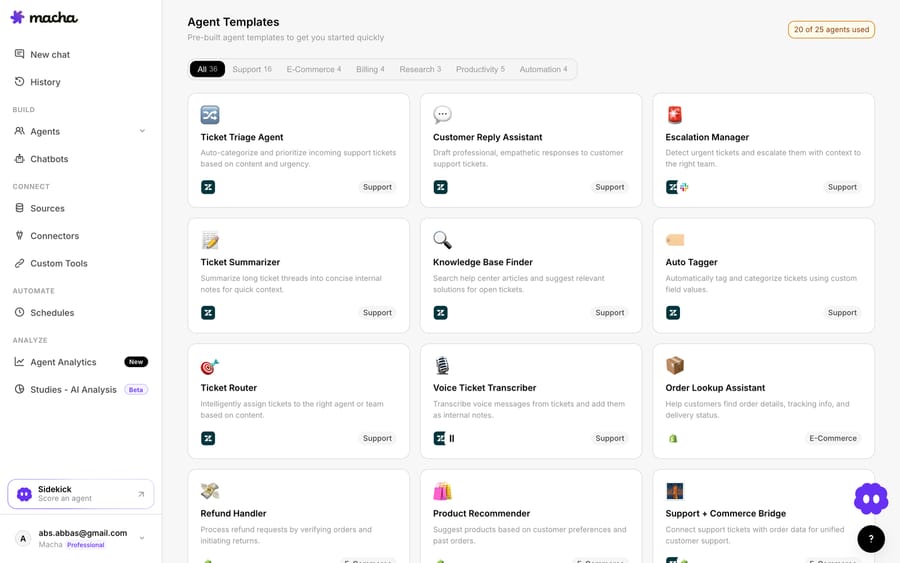
Start from a blank agent or a template, and describe its job in plain language: "You are a support agent for Acme. Answer questions from the help center, look up orders when asked, and escalate anything about refunds over $100 to a human." That instruction is the agent's brain — no prompt engineering framework required.
2. Connect your help desk and knowledge
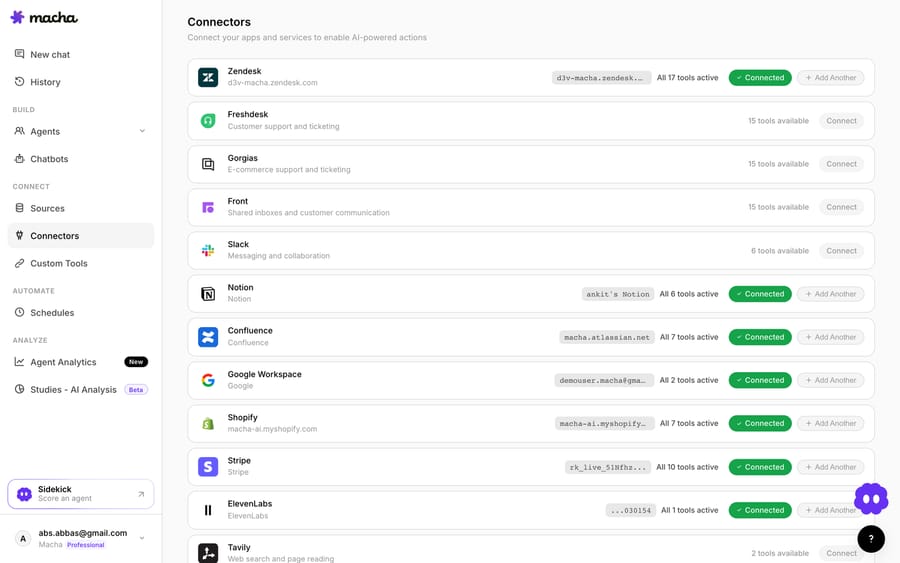
Point the agent at where it works and what it knows. For our Acme agent, that's two clicks: connect Zendesk (an OAuth authorization lets Macha read tickets and post replies) and point Sources at Acme's help center, which Macha crawls and indexes so the agent quotes real articles instead of guessing. Your help desk can be Zendesk, Freshdesk, Front, Intercom, HubSpot, Help Scout, Salesforce, Jira Service Management, or Pylon. What was OAuth clients, pagination handling, webhook endpoints, and a vector store in a coded build is click-to-connect here.
3. Give it capabilities — by describing them
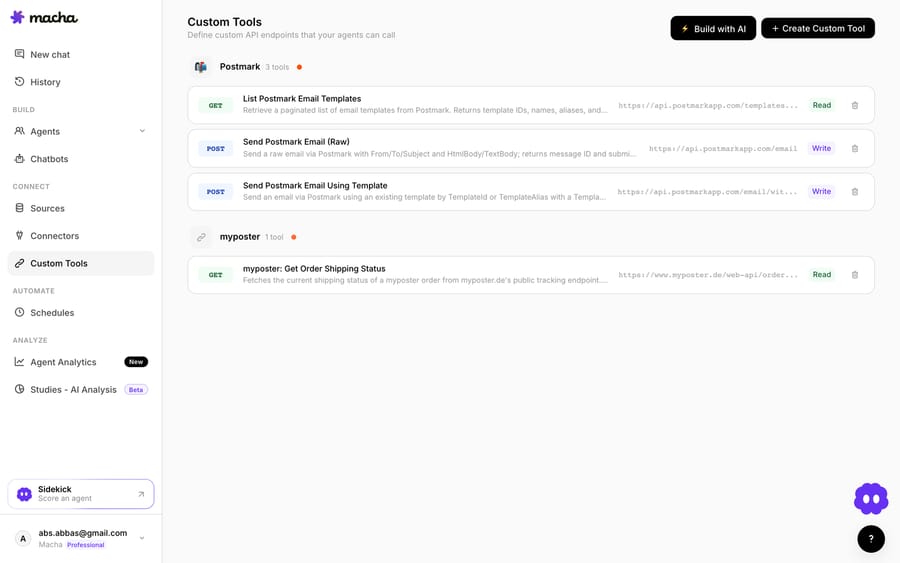
This is the part that used to require a developer. To let the agent do something — check shipping status, issue a credit, look up a subscription — you point Macha's Custom Tools builder at the relevant API and describe what you want: "Connect our orders API and add a tool to get shipping status by order ID." The AI builder discovers the endpoints, tests them with your credentials, and creates the tool. No client library, no code.
4. Test before it touches a customer
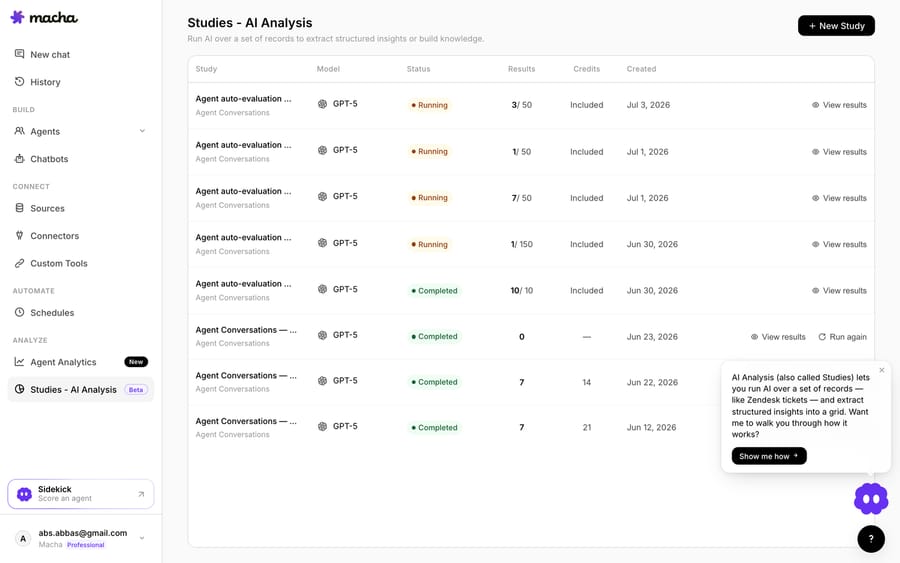
Don't ship on a hunch. Feed the Acme agent a batch of real past tickets — 50 "where's my order" and refund cases — as a Study: Macha runs the agent on each and scores whether it resolved correctly and escalated the over-$100 refunds it was told to. You read the grid, spot that it wrongly answered three shipping questions from a stale article, tighten the instruction, and re-run. That's the same eval loop a coded build needs a whole test harness for — here it's a screen.
5. Deploy with a safety net
Start Acme in draft/approve mode — the agent drafts a reply and a human clicks approve before it sends. Once the Study and the first live days show it nails shipping questions, flip those to autonomous while refunds still route to a person. It runs in the cloud, and Agent Analytics shows every run — so you widen its autonomy on evidence, one ticket type at a time, not on faith.
No-code vs. code — an honest comparison
| No-code (e.g. Macha) | Code (SDK / from scratch) | |
|---|---|---|
| Who can build it | Support/ops, no engineer needed | Developers |
| Time to a live agent | Hours | Weeks |
| Connect help desk + docs | Click / describe | Build API clients + retrieval |
| Add a capability | Describe the API | Write + host a tool |
| Custom orchestration / on-prem | Limited | Full control |
| Maintenance | Handled by the platform | Yours forever |
Neither is "better" — they're different jobs. If you need a bespoke runtime you own, write code (our from-scratch vs. platform breakdown covers that path). If you need a support agent live this week that your team can actually maintain, no-code is the honest fastest route.
So, no code — what do you actually need?
For a support agent grounded in your help desk and docs, with real lookups and safe escalation: a platform account, your help-center content, and API access to the systems you want the agent to use. That's it — no repo, no hosting, no eval harness to build. You can start free on Macha, connect your help desk, and have a testable agent the same afternoon.
FAQ
Is a no-code agent as capable as a coded one? For standard support — answer from docs, look up and act via APIs, escalate — yes, effectively. The gap shows only in bespoke orchestration, unusual integrations, or on-prem constraints, where code wins.
Do I need any technical skill at all? You need to know which of your systems the agent should use and have API access to them (an API key). You don't need to write code; describing the API is enough with an AI tool builder.
Can I start no-code and add code later? Yes — a good platform lets you add custom-coded tools or call your own services alongside the no-code ones, so you're not boxed in if one capability needs real code.
How do I make sure it doesn't send a bad reply? Start in draft/approve mode (a human okays each reply), grade it against real past tickets first, and only widen autonomy on the ticket types it handles well.
Resolve tickets automatically with AI agents
Macha's AI agents work on top of the help desk you already use — no code.