Intercom
 Shopify
 Stripe
 Slack
Slack Notion
 Google Workspace
 Confluence

Zingtree: The Complete Guide (2026)


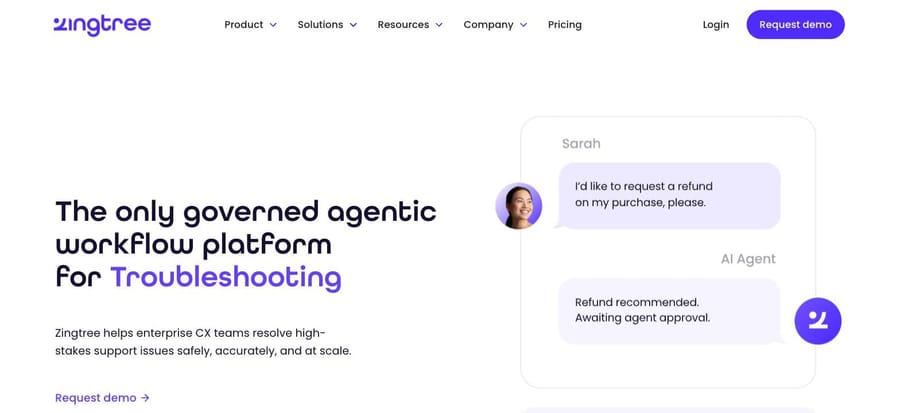
Zingtree started as a tool for building interactive decision trees, and it now markets itself as "the only governed agentic workflow platform" for enterprise customer support. That repositioning is the story worth understanding before anything else, because the pricing, the features, and who it's actually built for all shifted with it. This guide covers what Zingtree is today, how its AI works, what it costs now that self-serve tiers are gone, and which alternatives are worth putting next to it.

We browsed Zingtree's own site directly for this guide, including its live pricing page, since the marketing site sits behind a bot check that blocks a lot of automated tools; the screenshots below are first-hand.
What Zingtree is
Founded in 2014 and reportedly having raised around $18.5M, Zingtree built its name on no-code decision trees: branching, if-this-then-that workflows that guide a support agent (or a customer, self-serve) through a process step by step, with logic instead of a free-text chatbot deciding what happens next. That foundation is still there. What changed is the marketing and the product layer on top of it: Zingtree now leads with AI agents that operate inside those same guardrails, and it positions itself squarely at enterprise CX teams in regulated or high-stakes environments, leaving behind the smaller self-serve accounts its pricing used to cater to.
The company's published customer stories back that shift up. doTERRA uses it for order cancellation and retention, Pearson for billing disputes and payments, and Corpay for tech support and diagnostics; a Corpay VP is quoted on Zingtree's site citing a $1.5M increase in operations revenue, a 92% reduction in agent errors, and a 95% boost in NPS after implementation. Zingtree's own homepage also markets aggregate figures of 30% FCR improvement, a 12x increase in deflections, a 30% CSAT boost, and a 40% revenue increase across its customer base. No methodology is published alongside them, so treat those as marketed averages worth verifying against your own pilot before you plan around them.
How Zingtree's AI works
The mechanism Zingtree describes is a "multi-guardrailed AI engine": before any AI response reaches a customer or an agent, it passes through logic gates, confidence thresholds, and compliance checks the business defines up front. In practice this means a support team writes the rules first (what's allowed, what needs approval, what a compliant answer looks like for a regulated process) and the AI operates inside those rules instead of reasoning freely from a prompt. One demo on Zingtree's own homepage illustrates the pattern directly: a customer asks for a refund, and the AI agent's response is "Refund recommended. Awaiting agent approval," instead of the refund being issued outright.
Two modes sit on top of that engine, and they're aimed at different people:
- Customer Self-Service. Customers work through a workflow directly, guided by the business's logic and real-time data, without an agent involved unless the workflow escalates.
- Agent Assist. Agents get a step-by-step script plus an AI co-pilot that summarizes ticket data, surfaces knowledge, and can trigger actions across connected systems, so the human stays in the loop on judgment calls while the AI handles the retrieval and busywork.
The incentive behind this design is worth naming: a generic LLM chatbot is cheap to stand up but hard for a bank or a healthcare provider to certify, because nobody can point to the exact rule that produced a given answer. Zingtree's pitch is that a workflow built from explicit logic is auditable in a way a raw model response is not, which is also why its feature list leans so heavily on compliance (SOC 2 Type 2, HIPAA BAA, GDPR, an EU data center option) instead of on model benchmarks.
Key features
Zingtree's live pricing page lists the following under its single plan:
- No-code authoring tool: build and edit workflows visually, with draft and published version control.
- Knowledge Assist: surfaces relevant knowledge-base content to an agent or a self-service workflow mid-conversation.
- AI Action Agents: the automation layer that executes defined actions (updating a record, triggering a refund, creating a ticket) inside a workflow.
- Conversational AI: natural-language input layered on top of the underlying decision-tree logic.
- Co-Pilots: real-time agent assistance that summarizes tickets and surfaces next steps.
- Advanced reporting: tracks where workflows succeed, stall, or get abandoned.
- CRM and contact-center integrations: Salesforce, Zendesk, Freshdesk, Talkdesk, Cisco Finesse, WebEx Contact Center, plus premium connectors to Mailchimp, DocuSign, Intercom, Slack, and Twilio.
- Enterprise security: SOC 2 Type 2, GDPR compliance, encryption in transit and at rest, single sign-on, and a HIPAA BAA option.
Zingtree pricing (researched)
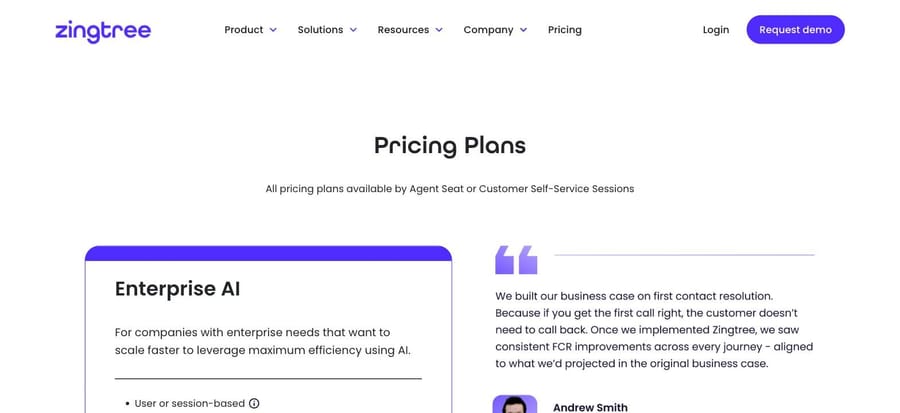
As of this writing, Zingtree's pricing page shows one plan, called Enterprise AI, and no published number: every deal runs through a "Get a quote" form. A few structural facts are stated plainly on the page:
- Billing is priced by Agent Seat or Customer Self-Service Session, and the page notes the per-unit cost decreases as the number of users grows.
- A "user" is the total count of workflow authors plus agents using the platform; a "session" is one activated workflow triggered by anyone other than an agent, counted when at least one button gets clicked.
- All plans are annual subscriptions. Zingtree's own FAQ confirms every plan bills annually, invoiced instead of charged month-to-month.
- Implementation costs extra instead of coming as a free onboarding call. Zingtree offers "implementation services and ongoing managed services" for teams that want help, priced separately through sales.
Worth flagging directly: third-party trackers such as PixieBrix have described older, cheaper Zingtree tiers, including a free plan (1,000 views, 2 trees, 2 seats), usage-based plans in roughly the $100-$900/month range, and per-user plans starting around $50/month. None of that appears on the live pricing page today. The most likely explanation is a genuine repositioning: Zingtree has moved from a self-serve decision-tree tool with a low entry price to an enterprise-only, quote-only AI platform, and the lighter tiers may simply no longer be sold. If you're comparing an old review or blog post's pricing numbers against Zingtree today, expect a materially different (and higher) conversation with sales.
Pros and cons
Pros
- Genuine differentiation on governance: logic gates, confidence thresholds, and compliance checks ahead of any AI response, which matters for regulated industries.
- Real customer references with specific, attributed numbers (Corpay's $1.5M revenue and 92% error reduction) beyond marketing copy.
- Strong contact-center integration list (Talkdesk, Cisco Finesse, WebEx Contact Center) beyond the usual Zendesk/Salesforce pairing.
- Both self-service and agent-assist modes from the same workflow logic, so you're not maintaining two separate systems.
Cons
- No published pricing at all now; every evaluation starts with a sales conversation and an annual commitment.
- Annual-only billing, with no month-to-month option for teams that want to test before committing longer term.
- The marketing site's own bot protection makes it harder than most vendors to do quiet, self-directed research before that first sales call.
- The vendor-marketed aggregate stats (30% FCR, 12x deflection) carry no stated methodology, so treat them as a ceiling case to verify against your own pilot instead of a number to plan around.
Who Zingtree is best for
Zingtree fits teams at enterprises in regulated or high-stakes environments (insurance, financial services, healthcare, and large contact-center operations), where an auditable rule ("this exact logic produced this exact answer") matters as much as the answer itself, and where a compliance or risk team needs to sign off on how AI is allowed to behave. If your business already runs on complex, branching support processes that a plain chatbot would get wrong, and you have the budget and patience for an annual, custom-quoted enterprise deal, Zingtree is a serious option.
It's a weaker fit for a smaller team that wants to try an AI agent this month on a monthly budget, or one whose support process doesn't require the kind of compliance-grade auditability Zingtree is built around. In that case, the governance Zingtree charges for is capability you won't use.
Zingtree vs alternatives
| Zingtree | Forethought | Macha | |
|---|---|---|---|
| Model | Governed agentic workflow platform (decision-tree logic + AI agents) | AI agent platform for support triage and resolution | AI agent layer on top of your existing help desk |
| Best for | Regulated enterprises needing auditable, rule-bound AI | Mid-market to enterprise support teams wanting AI triage and resolution | Teams on Zendesk, Freshdesk, Gorgias, or Front |
| Governance | Deep: logic gates, confidence thresholds, compliance checks pre-response | Standard enterprise controls | Standard controls, scoped per agent |
| Pricing | Custom quote only, no published tiers, annual billing only | Not fully published; sales-led | One plan by ticket volume, from $299/month for 750 tickets (about about $0.40 per ticket a ticket) |
| Self-serve trial | No | Limited | $50 of free usage (about 125 tickets), no credit card, no time limit |
| Setup | Sales-led implementation, paid managed services available | Guided onboarding | setup and monitoring by the Macha team, included on every plan |
| Replaces your help desk? | No, integrates with it | No, integrates with it | No, deliberately augments it |
If Zingtree's governance depth and enterprise pricing are more than your team needs, the honest alternative worth weighing is a lighter model. Macha runs as an AI agent layer on top of the help desk you already use, Zendesk, Freshdesk, Gorgias, or Front, priced on ticket volume with published numbers and a self-serve trial instead of a quote form. It won't match Zingtree's compliance depth for a regulated enterprise workflow, but for a support team that wants to build agents in plain-English instructions and see pricing before talking to anyone, it's the more direct path.
FAQ
What is Zingtree? Zingtree is a customer experience platform built around no-code decision trees and, more recently, AI agents that operate inside those same rule-bound workflows. It markets itself as a "governed agentic workflow platform" for enterprise support teams.
How much does Zingtree cost? Zingtree's live pricing page shows a single "Enterprise AI" plan with no published number; every deal goes through a custom quote. Billing is annual only, priced by agent seat or customer self-service session, with the per-unit cost decreasing as usage scales. Older third-party sources describe cheaper self-serve tiers that no longer appear on the live page.
Does Zingtree offer a free trial or free plan? Not on its current pricing page. A free tier has been reported by third-party trackers in the past, but the live site now shows only the custom-quote enterprise plan.
What is a "session" in Zingtree's pricing? A session is one activated workflow, counted when someone other than an agent (typically a customer, in self-service mode) triggers it and clicks at least one button.
How does Zingtree's AI stay accurate in regulated industries? Through what Zingtree calls a multi-guardrailed AI engine: responses pass through logic gates, confidence thresholds, and compliance checks defined by the business before they reach a customer or agent, instead of being generated freely by a model.
What CRMs and contact-center tools does Zingtree integrate with? Salesforce, Zendesk, Freshdesk, Talkdesk, Cisco Finesse, and WebEx Contact Center natively, plus premium connectors to Mailchimp, DocuSign, Intercom, Slack, and Twilio.
What are good alternatives to Zingtree? For enterprise AI agent platforms with a lighter sales process, Forethought is a common comparison. For teams that want to automate inside an existing help desk with transparent, published ticket-based pricing, Macha is a lighter-weight alternative.
Sources: Zingtree homepage (zingtree.com — blocks automated fetches with a 403, verified first-hand via browser), Zingtree pricing (zingtree.com/en/pricing — same bot check), Zingtree PRNewswire release on CX Answers and CX Actions, PixieBrix — What is Zingtree?.
Resolve tickets automatically with AI agents
Macha's AI agents work on top of the help desk you already use — no code.