Shopify
 Stripe
 Slack
Slack Notion
 Google Workspace
 Confluence

Ushur: The Complete Guide (2026)


Ushur is an AI platform built for the parts of customer experience that most vendors avoid: insurance claims, healthcare enrollment, and financial services servicing, where a wrong automated answer creates compliance consequences on top of an annoyed customer. This guide covers what Ushur actually does, how its agentic architecture works, what it costs (unpublished, and there's a reason for that), where it fits, and how it compares to the alternatives worth putting next to it.

We build AI agents for customer service ourselves, on top of the help desk a team already runs. We checked Ushur's own site and platform documentation first-hand before writing this, and flagged every number that comes from a third party instead of Ushur itself.
What is Ushur?
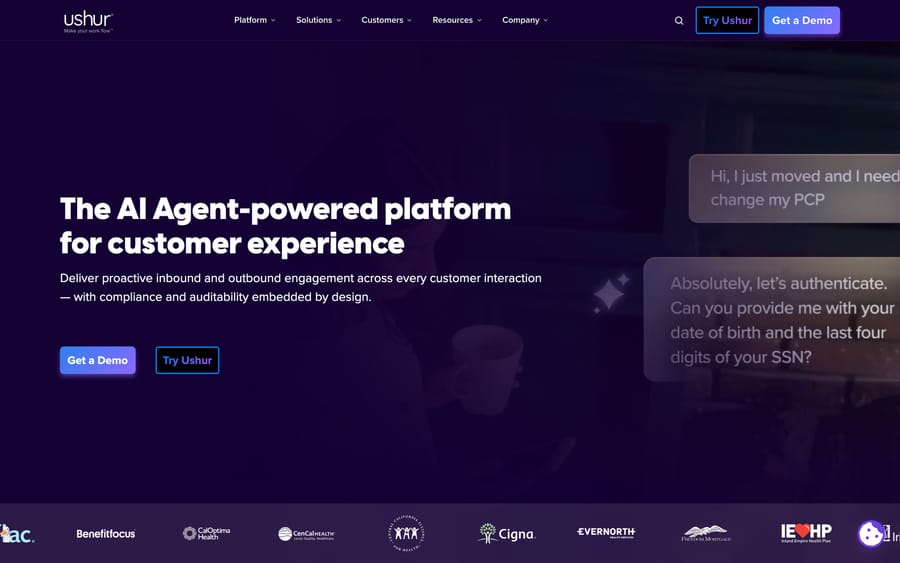
Ushur is a customer experience automation platform, founded in 2014 by Simha Sadasiva and Henry Peter, that builds AI agents for outbound and inbound engagement across SMS, RCS, email, voice, and web. On its site, Ushur describes the product as delivering "proactive outbound and inbound engagement, with compliance and auditability embedded into every interaction," which is a different opening line than most AI customer service vendors use, and it tells you who the buyer is.
Ushur has raised at least $50 million in a Series C round reported by TechCrunch in February 2023; third-party trackers report Ushur's total funding anywhere from roughly $107 million to $192 million depending on the source and update date, so treat any single total figure as an estimate; nobody has published a confirmed number. The company sells into healthcare (payers, providers, PBMs), insurance (life and health, P&C), and financial services and consumer lending. Customers shown on its site include Cigna, Aflac, Irish Life, Benefitfocus, and IEHP, all organizations that operate under real regulatory scrutiny.
That customer list is the fit signal. Ushur suits teams that need an AI agent to complete a multi-step, regulated process (a claims intake, a benefits enrollment, a loan servicing request) with a full audit trail of what the agent did and why. A team that mainly wants to answer "where is my order" faster is a different buyer entirely.
How Ushur's AI works
Ushur calls its approach "goal-driven planning" instead of scripted flows. Instead of following a fixed decision tree, an agent decomposes a stated goal (resolve this claim, complete this enrollment) into a plan, executes steps, and adapts when a step fails or new information arrives, while staying inside what Ushur calls "policy-bounded execution."
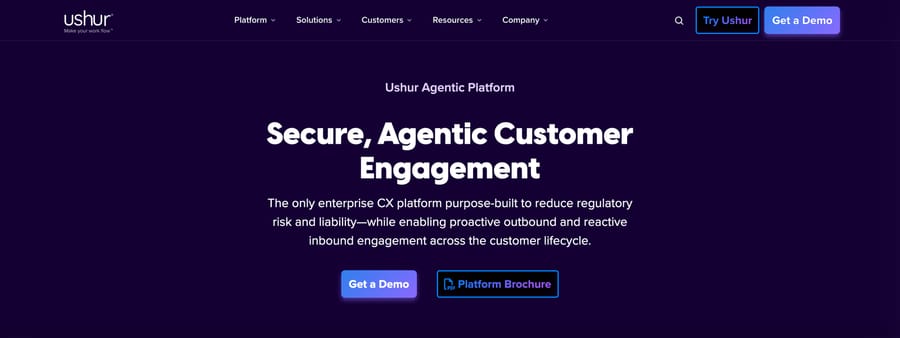
Two named components sit underneath that:
- The Agentic Experience Framework: the orchestration layer that plans and coordinates multiple agents working on one customer journey, replacing the static, single-path workflows that older automation tools rely on.
- The Agentic Knowledge Layer: a data infrastructure layer that unifies enterprise data into what Ushur calls "data blocks", semantic objects with typed schemas and policy-aware metadata, so an agent's decisions are grounded in governed data instead of a loose document search.
On top of that, Ushur's "Voice-Guided Experience" pairs conversational AI voice with synchronized visuals, aimed at phone-heavy processes like a benefits call where showing a screen mid-conversation shortens the call.
The compliance framing is not decoration. Ushur holds HIPAA, SOC 2 Type 2, and HITRUST r2 certifications and builds in real-time guardrails, consent management, audit trails, and what it calls "reasoning trace capture", a record of why an agent took a given action. For a healthcare payer or an insurer, that trace is what turns "the AI made a decision" into something a compliance team can actually review after the fact. A team without that regulatory burden pays for infrastructure it doesn't need.
Key features
- Omnichannel engagement across SMS, RCS, email, voice, and web, built for outbound campaigns as much as inbound support.
- Goal-driven, multi-agent orchestration that plans and adapts a journey instead of following a fixed script.
- Agentic Knowledge Layer unifying enterprise data into governed, typed "data blocks."
- No-code orchestration for business users to configure journeys without engineering time.
- Compliance and governance: HIPAA, SOC 2 Type 2, and HITRUST r2, with real-time guardrails, consent management, and full conversation replay for audits.
- Native integrations with Salesforce, ServiceNow, and legacy enterprise systems, alongside API and no-code connectivity.
Ushur pricing
Ushur does not publish pricing anywhere on ushur.ai; the URL a visitor would guess for a pricing page returns a 404. Like most enterprise CX-automation vendors selling into regulated industries, Ushur prices through a sales conversation scoped to volume, channels, and the specific regulated process being automated. That's a business model built around a compliance sale, where a health plan or insurer pays for risk reduction on a scale a fixed list price could never capture, and it earns Ushur more per deal than a self-serve tier would.
We could not find a third-party source (Vendr, G2, or otherwise) with a specific Ushur contract figure reliable enough to quote here. Even the aggregators that estimate opaque enterprise pricing for competitors don't have enough public Ushur deal data to publish a number. Budget for an enterprise procurement cycle, a proof-of-concept scoped to one regulated workflow, and a sales-led onboarding process instead of a self-serve signup.
Pros and cons
Pros
- Built specifically for regulated, multi-step processes (claims, enrollment, servicing) where most AI vendors only handle simple Q&A.
- Genuine compliance certifications (HIPAA, SOC 2 Type 2, HITRUST r2) and audit trail features actually built into the product.
- Omnichannel reach that includes outbound SMS, RCS, and voice campaigns alongside inbound chat.
- No-code orchestration lets a business team configure a journey without waiting on engineering.
Cons
- Zero published pricing and no visible self-serve path; every evaluation starts with a sales call.
- The regulatory and compliance depth is overhead a non-regulated support team doesn't need and shouldn't pay for.
- Built around outbound engagement and complex journeys; a team that just wants inbound ticket deflection is buying more platform than the job requires.
Who Ushur is best for
Ushur suits teams inside healthcare payers, insurers, and financial services firms that run multi-step regulated processes and need an audit trail proving what an AI agent did at each step. If your compliance team has to sign off on any AI-driven customer interaction, Ushur's governance layer is built for exactly that conversation.
It's a poor fit if you're not in a regulated industry, or if your actual problem is a support queue full of routine tickets rather than a claims or enrollment workflow. That's a narrower, cheaper problem, and one a help-desk-native AI agent solves without the compliance overhead Ushur is priced around.
Ushur vs alternatives
| Ushur | Cognigy | Macha | |
|---|---|---|---|
| Model | Agentic CX automation for regulated, multi-step processes | Enterprise conversational AI / contact-center automation | AI agent layer on top of your existing help desk |
| Best for | Healthcare, insurance, and financial services with compliance requirements | Enterprise contact centers, voice and chat at scale | Teams on Zendesk, Freshdesk, Gorgias, or Front handling day-to-day tickets |
| Compliance | HIPAA, SOC 2 Type 2, HITRUST r2; built-in audit trail and reasoning trace | Strong enterprise controls | Standard controls, scoped per agent |
| Channels | SMS, RCS, email, voice, web | Voice, chat, messaging | Inside your help desk (chat and email tickets) |
| Pricing | Opaque; enterprise sales cycle, no published figure | Opaque; enterprise sales cycle | From $299/month for 750 tickets (~$0.40/ticket), published |
| Setup | Sales-led, scoped proof-of-concept per workflow | Sales-led, professional services | Built, tested and monitored by the Macha team |
| Trial | None published | None published | $50 free usage |
| Replaces your help desk? | No, sits alongside it for regulated processes | No | No, deliberately augments it |
Ushur and Cognigy both sell into large enterprises with a compliance function and a procurement cycle to match. Where they differ from Macha is scope and surface: both are broad platforms meant to run entire regulated or contact-center processes end to end, while Macha is an agent layer that works the tickets that already land inside Zendesk, Freshdesk, Gorgias, or Front. If your problem is a regulated claims or enrollment journey, Ushur is a serious candidate. If your problem is a support inbox with thousands of routine tickets a month and no compliance mandate forcing a bespoke platform, Macha's pricing will make more sense than a sales call scoped to your entire claims process.
FAQ
What is Ushur? Ushur is an AI customer experience automation platform, founded in 2014, that builds agentic AI for outbound and inbound engagement across SMS, RCS, email, voice, and web, aimed at regulated industries like healthcare and insurance.
How much does Ushur cost? Ushur does not publish pricing. It sells through an enterprise sales cycle scoped to your volume, channels, and workflow. We found no reliable third-party estimate to cite.
Does Ushur offer a free trial? There's no published free trial or self-serve signup. Evaluation runs through a sales-led proof-of-concept.
Who founded Ushur, and when? Ushur was founded in 2014 by Simha Sadasiva and Henry Peter. It raised a $50 million Series C reported by TechCrunch in February 2023; total funding is reported differently across aggregators, roughly $107 million to $192 million.
What does "goal-driven planning" mean at Ushur? It's Ushur's term for agents that decompose a stated goal into a plan and adapt as they execute, instead of following a fixed, scripted workflow, while staying inside policy-bounded execution.
What compliance certifications does Ushur hold? HIPAA, SOC 2 Type 2, and HITRUST r2, with real-time guardrails, consent management, and conversation replay built in for audits.
Which companies use Ushur? Publicly shown customers include Cigna, Aflac, Irish Life, Benefitfocus, and IEHP, concentrated in health insurance, life and health insurance, and healthcare.
What are good alternatives to Ushur? Cognigy is a common enterprise comparison for conversational AI at scale. For a team that wants an AI agent working inside the help desk on the tickets it already receives instead of a full regulated-process automation platform, Macha is a different shape of tool worth comparing.
Sources: Ushur homepage, Ushur platform architecture, TechCrunch: Ushur raises $50M.
Resolve tickets automatically with AI agents
Macha's AI agents work on top of the help desk you already use — no code.