Intercom
 Shopify
 Stripe
 Slack
Slack Notion
 Google Workspace
 Confluence

Hyro: The Complete Guide (2026)


Hyro is a healthcare-focused AI agent platform that automates phone, chat, and SMS communication for hospitals and health systems, covering scheduling, patient access, and call-center deflection. This guide covers what it actually does, its real (unpublished) pricing, its funding and customer base, honest reviews, and where it fits next to broader conversational AI platforms.

We build AI agents for customer service ourselves, though not specifically for healthcare or voice, so we read Hyro the way a health-system buyer would: what's actually confirmed about the company, what a deal costs when there's no published rate card, and what's said about it once the sales deck is closed.
What is Hyro?
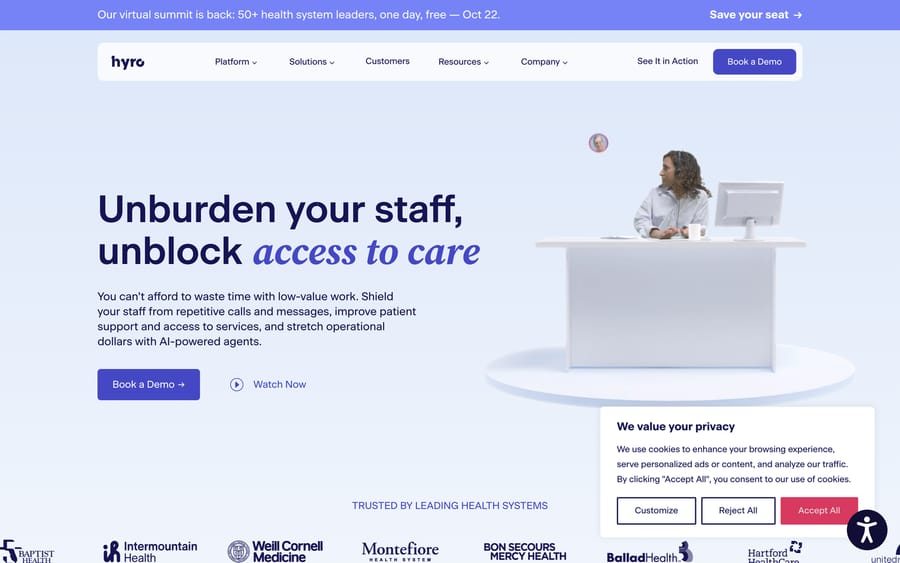
Hyro was founded in 2018 by Israel Krush and Rom Cohen, who developed the idea during their Cornell Tech MBA and engineering program. The company has raised a total of $95 million, most recently a $45 million growth round in October 2025 led by Healthier Capital, with Norwest and Define Ventures participating alongside strategic investment from Bon Secours Mercy Health (an existing Hyro customer) and ServiceNow Ventures, ServiceNow's investment arm. That customer-as-investor detail is a genuine signal: a health system that already runs Hyro in production put its own capital behind the next round.
Hyro brands itself the "Responsible AI Agent Platform for healthcare" and reports its agents are deployed across more than 45 health systems, with over 30 million patients engaging its voice and chat agents to date. Named customers on Hyro's own site include Intermountain Healthcare, Bon Secours Mercy Health, Hackensack Meridian Health, Baptist Health, Sutter Health, Weill Cornell Medicine, Montefiore Health System, Ballad Health, and Hartford HealthCare. These are Hyro's own reported figures; we found no independently audited version of the patient-volume number.
How Hyro's AI works
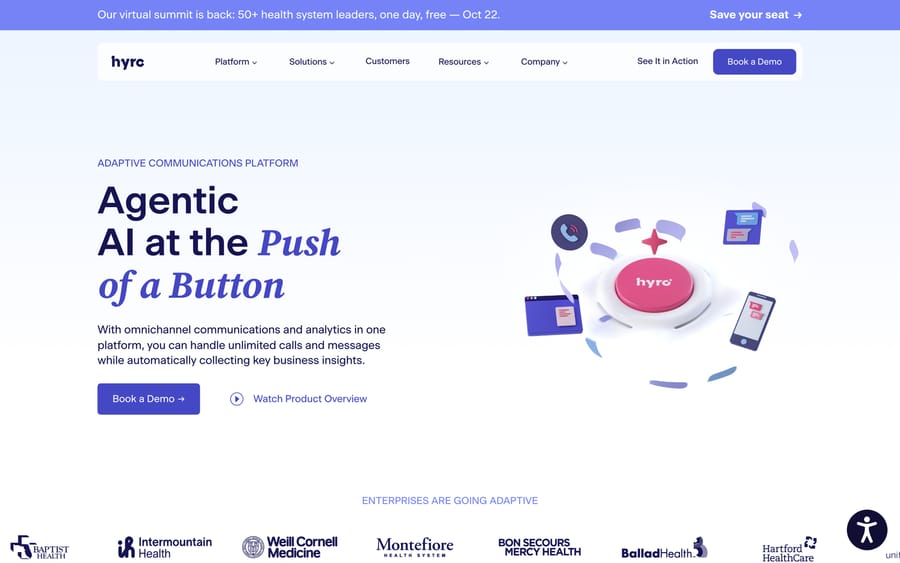
Hyro markets itself as an "adaptive communications platform": one AI layer handling calls, web chat, and SMS under a single conversational model instead of separate point tools for each channel. The pitch to a health system is specifically about deflecting repetitive front-desk and call-center work away from staff, appointment scheduling, insurance questions, referral status, general patient access inquiries, while routing anything clinical or urgent to a human.
The healthcare-specific mechanism worth understanding is depth of EHR/EMR integration. Hyro's agents connect into systems like Epic, and third-party research we found lists Salesforce and ServiceNow among the systems factored into custom implementation quotes. That's a meaningfully different integration surface than a general-purpose voice AI vendor: scheduling an appointment inside a hospital's actual EHR, not just collecting a callback request, is the difference between a real deflection and a fancier answering machine.
Key features
- Omnichannel patient communication: voice, web chat, and SMS under one conversational agent.
- EHR/EMR integration, including Epic, for real scheduling and record actions beyond simple information lookup.
- HIPAA-compliant infrastructure, a baseline requirement for any healthcare deployment.
- Analytics on call/message volume, deflection, and patient engagement built into the same platform.
- Health-system-specific solutions for patient access, call centers, and health plans, per Hyro's own site navigation.
Hyro pricing
Hyro does not publish pricing. There's no pricing page in its site navigation (Platform, Solutions, Customers, Resources, Company), and every engagement goes through a sales conversation. We checked for an AWS, Azure, or Google Cloud Marketplace listing (none found) and attempted G2's pricing tab (G2 blocked our direct access), so what follows is a third-party estimate, not a number from Hyro itself.
A software-listing aggregator lists Hyro's pricing starting around $10,000/month flat rate, scaling with deployment scope, integration complexity (Epic, Salesforce, ServiceNow connections specifically add to the quote), and support requirements. Treat this as a rough, unverified floor. It's the wrong number to budget against precisely.
Keeping pricing off the site is a deliberate choice at this end of the market, not an oversight: a health system's procurement process runs on custom scoping and multi-year contracts anyway, so a public rate card would only invite comparison shopping Hyro's own sales team would rather do in a discovery call. That's a normal incentive across enterprise healthcare software generally, a market pattern more than a flag specific to Hyro. It still means a buyer should ask for itemized scope (which integrations, which channels, what support tier) before treating any number, ours included, as comparable across health systems. The pattern lines up with Hyro's own customer base: it sells to large, multi-site health systems with procurement departments and multi-quarter buying cycles. A solo practice evaluating a monthly subscription is looking at the wrong vendor entirely.
Pros and cons
Pros
- Deep healthcare domain focus, not a general conversational AI platform adapted after the fact.
- Real EHR/EMR integration (Epic named specifically) that lets agents take scheduling actions, not just answer questions.
- A customer base of large, recognizable health systems, several of which are named directly on Hyro's site.
- HIPAA compliance and healthcare-specific workflows built in from the start.
Cons
- No published pricing anywhere, and a ~$10,000/month third-party starting estimate puts it out of reach for smaller practices.
- Thin presence on G2, Capterra, and TrustRadius: most available feedback lives in Hyro's own case studies.
- Reviewers report limited customization for workflows that don't match Hyro's standard healthcare patterns.
- A multi-quarter enterprise sales and implementation cycle, consistent with its health-system customer base but a real cost for a team wanting to move fast.
What actual users say
G2 lists Hyro at 4.9 out of 5, though we could not find a reliable review count. One source we checked specifically flagged that Hyro "maintains minimal presence on enterprise review platforms like G2, Capterra, and TrustRadius, with available feedback concentrating in company-published case studies rather than independent review channels," which means a 4.9 average here is a much thinner signal than the same score on a product with hundreds of reviews.
Within what we found, reviewers praise the conversational quality directly: "Hyro's conversational interface is outstanding! The way it engages patients feels natural." Reviewers also credit Hyro with reducing the volume of calls that reach a human, improving patient satisfaction through faster responses. On the harder edges, one review noted "the setup process took longer than expected, but once it was running, the results were worth the wait," and secondhand summaries describe limited customization for non-standard workflows as a recurring trade-off against the platform's healthcare specialization.
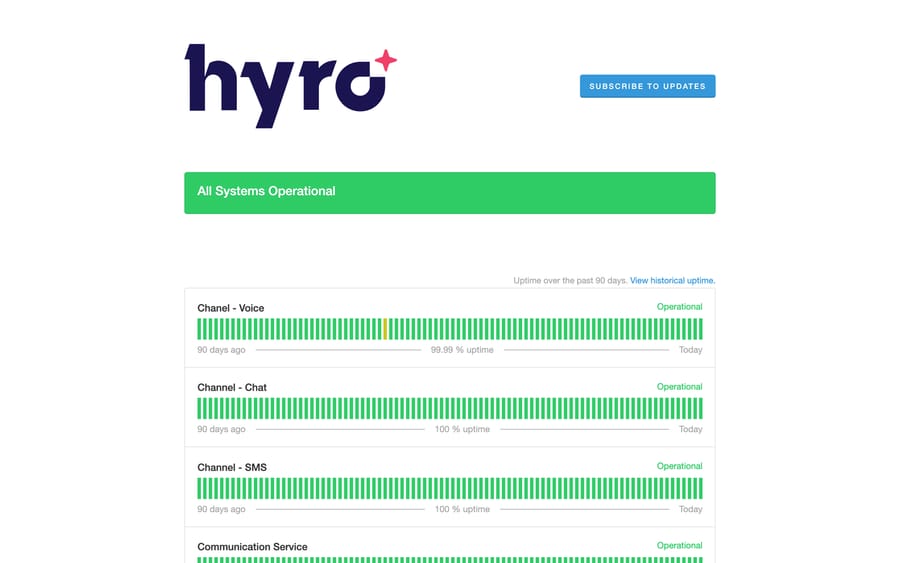
How we researched this: we checked Hyro's homepage and platform page directly on 2026-09-17, along with Hyro's own funding-announcement blog post and its public status page (shown above), which independently confirms Voice, Chat, and SMS as Hyro's actual live channel names. We also tried Hyro's documentation subdomain specifically to find a fourth or fifth screenshot, but docs.hyro.ai sits behind a customer sign-in wall (email or Google login required) rather than public docs, so it couldn't be captured. Cloudflare's bot-verification challenge blocked every other marketing subpage we tried, including the customers page and a second homepage pass, so this guide relies on fewer first-party pages than we'd prefer, disclosed here rather than filled in with guesses. G2's review page also blocked direct access; its rating and quotes above are cited secondhand from search results.
Who Hyro is best for
Hyro fits teams at large health systems and hospital networks with real call-center volume, an existing Epic (or comparable EHR) deployment, and a procurement process built for multi-quarter enterprise contracts. The named customer list, Intermountain, Sutter, Montefiore, Hartford HealthCare, is a good proxy for the buyer profile: multi-site, multi-thousand-employee organizations where front-desk deflection at scale genuinely moves a budget line.
It's a weaker fit for an independent practice, a small specialty clinic, or any team evaluating month-to-month without a dedicated procurement cycle. The unpublished pricing and third-party $10,000/month starting estimate alone rule most of that segment out before a features conversation even starts. A smaller clinic evaluating AI for patient scheduling is usually better served by a general-purpose scheduling tool or a lighter conversational AI vendor built for a self-serve buyer. Hyro is priced and sold around 45-plus health-system deployments, and that's the buyer it's actually built for.
Hyro vs alternatives
| Hyro | NiCE Cognigy | Macha | |
|---|---|---|---|
| Model | Healthcare-specific AI agent platform (voice, chat, SMS) | Enterprise conversational AI platform for contact centers | AI agent layer on your existing help desk |
| Best for | Large health systems with EHR integration needs | Broad enterprise contact centers across industries | Teams on Zendesk, Freshdesk, Gorgias, or Front |
| Pricing | Not published; ~$10,000/mo+ (third-party estimate) | Not independently verified here | From $299/mo for 750 tickets (~$0.40/ticket), published |
| Setup | Enterprise sales cycle, EHR integration work | Sales-led, enterprise onboarding | Built, tested, and monitored by the Macha team |
| Trial | Demo-gated | Demo-gated | $50 free usage |
| Replaces your help desk? | No, layers onto scheduling and call-center systems | No, layers onto contact-center infrastructure | No, deliberately augments it |
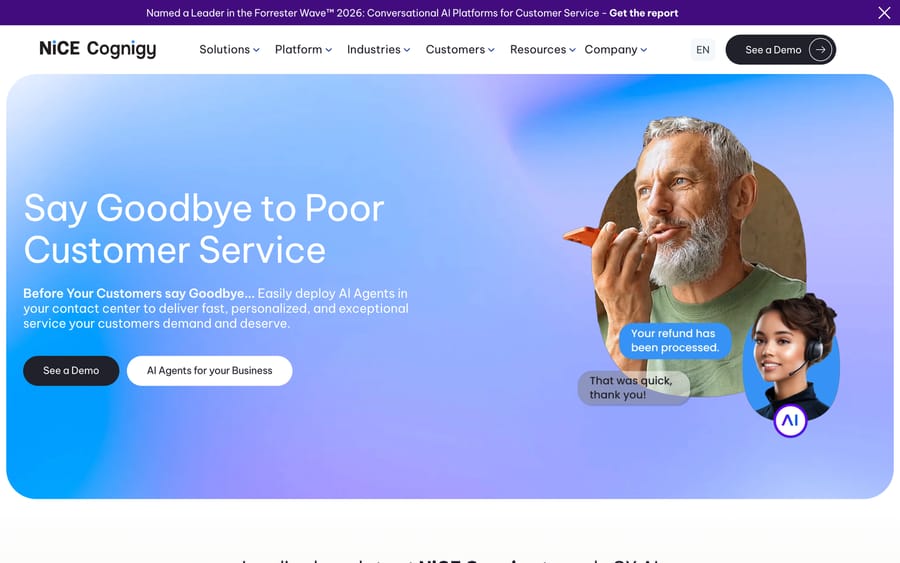
Cognigy (now under NICE) is the closer scale comparison: both are enterprise platforms sold through a sales-led process into large organizations with real integration requirements, though Cognigy's footprint spans industries generally while Hyro stays specifically in healthcare. For a voice-first comparison instead, the Parloa guide covers a contact-center-focused alternative in more depth.
Macha sits at a different layer and outside Hyro's category entirely: instead of a healthcare-specific voice and scheduling platform, it's an AI agent layer that runs on top of a help desk a team already uses (Zendesk, Freshdesk, Gorgias, or Front), for the email and chat ticket volume that makes up most non-clinical support queues. A hospital system's clinical call center is a genuinely different problem than a software company's Zendesk queue; Macha fits the latter. See Macha's pricing or start with $50 of free usage against real tickets.
FAQ
What is Hyro? Hyro is a healthcare-focused AI agent platform, founded in 2018, that automates patient-facing phone, chat, and SMS communication, including scheduling and call-center deflection, integrated with EHR systems like Epic.
How much does Hyro cost? Hyro doesn't publish pricing. A third-party estimate puts a starting rate around $10,000/month, scaling with deployment scope and integration complexity, but every deal goes through a sales conversation.
Who founded Hyro, and who funds it? Israel Krush and Rom Cohen founded Hyro in 2018 out of Cornell Tech. The company has raised $95 million total, including a $45 million round in October 2025 led by Healthier Capital, with Norwest, Define Ventures, existing customer Bon Secours Mercy Health, and ServiceNow Ventures also participating.
Which health systems use Hyro? Named customers on Hyro's site include Intermountain Healthcare, Bon Secours Mercy Health, Hackensack Meridian Health, Baptist Health, Sutter Health, Weill Cornell Medicine, Montefiore, Ballad Health, and Hartford HealthCare.
What do real users say about Hyro? G2 shows a 4.9 out of 5 rating, though Hyro has a notably thin presence on G2, Capterra, and TrustRadius compared to feedback in its own case studies. Reviewers praise natural-feeling conversational quality and reduced call volume; a recurring complaint is limited customization for non-standard workflows.
Does Hyro integrate with Epic? Yes. Hyro's own site and third-party research both name Epic among its EHR integrations, alongside Salesforce and ServiceNow for broader system connections.
Is Macha an alternative to Hyro? Not directly. Hyro is a healthcare-specific voice, chat, and scheduling platform tied to EHR systems; Macha is an AI agent layer that runs on top of a help desk a team already uses (Zendesk, Freshdesk, Gorgias, or Front) for email and chat support tickets. A hospital call center fits Hyro; a software company's support queue fits Macha.
Sources: Hyro's homepage (hyro.ai), Hyro's platform page (hyro.ai/platform), and Hyro's own funding-announcement blog post, all checked directly on 2026-09-17 (not linked here: hyro.ai sits behind Cloudflare bot-verification that blocks automated link checks, though we viewed each page directly). G2's review page for Hyro blocked our direct fetch; its rating and quotes are cited secondhand above.
Resolve tickets automatically with AI agents
Macha's AI agents work on top of the help desk you already use — no code.