Intercom
 Shopify
 Stripe
 Slack
Slack Notion
 Google Workspace
 Confluence

Capacity AI: The Complete Guide (2026)


Capacity is a St. Louis-based "unified CX automation platform" that puts AI agents, live agent assistance, quality auto-scoring, and outbound campaigns behind one shared knowledge layer, instead of the four or five point tools most contact centers stitch together to cover the same ground. This guide covers what Capacity actually does, how its AI works, what it costs (no published number, but a real third-party estimate and an honest range), what its own users say on G2, and how it compares to Forethought and to running an AI agent layer on the help desk you already use.

What is Capacity?
Capacity was founded in 2017 in St. Louis by David Karandish, who previously built Answers.com to a $960 million exit in 2014, according to a Yahoo Finance syndication of a press release on the company crossing $100 million in annual recurring revenue (finance.yahoo.com blocked our automated re-check with a 429 on this pass, so it's cited here without a link). That coverage reports Capacity growing from $5 million to $100 million in ARR in 3.5 years, serving more than 20,000 organizations including 20% of the Fortune 50, with named customers DSW (reporting $1.5 million in savings) and Choice Hotels (nearly $2 million).
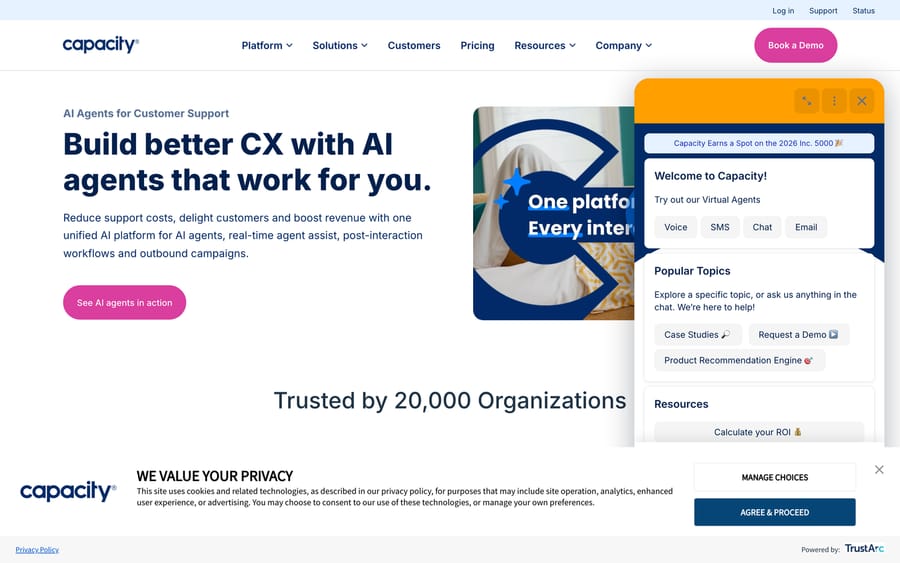
The company has raised more than $159 million total across equity and debt, most recently a Series E of over $54 million announced September 2, 2026, on top of an earlier $92 million round combining an oversubscribed $42.6 million Series D and a $50 million investment from Chicago Atlantic, with TVC Capital and Toloka.vc also participating, per Capacity's own announcement of that earlier round alongside its 10th and 11th acquisitions, Call Criteria and Verbio Technologies, which brought its combined team to roughly 250 people globally. That acquisition-heavy growth pattern shows up directly in the product. Capacity's platform spans channels and functions (chat, voice, SMS, email, agent assist, analytics, campaigns) that a company built organically over 8 years would more typically ship one at a time.
How we researched this: capacity.com, its pricing page, and its public help center at support.capacity.com all loaded directly for this guide. G2 and Capterra both blocked direct access (HTTP 403 and 404 respectively), so review evidence here is a mix of search-indexed G2 snippets and one attributed case-study quote from Capacity's own site, checked 2026-09-15. We could not get a live sales quote for pricing, so the dollar figures below are a third-party estimate, not a vendor number.
How Capacity's AI works
Capacity's pitch is a single "knowledge orchestration" layer feeding every other piece of the platform. You connect your knowledge base, help center, and 250+ supported integrations once; that shared layer then powers AI agents that answer chat, voice, SMS, and email inquiries directly, plus Agent Assist, which surfaces answers and next-best-actions to a human agent in real time during a live conversation. The human still sends the reply; the AI just makes them faster.
A second layer sits after the interaction ends. Capacity's Auto QA and conversation intelligence tools score every conversation automatically, where most contact centers can only manually audit a 1-2% sample, and its analytics assistant lets a manager ask plain-language questions about that data and get back a dashboard with a written summary attached.
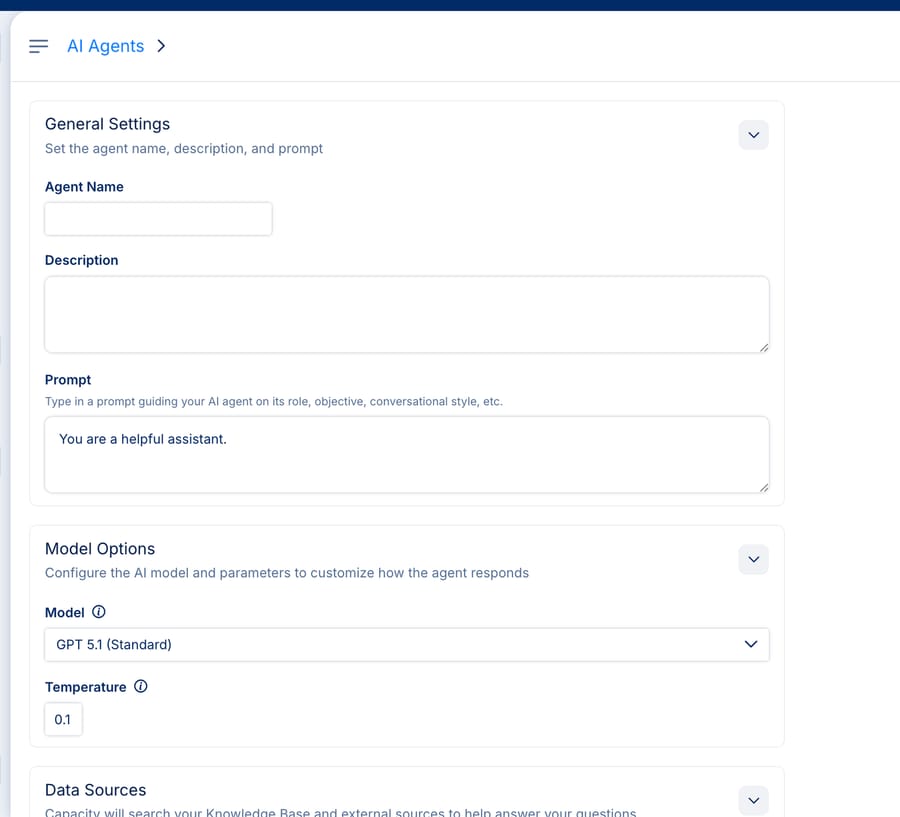
Building an individual AI agent is done through a form, not code: a name, a description, a system prompt, a model choice (Capacity's own documentation shows GPT-5.1 as a selectable option), a temperature setting, and a connected set of data sources the agent is allowed to search.
Key features
- Omnichannel AI agents: chat, voice, SMS, and email agents drawing from the same knowledge layer, so an answer doesn't drift between channels.
- Real-time Agent Assist: live transcription, intent detection, and suggested responses surfaced to a human agent mid-conversation.
- Auto QA and conversation intelligence: automated scoring and sentiment analysis across 100% of conversations, not a manual sample.
- Analytics Assistant: a natural-language interface to contact center data, returning charts and written summaries instead of requiring a report builder.
- Outbound campaigns: AI-driven SMS and voice outreach for renewals, win-backs, or proactive updates.
- 250+ native integrations and a developer platform (CapacityDB, an API) for teams that want to build past the point-and-click configuration.
Capacity pricing
Capacity's pricing page names three tiers, Core, Pro, and Enterprise, each adding functionality on top of the last (Core covers the knowledge base, helpdesk, AI Agent Builder, and 100GB storage; Pro adds live chat, inbox, and real-time Agent Assist; Enterprise adds campaigns, CRM, and a HIPAA compliance package). None of the three shows a number. The page describes a hybrid model instead: an annual platform fee plus usage-based add-ons, AI agent interactions charged per chat, email, voice minute or SMS, and Agent Assist charged per hour of agent time, with volume discounts as usage grows.
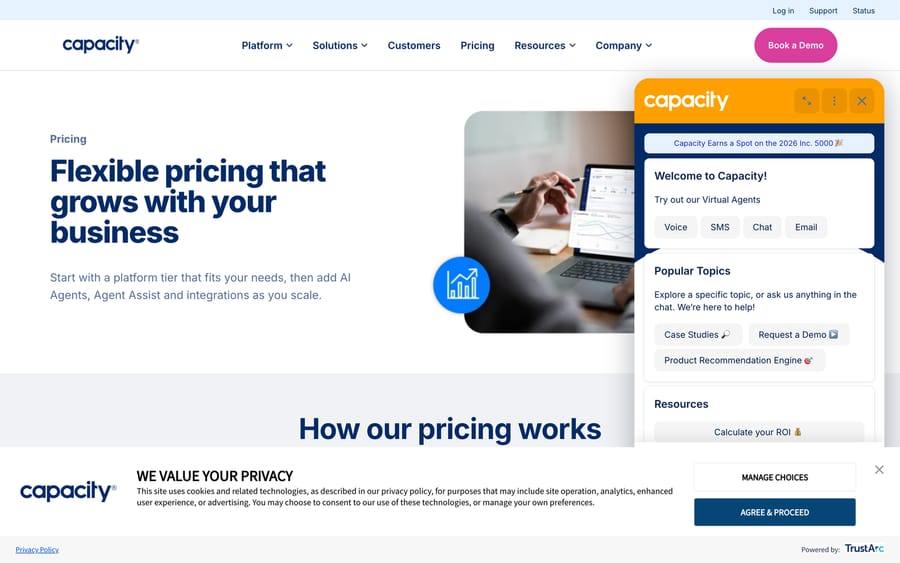
We checked Capacity's own site, G2's pricing tab, and searched for an AWS, Azure, or GCP marketplace listing; none publish a number. The closest thing to a real figure comes from aicxstack.com's review, current to its own August 2026 check: entry-level deployments running $2,000-3,000 a month for small teams, and large deployments (voice AI, QA automation, higher volumes) at $10,000 or more a month, based on seats and interaction volume. That's a third-party estimate. Treat it as a planning range until you get a real quote.
Usage-based add-ons stacked on top of an annual platform fee earn Capacity more as your ticket, call, and message volume grows. That's a normal metered-SaaS incentive, not a hidden one, but it's worth modeling your own volume against those tiers before you assume the platform fee is the whole bill.
What Capacity users say
Checked 2026-09-15. G2 and Capterra both blocked our direct access, so this section leans on search-indexed snippets instead of a live page read. G2 search snippets put Capacity at 4.8 out of 5 stars, from review counts that varied between 57 and 65 depending on the snippet, both undated. A third-party aggregator, aicxstack.com, reports a combined 4.5 out of 5 across G2 and Capterra from several hundred reviews, as of its own August 10, 2026 check.
We could not pull individually attributed G2 or Capterra quotes with a reviewer's role or company size through direct access or search. That's a real gap in this evidence, worth naming plainly instead of glossing over. One attributed quote we can source cleanly comes from a case study on Capacity's own site, from a Senior IT Manager: "The Capacity platform is powerful and puts business intelligence at your fingertips." It's a vendor-selected case-study quote, and it should carry less weight than an independent review.
The same third-party review summary names three recurring complaints worth taking at face value: setup complexity (initial configuration and knowledge base structuring take more effort than expected), an accuracy ramp period (the AI underperforms its advertised accuracy until tuned on real interaction data), and maintenance dependency (the platform rewards ongoing investment, and a set-and-forget deployment underperforms). None of that is unusual for an enterprise automation platform, but it's worth planning around before you sign.
Pros and cons
Pros
- One knowledge layer powering agents, live agent assist, QA, and analytics, instead of four disconnected tools each needing its own setup.
- Capital-efficient growth and apparent staying power: $100 million ARR, profitable, and 20,000+ customers is a different risk profile than a two-year-old seed-stage vendor.
- Auto QA scoring 100% of conversations addresses a real, common gap: most contact centers can only manually review a small sample.
- Broad integration surface (250+) and a developer platform for teams that want to extend past the built-in configuration.
Cons
- No published pricing anywhere we checked, including G2's pricing tab and a marketplace search; the real range (an estimated $2,000-10,000+/month) only comes from a third-party estimate.
- Real reviewer quotes with attribution were not accessible to us directly; the review evidence here is thinner than we'd like, and worth verifying yourself on G2 before a purchase decision.
- Setup complexity and an accuracy ramp period are named, recurring complaints in third-party review summaries. That's more than an isolated data point.
- A platform this broad (agents, assist, QA, campaigns, CRM) is a bigger commitment to configure and maintain than a single-purpose tool.
Who Capacity is best for
Capacity fits teams running a mid-market to enterprise contact center that wants one vendor covering AI agents, live agent assistance, and quality monitoring together, especially one already running a hybrid model of AI plus human agents instead of aiming for full deflection. The Auto QA and Agent Assist pieces specifically suit a team whose main goal is keeping humans in the loop and making them faster and more consistent.
It's a weaker fit for a smaller team that wants a single narrow tool and a published price before a sales call, or for a team whose actual bottleneck is ticket volume inside a help desk they already run well. If your support tickets mostly land in Zendesk, Freshdesk, Gorgias, or Front and the fix is better automation inside that system, that's a different shape of tool than a standalone omnichannel platform like Capacity. Our Forethought AI guide covers a comparable enterprise CX AI vendor, now folded into Zendesk itself, worth reading alongside this one if you're comparing the category broadly.
Capacity vs alternatives
| Capacity | Forethought | Macha | |
|---|---|---|---|
| Model | Unified CX automation: AI agents, Agent Assist, Auto QA and campaigns on one knowledge layer | Enterprise AI agents for customer support, now part of Zendesk | AI agent layer on your existing help desk |
| Best for | Mid-market to enterprise contact centers running hybrid AI-plus-human support | Enterprise support teams wanting agents across "any CX platform" | Teams on Zendesk, Freshdesk, Gorgias, or Front |
| Core mechanism | One knowledge layer powering agents, live assist, QA and analytics together | AI agents that plug into an existing CX/helpdesk stack | Acts inside real tickets per plain-English instructions |
| Pricing | Not published; three tiers plus usage add-ons, estimated $2,000-10,000+/mo per a third-party review | Not published; contact sales | From $299/mo for 750 tickets (~$0.40/ticket), published |
| Setup | Platform tier plus usage-based AI agent and Agent Assist add-ons, configured through sales | Enterprise deployment through sales | Built, tested, and monitored by the Macha team |
| Replaces your help desk? | No, it's a platform that sits across channels and often alongside a helpdesk | No, layers onto an existing CX platform | No, deliberately augments it |
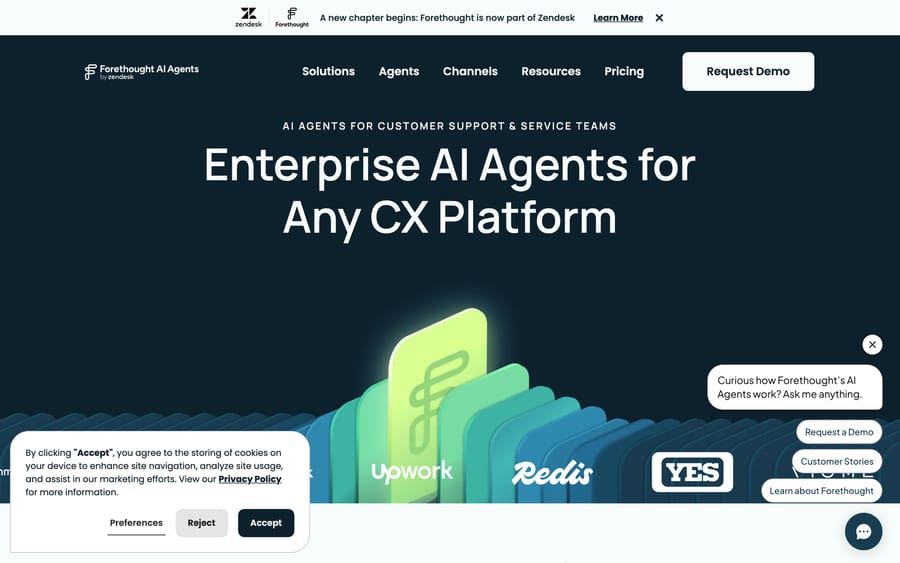
Capacity and Forethought both sell broad, enterprise-grade AI agent platforms, well beyond a single-channel bot, and both now carry the backing of a much larger acquirer's worth of credibility: Capacity through its funding and acquisitions, Forethought through being absorbed into Zendesk directly. If your team is genuinely running a multi-channel contact center and wants one vendor for agents, assist, and QA, either is a reasonable shortlist entry. If the actual problem is ticket volume inside a help desk your team already runs well, an AI agent layer like Macha is the more direct comparison: priced and published, with no sales call required to see a number. See Macha pricing or Macha on your help desk.
FAQ
What is Capacity AI? Capacity is a unified CX automation platform combining AI agents (chat, voice, SMS, email), real-time Agent Assist for human agents, automated quality scoring, and outbound campaigns on one shared knowledge layer.
How much does Capacity cost? Capacity doesn't publish pricing. It sells three tiers (Core, Pro, Enterprise) plus usage-based add-ons for AI agent interactions and Agent Assist hours, entirely through sales. A third-party review estimates $2,000-3,000/month for small teams and $10,000 or more for larger deployments, though that's an estimate, not a vendor figure.
When was Capacity founded, and who leads it? Capacity was founded in 2017 in St. Louis by David Karandish, who previously built Answers.com to a $960 million exit in 2014.
How big is Capacity's business? Capacity reports crossing $100 million in annual recurring revenue, up from $5 million in 3.5 years, serving more than 20,000 organizations, and describes itself as profitable. It has raised more than $159 million total, most recently a $54 million Series E announced in September 2026.
What do Capacity's users say in reviews? G2 search results put Capacity around 4.8 out of 5 stars; a third-party aggregator reports 4.5/5 combined across G2 and Capterra from several hundred reviews. Recurring complaints include setup complexity, an accuracy ramp period before the AI performs as advertised, and the platform needing ongoing maintenance investment to keep performing well.
Does Capacity replace a contact center's human agents? Not entirely. A meaningful part of the platform, Agent Assist and Auto QA, is built around keeping humans in the loop and making them faster and more consistent, without deflecting them out of the workflow entirely.
What's a good Capacity alternative? Forethought is a comparable enterprise AI agent platform, now part of Zendesk. If your real bottleneck is ticket volume inside an existing help desk instead of a full omnichannel contact center buildout, Macha runs as an AI agent layer on top of Zendesk, Freshdesk, Gorgias, or Front.
Is Capacity a new or established company? Established: founded in 2017, profitable, past $100 million in ARR, having just closed a $54 million Series E in September 2026, and grown partly through 10-11 acquisitions, which is a different risk profile than a recently launched AI startup.
If your team is comparing broader AI agent categories, our Decagon AI guide covers another enterprise-focused conversational AI vendor worth a look. And if ticket volume inside a help desk you already run is the actual problem, you can start a Macha trial with $50 of free usage and no credit card, or check current pricing first.
Sources: Capacity's homepage, pricing page, platform page, Agent Assist page, and its public help center at support.capacity.com, all fetched directly on 2026-09-15. Capacity's own announcement of its $92M raise and two acquisitions, Capacity's Series E announcement (PR Newswire, September 2, 2026), a Yahoo Finance syndication on Capacity crossing $100M ARR (blocked our re-check with a 429; cited without a link), aicxstack.com: Capacity Review 2026.
Resolve tickets automatically with AI agents
Macha's AI agents work on top of the help desk you already use — no code.