Intercom
 Shopify
 Stripe
 Slack
Slack Notion
 Google Workspace
 Confluence

Certainly AI: The Complete Guide (2026)


Certainly is a Copenhagen-founded AI agent platform for ecommerce and D2C support, built around a multi-model architecture (Claude, Gemini, GPT, and 200+ others via OpenRouter) and published, per-conversation pricing. This guide covers what Certainly actually does, its real pricing tiers, where it holds up and where it doesn't, and how it compares to the alternatives worth putting next to it.

We build AI agents for customer service ourselves, so this is written by people who have to evaluate platforms like Certainly in practice. We checked Certainly's own site directly for every claim below instead of working from a review aggregator.
What is Certainly AI?
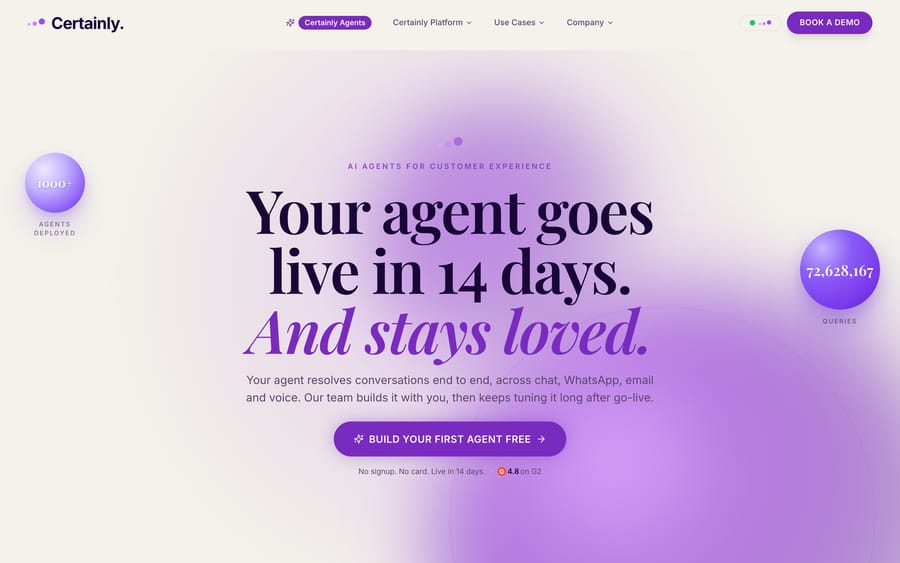
Certainly was founded in 2017 in Copenhagen and, per its own site, has deployed 1,000+ AI agents that have handled a live-updating count of tens of millions of queries (over 72.6 million at the time of this screenshot) across its customer base. The pitch leads with implementation risk instead of feature breadth: Certainly's own homepage states plainly that "most AI projects stall," positioning its own agents as ones that "go live, and stay loved," a direct jab at the industry's well-documented pilot-to-production drop-off. Leading with that framing optimizes for a buyer who has already been burned by one failed AI pilot and is shopping for reassurance as much as for features.
That 2017 founding date is worth pausing on. Most of the "AI agent" category, including most vendors in this guide series, only started existing after large language models became commercially usable around 2022 and 2023. Certainly predates that shift by five years, which means its earliest years were spent on rule-based and NLU-driven chatbots before layering generative AI on top. That history shows up in the product today as a genuine multi-model, multi-channel platform rather than a single-model wrapper rushed to market during the recent AI agent boom.
Named customers with published results include Feastables (the MrBeast chocolate brand), where Certainly's agent is credited with 6.5% of total revenue and a 20% higher average order value on post-chat purchases; Fintiba, which reports a 97% chat containment rate with 24/7 multilingual support; and Quad Lock, which reports a 43.4% resolution rate and 5x agent productivity. Other named clients include Ticketmaster, McDonald's, and GANNI. These are Certainly's own case-study figures. Certainly doesn't cite an independent audit of them, but the range of brand sizes, from a DTC phone-mount company to a McDonald's-scale enterprise, suggests the product genuinely spans different deployment sizes instead of only working at one end.
How Certainly's AI works
The mechanism worth understanding first is Certainly's multi-model architecture. Instead of building on a single LLM, Certainly natively supports Claude, Gemini, and GPT, plus more than 200 additional models through OpenRouter, with what it calls "zero lock-in." In practice, that means a team isn't betting its entire support automation on one model vendor's pricing or availability. If a model gets deprecated or a better one ships, the underlying agent framework doesn't need to be rebuilt around it.
On top of that model layer, Certainly's agents are built to "reason, act, and resolve" a conversation end to end instead of just answering a question and stopping. That's the difference between a chatbot that tells a customer where to click and an agent that actually looks up an order, applies a discount, or processes a return inside the connected systems.
Channels and integrations
Certainly deploys across web, Meta (WhatsApp and Messenger), SMS, email, and voice, and connects to more than 50 pre-built integrations spanning ecommerce, CRM, help desk, and marketing platforms, per its own site. That breadth matters for the DTC brands Certainly names as customers, since a single shopper's journey with a brand like Feastables or GANNI often spans an Instagram DM, a website chat widget, and a follow-up email, and Certainly's pitch is answering all three with one consistent agent instead of three disconnected tools.
Security and compliance posture
Certainly states it is GDPR compliant with EU data residency, SOC 2 aligned, and backed by a 99.9% uptime SLA. The EU data residency detail matters specifically for the Fintiba case study (a German fintech) and any other European financial-services buyer where data location is a compliance requirement, not a preference.
Key features
- Multi-model AI, native support for Claude, Gemini, and GPT plus 200+ models via OpenRouter.
- Multi-channel deployment: web, Meta, SMS, email, and voice.
- 50+ pre-built integrations across ecommerce, CRM, help desk, and marketing platforms.
- AI reporting, tracking revenue influenced, resolution rate, and CSAT.
- GDPR compliance and EU data residency, plus SOC 2 alignment.
- 99.9% uptime SLA, with custom SLA terms and uptime credits on Enterprise.
Certainly AI pricing
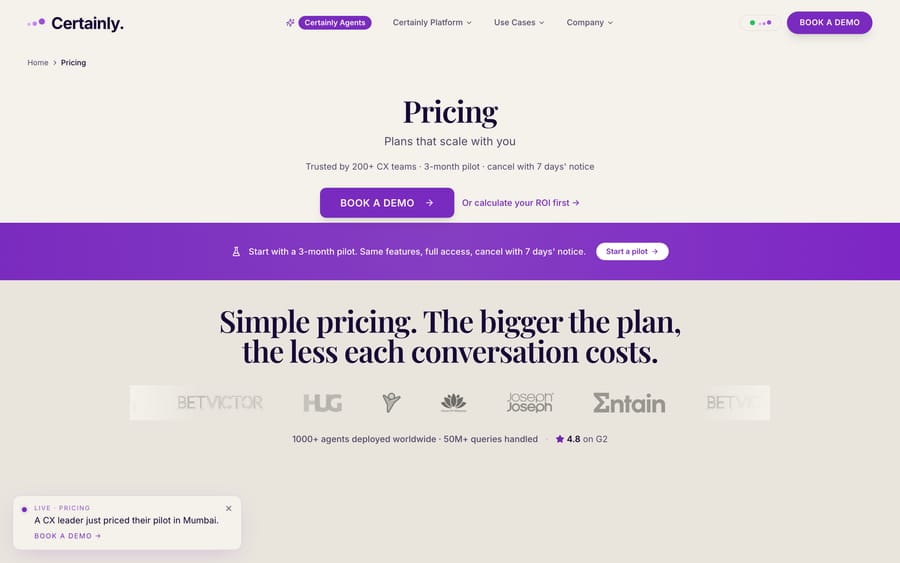
Certainly publishes real, checkable pricing, billed annually, prices excluding VAT and sales tax. Its pricing page states the company is "trusted by 200+ CX teams," with logos including BetVictor, HUG, Joseph Joseph, and Entain alongside the DTC and enterprise names on its homepage:
| Plan | Price/month | Conversations/month | Cost per conversation | Notable inclusions |
|---|---|---|---|---|
| Starter | €500 | 2,000 | ~€0.25 | 1 AI agent, web widget, knowledge base, CRM integration, unlimited seats |
| Pro | €1,250 | 10,000 | ~€0.125 | 3 AI agents, bring-your-own-key, 2 additional channels, AI reporting, dedicated onboarding |
| Enterprise | From €2,500 | From 40,000 | From ~€0.0625 | Unlimited AI agents, all channels, white-label, custom SLA, dedicated account manager |
The per-conversation rate halves at each tier: roughly €0.25 on Starter, €0.125 on Pro, and under €0.0625 on Enterprise. That's a genuine volume discount instead of a flat rate dressed up as one. A team's real cost per resolved conversation depends heavily on which tier its actual volume lands in; the plan's headline number alone doesn't tell the whole story.
Every plan runs as a 3-month pilot with 7-day cancellation notice, and Certainly notes annual billing over quarterly saves roughly 25%. Payment runs by bank transfer or credit card via Stripe, with a 5% surcharge on card payments, a detail worth knowing before assuming a monthly card charge is the only option.
Pros and cons
Pros
- Real, published, per-conversation pricing with a clear volume discount structure.
- Multi-model architecture avoids single-vendor LLM lock-in.
- Named case studies spanning a wide range of company sizes, from DTC brands to Ticketmaster and McDonald's.
- GDPR compliance and EU data residency, relevant for European and regulated buyers.
- Genuine multi-channel reach: web, Meta, SMS, email, and voice from one platform.
Cons
- Entry pricing (€500/month for 2,000 conversations) is meaningfully higher than the self-serve tools in this category.
- Annual billing commitment required to access the published rates; the 3-month pilot softens but doesn't remove that commitment.
- A 5% surcharge applies to card payments, an unusual line item worth budgeting for.
- Case-study results (containment rate, resolution rate, revenue share) are vendor-reported, without independent audit.
Who Certainly AI is best for
Certainly fits a D2C or ecommerce brand with real, multi-channel support volume, web chat, Meta, email, maybe voice, that wants one AI agent handling all of it with model flexibility baked in. The named case studies suggest it's genuinely used at both a DTC scale (Quad Lock, Feastables) and a large-enterprise scale (Ticketmaster, McDonald's), which is a wider range than most vendors in this guide series can credibly claim.
Certainly fits teams with a real, multi-channel support operation and a budget to match; it's a weaker fit for a small team just starting to explore AI support automation, since the €500/month entry price and annual billing commitment are a real budget decision instead of a low-friction trial. It's also not built around a traditional help desk ticket queue. A team whose support already runs through Zendesk or Freshdesk and wants AI acting inside that existing system is solving a different problem than Certainly is built for.
Certainly AI vs alternatives
| Certainly AI | Yuma AI | Macha | |
|---|---|---|---|
| Model | Multi-model AI agent for ecommerce/D2C, multi-channel | AI agent for ecommerce customer support tickets | AI agent layer on your existing help desk |
| Best for | D2C and enterprise brands with multi-channel support volume | Shopify/ecommerce brands automating support replies | Teams on Zendesk, Freshdesk, Gorgias, or Front |
| Pricing | €500-€2,500+/mo billed annually, published on certainly.io/pricing | Published tiers on its site | From $299/mo for 750 tickets (~$0.40/ticket), published |
| Setup | Guided onboarding, annual contract | Self-serve or guided | Built, tested, and monitored by the Macha team |
| Trial | 3-month pilot, 7-day cancellation notice | Free trial published | $50 free usage |
| Replaces your help desk? | Often yes, as the primary multi-channel agent | No | No, deliberately augments it |
Certainly and Macha sit at different points in a support stack. Certainly is built to be the primary agent handling a brand's web, Meta, SMS, email, and voice conversations directly, often instead of routing everything through a traditional help desk first. Macha runs as an agent layer on top of the help desk a team already has, so it fits a team that has already standardized on Zendesk, Freshdesk, Gorgias, or Front and wants those existing tickets automated, instead of adopting a new multi-channel platform. For a closer comparison focused specifically on ecommerce support tickets rather than a full multi-channel agent, Yuma AI sits nearer to Certainly's ecommerce customer base.
FAQ
What is Certainly AI? Certainly is a Copenhagen-founded AI agent platform for ecommerce and D2C brands, built on a multi-model architecture (Claude, Gemini, GPT, and 200+ others) and deployed across web, Meta, SMS, email, and voice.
How much does Certainly AI cost? Starter is €500/month for 2,000 conversations, Pro is €1,250/month for 10,000, and Enterprise starts at €2,500/month for 40,000 conversations, all billed annually and excluding VAT.
Does Certainly AI offer a free trial? Not a self-serve free trial. Every plan runs as a 3-month pilot with a 7-day cancellation notice rather than an instant sign-up.
When was Certainly AI founded? Certainly was founded in 2017 in Copenhagen, per its own site, predating the post-2022 wave of large-language-model-based AI agent startups by five years.
What AI models does Certainly AI use? Certainly natively supports Claude, Gemini, and GPT, plus more than 200 additional models through OpenRouter, describing this as a "zero lock-in" architecture.
Which companies use Certainly AI? Named customers with published results include Feastables (MrBeast's chocolate brand), Fintiba, Quad Lock, Ticketmaster, McDonald's, and GANNI.
Is Certainly AI GDPR compliant? Yes. Certainly states it is GDPR compliant with EU data residency and SOC 2 alignment, relevant for European and regulated buyers.
What's a good alternative to Certainly AI for a help desk-based support team? Macha runs as an agent layer on top of the help desk (Zendesk, Freshdesk, Gorgias, or Front) a team already uses, instead of adopting a new multi-channel platform, and Yuma AI is a closer comparison for ecommerce-specific support ticket automation.
Sources: Certainly homepage (certainly.io — unreachable at time of publish, verified via cached screenshot 2026-09-15), Certainly pricing (certainly.io/pricing — unreachable at time of publish, verified via cached screenshot 2026-09-15).
Resolve tickets automatically with AI agents
Macha's AI agents work on top of the help desk you already use — no code.