Intercom
 Shopify
 Stripe
 Slack
Slack Notion
 Google Workspace
 Confluence

Alhena AI Review and Complete Guide (2026)


If you sell online and you've started shopping for an AI agent to handle customer questions — and maybe nudge a few more carts to checkout — Alhena (the product at alhena.ai) has probably surfaced in your research. It pitches itself as a "hallucination-free" AI shopping assistant that both answers support tickets and actively sells: recommending products, answering pre-purchase questions, and closing the loop on returns and order updates. If the name feels new, that's because it is: Alhena rebranded from Gleen AI in early 2025, so a lot of older reviews and app-store links still carry the Gleen name.

This is our honest, researched guide to Alhena — what it is, how it works, what it actually costs, who it fits, and how it stacks up against the alternatives. Full disclosure up front: we build an AI support product (Macha) ourselves, so we'll be transparent about that. But the goal here is a genuine guide to Alhena, not a pitch. Where we can't verify a number, we say so.
Alhena AI review: our verdict, scored
Six criteria, 0 to 5 each, 30 available, and 18 out of 30 is the bar a product has to clear to make one of our shortlists. It is the same rubric, with the same anchors, that we publish and show the working for on best help desk software. For an AI agent vendor rather than a help desk, "AI that resolves" means resolves end to end rather than drafts a suggestion for a human.
| Criterion (0-5) | Alhena | Why |
|---|---|---|
| Published pricing | 4 | Every tier, its conversation allowance and an explicit list of what does not consume credits are on the pricing page, re-read 22 September 2026. The overage rate is the one number that isn't there, and it is the number that decides a busy month. |
| Entry cost for a small team | 4 | There is a genuine $0 plan and it is not seat-priced, but 25 conversations a month is a taster rather than real volume, and the first paid step is $199 a month. |
| AI that resolves | 5 | The agent closes the loop rather than deflecting: order tracking, returns, cancellations and in-chat refunds, without a person in the middle. |
| Write actions | 5 | Documented actions change real records in Shopify and connected systems: process a return, issue a refund, update an order, trigger a multi-step flow. |
| Independent review base | 1 | 35 ratings on G2 and 6 on the Shopify App Store. Its Capterra listing exists and carries zero reviews, and there is no Trustpilot profile at all (all checked 22 September 2026). |
| Channel coverage | 3 | Storefront chat, plus email and tickets through Zendesk, Gorgias, Gladly, Salesforce and Intercom, plus social. No voice. |
| Total | 22 / 30 | Clears the 18/30 bar. |
Alhena clears the bar, and it does it the unglamorous way: by publishing its prices where a buyer can read them. It takes 13 of the 15 capability points, losing the rest on a voice channel it doesn't have, and the only thing genuinely holding the total down is that not many people have reviewed it yet.
Is Alhena AI worth it?
It is worth it if you sell physical goods online, mostly on Shopify, and you want one agent that answers pre-purchase questions and handles order and return work in the same conversation. You can start on the free plan, you will be live in days rather than months, and you will know what a busy month costs before it happens.
It is not worth it if you are outside e-commerce. That is not a criticism; it is the product's stated scope. The pricing, the agents and the integrations all assume you sell goods, and a B2B SaaS or services team will find most of it inapplicable. It is also the wrong buy if you need voice, or if a 41-review track record across two sites is not enough evidence for your procurement process.
What is Alhena AI?
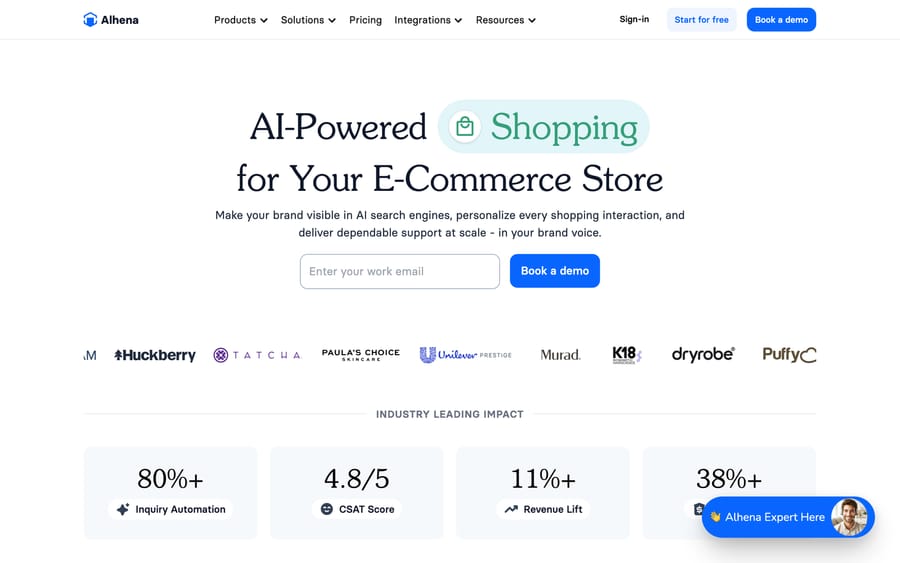
Alhena AI's homepage, aimed at ecommerce customer experience.
Alhena is an AI shopping and support assistant built specifically for e-commerce brands. Its promise is two-sided: automate customer support (order status, returns, WISMO, policy questions) and drive revenue (product discovery, recommendations, upsells) from the same conversational agent. It's sold as an all-in-one layer for Shopify-first merchants, with pre-trained "vertical" agents tuned for categories like fashion, beauty, home, travel, and sports.
The company launched in 2022 — originally as Helix3 Labs, Inc., based in Pleasanton, California — and was founded by ex-LinkedIn engineers, with Ashu Dubey as CEO and Nagendra Kumar as CTO. It rebranded from Gleen AI to Alhena in February 2025 (Alhena). On the funding side, the company (as Gleen) reportedly announced a ~$4.9M seed round led by Slow Ventures around 2023 (Alhena); reported totals vary across sources, so treat the number as approximate.
Architecturally, Alhena is an AI agent layer that connects to the tools you already run — Shopify, plus helpdesks like Zendesk, Gorgias, Gladly, and Intercom — rather than a helpdesk replacement. It answers from your knowledge and store data, and where you wire it up, it can take actions like processing returns and updating orders. It's worth being clear on scope from the start: Alhena is deliberately narrow. Where a horizontal platform tries to serve every industry, Alhena's product, pricing, and workflows all assume you are selling physical or digital goods online. That focus is its greatest strength and its clearest limitation.
A quick note on the Gleen → Alhena rebrand
Because the rebrand only happened in February 2025, the product carries a split identity across the web. The Shopify App Store listing still lives at apps.shopify.com/gleen-ai, older G2 and Capterra records reference "Gleen AI," and third-party teardowns are scattered across both names. When you research the product, treat "Gleen AI" and "Alhena AI" as the same company and pool the reviews — otherwise you'll undercount the track record and get a distorted read on maturity.
How Alhena's AI works
Alhena's central marketing claim is that its agent is "hallucination-free." In practice that means it's grounded in your knowledge sources and store data, with guardrails intended to keep it from inventing answers. You connect your help-center content, product catalog, and order data, and the agent responds from that corpus rather than improvising from a generic model. Like most modern e-commerce agents, its answer quality lives and dies by the quality of the knowledge you feed it — the "hallucination-free" framing is best read as a design goal to validate in a pilot, not a guarantee.
Under the hood, Alhena organizes the work into specialized agents rather than a single monolithic bot. A Product Expert Agent handles product discovery, comparisons, and guided shopping by reading your full product catalog and real-time inventory (on Shopify, this maps to the read_products scope, powering product search and recommendations). An Order Management Agent handles order tracking, returns, cancellations, and refund workflows — including in-chat refund processing, return initiation, and live carrier tracking updates. Splitting the job across purpose-built agents is what lets Alhena both answer "which of these two jackets is warmer?" and "where is my order and can I return it?" in the same conversation.
Beyond answering, Alhena is pitched as a full agentic platform: it processes returns, updates orders, triggers workflows, and closes the loop end-to-end without a human in the middle (Alhena). That action-taking — reaching into Shopify and connected systems to actually do things — is what separates a true agent from a deflection chatbot that only links to help articles. If you're evaluating how far that goes, our guide to building custom tools and actions for an AI agent covers the mechanics.
The other half of Alhena is revenue: an AI Shopping Assistant that handles product discovery, recommendations, and upsells, plus a Sales AI and an AI Social Commerce layer that extends the same guided-selling motion into social channels. It also engages customers in 90+ languages, which matters for brands selling across markets. Note that AOV-lift and resolution-rate figures Alhena cites are vendor-reported — useful as directional signals, not independently verified benchmarks.
Key features
- AI Shopping Assistant / Product Expert Agent — pre-purchase Q&A, product comparisons, guided selling, and upsells drawn from your live catalog and inventory to lift conversion and AOV.
- AI Support Concierge / Order Management Agent — automated resolution for order status, returns, cancellations, refunds, WISMO, and policy questions, with in-chat refund processing and live carrier tracking.
- AI Agent Assist — a copilot that drafts replies for human agents rather than fully automating, so the same knowledge base serves both the bot and your team.
- Actions & workflows — process returns, issue refunds, update orders, and trigger multi-step flows in Shopify and connected systems.
- Vertical agents — templates tuned for fashion, beauty, home, travel, and sports, so setup starts from a category-aware baseline instead of a blank slate.
- Review management & social commerce — surface and act on reviews, and carry the shopping assistant into social channels.
- Integrations — Shopify, WooCommerce, Magento, BigCommerce, and headless/custom stacks on the storefront side; Zendesk, Gorgias, Gladly, Salesforce, Klaviyo, and Intercom on the support and marketing side (Alhena Shopify integration).
- 90+ languages for multi-market brands.
- Analytics dashboard — reporting on conversations, resolution, and performance (see the honest note on depth below).
Deployment and setup reality
One of Alhena's more credible operational claims is speed of deployment. For Shopify merchants, setup runs through a standard OAuth flow that handles permissions, token exchange, and automated agent configuration — and Alhena reports most brands are live within 48 hours, with no developer resources, no Liquid theme changes, and no separate implementation fee. That is a genuinely low-friction on-ramp compared with platforms that require a professional-services engagement before you see a working agent.
The trade-off to plan for is the training work behind that speed. Because the agent answers from your knowledge, catalog, and order data, the quality of a pilot is bounded by how clean and complete those sources are. Alhena offers automated weekly retraining to keep answers fresh as your catalog and policies change, but the honest expectation for any grounded agent is that the first week is a tuning exercise: seed the knowledge base well, watch the transcripts, and correct gaps before you widen automation. Alhena is also platform-agnostic beyond Shopify — WooCommerce, Magento, BigCommerce, and headless stacks are supported — though Shopify remains the most polished, best-documented path.
Alhena AI pricing (2026)
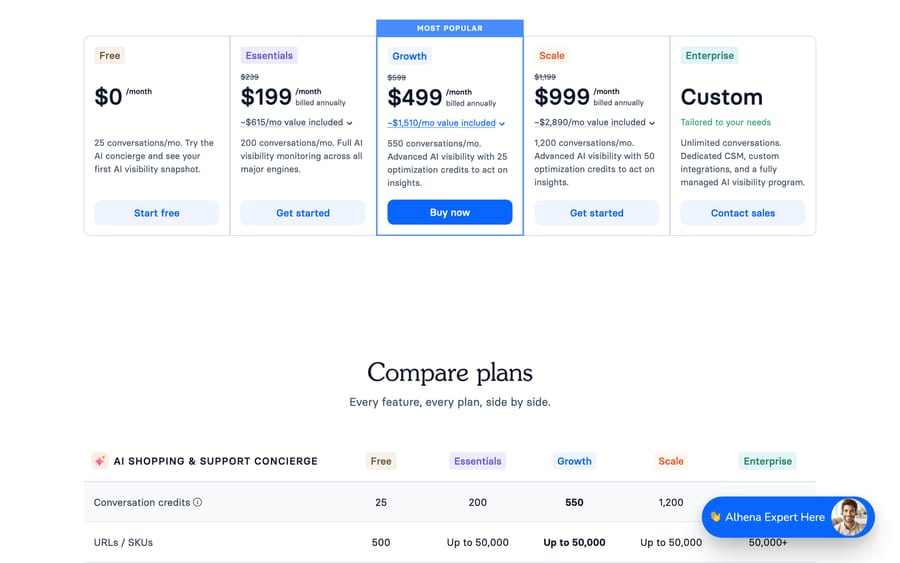
Alhena AI's published pricing tiers.
Alhena publishes pricing, which is a point in its favor — many competitors hide it behind a demo. Every figure below was read on alhena.ai/pricing in a browser, and each one starts with a dollar sign on the US page.
| Plan | Billed annually | Billed monthly | Conversations a month | Prices read |
|---|---|---|---|---|
| Free | $0 | $0 | 25 | 22 September 2026 |
| Essentials | $199 | $239 | 200 | 22 September 2026 |
| Growth | $499 | $599 | 550, plus 25 optimization credits | 22 September 2026 |
| Scale | $999 | $1,199 | 1,200, plus 50 optimization credits | 22 September 2026 |
| Enterprise | Custom | Custom | Unlimited, dedicated CSM | 22 September 2026 |
One naming change worth knowing about if you are reading an older review: the $199 tier is now called Essentials, not Pro. The Shopify App Store listing carries the same ladder at the monthly rate — Free, Essentials $239, Growth $599, Scale $1,199 — which is a useful cross-check that the page is not showing you a personalised price. Essentials also carries up to ~50,000 SKUs or URLs, several AI profiles, advanced analytics, email support, automated weekly training, review management, social integrations and API agents.
A word on the billing model: Alhena bills by conversations and "optimization credits," not strictly per resolution. Encouragingly, it publishes what it doesn't charge for — spam, irrelevant queries, and immediate human handoffs where the AI never engages cost zero credits — which softens the usual worry with conversation-metered pricing. Additional actions beyond your plan are billed as overage at roughly $1.20 each (some earlier listings cited a lower ~$0.83 floor; the published rate has trended toward $1.20). Model this against your real ticket volume: a high-traffic store can move through a conversation allotment quickly, and overage adds up, so the plan tier you pick matters more than the headline price. All figures here are fast-moving — confirm the current numbers directly with Alhena (Alhena pricing).
What real users say about Alhena
Here is every rating base we could find, with the date we read it. Two of the four sites a review query usually lands on have nothing to give you, and that is the finding rather than a gap in our research.
| Source | Rating | Ratings counted | Checked |
|---|---|---|---|
| G2 | 4.9 / 5 | 35 | 22 September 2026 |
| Shopify App Store | 5.0 / 5 | 6 | 22 September 2026 |
| Capterra | listing exists, no score | 0 | 22 September 2026 |
| Trustpilot | no profile | 0 | 22 September 2026 |
Forty-one ratings across two sites is a real track record for a company this size and a thin one against anything you would call an incumbent. Read the 4.9 as a genuine signal about a small, engaged customer base, not as a number comparable to a help desk's 7,000-rating average. The Shopify listing is also still filed under apps.shopify.com/gleen-ai, which is the rebrand showing through again.
What users complain about
The honest answer is that the G2 dislikes are unusually mild, and we are reporting that rather than inventing a complaint. The head of customer service at a mid-market company wrote on 29 August 2025: "No immediate dislikes, we grow with Alhena" (G2). The substantive criticisms that do exist are feature requests from the Gleen era rather than failures. A marketing technology specialist at a mid-market retailer wanted the agent pushed further into revenue: Alhena "has been focused primarily on improving customer service, but improving conversion is a big deal as well", and noted the team was "in the process of adding a lot of conversion features". A small-business reviewer flagged billing mechanics rather than the product: "their billing system isn't yet built to automatically support a pay-as-you-go model and just leave a credit card on file", adding that the team worked around it manually.
Two of those three are dated 2024, which is the real caveat: a meaningful share of Alhena's review base predates the rebrand and describes Gleen AI. Pool them, as the rebrand section above says, but read the dates.
Pros and cons
Pros
- Purpose-built for e-commerce, with deep Shopify integration, live-inventory awareness, and specialized product/order agents.
- Genuinely two-sided — it's built to sell, not just deflect, which is rare in support-first tools.
- Fast, low-friction deployment — OAuth setup, most brands live within ~48 hours, no Liquid changes or separate implementation fee.
- Transparent, published pricing with a free tier and a clear list of what doesn't consume credits.
- 90+ languages and vertical templates speed up setup for niche brands.
- Reviewers on G2 rate it highly (4.9 out of 5 from 35 ratings, read 22 September 2026), praising response quality, easy training, and — carried over from the Gleen era — a responsive team during onboarding.
Cons
- E-commerce-only focus — B2B SaaS, agencies, and service businesses should look elsewhere; the product, pricing, and workflows all assume you sell goods online.
- Analytics depth is limited — the most consistent reviewer complaint is that the dashboard lacks deep trend analysis and long-term comparisons; fine for smaller stores, frustrating at larger scale.
- Modest review volume — the footprint is genuine but still small (tens of reviews, not hundreds), and it's fragmented across the Gleen and Alhena names, so social proof takes some digging to assemble.
- Conversation-based billing can get expensive at high volume once you exceed your plan and hit ~$1.20 overage per action.
- Newer brand identity means some third-party docs, integrations lists, and app-store links still point at "Gleen," which can slow due diligence.
Who Alhena is best for
Alhena is a strong fit if you're a DTC or e-commerce brand — especially on Shopify — that wants one agent to both handle support and drive revenue. If product discovery, recommendations, and upsells matter as much as ticket deflection, its two-sided design is a genuine differentiator. It's also a good option for multi-market brands that need 90+ languages out of the box, and for smaller teams that want transparent pricing and a free tier to start.
It's a weaker fit if you're outside e-commerce, if you need deep analytics and reporting, or if you want an AI layer that spans a broader stack of helpdesks and internal tools beyond the e-commerce core.
Who should not buy Alhena AI
- Anyone not selling goods online. B2B SaaS, agencies, professional services: the product, the pricing units and the pre-built agents all assume a catalog and an order. There is no version of this that fits.
- Anyone who needs voice. There is no voice channel. If phone is a real part of your support mix, Alhena covers the rest and not that.
- Teams whose procurement needs a deep review base. Forty-one ratings across two sites, no Trustpilot profile and an empty Capterra listing is a thin evidence base, and a committee that wants hundreds of independent reviews will not get them here.
- High-volume stores that haven't modelled overage. Conversation allowances are generous at the top tier and the overage rate is the one figure the pricing page does not publish. Get it in writing before you sign, not after your first sale week.
Alhena vs alternatives
No single AI agent wins for everyone. Here's an honest comparison of Alhena against the vendors it most often gets shortlisted with — including us. We have full guides to Yuma AI and Rep AI if you want the detail on the two it loses and wins deals against most often.
| Alhena | Yuma AI | Rep AI | Gorgias native AI | Macha | |
|---|---|---|---|---|---|
| Best for | E-commerce support + sales | Shopify support automation | Shopify conversion / guided selling | Existing Gorgias merchants | Teams layering AI onto any helpdesk |
| Core model | AI shopping + support agents | Autonomous resolutions | Sales-first shopping assistant | Add-on to Gorgias | AI agent layer on your existing helpdesk |
| Pricing | Published; conversation-based, from ~$199/mo | Outcome-based, quote-only | Tiered, conversion-focused | Bundled/usage add-on | Per ticket |
| Sells + supports | Yes (two-sided) | Support-focused | Sales-focused | Support-focused | Support + workflow automation |
| Storefront platforms | Shopify, Woo, Magento, BigCommerce, headless | Shopify-first | Shopify-first | Shopify (via Gorgias) | Helpdesk-agnostic |
| Runs on your helpdesk | Connects (Zendesk, Gorgias, Gladly, Intercom) | Connects (Gorgias, Zendesk) | Connects (Gorgias, others) | Native only | Yes — Zendesk, Freshdesk, Front, Intercom, Gorgias |
| Deploy speed | ~48 hrs, no dev work | Days | Fast | Instant (in-Gorgias) | Days; plain-English build |
Where we fit: Macha is an AI agent layer that runs on top of the helpdesk you already use — Zendesk, Freshdesk, Front, Intercom, or Gorgias — and you build agents in plain English. Instead of conversation bundles, we price per ticket (one plan from $299/month for 750 tickets, one charge per thread), so the lookups, tool calls and replies inside a ticket don't add to the bill. If you want the two-sided sell-and-support motion Alhena is built around, Alhena may be the cleaner fit; if you want to bring your own helpdesk and automate real workflows across it, that's where Macha lives. Compare the pricing model and decide by fit.
How we researched this
The plans, limits and feature detail in this guide come from Alhena’s own pricing and product pages, its help documentation, and the app-store listings for the storefronts and help desks it connects to, read when the post was written; the G2 figures quoted above are from that same pass. On 22 September 2026 we re-read alhena.ai/pricing, the Shopify App Store listing and the G2, Capterra and Trustpilot records in a real Chrome session, which is how the plan table, the Essentials rename and all four rating figures above are dated to that day. We have not run Alhena on a live store ourselves, and the Gleen AI / Alhena AI rename means some older review records sit under the former name.
Frequently asked questions
What is Alhena AI? Alhena is an e-commerce AI shopping and support assistant (at alhena.ai) that automates customer support and drives revenue through product recommendations and upsells. It rebranded from Gleen AI in February 2025.
Is Alhena the same as Gleen? Yes. Alhena is the rebranded name for Gleen AI; the rebrand happened in February 2025, so older reviews and links may still reference Gleen.
Is Alhena AI worth it? For a Shopify-first brand, yes on the evidence available: it scores 22 out of 30 on our rubric, clearing the 18-point bar, mostly because it publishes what it charges and its agent actually closes returns and refunds rather than linking to an article. The caveats are scope and sample size: e-commerce only, no voice, and 41 independent ratings in total.
What do users complain about with Alhena AI? Very little, and we would rather say that than invent something. The G2 dislikes are mostly "no immediate dislikes" or feature requests: more conversion features alongside the support ones, and a billing system that did not support leaving a card on file for pay-as-you-go. Note that a meaningful share of the review base is dated 2024 and describes the product under its old Gleen AI name.
What is Alhena AI rated on G2 and Capterra? 4.9 out of 5 from 35 ratings on G2 and 5.0 from 6 on the Shopify App Store, both read on 22 September 2026. Its Capterra listing exists but carries no reviews, and there is no Trustpilot profile for alhena.ai at all.
How much does Alhena AI cost? Alhena publishes pricing, read on 22 September 2026: a free tier with 25 conversations a month, Essentials at $199 a month billed annually or $239 monthly, Growth at $499 or $599, Scale at $999 or $1,199, and custom Enterprise pricing. Billing is conversation- and credit-based; the overage rate is not on the pricing page, and third-party listings have quoted roughly $0.83 to $1.20 per action, so get it in writing.
Who funds Alhena AI? As Gleen, the company reportedly raised a ~$4.9M seed round led by Slow Ventures (reported totals vary across sources, so treat the figure as approximate).
Does Alhena work with Shopify? Yes — Alhena is built for Shopify-first merchants and is listed on the Shopify App Store (still under the gleen-ai app URL). Setup runs through OAuth with no theme or Liquid changes, and most brands are live within about 48 hours. Beyond Shopify it also supports WooCommerce, Magento, BigCommerce, and headless stacks, and integrates with helpdesks like Zendesk, Gorgias, Gladly, and Intercom plus Salesforce and Klaviyo.
How does Alhena's credit and conversation billing work? Plans include a monthly conversation allowance (roughly 25 free, ~200 on Pro, ~550 on Growth, ~1,200 on Scale), plus "optimization credits" on higher tiers. A credit is consumed when the AI resolves or assists an interaction; spam, irrelevant queries, and immediate handoffs where the AI never engages are not charged. Actions beyond your allowance bill as overage at roughly $1.20 each. Confirm current numbers with Alhena.
Is Alhena good for support only, or does it drive sales too? Both, by design. It runs a Product Expert Agent for discovery, comparisons, and upsells alongside an Order Management Agent for tracking, returns, and refunds. If you only need deflection, that dual focus may be more than you need; if pre-purchase selling matters, it's the point.
What do reviewers say about Alhena? On G2 it rates around 4.9/5 across roughly 36 reviews, with praise for response quality and easy training. The most common criticism is limited analytics depth — the dashboard lacks deep trending and long-term comparisons — which matters more for larger stores.
What are the best Alhena alternatives? Depending on your needs: Yuma AI (Shopify support automation), Rep AI (Shopify conversion/guided selling), Gorgias native AI (for existing Gorgias merchants), and Macha (an AI agent layer that runs on your existing helpdesk with per-ticket pricing).
Shopping for an AI agent that runs on the helpdesk you already use, with pricing that tracks the work done? See how Macha compares, or explore the pricing.
Resolve tickets automatically with AI agents
Macha's AI agents work on top of the help desk you already use — no code.