Intercom
 Shopify
 Stripe
 Slack
Slack Notion
 Google Workspace
 Confluence

Rep AI: The Complete Guide (2026)


Rep AI is a Shopify-focused AI agent that watches how shoppers behave on a storefront and steps in with both a sales pitch and support help in the same chat window, treating sales and service as one job instead of two separate tools. This guide covers what Rep AI actually does, how its behavioral-signal detection works, what it costs by visitor volume, where it falls short, and how it stacks up against Yuma AI and against running a support-focused AI layer on the help desk you already use. We checked Rep AI's own site and its Shopify App Store listing directly for this guide.

What is Rep AI?
Rep AI positions itself as an agentic commerce platform for ecommerce brands, built around a single AI agent that does two jobs on the same storefront: sell and support. On the sales side, it watches shopper behavior (hesitation on a product page, comparing items, signs a visitor is about to leave) and starts a contextual conversation to help with product discovery. On the support side, the same agent resolves the routine stuff, order tracking, returns, cancellations, policy questions, before those questions turn into a support ticket at all.
The company says it serves thousands of ecommerce brands and names Lashify, Kinn Studio, Ascent Nutrition, and Country Wine & Spirits as customers on its site. One case study describes Kinn Studio using conversation data from Rep AI to inform merchandising decisions, which points at a second thing Rep AI sells alongside automation: every chat becomes structured data about what shoppers actually ask and want.

Rep AI's homepage, describing "one AI brain" that powers sales and support across every channel.
How Rep AI's AI works
Rep AI's mechanism is behavioral detection first, conversation second. The system tracks what it describes as hundreds of signals per visitor: dwell time on a product, price-comparison behavior, cart abandonment risk, repeat visits to the same category. When a signal pattern suggests a shopper needs help or is about to leave without buying, the AI initiates a conversation instead of waiting for the shopper to open the chat widget itself. From there, it narrows product options dynamically through back-and-forth, similar to how a floor associate would ask a few questions before pointing someone at three specific items instead of the whole catalog.
On the support half, the same conversational layer answers the repeat questions ecommerce support queues are full of: "where is my order," "can I return this," "what's your shipping policy." Rep AI's pitch is that keeping sales and support in one agent means the AI already knows a shopper's order history and browsing behavior when a support question comes in, instead of starting cold the way a separate helpdesk bot would.
Key features
- Behavioral intent detection: monitors on-site signals to identify when to proactively engage a shopper, instead of waiting passively for a chat click.
- Dynamic product narrowing: guides shoppers to specific products through conversation, instead of a static recommendation widget.
- Automated support resolution: handles order status, returns, cancellations, and policy questions without a ticket.
- 175+ integrations: including Shopify, Klaviyo, WooCommerce, Salesforce Commerce, and Gorgias, across website chat, email, Facebook, Instagram, and WhatsApp.
- Conversation intelligence: structures chat data into merchandising and product insights, as in the Kinn Studio case study.
- 5x ROI guarantee: Rep AI states this on its pricing page, alongside a free ROI calculator.
Rep AI pricing
Rep AI's own pricing page is a "build your stack" calculator instead of a static price list, but the plan structure and numbers are published on its Shopify App Store listing:
| Plan | Price | Visitor cap | Product cap |
|---|---|---|---|
| Pay-as-you-Grow | Free to install, $12 per additional 1,000 visitors | 100 free visitors/month | Up to 100 products |
| Starter | $104/month ($995/year) | 10,000 visitors/month | 1,000 products |
| Basic | $209/month ($2,006/year) | 25,000 visitors/month | 2,000 products |
| Standard | $368/month ($3,528/year) | 50,000 visitors/month | 5,000 products |
Annual billing saves about 20% against the monthly rate on every paid tier. All plans include AI sales skills, custom branding, and AI training on your catalog, and Starter through Standard carry a 14-day free trial with no credit card required.
The pricing mechanism is worth naming directly: Rep AI charges by store traffic instead of by resolutions or conversations closed. That's an incentive worth sitting with. The bill grows with how many people visit your store, whether the AI converts them, deflects a ticket, or does neither, so Rep AI earns more from your traffic growth even in a month its agent adds little value. It's a fair proxy for the load a busy storefront puts on the tool, but a high-traffic, low-conversion store pays a premium for volume the AI isn't necessarily doing much with.
Pros and cons
Pros
- Combines sales and support in one agent, so shopper context (order history, browsing behavior) carries into support conversations instead of starting cold.
- Proactive engagement based on real behavioral signals, going well beyond a static "chat with us" prompt.
- Deep ecommerce integration list (175+), covering the tools a Shopify store typically already runs.
- Strong reported satisfaction on the Shopify App Store: 4.7/5 across 116 reviews.
Cons
- Pricing scales with visitor traffic, so a high-traffic store pays more regardless of how much the AI actually resolves or sells.
- Built specifically for Shopify-adjacent ecommerce; it isn't a fit for a company running B2B or account-based support outside a storefront.
- The published tiers live on the Shopify App Store rather than on Rep AI's own site, which makes pricing harder to find if you start from hellorep.ai directly.
- The support side is scoped to routine, order-and-policy questions; it isn't built for account-level or technical support outside commerce.
Who Rep AI is best for
Rep AI fits Shopify (and Shopify-adjacent) stores that want one AI agent covering both proactive sales assistance and the repeat support questions a storefront generates, especially stores with meaningful visitor volume where behavioral engagement can meaningfully lift conversion. It suits teams that already treat chat as a revenue channel and want it to keep earning that way, since that's the premise the whole product is built on.
It's a weaker fit for a business without a storefront at the center of its support (B2B SaaS, account-based service, high-touch technical support), and for a low-traffic store where the visitor-based pricing doesn't leave much room to prove ROI before the calculator starts adding up. If your support volume genuinely lives inside a help desk like Zendesk or Gorgias instead of a chat widget on the storefront, this is a different shape of product than what you need.
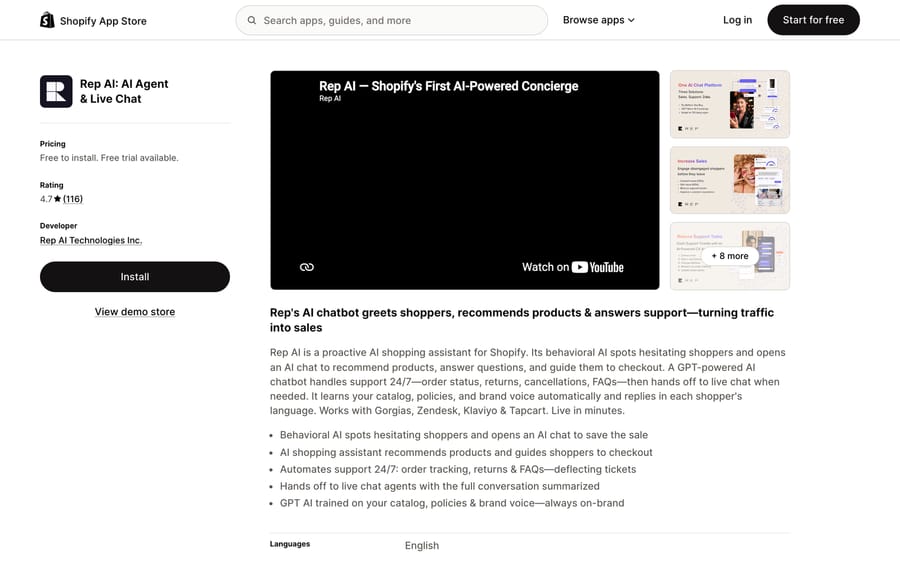
Rep AI's Shopify App Store listing, showing its 4.7-star rating across 116 reviews and "free to install" pricing summary.
Rep AI vs alternatives
| Rep AI | Yuma AI | Macha | |
|---|---|---|---|
| Model | Combined sales + support agent for storefronts | Support-focused AI agent for ecommerce help desks | AI agent layer on your existing help desk |
| Best for | Shopify stores wanting proactive sales plus support | Ecommerce teams automating support tickets specifically | Teams on Zendesk, Freshdesk, Gorgias, or Front |
| Where it runs | Storefront chat widget | Inside the help desk (Gorgias, Zendesk, etc.) | Inside the help desk you already run |
| Pricing | $104–$368/mo by visitor volume, published | Not fully published; see Yuma AI guide | From $299/mo for 750 tickets (~$0.40/ticket), published |
| Trial | 14 days, no credit card | Varies by plan | $50 free usage |
| Setup | Self-serve install, live in a few clicks | Self-serve to guided, depending on plan | Built, tested, and monitored by the Macha team |
| Replaces your help desk? | No, sits on the storefront | No, sits inside the help desk | No, deliberately augments it |
Rep AI and Yuma AI both specialize in ecommerce, but they sit in different places: Rep AI lives on the storefront and is built to sell as much as it supports, while Yuma AI and Macha both work from inside the help desk where support tickets already land. If proactive on-site sales assistance is what you're after, Rep AI is a direct, purpose-built option. If your actual problem is the ticket queue in Zendesk, Freshdesk, Gorgias, or Front, an AI agent layer like Macha, priced and scoped around ticket volume rather than storefront traffic, is the more direct fit; see Macha pricing for the full table.
FAQ
What is Rep AI? Rep AI is an AI agent for ecommerce storefronts, mainly Shopify, that combines proactive sales assistance (based on shopper behavioral signals) with automated support for routine questions like order status and returns.
How much does Rep AI cost? Its Shopify App Store listing shows a free Pay-as-you-Grow tier ($12 per additional 1,000 visitors after the first 100 free), then Starter at $104/month, Basic at $209/month, and Standard at $368/month, each with rising visitor and product caps. Annual billing saves about 20%.
Does Rep AI have a free trial? Yes, a 14-day free trial on paid plans with no credit card required.
Does Rep AI only handle sales, or support too? Both. The same agent detects buying signals for sales conversations and resolves routine support questions like order tracking and returns.
What ecommerce platforms does Rep AI integrate with? Shopify, WooCommerce, and Salesforce Commerce as core commerce platforms, plus Klaviyo and Gorgias among 175-plus total integrations.
Who are Rep AI's customers? Rep AI names Lashify, Kinn Studio, Ascent Nutrition, and Country Wine & Spirits on its site, and says it serves thousands of ecommerce brands overall.
What's a good Rep AI alternative? Yuma AI is a close comparison for ecommerce-specific support automation, though it runs inside the help desk rather than on the storefront itself. If your support volume lives in an established help desk, Macha runs as an AI agent layer on top of it instead of adding a separate storefront tool.
Does Rep AI replace my help desk? No. It sits on your storefront as a chat widget; it doesn't replace whatever ticketing system your support team uses behind the scenes.
Sources: Rep AI homepage, Rep AI pricing, Rep AI on the Shopify App Store.
Resolve tickets automatically with AI agents
Macha's AI agents work on top of the help desk you already use — no code.