



 Intercom
 Shopify
 Stripe
 Slack
 Notion
 Google Workspace
 Confluence


What Is Zipchat? Pricing, Features and Alternatives (2026)


Zipchat is an AI sales and support agent for ecommerce stores, sold mainly as a Shopify app, with paid plans from $80 a month for 750 AI replies. It recommends products, recovers carts and answers order and refund questions in one chat widget, and each store needs its own plan.
Key takeaways
- Zipchat is an AI sales and support agent for ecommerce stores, sold mainly as a Shopify app, that recommends products, recovers carts and handles order tracking and refunds.
- Zipchat's paid plans run from Starter at $80 a month for 750 AI replies to Scale plus at $1,200 a month, with Unlimited from $2,100.
- Zipchat charges $49 for 250 extra replies once the monthly allowance runs out, annual billing saves 20%, and every paid plan has a 7-day free trial and a 30-day money-back guarantee, with each store on its own plan.
- Zipchat says under 3.2% of conversations are escalated to a human agent, a vendor-reported figure, and holds 4.9 out of 5 from 196 Shopify App Store reviews.
- For support that lives in a help desk across more than one store, Macha is the done-for-you alternative: the Macha team builds and runs the agent at about $0.40 a ticket, dedicated success manager included.

Zipchat is an AI sales and support agent for ecommerce stores, sold mainly as a Shopify app, and its paid plans start at $80 a month (or $64 a month billed annually) for 750 AI replies. It recommends products, tries to recover abandoned carts, and answers order-tracking and refund questions in the same chat widget.
| Question | Answer (checked 24 September 2026) |
|---|---|
| What it is | AI sales and support agent for ecommerce, native Shopify app |
| Paid plans | Starter $80, Pro $300, Scale $600, Scale plus $1,200 a month (20% less billed annually); Unlimited from $2,100 |
| Free option | Free plan with 120 replies a month on the Shopify App Store listing only |
| Trial | 7-day free trial and 30-day money-back guarantee on paid plans |
| Channels | Website chat, WhatsApp, Instagram DM, Messenger, email |
| Ratings | 4.9 on Shopify (196 reviews), 4.8 on G2 and Capterra |
We build an AI agent layer for customer service ourselves, so we have a stake in this comparison. We checked Zipchat's own site, its Shopify App Store listing, and its pricing page directly, and we flag the places those sources don't agree.
What is Zipchat?
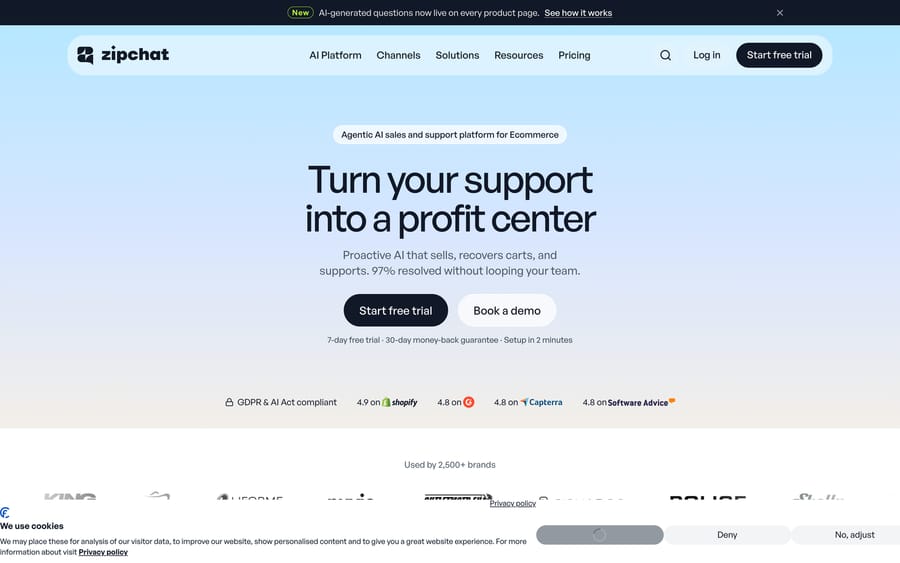
Zipchat Inc. is registered in Wilmington, Delaware, and its Shopify app listing shows a launch date of May 23, 2023. The homepage says it serves 2,500+ ecommerce brands, from DTC stores to enterprise retailers, and names three case studies: Burger Motorsports ($1.45M+ in revenue attributed to Zipchat and an 80x return on spend), Tropicfeel (85% of customer questions handled without a person) and Shelly (8 to 12x return on spend every month). Those are vendor-published figures, closer to a sales pitch than an audited result. Still, named customers with specific numbers are a real signal that stores are running it.
The pitch is narrower than a generic support chatbot: Zipchat is built to sell as much as it answers. It recommends products in conversation, tries to recover a cart before checkout is abandoned, and handles the post-purchase questions (where's my order, can I get a refund) that would otherwise land in a support inbox. Shopify is the main listing, and the homepage also lists Shopify Plus, WooCommerce, BigCommerce, Wix, Magento/Adobe Commerce, PrestaShop and Salesforce Commerce Cloud.
How does Zipchat's AI work?
Zipchat auto-crawls a store's product catalog, policies, and FAQ pages to build its knowledge base, then lets a merchant refine it directly: "ask real questions, review answers, and correct anything off. It learns from every fix," per Zipchat's own site. That's a manual-correction loop, not a fully automated retraining pipeline. Someone on the team still has to notice a wrong answer and fix it, which is a real time cost worth planning for in the first few weeks.
On top of that knowledge base sits what Zipchat calls Agentic AI Search, described as a layer that "understands intent, searches across your data, and answers instantly." That's meant to go beyond keyword matching against the FAQ. In practice that's the difference between a shopper asking "does this run small" and getting a real sizing answer instead of a return-policy link.
The AI works across five channels: the website widget, WhatsApp, Instagram DM, Facebook Messenger, and email. Zipchat's homepage now says "under 3.2% of conversations are escalated to a human agent" and claims a 16.4% average chat-to-sale conversion. Both numbers are worth testing against your own ticket mix before you trust them, since a fashion store's sizing questions and an electronics store's warranty claims are very different automation problems.
What can Zipchat act on?
Beyond answering, Zipchat's feature set includes order tracking and refund processing, a size-and-fit advisor that asks qualifying questions before recommending a product, and discount-code generation with negotiation-based rules, meaning a merchant sets the limits on when and how much of a discount the AI can offer. It hands conversations to help desks including Zendesk, Gorgias, Intercom, Freshdesk and HubSpot, and states "GDPR & AI Act compliant" on its homepage.
What features does Zipchat include?
- Agentic AI Search across product catalog, policies, and FAQs, built to understand intent instead of matching keywords.
- Cart recovery and in-conversation product recommendations aimed at converting a browsing visitor.
- Order tracking and refund processing for post-purchase support.
- Size and fit advisor with qualifying questions before a recommendation.
- Discount-code generation under merchant-configured rules.
- Five channels: website, WhatsApp, Instagram DM, Facebook Messenger, and email.
- Manual correction loop: review and fix any wrong AI answer directly, with the fix applied going forward.
How much does Zipchat cost?
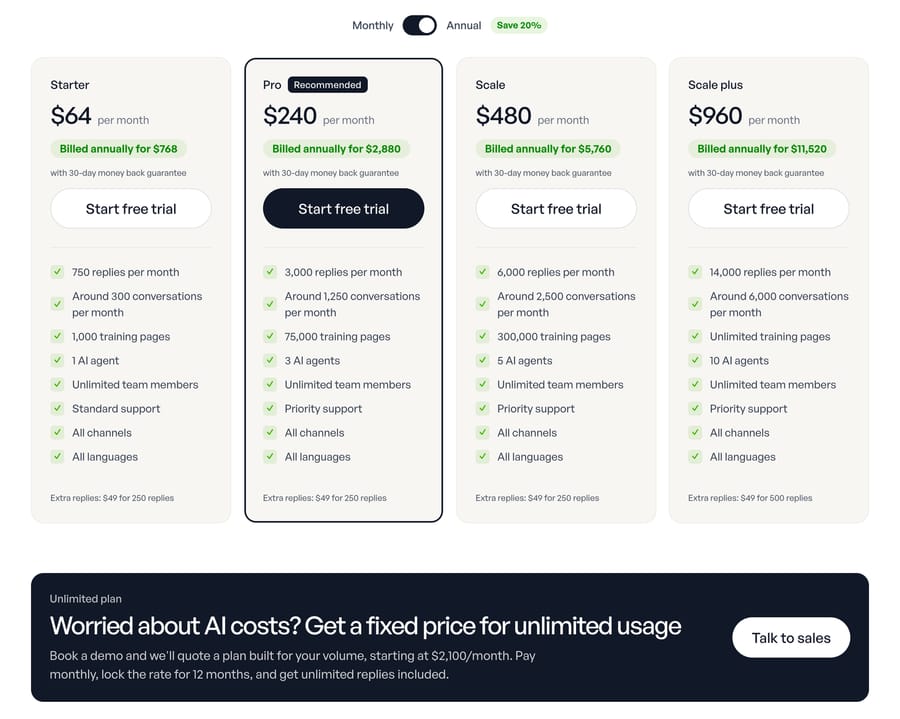
The screenshot above predates Zipchat's current price list; the table below is what the pricing page showed on 24 September 2026.
Zipchat publishes real numbers, which already puts it ahead of most of the category on transparency. The plan lineup changed since we first wrote this guide: the old Growth tier is gone, Starter now includes 750 replies instead of 500, and a Scale plus tier sits above Scale.
| Plan | Billed monthly | Billed annually | AI replies/month | Training pages | AI agents |
|---|---|---|---|---|---|
| Free (Shopify listing only) | $0 | n/a | 120 (~50 conversations) | n/a | n/a |
| Starter | $80 | $64/mo ($768/yr) | 750 (~300 conversations) | 1,000 | 1 |
| Pro | $300 | $240/mo ($2,880/yr) | 3,000 (~1,250 conversations) | 75,000 | 3 |
| Scale | $600 | $480/mo ($5,760/yr) | 6,000 (~2,500 conversations) | 300,000 | 5 |
| Scale plus | $1,200 | $960/mo ($11,520/yr) | 14,000 (~6,000 conversations) | Unlimited | 10 |
| Unlimited | from $2,100 | Custom | Unlimited | Custom | Custom |
Annual billing saves 20% on every paid tier. Every paid plan includes a 7-day free trial and a 30-day money-back guarantee, and extra replies cost $49 for 250 on Starter, Pro and Scale, or $49 for 500 on Scale plus. Each store runs on its own plan, so a brand with three storefronts pays three times or asks sales for multi-store pricing. The Free plan and its 120-reply cap appear on the Shopify App Store listing but not on Zipchat's own pricing page, so confirm it's available before counting on it.
The overage pricing is worth naming directly: Zipchat earns an extra $49 every time a store runs out of replies, which gives it an incentive to size the lower tiers tightly rather than generously. Starter's 750 replies a month works out to about 25 a day, which a busy store selling year-round will use up fast once cart-recovery messages and proactive outreach draw from the same pool. Proactive WhatsApp campaigns also carry Meta's own per-message fee on top (Zipchat cites $0.02 per chat initiated in the US).
What reviewers say: Zipchat holds 4.9 out of 5 from 196 reviews on the Shopify App Store (checked 24 September 2026), 4.8 out of 5 from 26 reviews on Capterra and 4.8 out of 5 from 9 reviews on G2, the last two checked 21 September 2026. The Shopify sample is the large one; the other two sites agreeing at 4.8 is a useful cross-check.
What are Zipchat's pros and cons?
Pros
- Published, plan-by-plan pricing with a 7-day trial and a 30-day money-back guarantee, unusual for the category.
- Sells as well as it supports: cart recovery and product recommendations are built in, not bolted on.
- Real multi-channel coverage (website, WhatsApp, Instagram, Messenger, email) under one AI.
- A workable correction loop for fixing wrong answers directly, instead of filing a support ticket to Zipchat itself.
Cons
- Reply-based pricing means a busy store can burn through a plan's allowance quickly, and overages cost extra.
- The under-3.2% escalation figure is vendor-reported and store-mix dependent; a warranty-heavy electronics store shouldn't expect the same number as a straightforward apparel shop.
- Ecommerce-only. There's no version for a SaaS or services business.
- Prices differ by channel: the Free plan shows on the Shopify listing but not on the main pricing page, which is worth double-checking before you commit.
Who is Zipchat best for?
Zipchat is for teams already running a Shopify (or WooCommerce, BigCommerce, or Wix) store that want one AI handling pre-sale questions, cart recovery, and post-sale support together, instead of stitching together a separate chatbot and a separate helpdesk macro system. If your support volume is dominated by "does this fit," "where's my order," and "can I get a discount," Zipchat's feature set maps directly onto that traffic.
It's a weaker fit for a business that isn't ecommerce, or one whose support load is mostly account-specific and technical, not product- and order-shaped. A B2B SaaS company or a services business gets little value from a size-and-fit advisor or cart-recovery messaging, and would be paying for features built around a different kind of store.
How does Zipchat compare with Yuma AI and Macha?
| Zipchat | Yuma AI | Macha | |
|---|---|---|---|
| Model | AI sales and support agent, native Shopify app | Shopify support-automation agent inside your help desk | AI agent layer on your existing help desk |
| Best for | Shopify (or WooCommerce/BigCommerce/Wix) stores wanting sales plus support in one widget | Shopify merchants wanting ticket-resolution actions inside Gorgias or Zendesk | Teams on Zendesk, Freshdesk, Gorgias, Front, HubSpot, Intercom |
| Pricing | Published, $80 to $1,200/mo billed monthly, Unlimited from $2,100 | Quote-only on yuma.ai; Shopify listing shows plans from $850/mo | From $299/mo for 750 tickets, published |
| Setup | Self-serve, auto-crawls store data | Managed rollout on a share of real tickets | Done for you by the Macha team, with a dedicated success manager, included |
| Trial | 7 days free, 30-day money-back guarantee | 14-day trial on the Shopify listing | $50 free usage |
| Replaces your help desk? | Runs as its own widget, hands off to a help desk | No, connects to Gorgias/Zendesk | No. Deliberately augments it |
Zipchat and Yuma both specialize in ecommerce, but they solve different problems. Zipchat is the front door: a chat widget that sells and supports at once, self-serve and transparently priced. Yuma sits deeper inside an existing helpdesk, taking actions like refunds and subscription pauses on tickets that are already there, with its main site still quote-only. A store evaluating both is really choosing between a standalone AI storefront agent and a resolution engine attached to Gorgias or Zendesk.
If neither shape fits, because your support work spans more than one storefront or lives mostly in tickets rather than chat, Macha runs as an agent layer on top of the help desk you already use (Zendesk, Freshdesk, Gorgias, Front, HubSpot or Intercom). Pricing is on monthly ticket volume from $299/month for 750 tickets, about $0.40 a ticket, billed per ticket rather than per message (see pricing). That price includes the setup and a dedicated success manager who handles your changes: the Macha team analyzes your past tickets, builds the knowledge base and the agent, and runs it in safe mode until the drafts are right. The trial starts with $50 of free usage.
Two ecommerce alternatives belong on the same shortlist: Yuma AI, which is built around Shopify support actions rather than storefront selling, and Rep AI, which competes with Zipchat directly on the on-site sales agent.
How we researched this: On 24 September 2026 we re-read Zipchat's pricing page, homepage and Shopify App Store listing and updated every price, plan and customer figure above to match. The Capterra and G2 scores were read in a real browser session on 21 September 2026 because both sites block scripted requests.
FAQ
What is Zipchat? Zipchat is an AI sales and support agent for ecommerce stores, sold primarily as a Shopify app, that recommends products, recovers abandoned carts, and handles post-sale support like order tracking and refunds.
How much does Zipchat cost? Paid plans run from Starter at $80 a month (750 replies) through Pro at $300, Scale at $600 and Scale plus at $1,200, with Unlimited from $2,100 a month. Annual billing saves 20%, so Starter is $64 a month billed annually. A Free plan with 120 replies a month appears on the Shopify listing.
What happens if I run out of AI replies? Zipchat sells extra replies at $49 for 250 on Starter, Pro and Scale, and $49 for 500 on Scale plus.
Does Zipchat only work with Shopify? No, though Shopify is its primary listing. Its homepage also lists WooCommerce, BigCommerce, Wix, Magento/Adobe Commerce, PrestaShop and Salesforce Commerce Cloud.
How accurate is Zipchat's AI? Zipchat says under 3.2% of conversations are escalated to a human agent. That figure is vendor-reported and will vary by store and question type, so test it against your own ticket mix before relying on it.
Can Zipchat process refunds and track orders? Yes, order tracking and refund processing are built into the platform's post-sale support features.
Can one Zipchat plan cover several stores? No. Zipchat's pricing page says each store runs on its own plan, and multi-store pricing is a conversation with sales.
What are good alternatives to Zipchat? Yuma AI is a close comparison for Shopify merchants who want ticket-resolution actions inside Gorgias or Zendesk instead of a standalone chat widget. Teams whose support work is spread across a help desk instead of a storefront chat tend to look at a layer like Macha.
Is Zipchat good for a non-ecommerce business? Not really. Its feature set (cart recovery, size and fit, product recommendations) is built around store traffic, so a SaaS or services business would be paying for capabilities it can't use.
Sources: Zipchat homepage, Zipchat pricing, Zipchat on the Shopify App Store, Zipchat docs.
Simple per-ticket AI pricing
One thread with one person is one charge, however many replies it takes.