



 Intercom
 Shopify
 Stripe
 Slack
 Notion
 Google Workspace
 Confluence


What Is Ema AI? EmaFusion, Pricing and the $77M Series B (2026)


Ema is an enterprise AI Employee platform for HR, IT, finance and support that runs on EmaFusion, combines 100+ models, and publishes no pricing. It raised a $77 million Series B on 23 September 2026, taking total funding to $140 million.
Key takeaways
- Ema AI builds AI Employees for HR, IT, finance and support on EmaFusion, which combines 100+ models, and publishes no pricing at all.
- Ema AI, founded in February 2023 by Surojit Chatterjee and Souvik Sen, has raised $140 million in total, including a $77 million Series B led by Creaegis on 23 September 2026.
- Ema AI's product page claims its Customer Support AI Employee resolves more than 75% of customer issues autonomously, with no published method behind the figure.
- Ema AI's pricing URL redirects to a demo-request form, and the free-trial signup flow showed no plan names or prices either.
- For ticket volume inside a help desk you already run, Macha is the done-for-you option: the Macha team builds and runs the agent at about $0.40 a ticket, with a dedicated success manager included.

Ema is an enterprise "Universal AI Employee" platform that builds AI agents for HR, IT, finance and customer support on one system called EmaFusion, which combines 100+ language models, and it publishes no pricing at all: ema.ai/pricing redirects to a demo-request form. On 23 September 2026 Ema announced a $77 million Series B led by Creaegis, bringing its total funding to $140 million.
| Ema at a glance | Detail (checked 24 September 2026) |
|---|---|
| What it sells | "AI Employees" for HR, IT, finance and customer support |
| Core mechanism | EmaFusion, combining 100+ models per task |
| Integrations | 250+ prebuilt (homepage); the support page still says 200+ |
| Support claim | >75% of customer issues resolved autonomously (Ema's own figure) |
| Pricing | None published; free trial and demo only |
| Funding | $140 million total after a $77 million Series B (23 September 2026) |
| Founded | February 2023, Mountain View, California |
What is Ema?
Ema was founded in February 2023 by Surojit Chatterjee (CEO), formerly Chief Product Officer at Coinbase through its 2021 IPO and before that VP and Head of Product at Google, where he worked on Mobile Ads and Google Shopping, and Souvik Sen, listed as Technical Co-Founder and Head of Engineering, formerly VP of Engineering at Okta, according to Ema's own about page. The company is headquartered in Mountain View, California, with offices in Bangalore, London, and Canada, and grew from 50 employees in May 2024 to 150 by 2025.
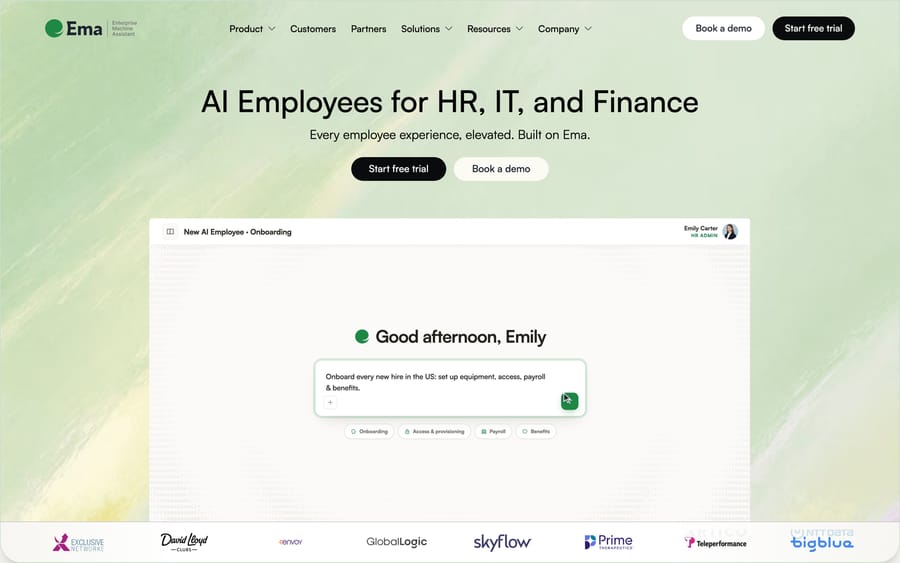
The funding picture changed this week. Before, Ema had raised about $61 million, including a $36 million addition to its Series A led by Accel and Section 32, per a PRWeb release of that round. On 23 September 2026, Ema announced a $77 million Series B led by Creaegis, with Accel, S32 and Prosus increasing their stakes. Ema says the round brings total funding to $140 million and more than quadruples its valuation from the previous round. The same post names Wipro as a customer, with Ema handling about 2.9 million employee queries a year across 240,000+ Wipro associates, and claims revenue grew 50x over 24 months. Those are Ema's own figures. The about page also names angel investors including Yahoo co-founder Jerry Yang and Roblox CEO David Baszucki.
How we researched this: ema.ai loaded directly for every page we needed, first checked 2026-09-15 and re-checked 2026-09-24, including a specific check for a pricing page (there isn't one). G2, Capterra, and TrustRadius all blocked direct access, and a search for Ema's G2 rating returned nothing usable, partly because the name collides with an EU medicines-agency acronym. We couldn't find an independent review rating or attributed G2 quote; the one attributed customer quote we could source is from Ema's own site and is labeled as such below.
How does Ema's AI work?
Ema's core mechanism, EmaFusion, is described on its homepage as combining "100+ models in real time" and fusing the best ones for each task, instead of running everything through one foundation model. The aim is to send each task to whichever model handles it most accurately at the lowest cost. On top of that sits what Ema calls a Generative Workflow Engine, which generates the orchestration code for a task and connects it to prebuilt data connectors (250+ on the homepage, 200+ on the support page) instead of an engineer hand-wiring each integration.
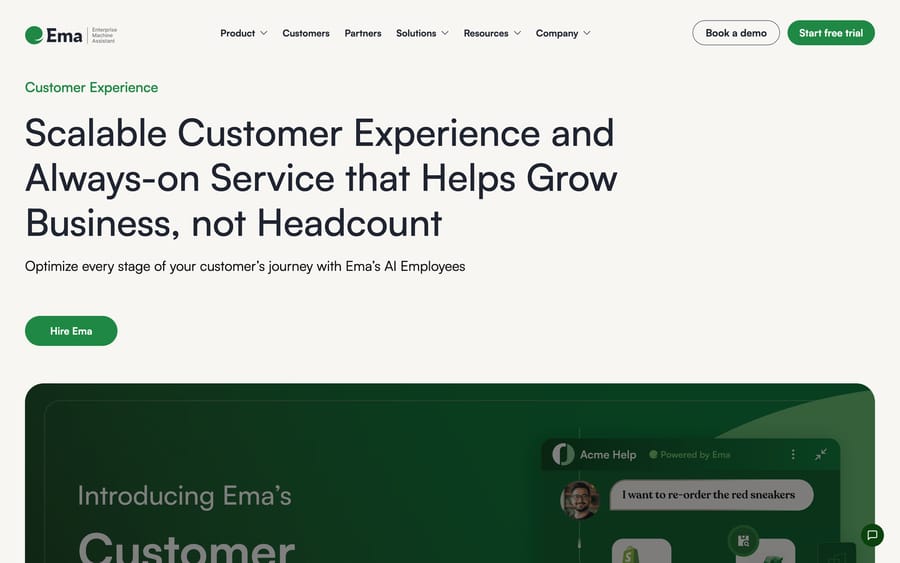
For customer support, Ema packages that mechanism into named "AI Employee" personas instead of one generic bot: a Voice AI Employee handling voice, messages and email in 30+ languages, a Customer Support AI Employee for chat and email, and an Agent Assist AI Employee that sits alongside a human agent.
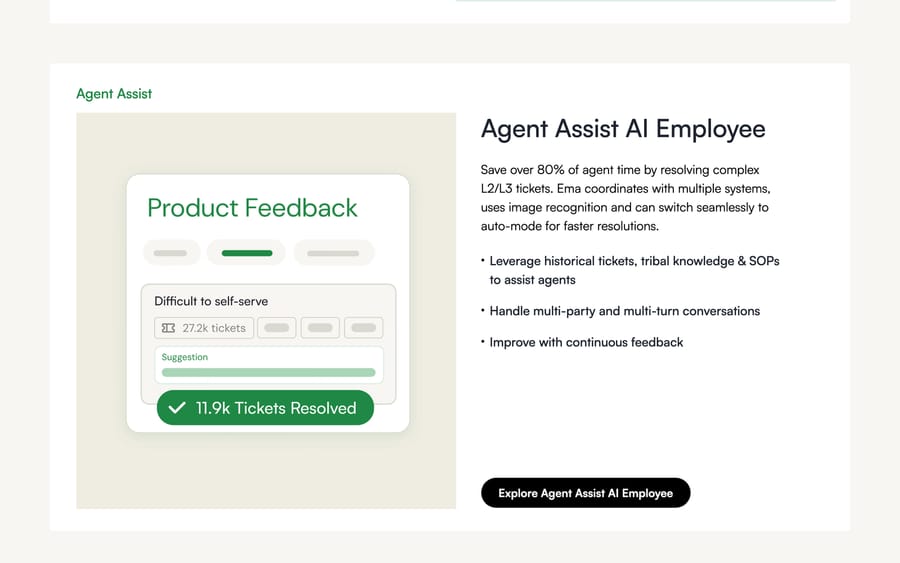
Agent Assist is pitched at complex L2/L3 tickets: Ema's page claims it saves over 80% of agent time on tickets that need image recognition, multi-system coordination, or multi-turn conversations, the kind a simple deflection bot would escalate rather than solve.
What are Ema's key features for support?
- EmaFusion: combines 100+ public and custom models, aimed at accuracy while controlling cost per task.
- Generative Workflow Engine: auto-generates orchestration code connecting a task to Ema's prebuilt connectors.
- Customer Support AI Employee: resolves ">75% of customer issues" autonomously across chat, voice, and email, per Ema's product page. The same page's FAQ goes further and says "over 85% of the tickets." Neither figure has a published method.
- Agent Assist AI Employee: cuts handling time on complex L2/L3 tickets using image recognition and multi-system coordination.
- Agent QA AI Employee: evaluates 100% of conversations instead of a manual sample, surfacing coaching feedback.
- Knowledge Base Augmentor and Insight Finder: detects knowledge gaps and surfaces upsell, cross-sell, and churn-risk signals from support conversations.
How much does Ema cost?
Ema doesn't publish a price. That's a step past the usual "pricing page with no number" pattern: typing ema.ai/pricing lands you on the demo-request page, and the navigation and footer have no pricing link. Even a sales-gated page describing tiers in the abstract would have been something. The site's two calls to action are "Start free trial" and "Book a demo," and the free-trial signup flow (a separate app at try.ema.ai) didn't show any plan information either when we checked on 2026-09-15.
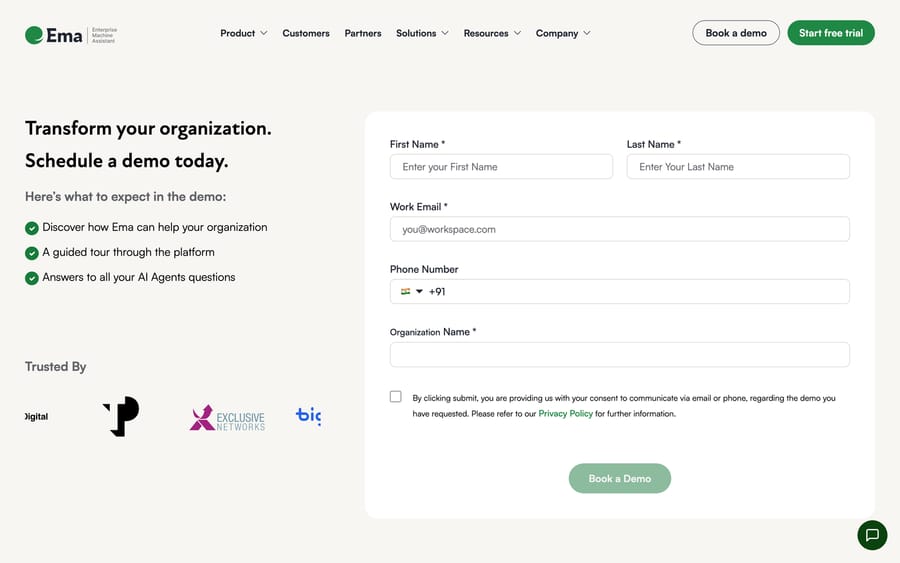
We couldn't find an AWS, Azure, or GCP marketplace listing for Ema either, which is where a couple of other vendors in this series turned out to have real numbers. The incentive is easy to read: a platform sold to enterprises across HR, IT, finance, and support at once prices each deal to the size of the rollout, and a public number would anchor that negotiation. It still means there's nothing to compare against, not even a rough range.
What do Ema customers say?
This is the thinnest review-evidence section in this series, and it's worth being direct about why: G2, Capterra, and TrustRadius all blocked our direct access, and a targeted search for Ema's G2 rating and review count came back empty, complicated by "Ema" also being an EU medicines-agency acronym. We couldn't find a star rating, a review count, or an attributed G2 quote for Ema, and we're saying so instead of presenting an unverified number.
The one attributed customer quote we could source comes from Ema's own customer-support page: Venkatraman Narayan, Head of Customer Experience at Moneyview, saying Ema "has been a game-changer for us," citing accuracy and efficiency in Moneyview's support operation. That's a single, vendor-selected quote, not an independent review sample. The Wipro figures in the Series B post are the same kind of evidence: real, named, and chosen by Ema.
What are Ema's pros and cons?
Pros
- A specific mechanism: EmaFusion's approach across 100+ models is a more concrete technical claim than most "we use AI" positioning in this category.
- One platform spanning HR, IT, finance, and customer support, useful for an enterprise that wants one AI vendor relationship instead of one per department.
- Agent QA scoring 100% of conversations, and Agent Assist aimed at complex L2/L3 tickets, address real gaps beyond simple ticket deflection.
- Founders with relevant backgrounds (a former Coinbase CPO and an ex-Okta VP of Engineering) and a fresh $77 million Series B, which lowers the near-term vendor-survival risk.
Cons
- No pricing page at all, not even a sales-gated one describing tiers.
- We couldn't find independent review evidence (G2, Capterra, or TrustRadius); the only customer quotes available are vendor-selected.
- A young company (founded 2023) spreading across five-plus business functions at once is a broader bet than a vendor focused on one problem.
- The "Universal AI Employee" positioning makes support-specific fit harder to judge; the homepage now leads with HR, IT, and Finance, not support.
Who is Ema best for?
Ema fits an enterprise that wants one AI vendor across several departments (HR, IT, finance, and customer support together) and is comfortable with an entirely sales-led buying process with no public pricing at any stage. It suits a team drawn to the EmaFusion idea of routing tasks across many models instead of betting on one.
It's a weaker fit for a support team buying on its own, since Ema's marketing, case studies, and positioning lean toward the multi-function pitch. It's also a weaker fit for a buyer who wants a comparable number before a sales conversation; that isn't published anywhere on Ema's site. A team whose actual problem is ticket volume inside a help desk it already runs is better served checking a published number first; see Macha on your help desk.
How does Ema compare with Moveworks and Macha?
| Ema | Moveworks | Macha | |
|---|---|---|---|
| Model | "Universal AI Employee" across HR, IT, finance, and customer support on one platform | AI assistant platform for the entire workforce, now part of ServiceNow | AI agent layer on your existing help desk |
| Best for | Enterprises wanting one AI vendor across multiple departments | Large enterprises standardizing on ServiceNow's AI assistant layer | Teams on Zendesk, Freshdesk, Gorgias, Front, HubSpot or Intercom |
| Core mechanism | EmaFusion, combining 100+ models per task | Enterprise search and action across connected business applications | Acts inside real tickets per plain-English instructions |
| Pricing | No pricing page; ema.ai/pricing redirects to a demo form | Not published; contact sales, now under ServiceNow's enterprise pricing | From $299/mo for 750 tickets (~$0.40/ticket), published |
| Setup | Sales-led; free trial exists but shows no pricing during signup | Enterprise deployment, typically alongside other ServiceNow products | Done for you by the Macha team, with a dedicated success manager, included |
| Replaces your help desk? | No, layers onto existing HR, IT, finance, and support systems | No, sits across connected workforce applications | No, deliberately augments it |
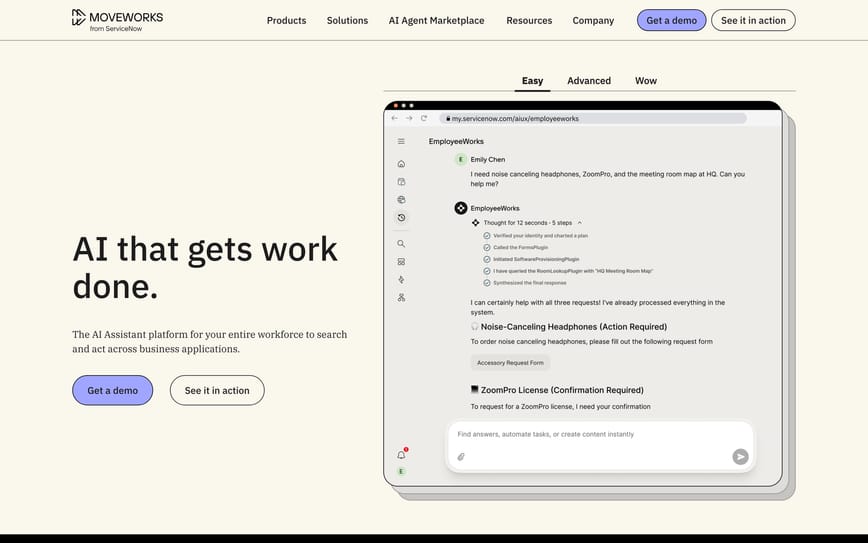
Ema and Moveworks share a horizontal, multi-department pitch, and both now carry a form of big-backer credibility: Moveworks through being folded into ServiceNow, Ema through a $140 million funding total and named institutional investors. Neither publishes pricing, so the real difference is scope and technical approach, not transparency. Aisera is a third platform sold on the same multi-department promise. If the actual problem is ticket volume inside a help desk your team already runs, an AI agent layer like Macha is a narrower, more direct comparison: priced per ticket and published, with no sales gate. It's also done for you: the Macha team analyzes your past tickets, builds the knowledge base and the agent, and runs it in safe mode until the drafts are right, at about $0.40 a ticket including setup and a dedicated success manager who handles your changes. See Macha pricing.
FAQ
What is Ema AI? Ema is a "Universal AI Employee" platform building AI agents across HR, IT, finance, and customer support on one underlying system, powered by EmaFusion, which combines 100+ models.
How much does Ema cost? Ema has no pricing page; ema.ai/pricing redirects to a demo-request form, and we couldn't find a marketplace listing or third-party estimate. Pricing is entirely sales-led, and the free-trial signup flow shows no plan or cost information.
When was Ema founded, and who leads it? Ema was founded in February 2023 by Surojit Chatterjee (CEO, former Coinbase CPO) and Souvik Sen (Technical Co-Founder and Head of Engineering, former Okta VP of Engineering), headquartered in Mountain View, California.
How much funding has Ema raised? $140 million in total, according to Ema's 23 September 2026 announcement of a $77 million Series B led by Creaegis, with Accel, S32 and Prosus also investing.
What is EmaFusion? EmaFusion is Ema's core AI mechanism: it combines more than 100 public and domain-specific models in real time, aiming to route each task to whichever model handles it most accurately at the lowest cost, rather than running everything through one foundation model.
What do Ema's customers say? We couldn't find independent review evidence on G2, Capterra, or TrustRadius. The one attributed quote comes from Ema's own site: Moneyview's Head of Customer Experience credits Ema with improved accuracy and efficiency. That's a single vendor-selected account, not an independent sample.
What's a good Ema alternative? Moveworks, now part of ServiceNow, is a comparable horizontal AI assistant platform spanning multiple departments. If your real bottleneck is ticket volume inside an existing help desk rather than a multi-department rollout, Macha runs as an AI agent layer on top of Zendesk, Freshdesk, Gorgias, Front, HubSpot or Intercom instead.
Does Ema replace a help desk like Zendesk? No. It's positioned as an AI layer across HR, IT, finance, and support systems, including help desks, rather than a replacement for any one of them.
Is Ema a new or established company? Relatively new: founded in 2023 and grown from 50 to 150 employees between 2024 and 2025, now with $140 million raised, but still young next to established enterprise AI vendors.
If your team is comparing broader enterprise AI agent platforms, our Moveworks guide covers a directly comparable multi-department vendor in more depth. And if ticket volume inside a help desk you already run is the actual problem, you can start a Macha trial with $50 of free usage and no credit card, or check current pricing first.
Sources: Ema's homepage, about page, Customer Experience product page, demo-request page and Series B announcement, fetched directly on 2026-09-15 and 2026-09-24. PRWeb: Ema increases its Series A to $50M.
Simple per-ticket AI pricing
One thread with one person is one charge, however many replies it takes.