Intercom
 Shopify
 Stripe
 Slack
Slack Notion
 Google Workspace
 Confluence

Aisera: The Complete Guide (2026) — Features, Pricing & Alternatives


If you're researching enterprise AI for IT, HR, or customer service in 2026, Aisera almost certainly shows up on the shortlist. It's one of the more established names in agentic AI — founded back in 2017, backed by Goldman Sachs and Thoma Bravo, and, as of late 2025, part of Automation Anywhere. But like most enterprise AI platforms, Aisera is also frustratingly opaque: there's no public pricing page (the one that used to exist now returns a 404), no self-serve signup, and no way to try it without booking a demo. That leaves buyers with the same three questions they always have — what is Aisera, what does it actually cost, and is it right for my team?

This guide is our honest attempt at answering them. We'll cover what Aisera does, how its AI agents work, who uses it, what it realistically costs (with every number flagged for confidence), where it's strong, where it isn't, and how it compares to the alternatives. We build an AI support product ourselves, so we'll be upfront about that — but the goal here is a genuine guide to Aisera, not a sales pitch. Where we can't verify something, we say so.
What is Aisera?
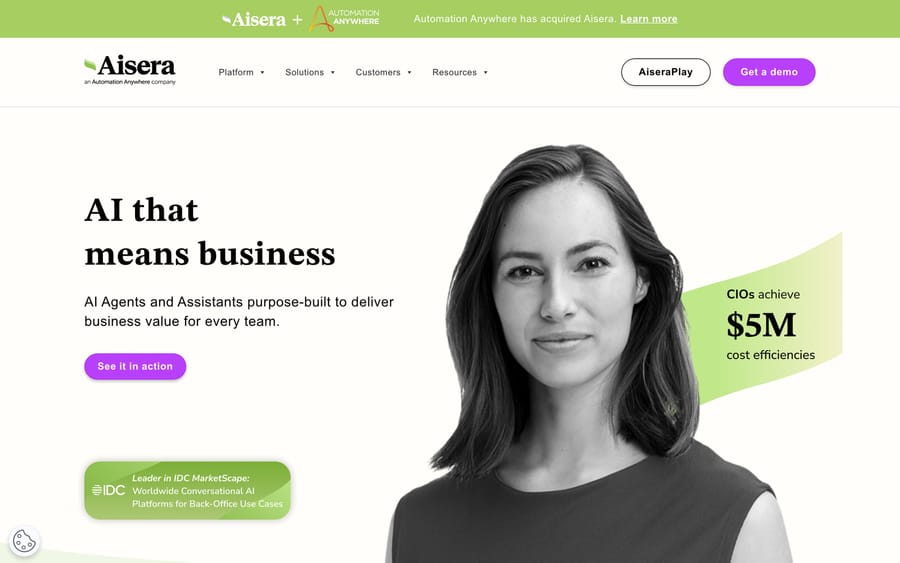
Aisera's homepage, positioning it as an agentic AI platform for enterprise service.
Aisera is an agentic AI platform for the enterprise that automates service and support across multiple domains — IT service desk, HR, finance, legal, facilities, and customer service — from a single system. Rather than being a point tool for one team, it positions itself as a horizontal "AI service experience" layer that resolves employee and customer requests autonomously, deflects tickets, and routes what it can't handle to humans (aisera.com). The company describes the platform as cross-functional from day one: a single Universal Agent orchestrates narrower domain agents (IT, HR, finance, customer service) and task-level agents beneath them, so one request can flow across departments without the user knowing (or caring) which team owns it.
The company was founded in 2017 by Muddu Sudhakar — a serial entrepreneur who previously built Caspida (acquired by Splunk) and Airvana — along with Christos Tryfonas (Aisera company page). Its product family includes AiseraGPT (generative self-service and resolution), AI Copilot (agent-assist for human reps), AI Search (grounded knowledge retrieval), and its own domain-specific LLMs (AiseraLLMs), all built on what it calls the AIX (AI Experience) platform. Aisera also markets vertical layers — Ticket AI for autonomous ticket classification, routing, and resolution, and an LLM Studio for tuning models on your own knowledge and ITSM data.
The trajectory is notable. Aisera reportedly raised roughly $90M in a Series D co-led by Goldman Sachs Asset Management and Thoma Bravo in 2022 (with participation from Zoom, True Ventures, Menlo Ventures, Norwest, Khosla Ventures, and First Round Capital), bringing its reported total to around ~$180M (Thoma Bravo co-led) across four rounds — though figures vary by source (Crunchbase's index lists ~$164.5M; other trackers cite $150–175M) (TechCrunch, Crunchbase). By 2024 third-party trackers reported roughly ~$257M in revenue with a ~340-person team (figures Aisera hasn't officially confirmed). Then, in November 2025, Automation Anywhere acquired Aisera — folding it into the RPA giant's automation stack (Automation Anywhere press room). The stated logic: pair Aisera's conversational AI — trained, Automation Anywhere says, on a reported 400M+ prior service interactions — with Automation Anywhere's Agentic Process Automation so the same system handles both the conversation and the back-office execution in one loop. That's a meaningful development for buyers, and we'll come back to what it implies for pricing and packaging.
How Aisera's AI works
Aisera's pitch is that it doesn't just answer questions — it resolves and acts across enterprise systems. A few pieces make that work.
Agent Composer and pre-built agents
You can start from an extensive library of out-of-the-box, purpose-built AI agents (for common IT, HR, and CX tasks) or build custom ones in natural language through Agent Composer, Aisera's no/low-code authoring tool. The idea is that a service owner describes what the agent should do, and Aisera assembles the workflow rather than requiring you to script decision trees by hand (Aisera platform).
Workflows, orchestration, and integrations
Behind the agents sits a library of 1,000+ pre-built workflows designed to automate complex requests and business processes — password resets, access requests, onboarding tasks, order lookups, and so on. Aisera supports multi-agent orchestration (handing a request between specialized agents via the Universal Agent) and connects into IT, HR, finance, and customer-service systems so agents can take real actions, not just surface articles (Aisera platform).
Domain-specific LLMs and LLM Studio
A differentiator Aisera leans on is AiseraLLMs — its own domain-tuned language models — alongside AiseraGPT for generative responses and AI Search for knowledge retrieval. The argument is that domain-specific models, grounded in your own knowledge base and ticket history, produce more accurate, enterprise-grounded answers than a general-purpose model alone, with fewer hallucinations on internal terminology. Aisera is model-flexible about this: through LLM Studio, customers can use Aisera's proprietary models, bring their own (OpenAI, Anthropic, and others), and tune on organizational knowledge and ITSM data (Gartner Peer Insights: AiseraGPT). For a regulated enterprise, that model choice — plus grounding controls and guardrails — is often as important as the automation itself.
Ticket AI and the service desk
For teams anchored in a service-management tool, Ticket AI is the piece that does the unglamorous work: it autonomously classifies, routes, and (where confident) resolves incoming tickets to cut agent workload. On the IT side it plugs directly into service-desk primitives — incidents, requests, changes, service catalogs, the knowledge base, the service portal, alerts, and the CMDB — which is what lets an agent do more than answer ("here's how to reset your VPN") and instead execute ("I've reset it, and opened a change record").
Key features
- Multi-domain coverage — one platform for IT, HR, finance, legal, facilities, and customer service, rather than a CX-only tool.
- AiseraGPT + AI Copilot — generative self-service and an agent-assist copilot for human reps.
- Agent Composer — natural-language, no/low-code agent creation.
- 1,000+ pre-built workflows and a library of ready-made agents to shorten time-to-value.
- Multi-agent orchestration across domains.
- Domain-specific LLMs (AiseraLLMs) plus AI Search for grounded retrieval.
- Omnichannel self-service across chat, portals, and messaging surfaces.
- Analytics and reporting on deflection, auto-resolution, and cost savings.
Integrations and deployment
The reason Aisera can act rather than just chat is its connector layer. Aisera reportedly ships 500+ out-of-the-box connectors into enterprise applications, with especially deep integration into ServiceNow — where it ships a dedicated AiseraGPT for ServiceNow and a Copilot for the ServiceNow Virtual Agent, natively wiring into incidents, requests, service catalog, knowledge, and CMDB (Aisera + ServiceNow). Beyond ITSM, it connects to other service desks, HRIS and HR platforms, ITOM/monitoring tools, CRMs, and collaboration surfaces (Slack, Microsoft Teams), plus the web/portal chat widgets and voice channels most enterprises expect.
On deployment, Aisera is firmly an enterprise, sales-led motion: expect a scoping and discovery phase, connector setup, knowledge ingestion, workflow configuration, and a tuning period before agents are trusted to auto-resolve at scale. There is no self-serve signup or free tier. Deployment options historically span cloud SaaS with enterprise-grade security posture (SOC 2, and support for data-residency and private-model requirements) — which is precisely why it appeals to regulated and public-sector buyers, and precisely why it takes internal owners and time.
Aisera pricing (what's actually knowable)
Here's the honest part: Aisera does not publish pricing. The aisera.com/pricing URL returns a 404, and every plan is quote-based and sales-led, varying by scope, domains (IT vs. HR vs. CX), integrations, and automation depth (eesel AI: Aisera pricing).
The only concrete public data point comes from the Azure Marketplace, where third-party teardowns report listings of roughly $200,000/year for up to 1,000 users and $1,200,000/year for up to 10,000 users (Workativ: Aisera pricing). Treat those as approximate marketplace figures rather than a confirmed rate card — actual enterprise contracts are negotiated.
What actually drives the cost
Even without a public rate card, the levers are predictable. Aisera pricing tends to scale with:
- Users / agents in scope — the marketplace tiers are banded by user count, so a 1,000-seat rollout and a 10,000-seat rollout are very different contracts.
- Domains covered — one platform for IT plus HR plus customer service costs more than a single-domain deployment; breadth is where Aisera's value (and price) concentrates.
- Interaction / resolution volume — more automated conversations and resolutions generally mean more cost, in the same way most usage-priced AI platforms work.
- Integrations and workflow depth — connecting into ServiceNow, CRMs, and custom systems, and building bespoke workflows, adds implementation and licensing weight.
- Deployment and model requirements — data-residency, private models, and premium support all push the number up.
The acquisition wildcard
The Automation Anywhere acquisition adds real uncertainty around future packaging, bundling, and procurement. Notably, Automation Anywhere has signaled a shift away from per-seat licensing toward charging for actual AI-driven work — it has reportedly signaled AI agents could cut ITSM seat requirements meaningfully, which changes the math on any per-user quote. Whether that outcome-/work-based model becomes Aisera's default pricing in 2026 is worth confirming directly. The safe takeaway for budgeting: Aisera is a six-figure, enterprise-scale commitment, not a self-serve tool you can spin up on a card.
Pros and cons
Strengths
- Genuinely broad, multi-domain automation. Few platforms cover IT, HR, finance, and customer service under one roof. For a large enterprise consolidating service desks, that breadth is real leverage.
- Mature and proven. Founded in 2017, with reportedly ~$257M in revenue (2024, third-party estimate) and marquee customers, Aisera isn't a science project — it has scale and a track record.
- Strong reported outcomes. Vendor case studies cite results like the City & County of Denver's reported 81% auto-resolution and ~79,000 hours saved, and LifeScan's reported ~$2.2M in savings at 65% auto-resolution (Aisera customers) — though these are Aisera-reported figures, not independently verified.
- Pre-built agents and workflows shorten time-to-value versus building from scratch.
- Domain-specific LLMs aim for more accurate, enterprise-grounded responses.
Limitations
- Opaque, sales-led, no trial. No public pricing, no self-serve signup, no way to evaluate without engaging sales.
- Setup and tuning take effort. G2 reviewers consistently note that the platform is powerful but needs guidance to set up, that workflows take time to fine-tune, and that documentation could be more structured (G2 pros and cons).
- Six-figure cost floor. Impractical for SMBs and mid-market teams.
- Acquisition uncertainty. The Automation Anywhere deal signals deeper enterprise bundling, but raises open questions about packaging flexibility, roadmap priorities, and procurement cycles in 2026.
- Enterprise-weight implementation. Realistic deployments need internal owners and time — connector setup, knowledge ingestion, and a tuning period before agents auto-resolve at scale.
- IT/employee-service center of gravity. Aisera's roots and deepest muscles are in ITSM and employee service (its ServiceNow integration is a tell). For pure customer-support teams on a CX helpdesk, a lot of that enterprise breadth is capability you pay for but don't use.
Who Aisera is best for (and who it isn't)
Best for: large enterprises — especially those consolidating IT and HR service management alongside customer service — with the budget for a six-figure contract and the internal resourcing to implement and tune. If you want one agentic platform spanning employee and customer support, and you're comfortable with a sales-led enterprise motion (and possibly Automation Anywhere bundling), Aisera is a legitimate fit.
Not for: SMBs and mid-market teams, anyone who wants to try before they buy, teams that only need customer-support automation on an existing helpdesk, or teams without the time to fine-tune workflows. For those, Aisera's breadth and cost are overkill.
Aisera vs. alternatives
Third-party review evidence for Aisera is unusually thin for a platform this expensive. Its Capterra listing — published since the 2025 acquisition as Automation Anywhere Aisera Solutions — showed 4.5 out of 5 from just 2 reviews when we checked it on September 21, 2026, and G2 refused our request that day. Two reviews is not a sample you can lean on, so treat buyer sentiment as unproven rather than good or bad.
Aisera sits in a crowded enterprise field. The honest shortlist (we have full guides to Moveworks and Kore.ai if you want the detail on the two closest comparisons):
| Tool | Best for | Primary domains | Pricing | Deployment |
|---|---|---|---|---|
| Aisera | Multi-domain enterprise service automation | IT + HR + CX (+ finance, legal, facilities) | Custom, six-figure (opaque) | Sales-led, heavy |
| Moveworks | Enterprise employee support (now part of ServiceNow) | IT + HR (employee) | Custom, enterprise | Sales-led, heavy |
| Kore.ai | Enterprise conversational + agentic AI platform | IT + HR + CX | Custom + some tiers | Sales-led |
| Intercom Fin | CX automation with public per-resolution pricing | Customer support | Public, per resolution | Self-serve-ish |
| Macha | AI agents on top of the helpdesk you already run | Customer support | From $299/mo for 750 tickets, self-serve trial | Self-serve, light |
A note on where we fit, since we'd rather be upfront than pretend we're neutral. Macha is an AI agent layer that runs on top of your existing helpdesk — Zendesk, Freshdesk, Front, Intercom, or Gorgias — not a horizontal IT/HR/CX platform like Aisera. We don't claim to do what Aisera does across every enterprise domain; we're focused on customer-support automation for teams that already have a helpdesk and want to add AI agents without ripping anything out. The honest differentiators: Macha is self-serve and fast to deploy (start on a free trial instead of a multi-month sales cycle), you build agents in plain English, and it bills per ticket — one charge per thread, however many replies it takes — rather than an opaque six-figure enterprise contract. If your need is broad enterprise service management across IT and HR, Aisera (or Moveworks) is the right category; if it's AI customer support on the helpdesk you already run, that's exactly where Macha fits. See AI agents for customer service for how that model works, and custom tools for how agents take real actions.
How we researched this
This guide is built from Aisera’s own site and product pages, its Azure Marketplace listing for the only public price points, and the November 2025 Automation Anywhere acquisition announcements; the pricing and product detail were last verified against those sources in the month the post was written. On September 21, 2026 we re-checked the internal links, pulled the Capterra rating quoted above, and added the cross-references — we did not re-price the Marketplace listing on that pass. Aisera has no self-serve trial and its pricing page returns a 404, so nothing here comes from hands-on use, and G2 blocked our scripted request for its rating.
Frequently asked questions
What is Aisera? Aisera is an agentic AI platform for the enterprise that automates service and support across IT, HR, finance, legal, facilities, and customer service. Founded in 2017, its products include AiseraGPT, AI Copilot, AI Search, and domain-specific LLMs on the AIX platform. It was acquired by Automation Anywhere in November 2025.
How much does Aisera cost? Aisera doesn't publish pricing — it's fully custom and sales-led, and its pricing page returns a 404. The only public data point comes from the Azure Marketplace, with reported figures around $200,000/year for up to 1,000 users and $1,200,000/year for up to 10,000 users. These are approximate marketplace numbers; actual contracts are negotiated, and post-acquisition packaging may change.
Who uses Aisera? Large enterprises and public-sector organizations. Publicly referenced customers include NJ Transit, BDO Canada, the City and County of Denver, and LifeScan, primarily for IT, HR, and customer-service automation.
Is Aisera good for small businesses? Generally no. With a six-figure cost floor, no public pricing, no trial, and an implementation that needs internal owners and tuning, Aisera is built for large enterprises. Smaller teams are usually better served by self-serve tools that layer onto an existing helpdesk.
What are the main alternatives to Aisera? Moveworks (now part of ServiceNow) and Kore.ai are the closest multi-domain peers. For customer-support automation specifically, Intercom Fin offers public per-resolution pricing, and Macha is a self-serve AI agent layer that runs on top of an existing helpdesk.
Was Aisera acquired? Yes. Automation Anywhere acquired Aisera in November 2025, folding it into its automation stack and pairing Aisera's conversational AI with Automation Anywhere's process automation. Buyers should confirm current packaging and roadmap directly, as bundling and procurement may shift post-acquisition.
Does Aisera integrate with ServiceNow? Yes — ServiceNow is one of Aisera's deepest integrations. It ships AiseraGPT for ServiceNow and a Copilot for the ServiceNow Virtual Agent, wiring natively into incidents, requests, the service catalog, knowledge base, and CMDB. Aisera reports 500+ connectors overall, spanning ITSM, HR, CRM, and collaboration tools.
What LLM does Aisera use? Aisera offers its own domain-specific models (AiseraLLMs / AiseraGPT), grounded in your knowledge base and ticket data. Through LLM Studio, customers can also bring their own models (such as OpenAI or Anthropic) and tune them on organizational data — model choice and grounding are a core part of the pitch.
Is Aisera the same as Automation Anywhere's AI Assistant? Post-acquisition, Aisera's technology increasingly appears inside Automation Anywhere's portfolio (branded around an enterprise AI Assistant and agentic automation). If you're evaluating in 2026, ask specifically how Aisera is packaged, licensed, and roadmapped within Automation Anywhere.
The bottom line
Aisera is one of the more mature agentic AI platforms in 2026 — broad, proven, and now backed by Automation Anywhere. If you're a large enterprise looking to consolidate IT, HR, and customer-service automation under one system, have the budget for a six-figure contract, and can staff the implementation, Aisera belongs on your shortlist.
The caveats are equally real: it's opaque, sales-led, expensive, and takes effort to tune, and the acquisition adds a layer of packaging uncertainty. If you can't get past a sales gate, can't justify enterprise pricing, or only need AI for customer support on a helpdesk you already run, a lighter, self-serve AI layer will get you most of the value for a fraction of the cost and effort. Match the tool to your scope — that's the whole decision.
Researched and verified July 2026 against Aisera's site, G2, Gartner Peer Insights, TechCrunch, Crunchbase, and independent pricing teardowns. Pricing is custom and unpublished; all figures are third-party or marketplace estimates and may be outdated — confirm directly with Aisera/Automation Anywhere. We'll re-check this guide within six months.
Simple per-ticket AI pricing
One thread with one person is one charge, however many replies it takes.