Shopify
 Stripe
 Slack
Slack Notion
 Google Workspace
 Confluence

Giga AI: The Complete Guide (2026)


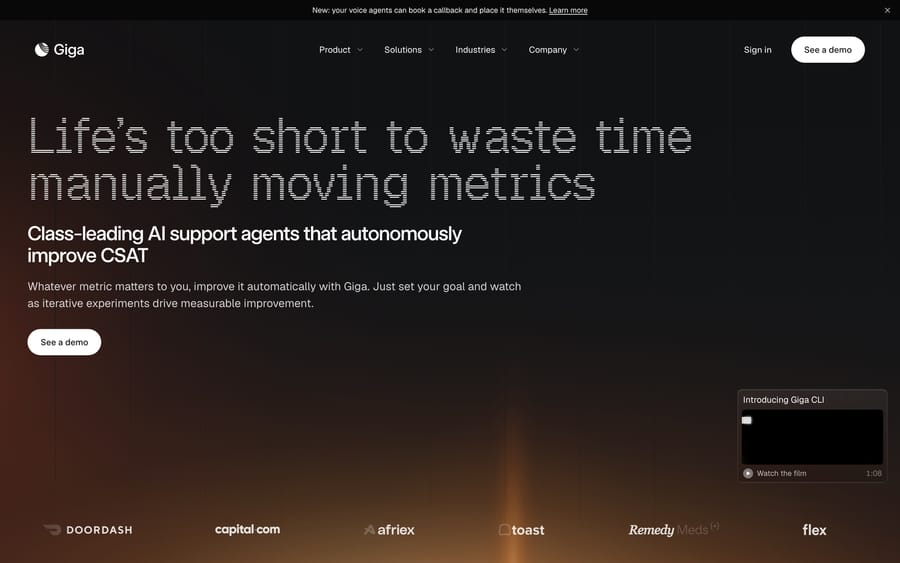
Giga AI is a San Francisco company that builds AI support agents for large enterprises, mostly on voice, with chat and email alongside. Until August 2025 it was called Giga ML and sold on-premise language models. It now sells agents that take actions in a company's live systems, has DoorDash as its flagship customer, and raised a $61 million Series A in November 2025. This guide covers the rebrand, how the agents are built and tested, what we could and couldn't find about pricing, and how Giga compares with Decagon, Sierra and Macha.

What is Giga AI?
The company went through Y Combinator's Summer 2023 batch as Giga ML. Its YC profile still describes the original product: secure, on-premise large language models for enterprises, including "X1 Large" models fine-tuned from Llama 2 70B. The founders are Varun Vummadi (CEO) and Esha Manideep (CTO; listed as Esha Dinne on YC), both IIT Kharagpur graduates according to Fortune.
Somewhere between 2024 and 2025 the business moved from selling models to selling support agents built on them. On August 25, 2025, the company announced a new identity: the name dropped "ML" and became Giga, with a new logo system. The old gigaml.com domain now returns a 301 redirect to giga.ai, and the product console still sits at console.gigaml.com, so you'll see both names in the wild. If you're researching "Giga ML" and "Giga AI" as two vendors, they're the same company.
The funding followed quickly. Fortune reported a $61 million Series A in November 2025, led by Redpoint Ventures with Y Combinator and Nexus Venture Partners participating, earmarked for Fortune 100 sales and regulated industries such as healthcare and finance.
The people researching Giga tend to be CX and contact-center leaders at companies with very high contact volume, often after seeing the DoorDash case study or a comparison page. Giga publishes head-to-head pages against Zendesk, Ada, Decagon, Sierra, Fin, Cresta, Forethought and Agentforce, which tells you which deals it expects to be in.
How Giga's AI works
Giga describes four parts that fit together. We read the product and news pages to work out what each one does.
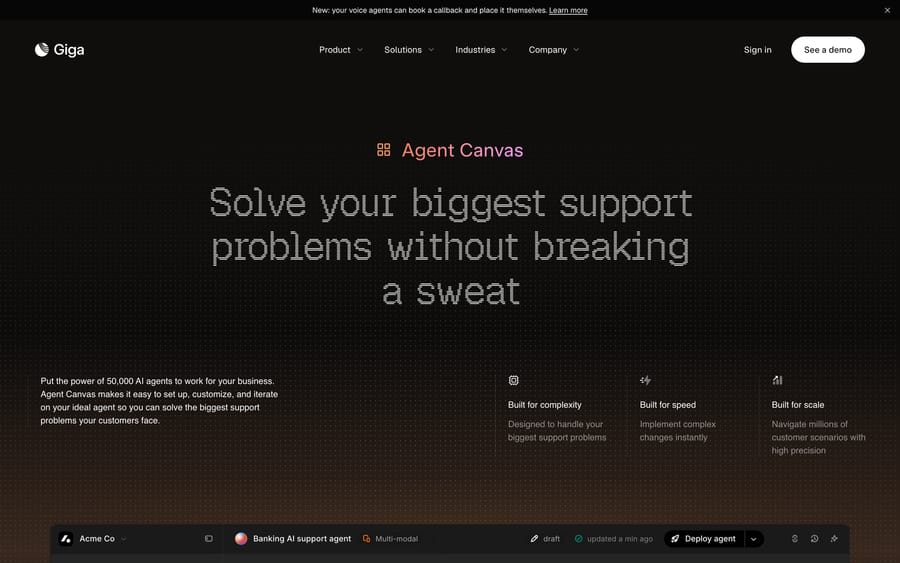
Agent Canvas is where an agent is defined. According to the Agent Canvas page, you start from transcripts, call recordings or written SOPs, write support policies, and run simulated test cases. The page lays out a 12-day timeline: on day 1 the system ingests your policies and drafts a baseline agent, by day 6 "modular code + APIs deliver a review-ready version" that people QA by hand, and on day 12 the agent goes live on 1% of traffic before scaling up.
Scout is an agent that works on the agents. When a conversation escalates, Giga says Scout can "trace the conversation, isolate the policy gap, and point at the part of the config that needs to change." It also helps wire up APIs during setup, and since July 2026 it runs in Slack.
The CLI is the least common part, and the most revealing. The Giga CLI announcement says an agent's policies, intents, tests and code blocks live in a git repository, where every change is a commit. You install it with pip install giga-sdk, run giga validate for a fast local check, and gate deploys with giga tests run --gate, which exits non-zero when a test fails. That means an agent change can go through code review and CI like any other production software, with diffs and rollback.
Browser Agent handles systems that don't have usable APIs. Per Giga's post on it, the agent logs into a browser-only internal tool and clicks through the interface the way a human agent would, with every click logged. It can also take control of a customer's browser session to complete an action on the website.
On voice, Giga has published more engineering detail than most vendors in the category. Its hallucination-correction write-up explains how it uses the gap between text generation and speech. A 30-word answer takes about a second to generate and 10 to 12 seconds to speak, so a reasoning model checks each sentence while the audio plays. If it catches a problem early, the bad audio never plays. If the sentence already played, the agent corrects itself out loud. Giga reports that across 1.2 million turns this cut the hallucination rate from 4-5% to under 1%, with false positives below 0.3%. Those are vendor figures, but the method is described clearly enough to question in a sales call.
Key features
- Channels: voice in 99 languages, plus chat, email and an omnichannel layer, per the homepage. One third-party review describes Giga as voice-only; the vendor's own site lists text channels, so ask for a live chat or email reference before assuming they're production-grade.
- Voice details: interruption handling tuned for accents, emotion detection (urgency, profanity), custom brand voices, scheduled callbacks (August 2026) and real-time synthetic voice detection (August 2026), all from the Giga news page.
- Agents that act: API connections plus the Browser Agent for tools without APIs.
- Testing and versioning: simulation in Agent Canvas, test suites and git-backed deploys through the CLI.
- Insights: KPI goals with warning and critical thresholds, and experiments that test changes against a metric.
- Compliance: SOC 2 Type II, ISO 27001 and ISO 42001, with details at trust.giga.ai. Fortune reports that Giga can deploy in a customer's own cloud for regulated sectors.
Customer logos on giga.ai include DoorDash, Postman, Toast, Capital.com, Afriex, Remedy Meds, Flex, Shiftsmart and Rio. The DoorDash case study covers multi-party delivery problems (geofence mismatches, merchant timing, payments) across hundreds of thousands of daily requests, and reports a resolve rate above 90% for September 20 to October 20, 2025, with a stated target of 98%. That's a vendor-reported number, measured over one month.
Giga doesn't publish an integrations directory. Its Zendesk comparison page says it runs on top of an existing help desk ("No rip and replace") and calls itself "channel- and helpdesk-agnostic." A third-party review on aicxstack mentions Salesforce for data pulls and post-call logging. Beyond that, we couldn't confirm named connectors, so ask for the list during evaluation.
Giga AI pricing
Giga doesn't publish pricing. We checked giga.ai/pricing on September 15, 2026 and got a 404, and there's no self-serve signup. The only official pricing language we found is on the Zendesk comparison page, which describes Giga's model as "outcome-based, scoped to the KPI you set."
No reliable contract data for Giga turned up on Vendr, and G2 blocked our fetch. The closest thing to a number is a third-party review that estimates enterprise voice AI contracts from comparable vendors typically start around $50,000 to $100,000 a year. That's an estimate about the category, not a Giga quote. Treat it as a rough floor for budgeting and get a real number from sales.
"Outcome-based, scoped to the KPI you set" deserves some attention before you sign. Tying the fee to a resolution rate or another KPI means Giga's incentive is to move that metric, which is the pitch. The risk sits in the definition: who decides what counts as a resolved call, over what window, and what happens to the bill if the customer calls back two days later. A vendor paid on outcomes earns more when the counted outcomes go up, so the counting rules are the real price sheet. Get those rules in writing.
Questions worth asking in the sales process:
- What unit is billed: resolved conversations, minutes, or a platform fee plus outcomes?
- Is there an annual minimum or committed volume?
- Are implementation, Scout and the Browser Agent included, or priced separately?
- How is a "resolution" measured, and can you audit it?
Pros and cons
Pros
- A clear build process: the git-backed CLI, test gates and 1% traffic launch fit engineering-led support orgs.
- Voice engineering with published mechanisms, such as the hallucination correction and synthetic voice detection.
- A named, very high-volume reference in DoorDash.
- The Browser Agent can operate browser-only internal tools, per Giga's own description.
- Current compliance certifications, including ISO 42001 for AI management.
Cons
- No published pricing and no trial, so every evaluation goes through sales.
- A short track record in this product: the company pivoted from on-prem LLMs, and most public proof is one flagship customer.
- Limited public detail on help desk and CRM integrations.
- Third-party reviews and the vendor disagree on how mature chat and email are.
- Built for scale, so a team handling a few thousand tickets a month is unlikely to get attention or pricing that makes sense.
Who Giga AI is best for
Giga suits enterprises with heavy phone volume and complicated, multi-system workflows: delivery marketplaces, fintechs, insurers, airlines and telecoms, where one contact might need a lookup in a billing system, an action in a legacy tool, and a spoken answer in Spanish. It suits teams that want to run agent changes through code review and CI, and that have the budget and procurement process for a custom contract.
It's a weaker fit if you only run email and chat tickets in a help desk, if you need to see a price before you talk to sales, or if you want to test an agent on your own tickets this week. If you already run Zendesk, Freshdesk, Gorgias or Front and want agents working inside those tickets, a help desk agent layer is the closer match.
Giga AI vs alternatives
Decagon and Sierra are the vendors Giga most often competes with; it publishes comparison pages against both. Our Decagon guide and our Sierra AI guide cover both options in depth.
| Giga | Decagon | Sierra | Macha | |
|---|---|---|---|---|
| Model | Enterprise AI agents, voice-first, with chat and email | Enterprise AI agents for chat, email and voice | Enterprise AI agents for chat and voice | AI agent layer on your existing help desk |
| Best for | High-volume voice, multi-system workflows | Large consumer and tech brands | Large consumer brands | Teams on Zendesk, Freshdesk, Gorgias or Front |
| How agents are built | Agent Canvas, Scout, git-backed CLI | Plain-language Agent Operating Procedures | Sales-led enterprise build | Built, tested and monitored by the Macha team |
| Pricing | Not published; "outcome-based" | Not published; third-party estimates only | Not published; sales-led | From $299/mo for 750 tickets (~$0.40/ticket), published |
| Trial | No | No | No | $50 free usage |
Decagon and Sierra are summarized from their public positioning; check their current terms directly.
Macha comes at the problem from a different starting point. Giga, Decagon and Sierra are programs you buy through sales and roll out over weeks. Macha is an AI agent layer for the help desk you already use: the agents read and act inside your Zendesk, Freshdesk, Gorgias or Front tickets, and the Macha team builds, tests and monitors them for you. Pricing is one plan based on monthly ticket volume, and a ticket is one charge however many replies it takes. The pricing page lists every tier. If your contact volume is mostly email and chat in one help desk, that setup fits. If you need voice in dozens of languages across DoorDash-scale traffic, Giga is built for that and Macha isn't. For a wider view of the category, see our overview of AI agents for customer service.
FAQ
Is Giga AI the same company as Giga ML? Yes. Giga ML rebranded to Giga in August 2025. gigaml.com redirects to giga.ai, and the console still uses the gigaml.com domain.
What does Giga AI do? It builds AI agents for enterprise customer support across voice, chat and email. The agents take actions through APIs and, for browser-only tools, through a browser agent that operates internal tools.
How much does Giga AI cost? Giga doesn't publish pricing. Its site describes the model as outcome-based and tied to a KPI you set. A third-party review estimates comparable enterprise voice AI contracts start around $50,000 to $100,000 a year, but that isn't a Giga quote.
Does Giga AI offer a free trial? We found no trial or self-serve signup on giga.ai. Evaluations go through the sales team.
Who are Giga AI's customers? DoorDash is the published case study. The site also shows logos for Postman, Toast, Capital.com, Afriex, Remedy Meds, Flex, Shiftsmart and Rio.
How much funding has Giga raised? Giga raised a $61 million Series A in November 2025, led by Redpoint Ventures with Y Combinator and Nexus Venture Partners, according to Fortune.
What are the alternatives to Giga AI? Decagon and Sierra are the closest enterprise alternatives. For teams that want agents inside Zendesk, Freshdesk, Gorgias or Front with published pricing, Macha is an AI agent layer on the existing help desk.
Does Giga replace Zendesk? No. Giga's Zendesk comparison page says it works on top of an existing help desk without replacing it.
Sources: Giga homepage, Giga news, Giga rebrand announcement, Giga Series A post, Giga CLI announcement, Giga hallucination correction, Agentic AI that executes, Agent Canvas, Giga vs Zendesk, DoorDash case study, Y Combinator company page, Fortune on the $61M Series A, aicxstack Giga review.
Resolve tickets automatically with AI agents
Macha's AI agents work on top of the help desk you already use — no code.