Intercom
 Shopify
 Stripe
 Slack
Slack Notion
 Google Workspace
 Confluence

Glia: The Complete Guide (2026)


Glia sells AI built specifically for banks and credit unions: voice, chat, and digital customer service tied to a banking-specific "Agentic Workflows" layer that can pull up an account, verify a caller, and execute a multi-step process like a travel notification without a human typing through five screens. This guide covers what Glia's banking AI platform actually does, how its AI works, what its unusual "Priceless Pricing" model really means, what real users say on G2, and how it compares to Posh (another bank-focused AI vendor) and to running an AI agent layer on the help desk you already use.

What is Glia?
Glia was founded in 2012 in New York as SaleMove, rebranding to Glia in February 2019 after raising a $20 million Series B led by Insight Partners, per Finovate's coverage of that round. Co-founder and CEO Dan Michaeli has led the company through two more raises since: a $78 million Series C in 2021 and a $45 million Series D in 2022. Glia's own about page reports the platform has processed more than 10 billion interactions across more than 500 financial institutions.
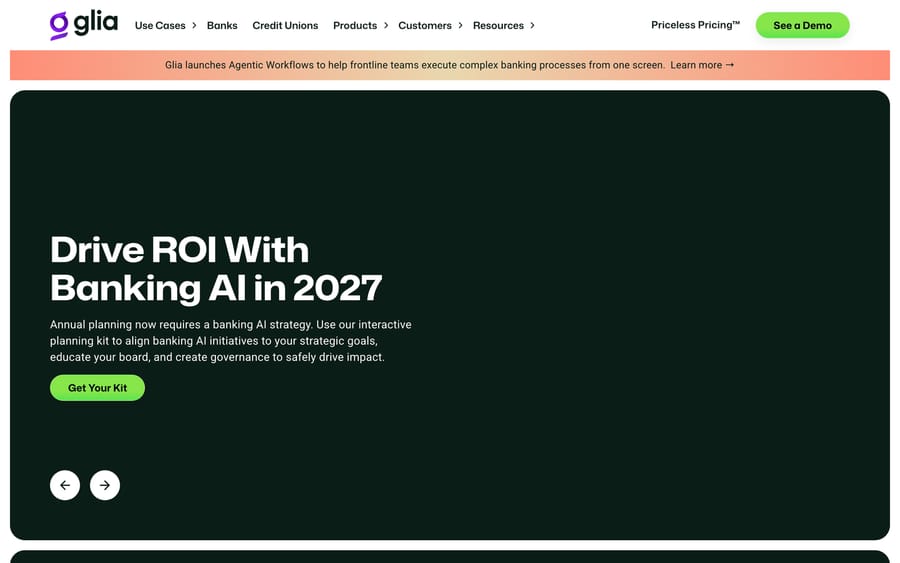
The company sells three product lines under one platform: Glia AI (the banking-specific AI workforce), Glia Voice, and Glia Digital, all built for regional and community banks and credit unions specifically. Its homepage names customers including First Hawaiian Bank, Liberty Bank, Fremont Bank, Columbia Bank, and credit unions like Logix, PSECU, Bethpage, and First Tech.
How we researched this: glia.com and its pricing and product pages loaded directly for this guide, checked 2026-09-15. G2 and Gartner Peer Insights both blocked our direct access; review evidence here comes from a search-indexed G2 rating snippet, from Glia's own blog recap of its G2 Fall 2025 report results (which names real reviewer roles and company sizes), and from an AWS Marketplace listing that mirrors G2's rating and review count more precisely. We could not get a dollar figure for Glia's pricing from any source, including that AWS listing, which is itself informative: Glia genuinely does not publish a number anywhere we could find.
How Glia's AI works
Glia's core mechanism is a unified interaction layer sitting underneath phone, chat, video, and digital channels, so a customer's history and identity carry across channels instead of resetting every time they switch from the mobile app to a phone call. On top of that layer, Glia AI answers routine questions directly and can automate up to 80% of inquiries, per Glia's own homepage claim, across voice and digital channels.
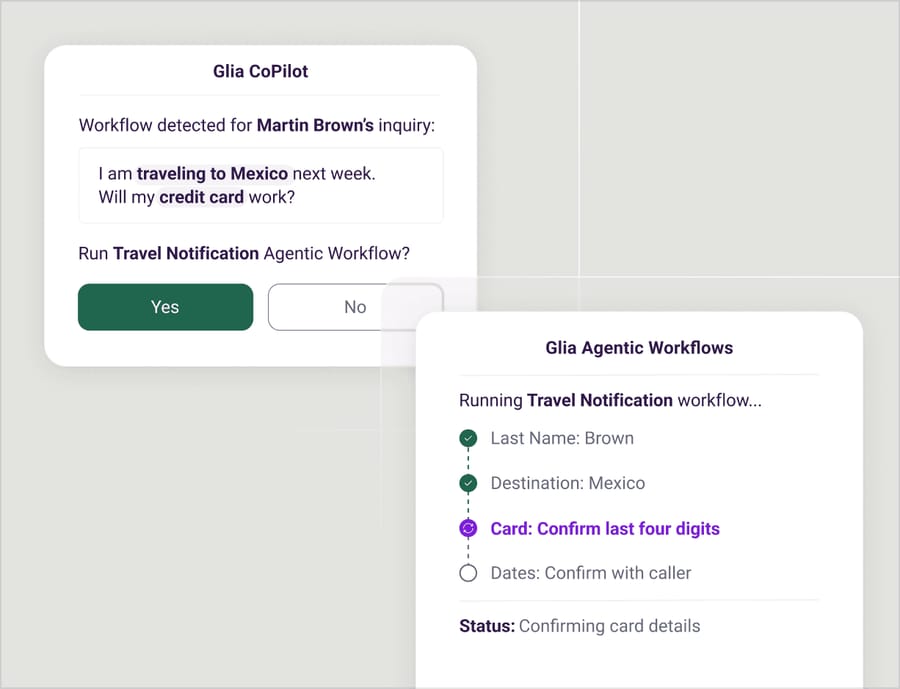
The newer piece, launched as Agentic Workflows, goes further: it detects an intent inside a live conversation (a customer says they're traveling and asks whether their card will work abroad) and offers to run a named, multi-step workflow, in this case a travel notification, that checks identity fields against the caller and executes the update without an agent manually opening a core banking screen.
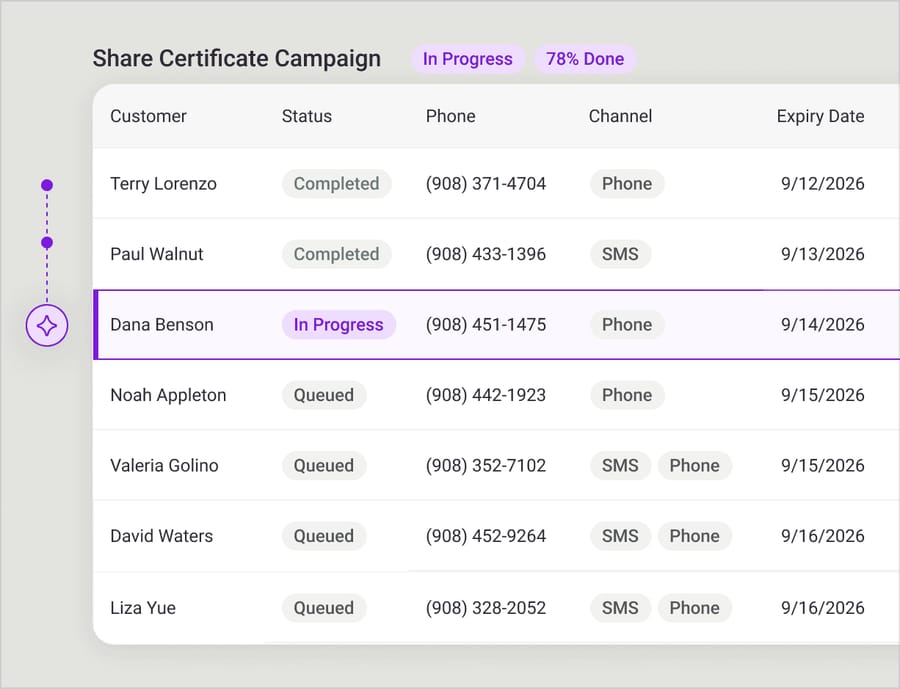
A separate piece, Glia Outreach, runs the same AI proactively: campaigns like a share-certificate renewal push contact a list of customers by phone or SMS on a schedule, tracked through to completion.
Key features
- Unified interaction layer: customer identity and history carry across voice, chat, video, and digital channels instead of resetting per channel.
- Agentic Workflows: detects intent in a live conversation and offers to execute a named, multi-step banking process (travel notifications, card disputes, and similar) directly.
- Glia CoPilot: surfaces the detected workflow to a human agent for a yes/no confirmation before it runs, keeping a person in the approval loop.
- Glia Outreach: proactive AI-driven phone and SMS campaigns for renewals, offers, or account actions, tracked to completion.
- Banking-specific benchmarking: Glia's own 2026 Banking AI Benchmarks Report, based on data from 400 financial institutions, reports banking-specific AI hitting a 95%+ intent-understanding rate versus under 50% for generic AI on the same task.
- Compliance-oriented workforce tools: coaching, workforce planning, and analytics built around regulated banking and credit union operations specifically.
Glia pricing
Glia doesn't publish a number, and it markets that fact as a feature rather than an omission. Its pricing page is built entirely around "Priceless Pricing™": a fixed-price model with $0 per minute, $0 per seat, and $0 per token, positioned against the usage-based and per-seat pricing common elsewhere in the category.
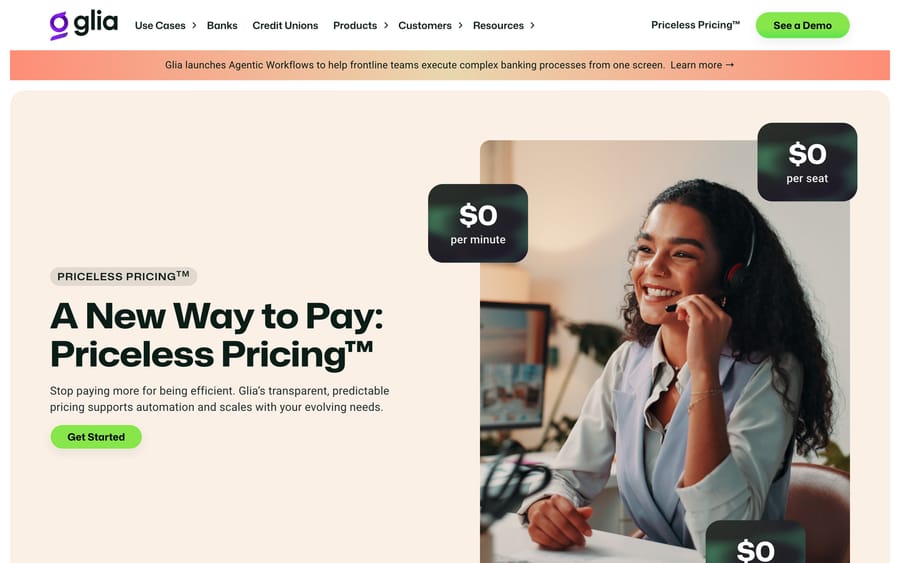
That framing is worth naming plainly: a $0 unit price doesn't mean free. It means Glia has moved the actual cost into a single negotiated platform fee you won't see until you talk to sales. A negotiated-only number earns the vendor a contract a buyer can't easily benchmark against a competitor's rate card, which is a normal incentive behind "contact sales" pricing, not unique to Glia. We checked Glia's own pricing page, G2's pricing tab, and Glia Voice's AWS Marketplace listing (a real listing, unlike some vendors in this series that have none). That marketplace listing is Private-Offer only, with no public per-unit price either, so even the marketplace-pricing check that surfaces real numbers for other vendors comes back empty here. What the AWS listing does confirm directly: contract terms of 12, 24, or 36 months, with the longer terms discounted up to 50% and 67% respectively, all negotiated per deal.
What Glia users say
Checked 2026-09-15. G2 and Gartner Peer Insights both blocked direct access. A search-indexed snippet puts Glia at 4.8 out of 5 on G2; the more precise figure comes from Glia Voice's AWS Marketplace listing, which mirrors 89 G2 ratings at the same 4.8/5 (89% five-star, 10% four-star, 1% three-star).
Glia's own recap of the G2 Fall 2025 report claims 35 new G2 badges, placement in 80 reports, and a Net Promoter Score of 73. That same recap names four attributed reviewer quotes, complete with role and company size, though it's worth being clear this is Glia's own selection from G2, not an independent pull:
- Digital Experience Manager, Mid-Market: "Glia gets what we say… when we talk about improving the member and employee experiences."
- Verified User in Banking, Mid-Market: "Glia provides an industry leading product suite… and they are super easy to work with."
- Financial Services Customer, Mid-Market: "From the kickoff meeting to testing through go live… Glia's team provided the best project management experience."
- Banking Customer, Mid-Market: "Glia allows us to connect with our customers where they are."
None of Glia's own selected quotes surface a complaint, which is exactly what a vendor picks when curating its own highlight reel. We couldn't independently pull a critical review through direct access, so treat the positive tilt here as a known limit of the source. It isn't proof the product has no weak points.
Pros and cons
Pros
- A genuinely banking-specific product, not a horizontal CX tool relabeled for finance: workflows, compliance framing, and benchmarking are built around regulated financial institutions.
- Agentic Workflows executing a real multi-step banking process (identity checks, core system updates) is a step past a chatbot that only answers questions.
- Strong, if vendor-selected, G2 standing: 4.8/5 from a meaningful review count (89 on the figure we could verify), NPS 73, and 35 badges in one report cycle.
- A long operating history for an AI-era vendor: founded 2012, three funding rounds since its 2019 rebrand, and 500+ financial institutions as customers.
Cons
- Genuinely no price anywhere, including its own pricing page, G2, and its AWS Marketplace listing; "Priceless Pricing" markets the absence of a number as a feature rather than disclosing one.
- The vendor-curated review quotes we found skew entirely positive, which tells you more about the source than about the product's actual weak points.
- Purpose-built for banks and credit unions specifically; a support team outside financial services gets a narrower feature set than the marketing implies.
- A negotiated, multi-year contract model (with steep discounts for locking in 24 or 36 months) rewards commitment over flexibility.
Who Glia is best for
Glia is for teams at banks and credit unions, especially regional and community institutions, that want AI built around real banking workflows: identity verification, account actions, compliance-aware coaching, instead of a generic support chatbot adapted to finance after the fact. It suits an institution already running phone and digital channels separately that wants one identity layer across both.
It's a weaker fit for a support team outside financial services, since the workflows, benchmarking, and positioning are all built around banking specifically, and for a team that wants a comparable number before a sales call, given "Priceless Pricing" is a marketing name for pricing that still isn't published anywhere we checked. A bank or credit union whose digital support runs through a mainstream help desk like Zendesk or Freshdesk for email and ticket-based inquiries, separate from Glia's voice and branch-focused workflows, is the narrow case where an AI agent layer like Macha fits alongside it, not in place of it.
Glia vs alternatives
| Glia | Posh | Macha | |
|---|---|---|---|
| Model | Unified banking AI: voice, digital, Agentic Workflows, and outreach on one identity layer | Agentic banking AI focused on conversational service for bank customers and employees | AI agent layer on your existing help desk |
| Best for | Regional and community banks and credit unions running phone plus digital channels | Banks and credit unions wanting conversational AI that "feels human" across customer and employee use cases | Teams on Zendesk, Freshdesk, Gorgias, or Front |
| Core mechanism | Detects intent in a live interaction and executes a named, multi-step banking workflow | Conversational AI agents trained specifically for banking interactions | Acts inside real tickets per plain-English instructions |
| Pricing | Not published anywhere checked, including its AWS Marketplace listing; "Priceless Pricing" names no number | Not published; contact sales | From $299/mo for 750 tickets (~$0.40/ticket), published |
| Setup | Negotiated contract, 12/24/36-month terms, deployed against core banking workflows | Enterprise deployment through sales | Built, tested, and monitored by the Macha team |
| Replaces your help desk? | No, it's a banking-specific interaction platform, often the primary channel itself | No, layers onto existing banking channels | No, deliberately augments it |
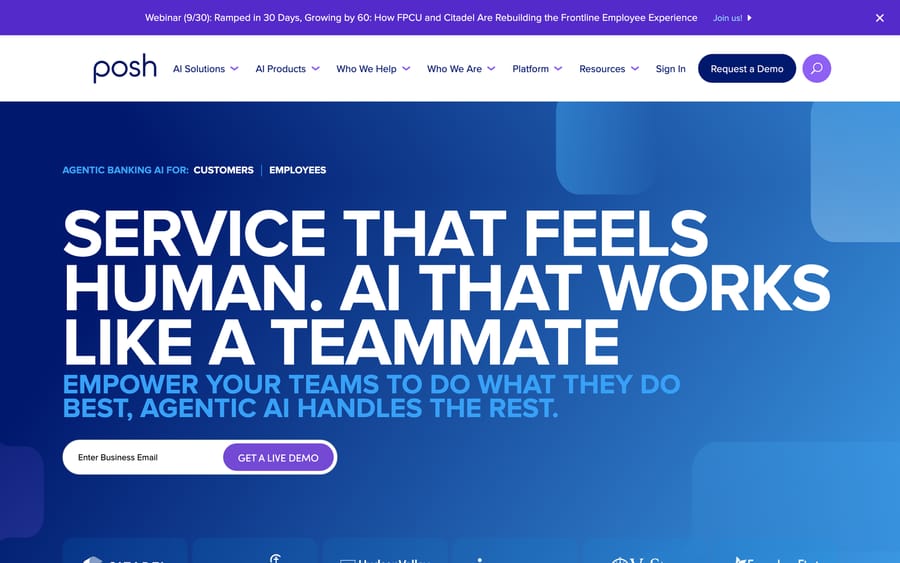
Glia and Posh both build specifically for banks and credit unions instead of support teams generally, which makes them a more direct comparison to each other than either is to a horizontal help-desk AI. Both gate pricing behind sales, so neither wins on transparency; the real difference is Glia's broader platform (voice, digital, outreach, workforce tools together) against Posh's narrower conversational focus. Neither is a fit for a support team whose actual channel is a mainstream help desk instead of a banking-specific interaction platform; for that case, see Macha pricing or Macha on your help desk.
FAQ
What is Glia? Glia is an AI platform built specifically for banks and credit unions, combining voice, chat, and digital customer service with "Agentic Workflows" that execute multi-step banking processes and proactive outreach campaigns.
How much does Glia cost? Glia doesn't publish a number anywhere we checked, including its own pricing page, G2, and its AWS Marketplace listing. It markets this as "Priceless Pricing," a fixed-price model with $0 per minute, seat, or token, but the actual platform fee is negotiated per deal.
When was Glia founded, and what was it called before? Glia was founded in 2012 in New York as SaleMove, rebranding to Glia in February 2019 around a $20 million Series B led by Insight Partners.
What do Glia's users say in reviews? G2 data (via a search snippet and an AWS Marketplace mirror) puts Glia at 4.8 out of 5 from at least 89 reviews. Glia's own recap of its G2 Fall 2025 report cites a Net Promoter Score of 73 and quotes from a Digital Experience Manager and several banking customers, all positive; we could not independently verify a critical review through direct access.
Is Glia only for banks and credit unions? Yes, that's its explicit focus. Its workflows, benchmarking, and product positioning are all built around regulated financial institutions instead of customer service generally.
What's a good Glia alternative? Posh is a comparable banking-specific conversational AI vendor. If your team's real problem is ticket volume inside a mainstream help desk instead of banking-specific voice and digital channels, Macha runs as an AI agent layer on top of Zendesk, Freshdesk, Gorgias, or Front.
Does Glia replace a bank's core banking system? No. It sits on top of core banking and account systems, executing actions like identity checks or travel notifications against them rather than replacing them.
Is Glia a new or established company? Established: founded in 2012 (as SaleMove), operating under the Glia name since 2019, with three funding rounds since and more than 500 financial institutions as customers.
If you're comparing broader AI agent categories beyond banking specifically, our Decagon AI guide covers another enterprise conversational AI vendor worth a look. And if your actual bottleneck is ticket volume inside a help desk you already run, you can start a Macha trial with $50 of free usage and no credit card, or check current pricing first.
Sources: Glia's homepage, pricing page, Banking AI Workforce product page, and about page, all fetched directly on 2026-09-15. Finovate: Glia (formerly SaleMove) raises $20M, Glia's own G2 Fall 2025 recap, AWS Marketplace: Glia Voice.
Resolve tickets automatically with AI agents
Macha's AI agents work on top of the help desk you already use — no code.