Intercom
 Shopify
 Stripe
 Slack
Slack Notion
 Google Workspace
 Confluence

Posh AI: The Complete Guide (2026)


Posh AI is a conversational AI platform built specifically for banks and credit unions, covering voice, digital, and internal employee-facing tools. It's raised $45 million since 2018, works with over 200 financial institutions, and publishes real named-customer results instead of only aggregate percentages. This guide covers what Posh actually offers, what its customers report, what we could and couldn't verify about pricing and reviews, and where it fits next to Macha.
Macha builds AI agents for customer service that run inside a help desk a team already uses, so we read a vertical AI platform like Posh from that angle: how much of its value is banking-specific depth versus general conversational AI you could get elsewhere.
What is Posh AI?
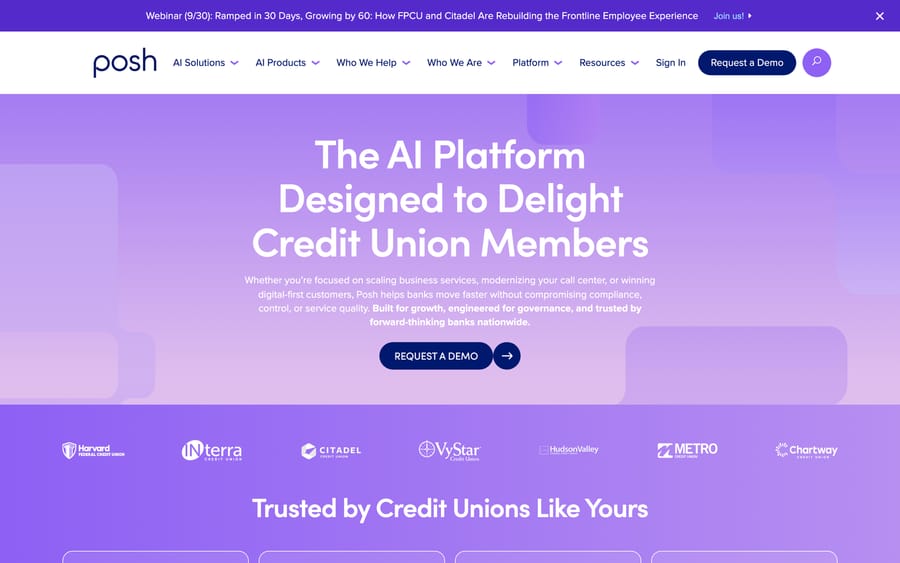
Posh was founded in 2018 by Karan Kashyap and Matt McEachern out of MIT, built specifically around conversational AI for financial institutions instead of as a horizontal chatbot platform later repositioned for banking. The company has raised $45 million across five rounds, including a $27.5 million Series A led by Canapi Ventures with participation from Curql Collective, CMFG Ventures and JAM FINTOP, investors with deep ties to the credit union industry specifically.
Posh reports over 200 AI deployments across banks and credit unions, with named customers including Metro Credit Union, Camden National Bank, Hudson Valley Credit Union, Ion Bank, VyStar Credit Union and Citadel Credit Union. It holds SOC 2 Type II and CSA STAR Level 1 attestations, and integrates with the core banking systems that actually run a credit union: Symitar, Fiserv, Corelation and Jack Henry, plus contact-center platforms including NICE CXone, Genesys Cloud, RingCentral and Five9.
How Posh's AI works
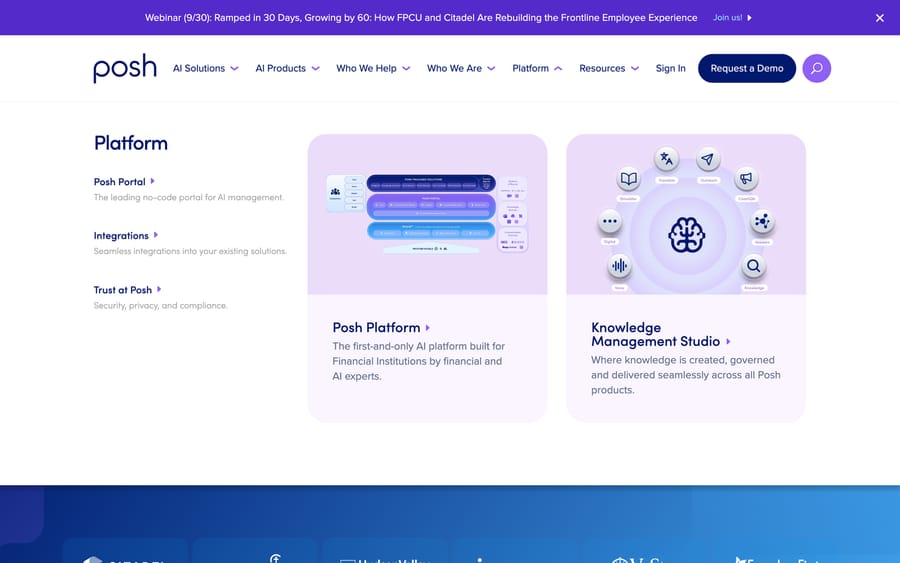
Posh organizes its AI around what it calls Operating Procedures, a reasoning framework every Posh Agent follows to enforce policy, keep responses inside compliance bounds, and stay consistent across channels. That framing matters in banking specifically: a hallucinated answer about a loan rate or an overdraft policy is a compliance problem, not just a bad customer experience, so a framework that constrains the model to approved procedures is a real differentiator versus a general-purpose chatbot.
The product line splits into customer-facing and employee-facing tools:
- Voice Assistant: 24/7 phone support, handling balance checks, loan payoffs, transfers, stop payments, card controls and profile updates with MFA/OTP/PIN authentication.
- Digital Assistant: the same conversational coverage across website, mobile, SMS and email.
- Posh Answers: an AI-powered help center for self-service.
- Posh Outreach: proactive engagement campaigns (loan offers, renewal reminders).
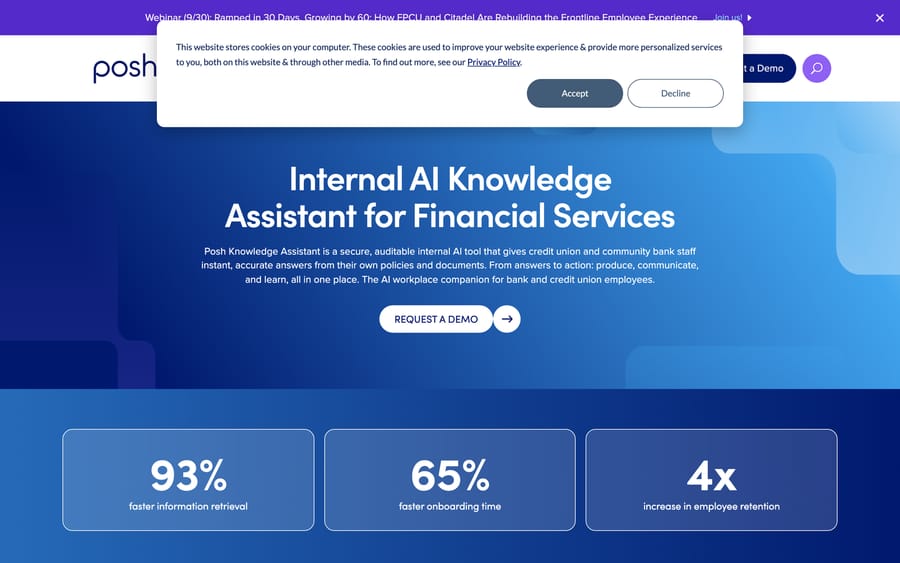
- Knowledge Assistant: an internal tool giving staff instant, auditable answers from the institution's own policies and documents.
- Posh Simulator: AI-generated training scenarios for staff.
- Posh CoachQA: automated conversation evaluation and compliance review.
Posh's own site claims 91% of requests get handled without a live agent, and its Knowledge Assistant page cites 93% faster information retrieval, 65% faster onboarding, and a 4x increase in employee retention for internal users.
Key features
- Operating Procedures framework: policy-bound reasoning designed for regulated banking conversations.
- Full channel coverage: voice, web, mobile, SMS, email, and an internal knowledge tool for staff.
- Core banking integrations: Symitar, Fiserv, Corelation, Jack Henry.
- Contact-center integrations: NICE CXone, Genesys Cloud, RingCentral, Five9.
- Compliance tooling: Posh CoachQA for conversation review, SOC 2 Type II and CSA STAR Level 1 attestations.
- Fast deployment claim: voice products live in weeks against what Posh describes as an industry norm of six to twelve months (per a third-party comparison, not Posh's own site).
Named customer results
Posh publishes specific, attributed outcomes instead of only blended averages, which is unusual enough in this category to call out directly:
- Citadel Credit Union: $660,000 in annual savings.
- Camden National Bank: a 60% reduction in call abandonment.
- Hudson Valley Credit Union: 201% ROI.
- Ion Bank: 95% containment rate.
These are vendor-published case-study figures, not independently audited numbers, so treat them the way you'd treat any vendor's best-case references: real, but self-selected.
Posh AI pricing
Posh doesn't publish a price list, a calculator, or a self-serve signup. Every engagement is quoted through a demo request, consistent with a third-party comparison of bank/credit-union AI vendors that found Posh "does not publish list pricing either" and instead "publishes customer-reported outcomes instead" of a rate card. We checked Posh's own site, a G2 pricing tab, and searched for a marketplace listing; none surfaced a number, so there is no published or estimable price to report here. That's a genuine gap for a buyer trying to budget before a sales conversation. Keeping pricing off the site and behind a demo is a common incentive for vendors selling into a small, high-touch buyer base (a few hundred credit unions and banks, not a mass market), where a salesperson can price to the account's asset size rather than compete on a public number. It's worth asking directly in a demo call what a comparable institution (by asset size and channel mix) actually pays.
Real-user reviews: what we could (and couldn't) verify
This is the honest limitation of this guide: we could not access a working G2, Capterra or TrustRadius review page for Posh AI. Posh's Capterra listing returned a 404 on direct fetch, its G2 product page returned a 403, and TrustRadius returned a 403 as well. That doesn't mean reviews don't exist, only that we couldn't retrieve a verified rating or quote through the sources we checked on 2026-09-17. If you're evaluating Posh, ask its sales team directly for reference customers you can call, since the review-site route isn't reliably available the way it is for larger vendors in this series.
What we can say with confidence is that Posh's named case studies (above) are attributed to real credit unions and banks by name, which is a stronger signal than an anonymous review, even if it's vendor-selected.
Pros and cons
Pros
- Deep banking-specific design: an Operating Procedures framework built for compliance, not a general chatbot with a banking skin.
- Named core-banking and contact-center integrations (Symitar, Fiserv, Corelation, Jack Henry; NICE, Genesys, RingCentral, Five9).
- Specific, attributed customer results instead of only blended vendor averages.
- Investor base includes credit-union-specific funds (Curql, CMFG Ventures), suggesting real industry relationships, not just VC money.
Cons
- No published pricing anywhere, and no self-serve way to estimate cost before a sales call.
- No verifiable third-party review data (G2, Capterra, TrustRadius all inaccessible at the time of research).
- Narrowly built for banks and credit unions; none of its banking-specific depth transfers to a general customer-support use case.
- Vendor-published results (95% containment, 201% ROI) are real but self-selected and not independently audited.
Who Posh AI is best for
Posh fits teams at a bank or credit union that already runs (or is evaluating) a core banking system Posh integrates with (Symitar, Fiserv, Corelation, Jack Henry) and wants voice, digital and internal-knowledge AI purpose-built for regulated financial conversations, instead of a general platform retrofitted for banking compliance.
It's not built for a company outside financial services. There's no reason a retailer, a SaaS company or a general support team would choose Posh over a horizontal AI platform: its entire product, from the Operating Procedures framework to its named integrations, exists to solve banking-specific compliance and workflow problems.
Posh AI vs alternatives

| Posh AI | Glia | Macha | |
|---|---|---|---|
| Model | Conversational AI purpose-built for banks/credit unions | AI-native banking platform (voice, digital, outreach) | AI agent layer on your existing help desk |
| Best for | Banks/credit unions on Symitar, Fiserv, Corelation or Jack Henry | Banks/credit unions comparing AI-native platforms | Teams on Zendesk, Freshdesk, Gorgias or Front |
| Pricing | Opaque; no published rate, demo-only | Opaque; branded "Priceless Pricing," still sales-led | From $299/month for 750 tickets (about $0.40 per ticket), published |
| Reviews | Unverifiable at time of research | Established G2/Capterra presence | See our pricing and product pages |
| Replaces your help desk? | No, sits alongside core banking/CRM | No, sits alongside core banking/CRM | No, deliberately augments it |
Glia is the most direct comparison: another vendor building AI specifically for banks and credit unions, with a similar voice-plus-digital-plus-outreach product shape and similarly opaque, demo-gated pricing.
Macha is built for a different problem. If your support operation isn't bank-specific and runs inside a general help desk like Zendesk, Freshdesk, Gorgias or Front, Macha on your help desk is a more direct fit than a vertical banking AI platform, and our Cognigy guide covers another horizontal conversational AI platform worth comparing against Posh's approach.
How we researched this: Posh's own site (homepage, credit-union page, voice assistant page, knowledge assistant page, and its platform diagram) was fetched and screenshotted directly on 2026-09-17. Funding and founding history came from Posh's own blog posts and a VentureBeat article. A competitor's comparison article (Lorikeet) was used only to confirm the pricing model and integration list, both of which matched Posh's own site. We attempted to verify reviews on G2, Capterra and TrustRadius and could not access a working page on any of the three.
FAQ
What is Posh AI? Posh AI is a conversational AI platform built specifically for banks and credit unions, covering voice, digital and internal employee-facing tools, founded in 2018 by MIT graduates Karan Kashyap and Matt McEachern.
How much does Posh AI cost? Posh doesn't publish pricing. There's no rate card, calculator or self-serve signup; every deal is quoted after a demo request.
Does Posh AI have G2 or Capterra reviews? We couldn't access a working review page on G2, Capterra or TrustRadius for Posh AI as of 2026-09-17. That doesn't mean no reviews exist, only that they weren't retrievable through the sources we checked.
What core banking systems does Posh integrate with? Symitar, Fiserv, Corelation and Jack Henry, plus contact-center platforms including NICE CXone, Genesys Cloud, RingCentral and Five9.
What results do Posh customers report? Named, vendor-published case studies include $660,000 in annual savings for Citadel Credit Union, a 60% reduction in call abandonment for Camden National Bank, 201% ROI for Hudson Valley Credit Union, and a 95% containment rate for Ion Bank.
Is Posh AI good for a non-banking company? No. Posh is purpose-built for banks and credit unions, down to its core-banking integrations and compliance framework. A general support team would get more relevant fit from a horizontal AI platform.
What are the best Posh AI alternatives? Glia is the closest direct competitor, also building AI specifically for banks and credit unions with a similar voice-plus-digital product shape. For teams outside financial services running a general help desk, Macha is a more direct fit.
How is Posh funded? Posh has raised $45 million total across five rounds, including a $27.5 million Series A led by Canapi Ventures with participation from credit-union-specific investors like Curql Collective and CMFG Ventures.
Not in banking, and looking to automate tickets inside the help desk you already use? Start a Macha trial at dashboard.getmacha.com/signup or see pricing: $50 of free usage (about 125 tickets), no credit card, no time limit.
Sources: Posh AI homepage, Posh AI for Credit Unions, Posh Voice Assistant, Posh Knowledge Assistant, Posh Secures $27.5M Series A, VentureBeat ("Posh Technologies fuels call center automation with $27.5M funding"), Glia vs Posh vs Lorikeet comparison.
Resolve tickets automatically with AI agents
Macha's AI agents work on top of the help desk you already use — no code.