Intercom
 Shopify
 Stripe
 Slack
Slack Notion
 Google Workspace
 Confluence

interface.ai: The Complete Guide (2026)


interface.ai builds AI voice and chat agents specifically for credit unions and community banks, and it's grown to power more than 100 financial institutions handling 1.5 million conversations a day. This guide covers what the platform actually does, which results come from named customers versus marketing copy, what it likely costs since interface.ai doesn't publish pricing, and how it compares to Kore.ai and Macha for teams weighing banking-specific AI against a lighter, help-desk-native option.

Everything about interface.ai is built for one industry. It doesn't chase retail, travel, or general enterprise contact centers; it sells "the Banking AI Agent Platform" and nothing else.
What is interface.ai?
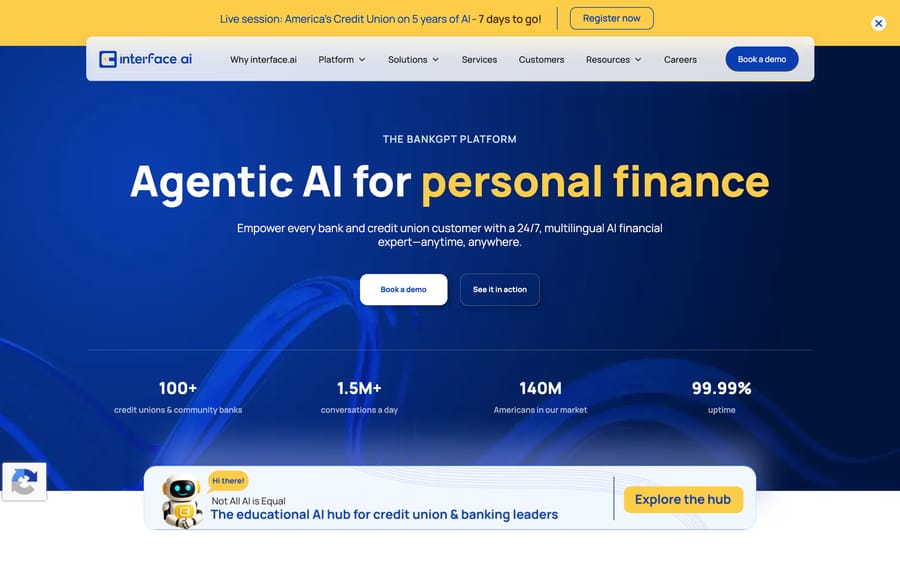
interface.ai describes its platform, branded BankGPT, as agentic AI purpose-built for credit unions and community banks, delivering "a 24/7, multilingual AI financial expert" across voice, digital, and employee-assisted channels. Founded in 2019 and based in Covina, California, the company raised $30 million in a round led by Avataar Venture Partners in October 2024 and has grown past 175 employees. Its own homepage reports 100+ credit unions and community banks, 1.5 million-plus conversations a day, and 99.99% uptime.
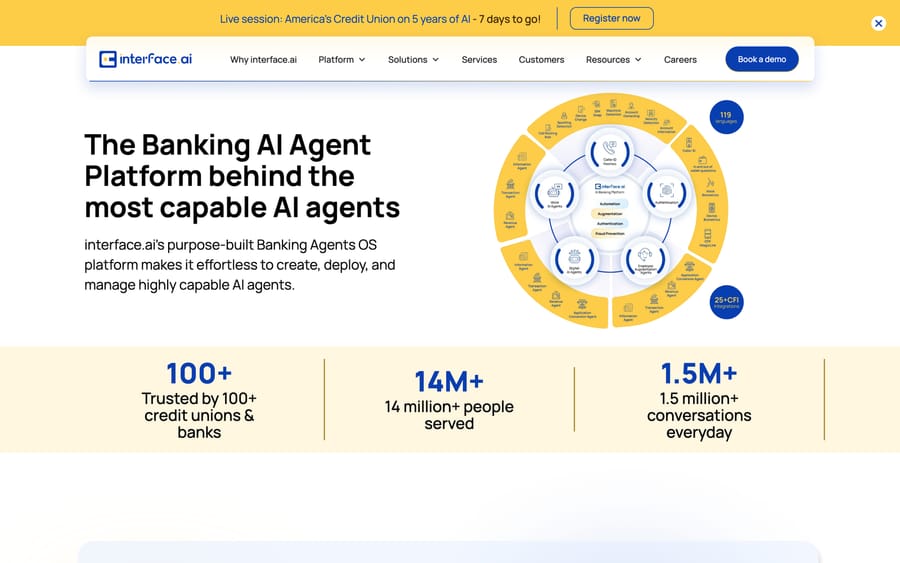
The platform organizes its agents into three groups: Voice AI Agents (phone-based support and fraud checks), Digital AI Agents (chat and self-service), and Employee Augmentation Agents (internal tools for frontline staff), wrapped around four functions the company calls Automation, Augmentation, Authentication, and Fraud Prevention. That fraud and authentication focus is specific to banking in a way a general contact-center AI vendor's feature list usually isn't: caller ID forensics, device biometrics, voice biometrics, SIM swap and spoofing detection, and account velocity detection all sit inside the same platform diagram as the conversational agents.
Real, named results versus marketing copy
interface.ai's site leans hard on aggregate homepage statistics (100+ institutions, 1.5 million conversations a day, 14 million people served), and separately publishes individual case studies with specific, attributed numbers. Worth treating those two tiers differently.
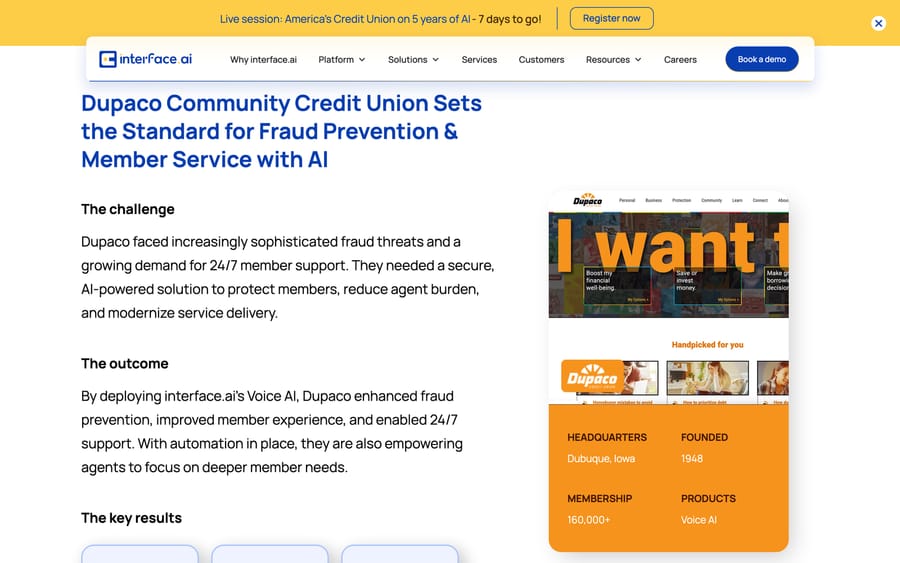
Radiant Credit Union, founded in 1953 and based in North Central Florida, reports its Voice AI now handles 31,700 calls a month at 67% containment, absorbing volume that let it avoid an estimated four additional hires while the credit union crossed $1 billion in assets on the same contact-center team. Dupaco Community Credit Union (Dubuque, Iowa, founded 1948, 160,000-plus members) reports deploying interface.ai's Voice AI specifically for fraud prevention and 24/7 member support, freeing agents to focus on more complex member needs.
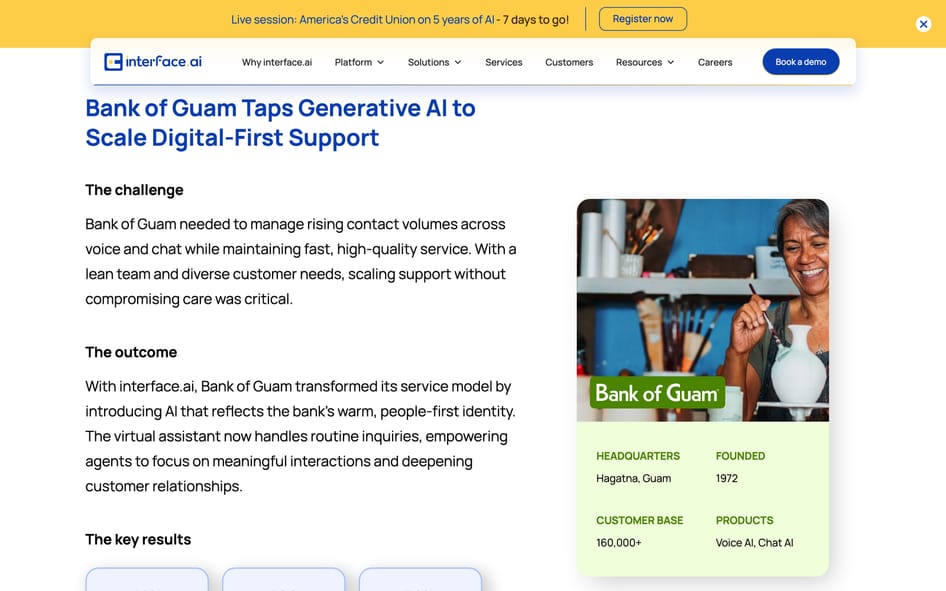
Bank of Guam (Hagatna, Guam, founded 1972, 160,000-plus customers) reports deploying both Voice AI and Chat AI to manage rising contact volumes with a lean team, describing the goal as scaling support "without compromising care." These named case studies, tied to a specific institution's founding date and member count, are a meaningfully stronger form of evidence than an aggregate homepage stat with no attribution behind it.
Key features
- Voice, Digital, and Employee Augmentation Agents from one platform, instead of separate point tools for each channel.
- Banking-specific fraud and authentication tooling: caller ID forensics, device and voice biometrics, SIM swap detection, spoofing detection, and account velocity checks built into the same agent stack that handles routine conversations.
- 119 languages and what the company describes as 25-plus core financial-institution (CFI) integrations, connecting to the banking cores credit unions already run.
- BankGPT platform positioning: a single underlying system, instead of separately branded voice and chat products bolted together.
interface.ai pricing
interface.ai does not publish pricing anywhere on its site; the pricing URL simply doesn't resolve, and every calls-to-action leads to "Book a demo." That's standard for banking-core-adjacent software sold to credit unions and community banks, where procurement usually runs through a formal RFP process instead of a self-serve signup.
We have no reliable published number or third-party estimate to cite for interface.ai specifically. Given the platform's integration depth into core banking systems and its focus on fraud and authentication (higher-stakes, higher-compliance functionality than a generic chatbot), budget for an enterprise-grade sales and integration cycle, similar in shape to other banking-core-adjacent software, on top of any monthly usage rate.
The incentive worth naming: selling exclusively to credit unions and community banks, skipping the broader enterprise contact-center market, means interface.ai's roadmap and pricing structure are built around a buyer that moves slowly and cares enormously about compliance and fraud liability. That's a reasonable trade for the target customer, but it also means the sales cycle looks nothing like signing up for a self-serve SaaS tool.
What actual users say
We could not produce a confident real-user product rating for interface.ai. G2's reviews page returned a 403 to direct access, and Gartner Peer Insights did the same. A search for interface.ai's rating mostly surfaced Glassdoor and RepVue results, which measure employee satisfaction working at the company instead of customer satisfaction with the product, so we're not citing those as product reviews here.
That gap is worth naming plainly instead of papering over with an unrelated number: interface.ai's named case studies (Radiant, Dupaco, Bank of Guam, and others in its published library) are the strongest public evidence available, and they read as credible specifically because they're attributed to a real, checkable institution instead of an anonymous quote.
Pros and cons
Pros
- Named, attributed case studies from real credit unions with specific figures, not just aggregate marketing statistics.
- Banking-specific fraud and authentication tooling built into the same platform as the conversational agents, not sold as a bolt-on.
- Deep specialization in one industry, with 100+ credit unions and community banks as customers and integrations into the cores they already run.
- Well funded ($30M raised) for the scale of institution it's built to serve.
Cons
- No published pricing anywhere, and no reliable third-party estimate exists to fall back on.
- No accessible independent review platform (G2 and Gartner Peer Insights both blocked automated access), so a prospective buyer is working almost entirely from interface.ai's own case studies.
- Narrow by design: it's built for banking. A retailer, travel company, or general enterprise contact center gets no benefit from the fraud and core-banking integrations that are the product's main differentiator.
- Aggregate homepage statistics and attributed case-study results sit side by side without always being clearly distinguished, worth checking carefully during a sales conversation.
Who interface.ai is best for
interface.ai fits teams at a credit union or community bank that need voice and chat support built around real banking workflows, balance inquiries, fraud checks, authentication, loan questions, rather than a generic FAQ bot repurposed for finance. The named case studies span credit unions from $500 million to over $1 billion in assets, suggesting the platform scales across a meaningful range within that specific industry.
It's the wrong choice for anyone outside banking. A retailer or a SaaS support team gets zero value from SIM-swap detection or core-banking integrations, and the sales-led, RFP-shaped buying process makes no sense for a team that wants to self-serve a trial this week.
interface.ai vs alternatives
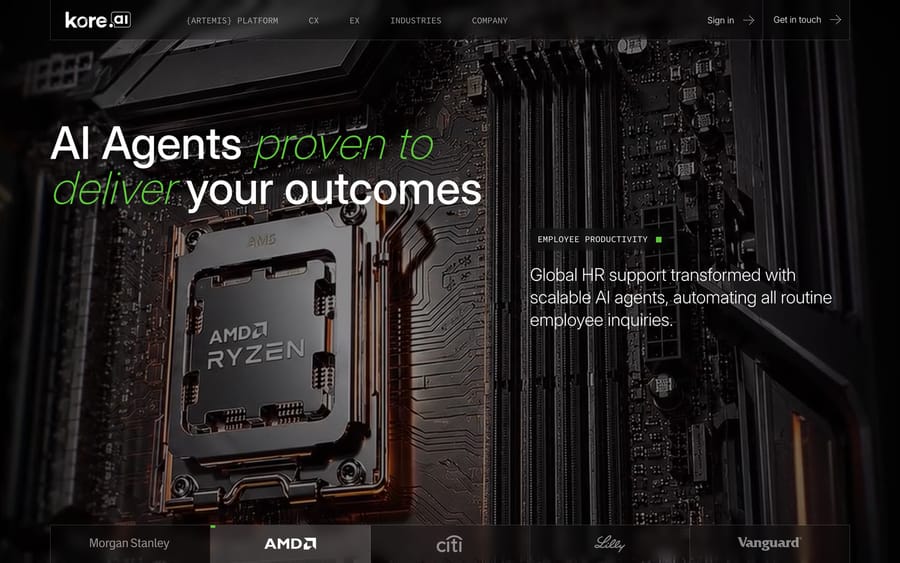
The closest comparison is Kore.ai, a broader enterprise conversational AI platform that also serves banking and financial services among many industries, rather than specializing in it exclusively. Kore.ai also publishes no pricing page, consistent with enterprise, sales-led software in this category generally.
| interface.ai | Kore.ai | Macha | |
|---|---|---|---|
| Model | Banking-exclusive voice, chat, and employee AI (BankGPT) | Broad enterprise conversational AI across industries | AI agent layer on your existing help desk |
| Best for | Credit unions and community banks specifically | Enterprise contact centers across many verticals | Teams on Zendesk, Freshdesk, Gorgias, or Front |
| Pricing | Unpublished, sales-led | Unpublished, sales-led | From $299/mo for 750 tickets (~$0.40/ticket), published |
| Fraud/authentication tooling | Built into the core platform | Available via broader enterprise configuration | Standard controls; scoped per agent |
| Self-serve trial | No | No | $50 free usage |
| Replaces your help desk? | No, layers onto core banking and contact-center systems | No, layers onto an existing CCaaS/CRM stack | No, sits on top of Zendesk, Freshdesk, Gorgias, or Front |
The real choice between interface.ai and Kore.ai for a bank or credit union is depth versus breadth: interface.ai builds only for banking and goes deep on fraud and core integrations, while Kore.ai serves banking as one of several verticals on a more general platform. For our detailed take on Kore.ai specifically, see our guide to Kore.ai. Neither vendor touches a support team's ticket queue in a help desk; that's where Macha fits, published per-ticket pricing and a self-serve trial as an AI agent layer inside Zendesk, Freshdesk, Gorgias, or Front. For more on how vertical AI platforms compare to help-desk-native agents generally, see our guide to AI agents for customer service.
How we researched this
interface.ai's site blocked direct automated fetches (403) across every page we tried, so we used a rendered browser capture instead, which returned the same public content a visitor sees. Its sitemap confirmed real case-study URLs for Radiant, Dupaco, Bank of Guam, and others, which we captured directly. No pricing page exists on the domain. G2 and Gartner Peer Insights both blocked review access; the only "interface.ai reviews" we could surface through search were Glassdoor and RepVue employee reviews, which we're not citing as product feedback. Kore.ai's homepage was captured the same way for the comparison.
FAQ
What is interface.ai? interface.ai builds AI voice, chat, and employee-assist agents specifically for credit unions and community banks, branded as the BankGPT platform, with built-in fraud detection and authentication tooling alongside conversational support.
How much does interface.ai cost? interface.ai doesn't publish pricing, and no reliable third-party estimate exists. Expect an enterprise sales and integration cycle typical of banking-core-adjacent software rather than a self-serve monthly rate.
Is there a free trial? No self-serve trial is published. Every path on the site leads to booking a demo.
What results do interface.ai customers report? Radiant Credit Union reports its Voice AI handles 31,700 calls a month at 67% containment while the credit union grew past $1 billion in assets on the same team. Dupaco Community Credit Union and Bank of Guam report similar deployments for fraud prevention and 24/7 member support. These are named, vendor-published case studies.
Does interface.ai only work with credit unions? Its case studies and platform positioning focus exclusively on credit unions and community banks; it isn't marketed for retail, travel, or general enterprise support.
What are good alternatives to interface.ai? Kore.ai is the closest comparison for banks and credit unions that want a broader enterprise conversational AI platform rather than a banking-exclusive one. For support teams running a single help desk instead of a full banking-core stack, a lighter, help-desk-native AI agent is a better fit than either vendor.
Does interface.ai replace a help desk? No. It layers onto a credit union or bank's existing core banking system and contact-center stack. It has no general-purpose ticket queue for non-banking support use cases.
Does interface.ai have good reviews? We couldn't confirm through an independent review platform. G2 and Gartner Peer Insights both blocked automated access, and no independent product-review sample was reachable at the time of writing; the strongest public evidence is interface.ai's own named case studies.
Ready to automate the ticket queue instead of the phone queue? See how Macha's pricing works or start a trial on top of the help desk you already run.
Sources: interface.ai, interface.ai platform, Dupaco Community Credit Union case study, Bank of Guam case study, Radiant Credit Union case study, Kore.ai.
Resolve tickets automatically with AI agents
Macha's AI agents work on top of the help desk you already use — no code.