Intercom
 Shopify
 Stripe
 Slack
Slack Notion
 Google Workspace
 Confluence

Google Customer Engagement Suite: The Complete Guide (2026)


Google's Customer Engagement Suite (CES) bundles four Google Cloud products, Conversational Agents, Agent Assist, Conversational Insights and Contact Center as a Service, into one contact-center AI platform built on Gemini. Unlike most enterprise vendors in this series, Google publishes exact per-request pricing down to the tenth of a cent. This guide covers what CES actually includes, what it costs at a stated volume, what real customers report, and where it fits next to Macha.

Macha builds AI agents for customer service that run inside a help desk a team already uses, so we read a platform like CES from that angle: how much of the cost is contact-center infrastructure you may not need, and how much is the AI you're actually here for.
What is Google Customer Engagement Suite?
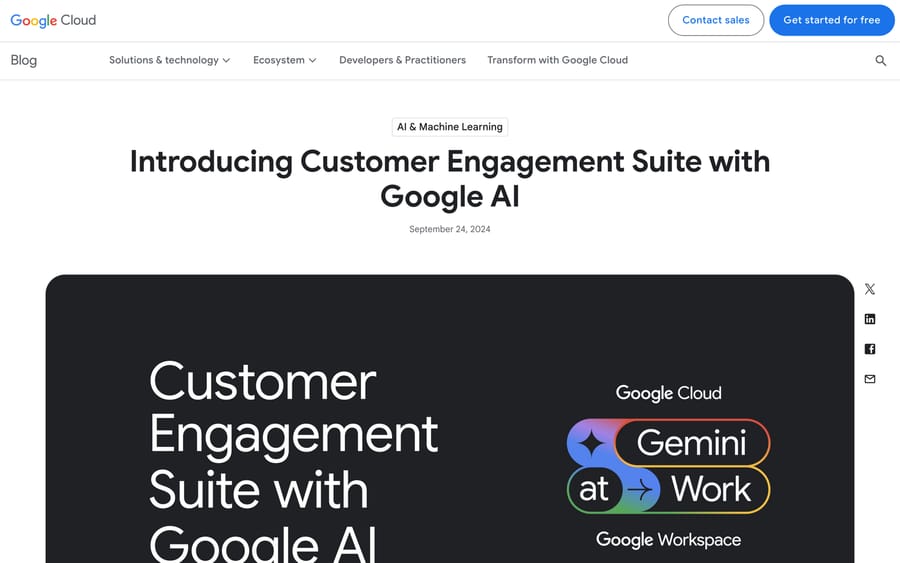
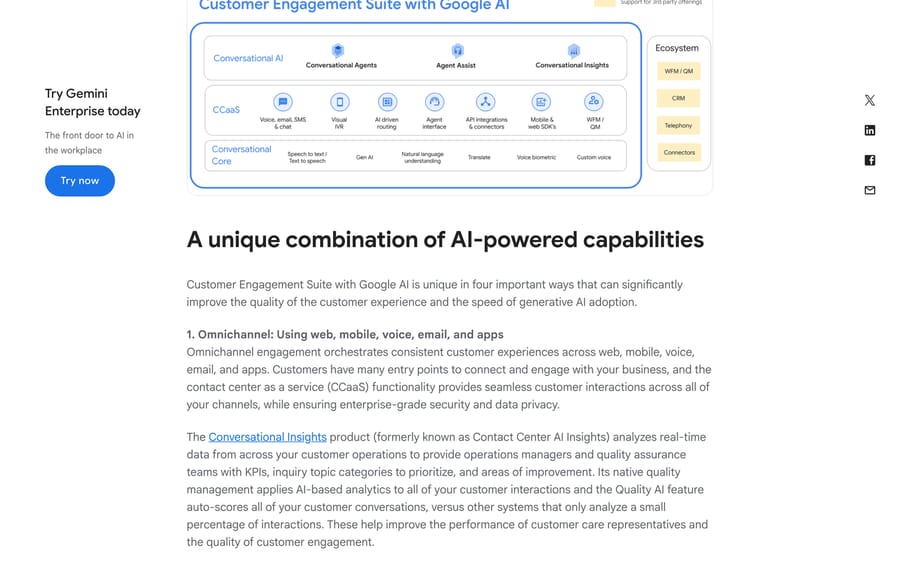
Google launched Customer Engagement Suite with Google AI on September 24, 2024, at its Gemini at Work event, positioning it as a fusion of its existing contact-center infrastructure with Gemini's generative AI. CES bundles four components under one umbrella:
- Conversational Agents (formerly Dialogflow CX): hybrid virtual agents combining deterministic flows for compliance-sensitive steps with generative "Playbooks" for open-ended queries.
- Agent Assist: real-time help for human reps, including generative knowledge assist, coaching, summarization, smart reply and live translation across 100+ languages.
- Conversational Insights (formerly Contact Center AI Insights): real-time analytics and quality management, auto-scoring every conversation instead of a manual sample.
- Contact Center as a Service (CCaaS): omnichannel infrastructure for web, mobile, voice, email and apps, with bring-your-own-telephony flexibility.
Google updated the suite again in March 2025 with 30 new HD voices, a generally-available unified console for hybrid agents, prebuilt reference agents (flight booking, movie ticketing, shopping, appointments), and 30+ data connectors plus 70+ action connectors into systems like BigQuery, Salesforce, SharePoint, Jira and ServiceNow. Note: Google also sells a separate, newer product called "Gemini Enterprise for Customer Experience," aimed at retail and restaurant shopping-plus-service use cases; it's a distinct offering from CES, not a rename of it, and this guide covers CES specifically.
How the AI works
Conversational Agents run on Gemini and support two building styles: Flows (deterministic, intent-and-flow based, good for compliance-critical steps like identity verification) and Playbooks (generative agents built from natural-language instructions, grounded against connected data stores). A single agent can combine both, using Flows where a script must be followed exactly and Playbooks where the conversation needs to handle open-ended questions.
Agent Assist and Conversational Insights sit on the human-agent side: Agent Assist surfaces knowledge and drafts replies in real time as a rep is on a call or chat, while Conversational Insights scores 100% of conversations instead of the small manual sample most quality programs rely on. Google frames the auto-scoring specifically against "other systems that only analyze a small percentage of interactions," which is a real, checkable distinction from traditional QA sampling.
Key features
- Hybrid agent building: deterministic Flows plus generative Playbooks in one console.
- Multimodal support: text, voice and image across channels.
- 100+ language live translation via Agent Assist.
- 100% conversation scoring through Conversational Insights, versus sampled manual QA.
- 30+ data connectors, 70+ action connectors: BigQuery, Salesforce, SharePoint, Jira, ServiceNow and more.
- AI Coach and AI Trainer (public preview as of March 2025): real-time rep coaching and AI-simulated new-hire training.
- Bring-your-own-telephony flexibility inside CCaaS.
Google Customer Engagement Suite pricing (published, worked example)
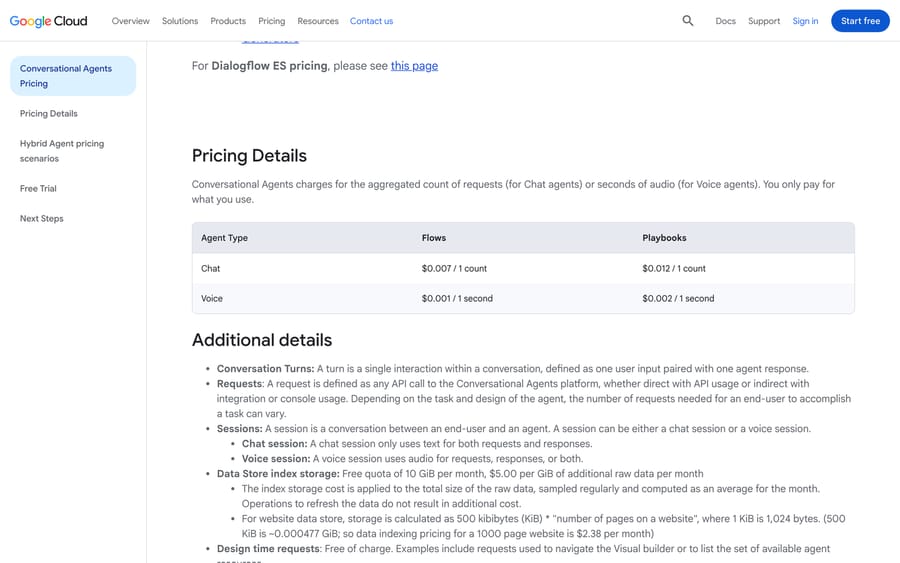
Google is unusually transparent here, publishing exact consumption-based pricing instead of tiers or a "contact sales" wall:
| Agent type | Flows | Playbooks |
|---|---|---|
| Chat (per request) | $0.007 | $0.012 |
| Voice (per second) | $0.001 | $0.002 |
A "request" is any API call to the platform; a "session" is one full conversation (chat or voice). Data Store index storage is free up to 10 GiB/month, then $5/GiB, and design-time requests (building an agent in the console) are free.
Worked example: a chat-based Playbook agent handling 50,000 conversations a month, averaging 4 requests per conversation, would cost roughly 50,000 × 4 × $0.012 = $2,400/month in Conversational Agents fees alone, before adding Agent Assist, Conversational Insights or CCaaS usage, which are priced separately and not detailed on this page. That's the pattern worth flagging: the published number covers one component of a four-part suite, so a full CES deployment costs meaningfully more than the Conversational Agents line item alone. Leading marketing and search results with the cheapest, most granular number in the stack is a normal incentive in usage-based pricing: it makes the platform look inexpensive to compare, while the full bill only becomes clear once Agent Assist, Insights and CCaaS usage are added.
Named customer results
Google publishes an unusually large set of specific, attributed outcomes:
- Bell Canada: $20 million in savings across customer operations, 1.1 million virtual assistant interactions year-to-date across three brands.
- Best Buy: resolves issues 90 seconds faster using automatic call summarization.
- TTEC (BPO provider): 40% of customer interactions automated, 40% reduction in escalations, 11% reduction in average handle time, 18% improvement in new-hire performance.
- loveholidays: 55% of customers get an answer in under a minute, £3 million (about $3.8 million) in annual operational savings.
- YouTube: 23% reduction in average handle time, 75% reduction in queue abandons.
These are Google's own published figures instead of independently audited numbers, the same caveat that applies to any vendor's case studies in this series.
Real-user reviews: what we could (and couldn't) verify
We checked G2 (two different product listings), Gartner Peer Insights, TrustRadius, Software Advice and PeerSpot on 2026-09-17. Every one of them returned a 403 or 404 to direct automated access, so we have no verified review-site rating to report for CES. That's a genuine gap in this guide, and we'd rather say so than estimate a number. The named customer results above (Bell Canada, TTEC, loveholidays, YouTube) are the best evidence available from what we could actually access, and they're specific and attributed instead of anonymous, even though they come from Google itself instead of an independent review platform.
Pros and cons
Pros
- Genuinely transparent, published per-unit pricing, unusual for enterprise contact-center AI.
- Real hybrid agent model: deterministic Flows for compliance steps, generative Playbooks for open-ended queries, in one console.
- 100% conversation scoring (Conversational Insights) instead of a manual sample.
- Large, specific, attributed customer results across multiple industries (telecom, retail, BPO, travel, media).
Cons
- The published pricing covers Conversational Agents only; Agent Assist, Conversational Insights and CCaaS are priced separately and not detailed publicly.
- No verifiable third-party review data at the time of research (G2, Gartner, TrustRadius, Software Advice and PeerSpot all inaccessible).
- Built around Google Cloud's broader ecosystem; a team not already on GCP takes on real platform lock-in to adopt it.
- A separate, similarly-named "Gemini Enterprise for Customer Experience" product adds real naming confusion when researching Google's CX AI lineup.
Who Google Customer Engagement Suite is best for
CES fits teams at an enterprise contact center already running (or willing to run) on Google Cloud, that wants a single vendor for conversational AI, agent assist, quality analytics and contact-center infrastructure, and that values transparent, usage-based pricing over a negotiated enterprise contract. TTEC's and Bell Canada's scale (millions of interactions, cross-brand deployment) is the shape of a "good fit" customer.
It's a weaker match for a team whose real workload is a help-desk ticket queue instead of a voice-heavy contact center, or a team not already invested in Google Cloud's ecosystem. The per-component pricing model and the four-part bundle add real complexity for a support team that just wants AI drafting replies inside Zendesk or Freshdesk.
Google Customer Engagement Suite vs alternatives
| Google Customer Engagement Suite | NICE (CXone) | Macha | |
|---|---|---|---|
| Model | 4-part bundle (Conversational Agents, Agent Assist, Insights, CCaaS) on Gemini | Enterprise CX AI platform (agentic AI + CXone WEM) | AI agent layer on your existing help desk |
| Best for | Enterprises already on Google Cloud running voice-heavy contact centers | Large contact centers, enterprise sales-led | Teams on Zendesk, Freshdesk, Gorgias or Front |
| Pricing | Published per-request/per-second for Conversational Agents; other components separate | Opaque; enterprise sales-led | From $299/month for 750 tickets (about $0.40 per ticket), published |
| Reviews | Unverifiable at time of research | Established G2/Capterra presence | See our pricing and product pages |
| Replaces your help desk? | No, sits alongside CRM/telephony | No, sits alongside ACD and CRM | No, deliberately augments it |
NICE is the closest enterprise-scale comparison: another vendor bundling conversational AI, agent assist and analytics into one contact-center platform, though NICE keeps its pricing behind a sales conversation entirely instead of publishing any component's rate.
Macha solves a narrower, more specific problem. If your team's real backlog lives in help-desk tickets instead of a voice-first contact center, Macha on your help desk is a more direct fit, and our Agentforce guide covers another big-tech agent platform worth comparing against Google's approach.
How we researched this: Google's own site (the Conversational Agents pricing page, the original CES launch blog with its architecture diagram, and a March 2025 update blog) was fetched and screenshotted directly on 2026-09-17. Named customer results came from Google's own blog posts. We attempted to verify reviews on G2, Gartner Peer Insights, TrustRadius, Software Advice and PeerSpot; all five returned errors to direct automated access.
FAQ
What is Google Customer Engagement Suite? CES is Google Cloud's contact-center AI bundle, combining Conversational Agents (built on Gemini), Agent Assist, Conversational Insights and Contact Center as a Service into one platform, launched September 2024.
How much does Google Customer Engagement Suite cost? Conversational Agents publishes exact rates: $0.007 (Flows) or $0.012 (Playbooks) per chat request, and $0.001 or $0.002 per voice second. Agent Assist, Conversational Insights and CCaaS are priced separately and not detailed on the same public page.
Is Google Customer Engagement Suite the same as Gemini Enterprise for Customer Experience? No. They're separate Google Cloud products. Gemini Enterprise for Customer Experience is a newer offering aimed at retail and restaurant shopping-plus-service scenarios; CES is the broader contact-center AI bundle covered in this guide.
What results have real customers reported? Bell Canada reports $20 million in savings and 1.1 million virtual assistant interactions across three brands; TTEC reports 40% interaction automation and a 40% reduction in escalations; loveholidays reports £3 million in annual savings; YouTube reports a 75% reduction in queue abandons.
Does Google Customer Engagement Suite have G2 or Capterra reviews? We couldn't access a working review page on G2, Gartner Peer Insights, TrustRadius, Software Advice or PeerSpot for this product as of 2026-09-17. That doesn't mean no reviews exist, only that they weren't retrievable through the sources we checked.
Is Google Customer Engagement Suite good for a small support team? Not especially. It's built for enterprise, voice-heavy contact centers already on Google Cloud. A small team whose main job is a help-desk ticket queue will find the four-component bundle more infrastructure than it needs.
What are the best Google Customer Engagement Suite alternatives? NICE (CXone) is the closest enterprise-scale bundle of AI, WEM and analytics. For teams whose real problem is help-desk ticket volume instead of a voice-first contact center, Macha is a more direct fit.
Does Google Customer Engagement Suite require using other Google Cloud products? It's built on Google Cloud's ecosystem (BigQuery, Cloud infrastructure) and integrates with third-party CRMs like Salesforce, but a team not already on GCP takes on real platform adoption to use it.
Looking to automate tickets inside the help desk you already use, without adopting a four-part contact-center bundle? Start a Macha trial at dashboard.getmacha.com/signup or see pricing: $50 of free usage (about 125 tickets), no credit card, no time limit.
Sources: Conversational Agents pricing, Introducing Customer Engagement Suite with Google AI, Customer Engagement Suite: Stronger results, new AI features, Gemini Enterprise for Customer Experience.
Resolve tickets automatically with AI agents
Macha's AI agents work on top of the help desk you already use — no code.